
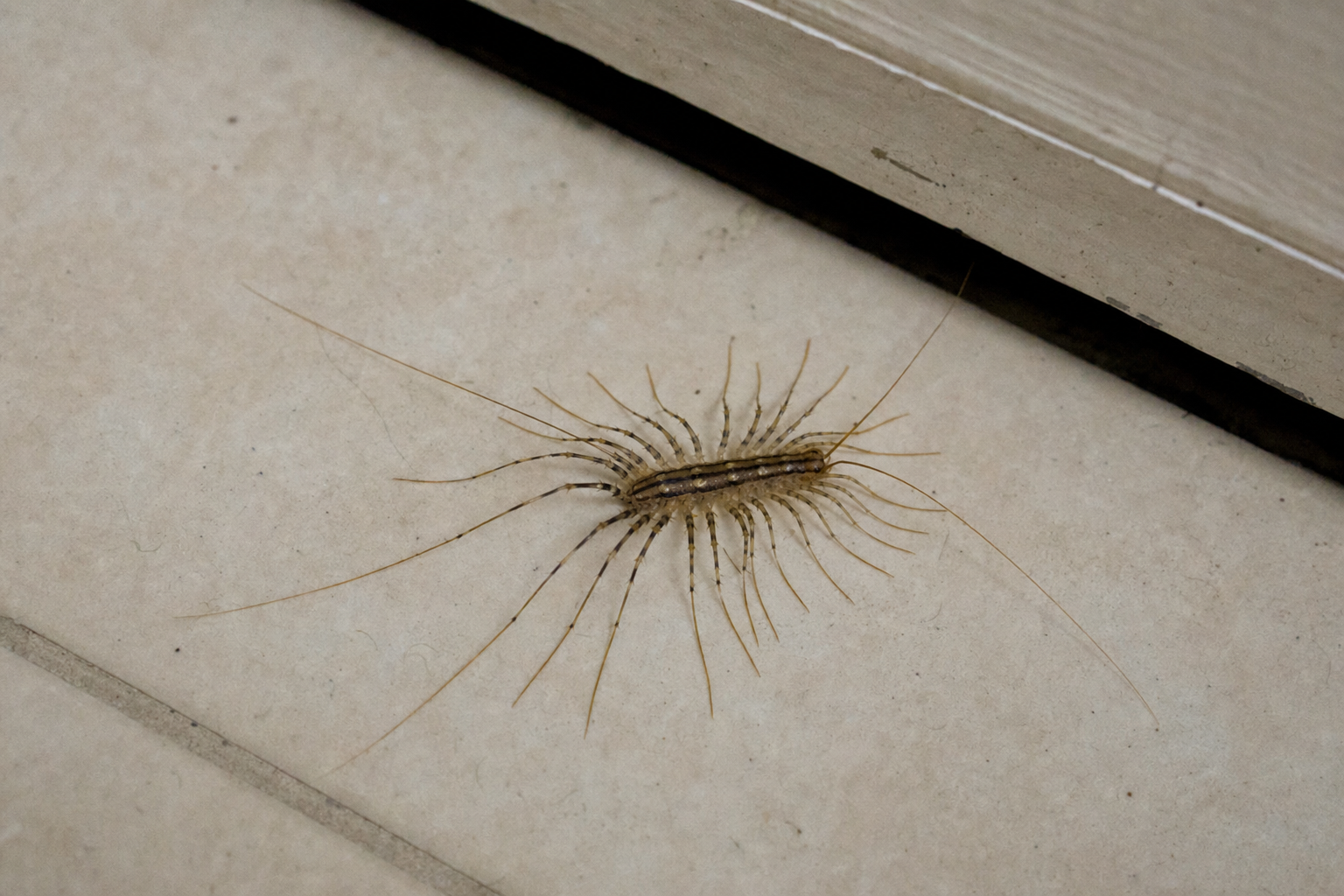
How and Why House Centipedes Get Into Your Home
House centipedes get into a home at ground level, through gaps that were already there, and almost always because something they eat got in first. That second half is the part nobody tells you, and it is the useful part. Penn State Extension puts it plainly: if you are seeing them often, some other insect is abundant in the building, and that may be a bigger problem than the centipedes. So a centipede on the bathroom floor in McKinney is worth reading as a report rather than an emergency.

- Seeing them often is a signal about something else. They eat other insects, so frequent sightings mean prey is abundant.
- The body is only 1 to 1.5 inches. The legs and antennae are what make it read as 3 or 4 inches.
- They need damp. Bathrooms, laundry rooms, under sinks and crawl spaces are where they turn up.
- They hunt at night and hide in the dark by day, which is why one crossing a lit floor startles everybody.
- A heated building lets them breed all year, so an indoor population does not die back in winter.
- Penn State calls them harmless and of little concern. They are on your side of the argument, which is a strange thing to accept.






What Causes House Centipedes in a House?
Food, damp and a gap, in that order of importance. House centipedes hunt silverfish, firebrats, carpet beetles, cockroaches and spiders, according to Penn State Extension, so a centipede population sits on top of a population of something else. The gap only matters because the other two make it worth using.
House centipedes are hunters. Penn State Extension lists what they eat: silverfish, firebrats, carpet beetles, cockroaches and spiders. None of that is in your house by accident either, so a centipede population is sitting on top of a population of something else. That is why the same extension page says that seeing them frequently indicates prey is abundant and may signify a greater problem than the centipedes themselves.
The damp is the second condition and it is usually local rather than whole-house. A slow trap under a sink, a bathroom that never dries out, a crawl space holding water after rain, or a laundry room with poor airflow will each support them while the rest of the house does not.
How Do House Centipedes Get In?
House centipedes get in low down and around the edges of the house, where they already live outdoors. The routes are gaps under exterior doors, foundation cracks and weep holes, pipe and utility holes, crawl space vents and drains that are rarely used. Gaps under doors are the most common way in by a distance.
| The way in | Why they use it | What closes it |
|---|---|---|
| Gaps under exterior doors | The most common route by a distance. Worn weather stripping leaves a slot at exactly their height | New sweeps on every exterior door, including the one from the garage |
| Foundation cracks and weep holes | They live in soil, mulch and leaf litter against the wall, so the foundation line is already their territory | Sealing cracks, and moving mulch and stored material back from the wall |
| Utility and pipe penetrations | The hole cut for a pipe is always bigger than the pipe, and it usually opens into a damp cabinet | Fresh collars and sealant at every penetration under sinks and behind appliances |
| Crawl space vents and access panels | A crawl space is dark, damp and connected to the rooms above through gaps around plumbing | Screening the vents and sealing the panel, plus dealing with any standing water underneath |
| Drains that are rarely used | A dry trap in a guest bathroom or a floor drain is an open pipe rather than a sealed one | Run the water. A cup down an unused drain every 30 days refills the trap and closes it |
Every route is at or below floor level, which is why they appear in bathrooms and laundry rooms and almost never upstairs.
 Source:
Does Pest Control Close the Entry Points House Centipedes Use?
Gap and crack sealing is part of the Pest Me Off RID Method, so the answer is yes. That matters at slab level. Penn State Extension notes house centipedes enter through expansion cracks in concrete slabs and around pipes passing through walls, and advises filling or sealing those cracks with the right filler.
Why Do I Have So Many Centipedes in My House?
Because the building is feeding them, and because they can breed indoors all year. Penn State notes that house centipedes do not survive winters outdoors in a cold climate but reproduce readily in heated structures, and the same principle holds here: an indoor population is not tied to the season the way an outdoor one is.
If the count is rising, the question worth asking is not how to kill centipedes faster. It is what they are eating, because one female can produce up to 150 young once a room gives her food and damp. A silverfish problem, a cockroach problem or a heavy spider year underneath will keep the numbers up no matter what you do to the centipedes themselves, and dealing with the prey drops the centipede count without anything being aimed at them.
Where Do Centipedes Come From?
From directly outside the wall, mostly. They live in soil, under mulch, in leaf litter, beneath stones and stacked material, and under anything sitting flat on damp ground. In summer they are often found outdoors right against the building, which is exactly why the foundation line is the boundary that matters.
They are also not originally from here at all. Penn State records the species as native to the Mediterranean, accidentally introduced into the southern United States, and now widespread across the country. That is a curiosity rather than a practical fact, but it does explain why they are as comfortable inside a Texas house as anywhere else.
Are House Centipedes Dangerous?
No. Penn State’s own summary calls them harmless and of little concern to homeowners despite the long legs and the alarming appearance. They can technically bite, it is rare, it takes handling one, and it amounts to less than a bee sting.
The University of Kentucky, Centipedes and Pseudoscorpions gives the reason. House centipedes are not dangerous because their small mouthparts cannot get through skin very well.
What they actually do to your house is nothing. They damage no wood, contaminate no food and carry no disease into a home. Set against that, they eat five pests you genuinely do not want, which is why the honest position on a single house centipede is that it is doing you a small favor. Regular sightings are a different conversation, and it is still a conversation about what they are eating.
How Do You Get Rid of House Centipedes?
Take away the damp, then take away the food, then close the gaps. Fix leaks and dry the rooms they are in, cut the silverfish, roaches and spiders they eat, and seal door sweeps, foundation cracks and unused drain traps. Treating for centipedes on their own is the least effective of the four things you can do.
- Dry the rooms they are in. Fix the slow leak, run the bathroom fan, put a dehumidifier in a damp utility room, and get standing water out of the crawl space. This does more than anything else on the list.
- Deal with the prey. Silverfish, roaches and spiders are the usual supply. Cutting that supply is what makes the centipede count fall and stay down.
- Close the ground-level routes. Door sweeps, foundation cracks, utility penetrations, crawl space vents, and the traps in drains nobody uses.
- Clear the outdoor edge. Mulch, leaf litter, stacked stone and firewood against the wall are where they live before they come in.
If you are seeing them regularly in Allen, Frisco or Plano, the useful question is what else is in the building. Professional pest control finds the prey population and the moisture that supports it, rather than treating the symptom. Get a free estimate or call us, and we will tell you what the centipedes are actually reporting.
Centipedes turning up regularly? Same-day service in McKinney and the surrounding cities when you call before noon.
Call us and we find what they are eating and the damp that supports it, because that is what actually lowers the count.