
Texas Cave Scorpions | Scorpions in Texas and What Collin County Gets
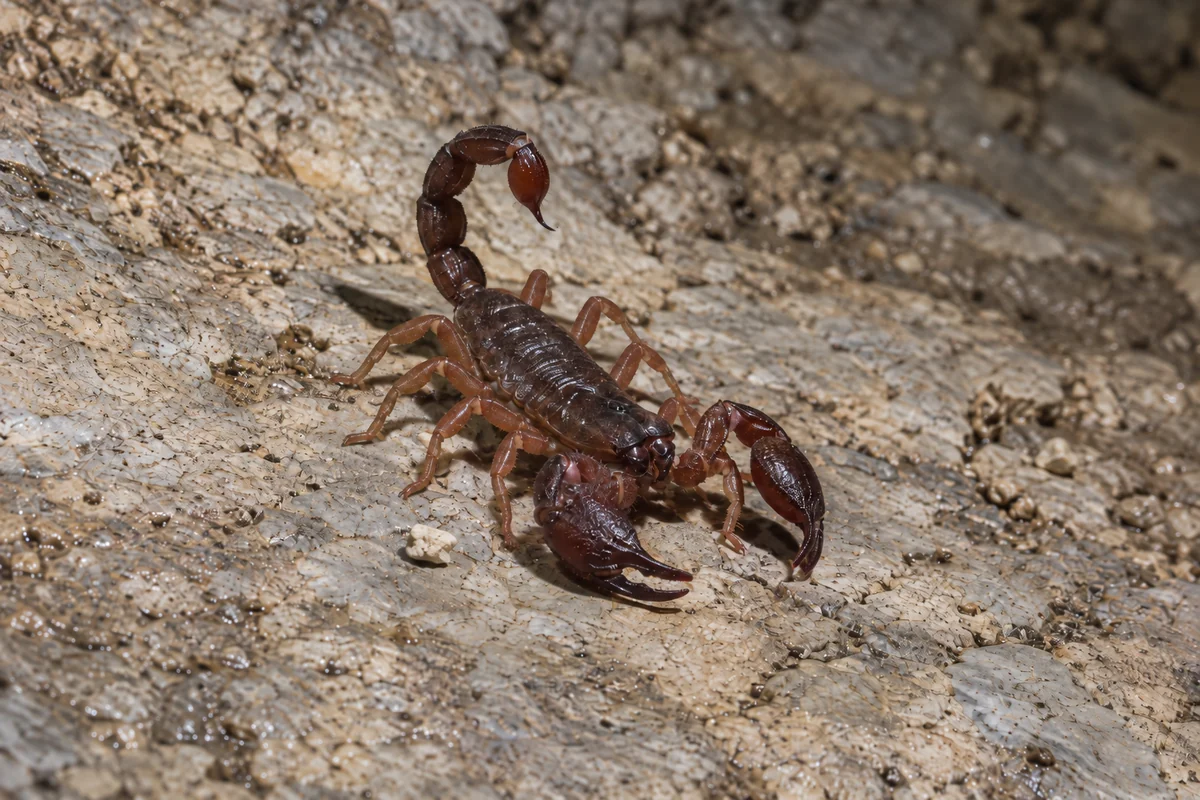
The Texas cave scorpion (Pseudouroctonus reddelli) is a large, dark reddish brown to blackish scorpion with heavy pincers that lives in the caves and limestone hills of Central Texas. It is not found in Collin County. The American Museum of Natural History’s 1972 description measured a female at 55.5 millimeters, about 2 1/4 inches. A scorpion in a Collin County home is almost always the striped bark scorpion.
Found a scorpion at home in Collin County? Our office sits where McKinney, Plano, Frisco and Allen meet, 5 to 10 minutes from most homes in those four cities. Call and we will tell you which scorpion it is and find how they are getting in.
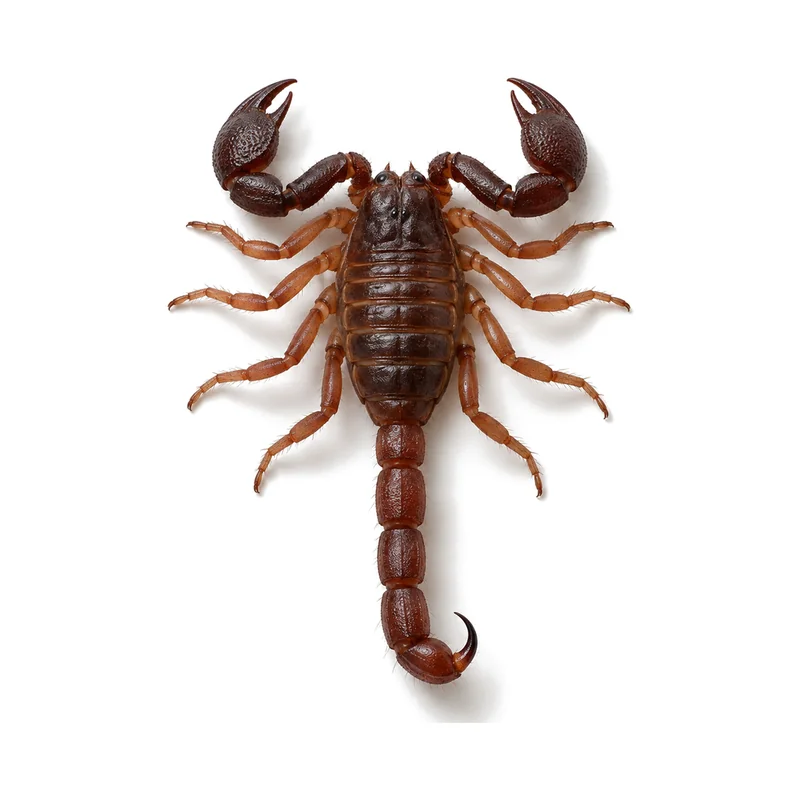
Texas Cave Scorpion
The Texas cave scorpion is a cave-loving scorpion of the Hill Country that hunts cave crickets near cave entrances and under limestone rocks. Texas Parks and Wildlife magazine says you are unlikely to find one in or around your home.
Risk Assessment
Choose a row for the full detail- Color
- Reddish to mahogany brown or blackish, with tan legs and no stripes
- Diet
- Mostly cave crickets
- Threat level
- Low, a shy scorpion with a painful sting
- Habitat
- Caves, grottos, limestone crevices and rocks in oak leaf litter
- Collin County status
- Not found here. Our scorpion is the striped bark scorpion
- Young to adult
- Born live, 53 young in the one litter studied
- Size
- About 1 3/4 to 2 1/4 inches long with the tail
What Does a Texas Cave Scorpion Look Like?
A large, dark scorpion with heavy pincers, tan legs and no stripes on its back
The Texas cave scorpion is big for a Texas scorpion and dark all over. The original scientific description, published by the American Museum of Natural History in 1972, calls it a large, reddish to mahogany brown or blackish scorpion with tan walking legs and a mostly tan underside, and measured a female at 55.5 millimeters and a male at 45.6 millimeters, about 2 1/4 and 1 3/4 inches. Young ones are paler.
The pincers are what most people notice. Texas A&M AgriLife Extension’s Austin entomologist writes that cave scorpions are dark in color and have thicker pincers than the striped bark scorpion. Like every scorpion, it glows under a UV flashlight. Texas Parks and Wildlife magazine describes an adult in a cave near Austin glowing teal green under ultraviolet light.
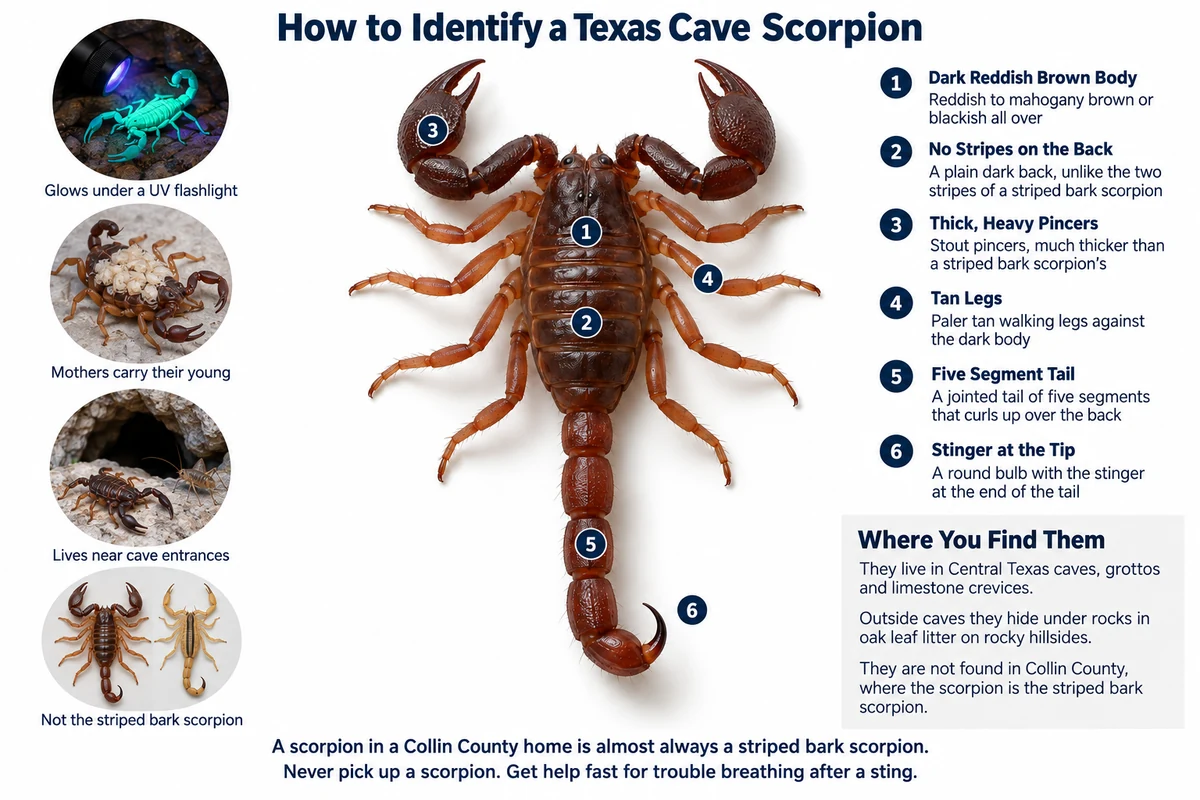
How to identify a Texas cave scorpion by its dark, unstriped body, thick pincers and tan legs
- A dark reddish brown to blackish body with no stripes down the back
- Thick, heavy pincers rather than thin ones
- Tan legs that look pale against the dark body
- Found in a cave, a grotto or under limestone rocks in the Hill Country
- Close to a cave entrance, often near cave crickets
- Seen in Central Texas, from Georgetown and Austin west and south, never in Collin County
Other Names for the Texas Cave Scorpion
Its name comes from where it lives. The American Museum of Natural History’s description named the species reddelli after James Reddell, who explored and studied Texas and Mexican caves and had already listed it from 22 caves in 10 counties. Christopher Brown of the University of Texas at Arlington, writing in the Journal of Arachnology in 1997, notes that scientists have moved it back and forth between two groups of scorpions, so older papers call it Vaejovis reddelli.
People searching for scorpions in Texas often describe what they saw as a black scorpion or a brown scorpion. Those are not species names. A dark scorpion in the Hill Country may be this one, but a scorpion in a Collin County home is almost always a striped bark scorpion.
| Name | What it means |
|---|---|
| Cave scorpion | A short form of the full name. |
| Vaejovis reddelli | Its older scientific name. |
| Pseudouroctonus reddelli | Its current scientific name. |
| Alacrán | The Spanish word for scorpion. |
| Black or brown scorpion | How people describe a dark scorpion, not a species. |
How to Tell a Texas Cave Scorpion from a Striped Bark Scorpion
These are the only two scorpions in Central Texas, and only one of them lives in Collin County. Texas Parks and Wildlife magazine counts 18 described scorpion species in Texas, two in Central Texas, and only the striped bark scorpion across the rest of the state. Color, stripes and pincers tell them apart.
| Species | Size and Color | Key Feature | Where Found |
|---|---|---|---|
|
Texas Cave Scorpion
AKA: Cave Scorpion
Pseudouroctonus reddelli
This species
|
About 1 3/4 to 2 1/4 inches with the tail. Reddish to mahogany brown or blackish with tan legs. | No stripes on the back and thick, heavy pincers. | Caves, grottos and limestone rocks in the Hill Country and around Austin and San Antonio. Not in Collin County. |
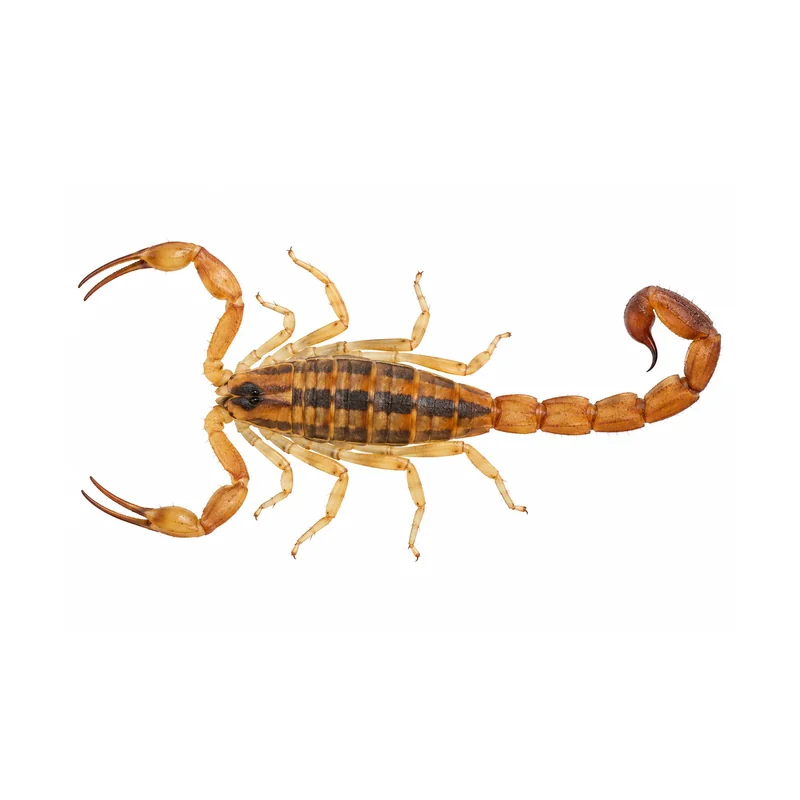
Striped Bark Scorpion
AKA: Bark Scorpion
Centruroides vittatus
|
About 2 1/2 inches with the tail. Yellowish tan with two broad, dark stripes down the back. | Two dark stripes, slender pincers and a long, thin tail. | All of Texas, including Collin County garages, bathrooms and attics. |
Texas Cave Scorpion vs Striped Bark Scorpion
The Texas Cave Scorpion in Three Numbers
55.5 mm
The American Museum of Natural History’s 1972 description of the Texas cave scorpion measured a female at 55.5 mm long, about 2 1/4 inches, and a male at 45.6 mm.
American Museum of Natural History, Gertsch and Soleglad, 1972
53 young
Christopher Brown recorded a Texas cave scorpion litter of 53 young in the Journal of Arachnology in 1997, a larger litter than related scorpions have.
Christopher Brown, Journal of Arachnology, 1997
20 to 25
Texas A&M AgriLife Extension says only about 20 to 25 of the world’s 1,500 scorpion species are regarded as dangerous, and that stings from Texas scorpions, a group that includes the Texas cave scorpion, cause only moderate reactions in most people.
Texas A&M AgriLife Extension, Scorpions fact sheet
Are Texas Cave Scorpions Poisonous?
They have venom, like every scorpion, but they are not considered dangerous. Texas Parks and Wildlife magazine says Texas cave scorpions are reclusive and lash out only if accosted, and that there are no medically dangerous scorpion species in Texas. Texas A&M AgriLife Extension says stings from Texas scorpions cause only moderate reactions in most people, because the venom has little effect on the nervous system, but that allergic reactions are possible and anyone stung should be watched closely.
What to Do If a Scorpion Stings You
Put an ice pack on the sting to ease the pain, and keep an eye on the person. The Texas A&M AgriLife Extension fact sheet says to get medical attention at once if pain or swelling does not go away or if breathing becomes difficult. It also warns that even a scorpion with mild venom can cause a dangerous reaction in a young child or in an adult allergic to it. No study we found looks at Texas cave scorpion stings on their own, so treat any sting the same way.
When a Scorpion Sting Needs Fast Action
Trouble Breathing
Any trouble breathing after a sting needs emergency medical care right away.
A Sting on a Young Child
Children react more strongly to scorpion venom. Call your doctor at once rather than waiting to see how it goes.
Hives or Swelling Away From the Sting
Hives, swelling of the face or lips, or feeling faint point to an allergic reaction and need help fast.
Pain That Will Not Settle
Pain or swelling that keeps going after ice and rest is a reason to see a doctor.
Is the Scorpion in Your House a Texas Cave Scorpion?
In Collin County, no. Texas A&M AgriLife Extension counts 18 scorpion species in Texas and says only one, the striped bark scorpion, lives throughout the state and is the only scorpion found in the eastern part of Texas, while two species have been recorded near Austin. The Texas cave scorpion is the second of those two. Its records in the American Museum of Natural History’s description reach no farther north than the caves around Georgetown, in Williamson County.
A scorpion in a Collin County bathtub, garage or attic is a striped bark scorpion, which climbs walls and slips in through weep holes and gaps. Young striped bark scorpions are paler, and an older one in dim light can look darker than you expect, so check for the two stripes and the thin pincers. Even in Central Texas, Texas A&M AgriLife Extension notes the cave scorpion does not live in the same places as the striped bark scorpion, so it is rarely the one in a house.
Where Texas Cave Scorpions Live
Most records come from caves, usually close to the entrance. Christopher Brown notes they are usually found within the first 50 to 100 meters of a cave. Bryson and coauthors, in a 2014 study of the species’ cave history, add that it lives on humid rocky hillsides throughout the limestone cave country of the Edwards Plateau and can be common outside caves in rocky areas with oak leaf litter.
Where Are Texas Cave Scorpions Found?
Texas cave scorpions are found in Central Texas, along the Balcones Escarpment and across the Edwards Plateau. The American Museum of Natural History’s records come from Travis, Williamson, Hays, Bexar, Comal, Kendall, Kerr, Bandera, Real, Uvalde, Edwards, Kimble, Burnet and Val Verde counties, from Georgetown and Austin to San Antonio and Del Rio. None are from Collin County or the counties around it.
Our scorpion calls come most often from McKinney, then Princeton, Allen, Melissa and Plano, and none of our records describes a dark cave scorpion.
Texas cave scorpions can be found in every season. Bryson and coauthors note that caves keep a steady climate, and the museum’s collectors found them in caves in winter, spring, summer and fall. They are not found in Collin County in any month.
Pattern from the American Museum of Natural History’s cave records, collected from January to December, and the steady cave climate Bryson and coauthors describe. No peak month has been published.
How Texas Cave Scorpions Live
How Pest Me Off Gets Rid of Scorpions
In Collin County the scorpion we treat is the striped bark scorpion. Our scorpion control is four steps, every job, and it starts by confirming which scorpion you have.
Inspect After Dark
A free inspection with a UV blacklight after dark, around the foundation, the garage and anywhere you have seen them indoors. We confirm which scorpion it is and see how many are really out there.
Treat Them and Their Food
We treat where scorpions hide, at the garage edges, the foundation and the wall openings, and treat the crickets and roaches that draw them in.
Barrier the Foundation
The Scorched Earth Barrier goes around the full foundation, using products chosen to cling to a scorpion’s waxy shell.
Seal the Way In
We seal and treat the brick weep holes, the garage door seal, door thresholds and the gaps around utility lines, and point out branches that let scorpions reach the roof.
& Other Companies
How to Get Rid of Texas Cave Scorpions Yourself
The same steps work for any Texas scorpion. Texas A&M AgriLife Extension puts changing the yard and sealing the house first, ahead of any spray.
Why Some DIY Responses Fail for Scorpions
Most DIY scorpion trouble comes from naming the wrong scorpion, spraying only the one you saw, or reaching into hiding places bare-handed.
Guessing the Species From Its Shade
A darker scorpion in a Collin County home is still a striped bark scorpion. Look for the two stripes and slender pincers before deciding anything.
Spraying Only Where One Was Seen
A spray on the baseboard does nothing for the scorpions in the walls, attic and weep holes. Scorpions are hard to control with insecticides alone.
Bare Hands Under Rocks
Scorpions sting when they are handled or pinned. Wear thick gloves to move rocks, boards and firewood, in the yard or out hiking.
Common Texas Cave Scorpion Questions
What is a Texas cave scorpion, and what does it look like?
Are there Texas cave scorpions in Collin County?
How big is a Texas cave scorpion?
Are Texas cave scorpions poisonous?
How many kinds of scorpions are in Texas?
What is the black or brown scorpion I found in Texas?
How long do scorpions live?
Do Texas cave scorpions glow under a blacklight?
What do Texas cave scorpions eat?
Do Texas cave scorpions carry their babies on their back?
How do I get rid of Texas cave scorpions?
Not Sure Which Scorpion You Found? We Will Tell You and Keep Them Out.
We walk the house with a UV light after dark, confirm which scorpion it is, treat the scorpions and the insects feeding them, and seal the weep holes and gaps they use to get in. Scorpion control across McKinney, Allen, Frisco, Plano, and all of Collin County.