
No-See-Um Control in McKinney TX
Serving McKinney, Plano, Frisco, Allen and across Collin County.
 Free inspection & estimate
 Inspection before any work
 Family-owned since 2014


Why McKinney Homeowners Choose Pest Me Off for No-See-Um Control
A sharp sting at dusk with nothing there to slap is the classic sign of no-see-ums, tiny biting flies. Pest Me Off is a family-owned, Texas-licensed pest control company working in McKinney, Plano, Frisco and Allen since 2014. We ask where and when the bites happen and look at the yard and the house before we recommend anything.
No-see-ums need wet ground to breed, and the University of Florida says regular window screens do not keep them out. So we look at both, the wet ground and the way in, and explain what we found.
How our no-see-um control service works
No-see-ums breed in wet ground and fly in from nearby, and the University of Arizona says the heaviest biting is usually close to where they emerge. That is why our no-see-um service starts with questions and an inspection. We ask where and when the bites happen, look for the wet ground nearby and the way they get in, and explain what we found and what we recommend before any work is done.
Find Where They Come From
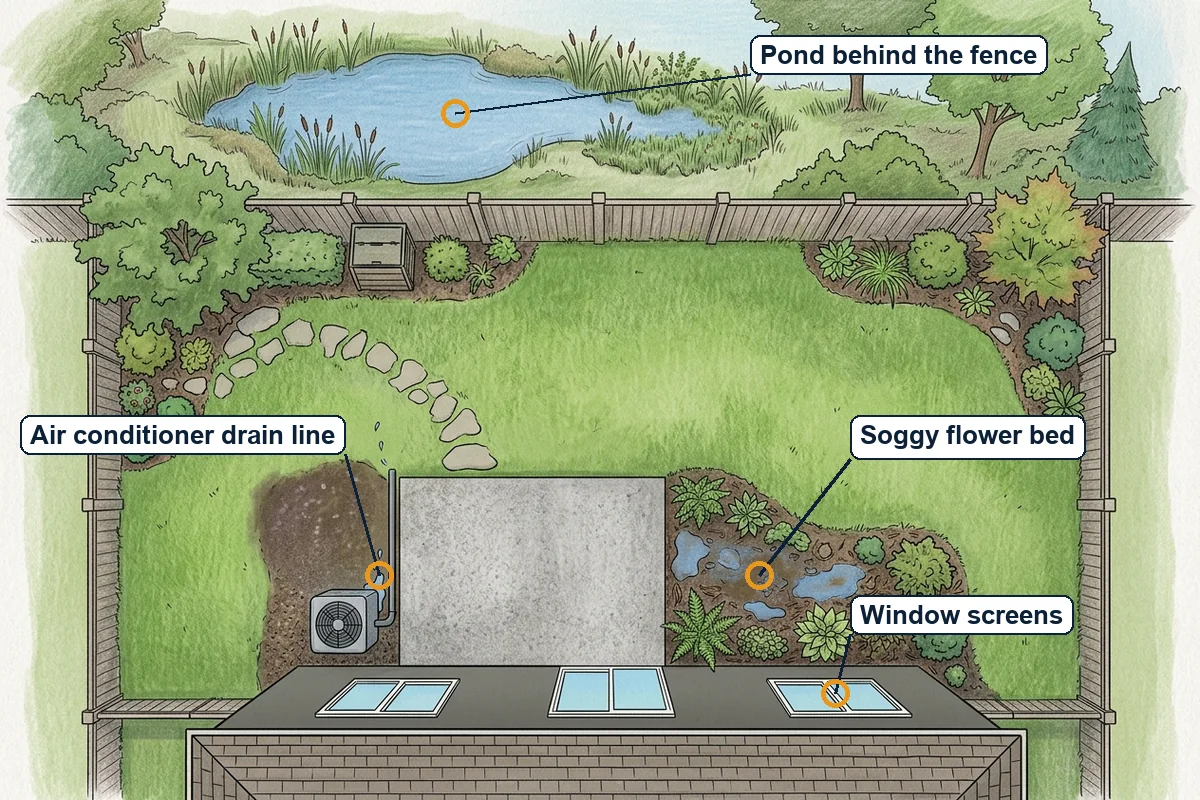
First we ask where your family gets bitten and at what time of day: on the patio at dusk, while watering the beds, or inside at night. Then we look at the soggy beds and lawn corners, the air conditioner’s drain line, the creek or pond behind the fence, and the screens and doors. A bite alone does not tell us which pest it was, so we put the whole picture together before we recommend anything.
- Where and when the bites happen, asked first
- Wet beds, soggy lawn corners and drain lines checked
- Screens, doors and the way they get in
Explain Before Any Work
We explain what we found, what we recommend and why, and what you can change yourself, before any work is done. The University of Florida says each biting midge species usually breeds in just one or two kinds of wet places, so the answer depends on your yard and what is around it.
- What we found, explained first
- What we recommend and why
- What you can change yourself
Make the Yard and House Harder for No-See-Ums
No-see-um eggs and larvae need wet ground. The University of Arizona says holding off irrigation and letting moist spots drain and dry kills the eggs and larvae, and that finer 30 by 30 mesh screens keep the adults out where standard screens do not. We point out the wet spots and the gaps. Tell us where and when the bites still happen, and we look again at what fits.
- Less watering near where the bites happen, so wet spots dry
- Air conditioner drain lines and leaky sprinkler heads fixed
- Doors kept shut at dusk and torn screens repaired
The University of Arizona Cooperative Extension explains that no-see-ums breed in muddy or moist spots such as over-irrigated mulch or sod, and that drying those spots out kills the eggs and larvae. The University of Florida IFAS notes that regular window screens do not keep biting midges out.



The No-See-Um in McKinney, Plano, Frisco & Allen
A no-see-um is a biting midge, a tiny true fly. Only the females bite, because they need blood to develop their eggs, the University of Florida says. Read more in No-See-Ums in our pest library, or browse the whole pest library.
 1 to 2 mmusual adult length, University of Florida
 2 to 3 daysthat hypersensitive people may itch
 About 1.2 milesthat adults of many species fly
 Identify
Small, dark flies barely visible to the naked eye, the University of Arizona says, that look like miniature mosquitoes up close.
 Where they breed
Wet ground. The University of Arizona lists over-irrigated mulch or sod, tree holes, new construction sites, indoor plant pots and water from air conditioners.
When they biteThe University of Florida says most kinds bite at dusk, at night or in the morning, though in cold weather and near the coast many bite in broad daylight.
 The bite
A local sting or burn with a defined red area, the University of Florida says. The University of Arizona describes a small red welt about 1/8 inch across, or a water-filled blister, that itches.
 Through the screen
The University of Arizona says they pass through standard 16 by 16 or 18 by 16 mesh screens, and recommends finer 30 by 30 mesh wherever possible.
Our approachAsk where and when the bites happen and inspect first, since a bite alone does not identify the pest. Look at the wet ground and the way in, then explain what we found and what we recommend before any work.

Telling No-See-Um Bites From Chigger and Mosquito Bites

No-see-ums. A sting or burn on bare skin, often the head and neck, the University of Arizona says, from a fly you can barely see, near wet ground around dusk.

Chiggers. Texas A&M says chigger bites are most common where clothing is tight, at the sock line, the waist and the groin, and itch from 3 to 6 hours later. See Chigger Control.

Mosquitoes. Usually a biter you can see, the University of Arizona notes, and larger, since a no-see-um looks like a smaller, more compact mosquito. See Mosquito Control.
No-See-Um Prevention in McKinney TX Homes
No-see-ums breed in wet ground and slip through ordinary screens. Covering up at dusk, drying out the wet spots and closing the way in stop most of the bites.
Before you sit outside at dusk. The University of Arizona suggests light-colored long sleeves, pants, shoes and socks, and a hat with fine mesh netting for the face and neck. It says repellents that work on mosquitoes work on biting midges. Follow the label.
When they get inside. Keep doors and windows shut as much as you can and do not prop doors open. The University of Arizona recommends 30 by 30 mesh screens and repairing any rips. A fan helps keep them away from you, its Backyard Gardener sheet adds.

We ask where and when the bites happen and look before we recommend anything. The inspection and estimate are free.
Get a free estimate
Let the wet spots dry. The University of Arizona says that when bites are heavy, holding off irrigation nearby and letting moist spots drain and dry kills the eggs and larvae. Fix the sprinkler head that keeps one corner soggy.

Check the water around the house. The University of Arizona lists indoor plant pots and water from air conditioners among the places they breed. Empty saucers and buckets, and run the drain line to a spot that dries.
No-See-Um Control in McKinney, Allen, Frisco, and Plano
The University of Arizona says the heaviest biting usually happens close to where no-see-ums emerge, so the wet ground nearest your yard matters most. We work across all 14 service cities.

Allen, TX
The Cottonwood Creek trail greenbelt runs right past the back fences of Twin Creeks and Cypress Meadows. The University of Florida names the edges of streams among the wet places biting midge larvae live, so a creek behind the fence is worth a look when bites come at dusk.
Allen pest control
Frisco, TX
The creek corridors behind Phillips Creek Ranch bring wet ground close to the homes. Heavily irrigated beds through Stonebriar and Hollyhock fit what the University of Arizona describes, over-irrigated mulch or sod as a breeding spot.
Frisco pest control
McKinney, TX
The trail systems and ponds winding through Stonebridge Ranch and Craig Ranch put water edges near many back yards. New Painted Tree yards sit beside active building, and the University of Arizona names new construction sites among the places no-see-ums breed.
McKinney pest control
Plano, TX
Plano’s Spring Creek corridor and the Arbor Hills trails run creek edges through the city. Mature trees through Gleneagles and Willow Bend can hold water-filled tree holes, which the University of Florida lists among biting midge breeding places.
Plano pest control
Get a free no-see-um control estimate
Tell us where and at what time of day the bites happen, and whether they happen inside or out. A team member gets back to you during business hours (Mon-Fri 8am-5:30pm).
- Inspection first, then what we found explained
- What you can change yourself, explained
- Yard and house both checked
- Free inspection and estimate
Thanks! We got your request.
A Pest Me Off team member will be in touch during business hours.
For faster help, call (972) 866-4720
No-See-Um Control Questions
What are no-see-ums?+
What do no-see-um bites look like?+
How long do no-see-um bites itch?+
When do no-see-ums bite?+
Where do no-see-ums breed around a home?+
Can no-see-ums get through window screens?+
What repellent works on no-see-ums?+
Are no-see-ums dangerous?+
How does Pest Me Off handle no-see-ums?+
All Pest Control Services in McKinney and Collin County
 Ant Control
 Bed Bug Control
 Cockroach Control
 Mosquito Control
 Rodent Control
 Spider Control
 Wasp and Hornet Control
 Wildlife Removal
 Termite Treatment
Ready to enjoy the patio again?
We ask where and when the bites happen, inspect first and explain what we recommend before any work. Family-owned and serving Collin County since 2014. 300+ five-star reviews. Best Pest Control McKinney 2025 and 2026. Texas TPCL #0937184. Open Mon-Fri 8am-5:30pm.