
Cellar Spiders in Collin County, TX | Identification and Control
Cellar spiders, the daddy long legs of ceiling corners, are the pale, thread-legged spiders hanging upside down in garage rafters, bathroom ceilings and utility closets across Collin County. Clemson Cooperative Extension measures the female long-bodied cellar spider’s legs at about 2 inches, on a body just 1/4 to 5/16 inch long. They vibrate into a blur when disturbed, they eat other spiders including the brown recluse, and they almost never need treatment. If you have them, you have a spider that is working for you.
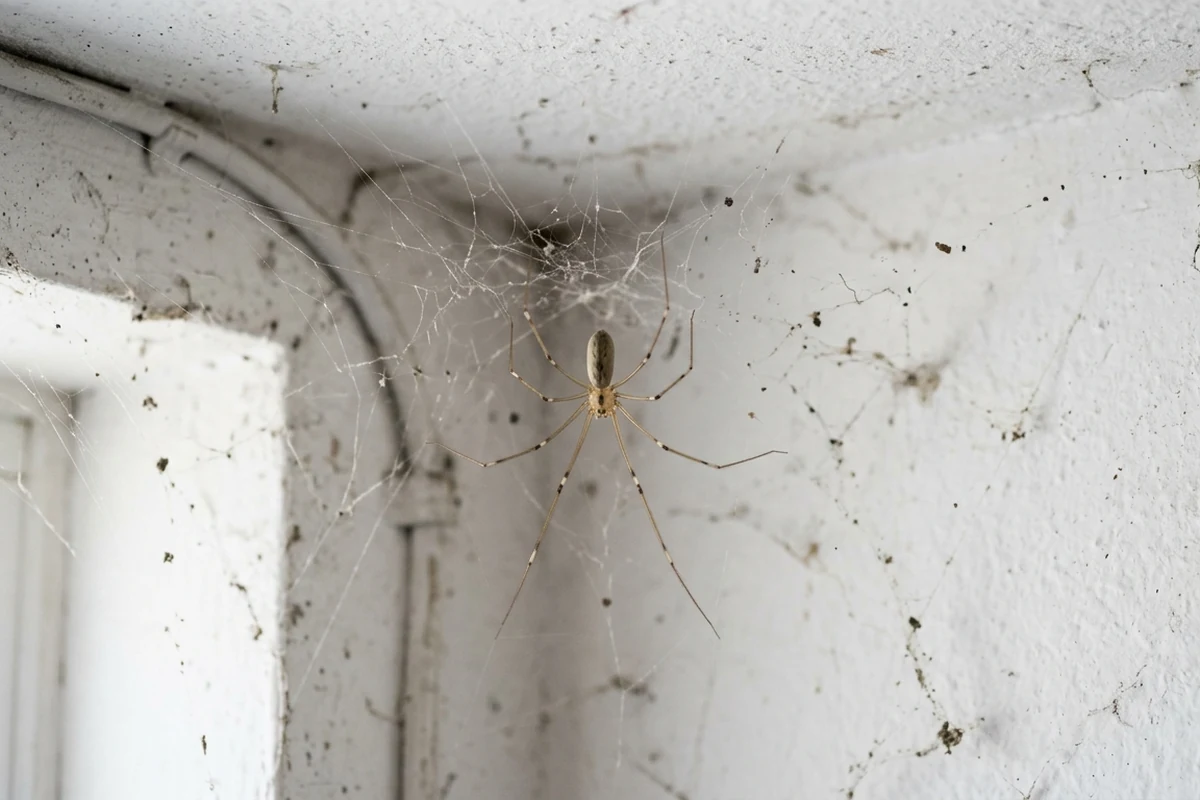
Found one in your ceiling corner in Collin County? Our office sits where McKinney, Plano, Frisco and Allen meet, 5 to 10 minutes from most homes in those four cities. Send us a photo or call, and we will tell you what the spider is.
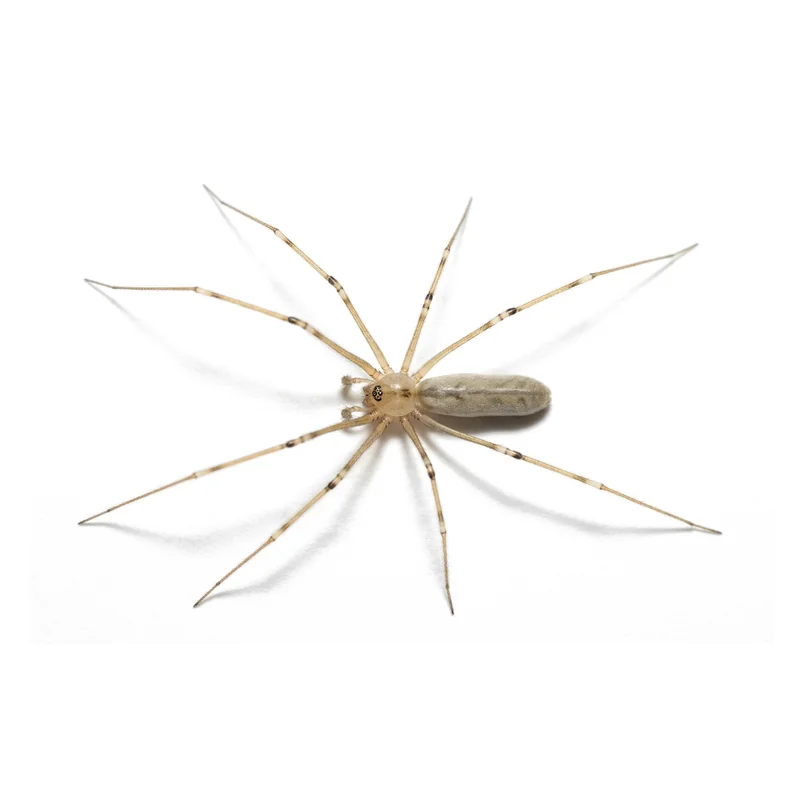
Cellar Spider
Cellar spider facts and control guidance from pest management professionals confirm what the cellar spider is: a harmless, thread-legged spider that vibrates into a blur when disturbed.
Risk Assessment
Choose a row for the full detail- Color
- Uniformly pale tan, gray or nearly translucent, with no stripes or markings
- Prey
- Other spiders, flies and small insects
- Threat level
- Low
- Hunting style
- Passive web ambush, hanging upside down in a loose, irregular cobweb
- Adult lifespan
- About 2 years as an adult, after about a year growing up
- Active season
- Year-round indoors in Collin County, with no seasonal rest
- Size
- Body about 1/4 in (6 mm), legs about 2 in (50 mm) long
What a Cellar Spider Looks Like
Cellar spiders look like a small, narrow body slung between eight hairpins. The body is only about 1/4 inch long, and Clemson Cooperative Extension puts the legs at about 2 inches long beyond it. The color is uniformly pale, tan, gray or nearly see-through, with no pattern, no stripes and no distinctive markings.
They hang upside down in loose, messy cobwebs in ceiling corners, garage rafters and the upper walls of bathrooms, closets and utility rooms. The web is an irregular tangle that gathers dust over time. When disturbed, the spider vibrates its body rapidly into a blur, the habit that earned it the name vibrating spider.
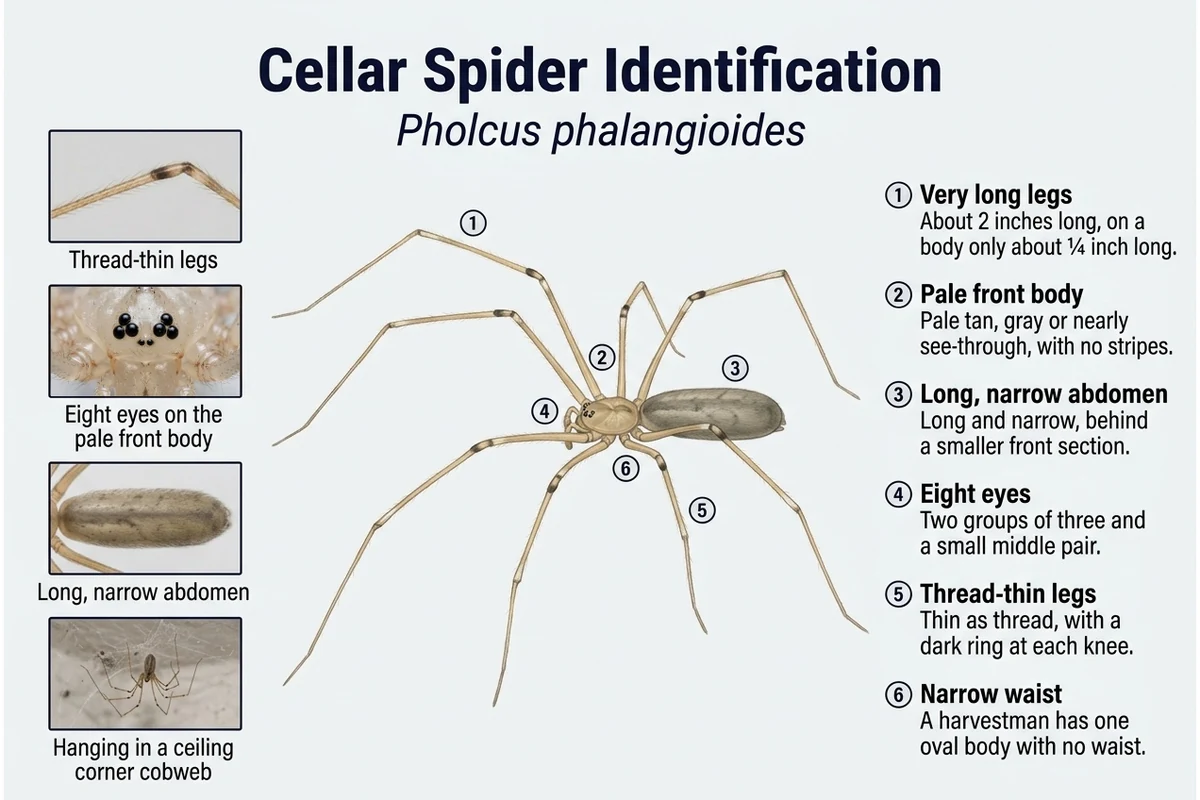
How to identify a cellar spider, with its main features labeled
- Tiny cylindrical body (0.25 in) with legs 8 to 10 times longer than the body is wide
- Pale tan to nearly translucent color, with no bold markings or stripes
- Hangs upside down in a loose, dust-collecting cobweb in a ceiling corner
- Vibrates into a rapid blur when the web is touched or the spider is approached
- Two body sections joined by a narrow waist, with a long, narrow abdomen behind a smaller front section
- A female may hold a round egg sac in her jaws
- Seen every month of the year, not just in one season like most spiders found indoors
Other Names for the Cellar Spider
Most people know this spider as daddy long legs. The name cellar spider comes from its old link to cellars. In Collin County slab homes, garages, bathrooms and utility closets fill the same role. Every name in the table means the same pale, long-legged spider, Pholcus phalangioides, so if you searched for any of them, this is your spider.
Are Daddy Long Legs Spiders?
It depends which daddy long legs you mean, because the name covers two different animals. The one hanging in a cobweb in your ceiling corner is the cellar spider, a true spider with two body sections joined by a narrow waist, eight eyes and silk for webs.
The other daddy long legs is the harvestman, order Opiliones, which is an arachnid but not a spider. It has one fused oval body with no waist, makes no silk and has no venom glands. The quick check is the waist. A visible narrowing between two body sections means a spider. One solid oval means a harvestman.
| Name | What it means |
|---|---|
| Daddy long legs | The name most people use, also written daddy longlegs or daddy long leg spider. It is shared with the harvestman, which is not a spider. |
| Long-legged spider | Not a name, but the way most people describe it before they know one. The legs are the whole identification. |
| Vibrating spider | Named for the way it shakes its body into a blur when disturbed. |
| Skull spider | A less common nickname for the same spider. |
| Pholcid spider | From Pholcidae, the scientific family the cellar spider belongs to. |
| Zitterspinne | The German name, meaning trembling spider, for the same vibrating habit. |
How to Tell Cellar Spiders from Other Collin County Spiders
The cellar spider’s extreme leg length and its ceiling-corner cobweb set it apart from most species. The usual mistakes are taking it for a southern house spider, which has a different web and body shape, or a brown recluse, which never hangs in ceiling cobwebs.
| Species | Size | Key Feature | Where Found |
|---|---|---|---|
|
Cellar Spider
AKA: Daddy Long Legs, Vibrating Spider
Pholcus phalangioides
This species
|
About 1/4 in body, legs about 2 in long. Tiny body dwarfed by thread-like legs. Pale tan to nearly translucent. | Hangs upside down in a loose, irregular ceiling cobweb. Vibrates its body rapidly when disturbed. Female carries her egg sac in her jaws rather than attaching it to the web. Two-section body with a visible waist. | Ceiling corners, garage rafters, bathroom walls, utility closets, under stairs. Indoors year-round in undisturbed spots with low traffic and moderate humidity. |
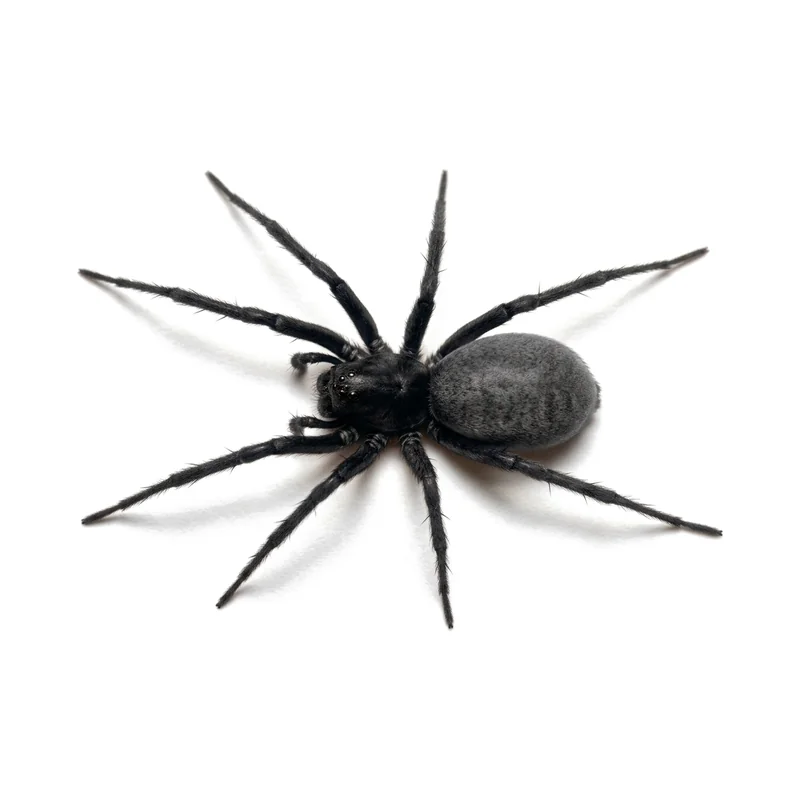
Southern House Spider
AKA: Crevice Weaver, Woolly Web Spider
Kukulcania hibernalis
|
Female 0.51 to 0.75 in body, leg span up to 2 in. Male 0.35 to 0.5 in. Much heavier-bodied than a cellar spider and not pale or translucent. | Flat woolly web spreading from a wall crevice, not a ceiling cobweb. Female dark charcoal-gray and velvety. Male khaki with extremely long pedipalps. Does not vibrate. | Wall crevices, window frames, door frames, weep holes. Always in or near a flat woolly web spreading from a crack at wall level, not hanging in ceiling corners. |
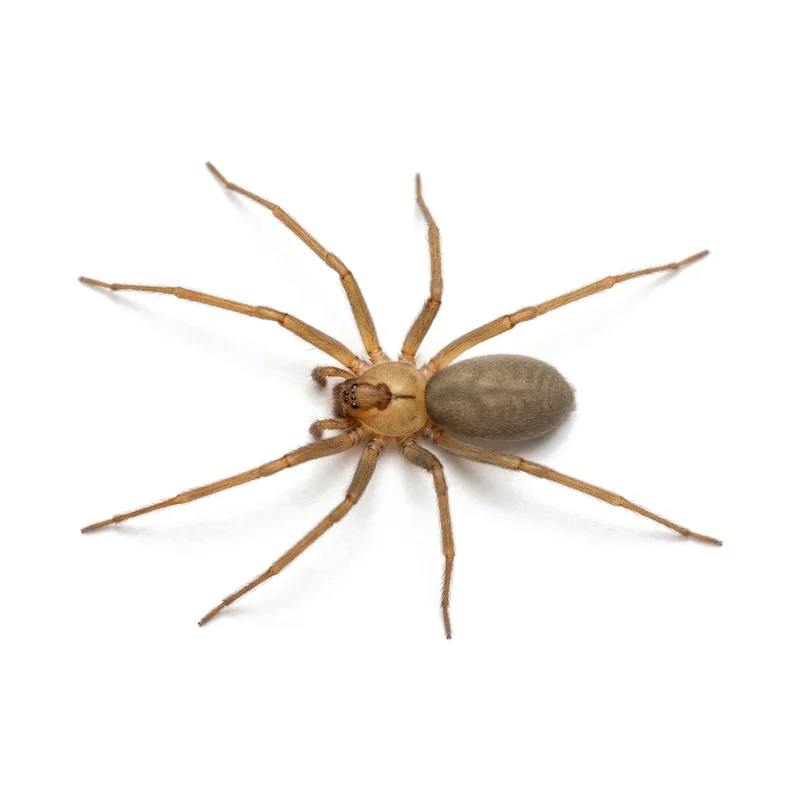
Brown Recluse
AKA: Violin Spider, Fiddleback
Loxosceles reclusa
|
0.25 to 0.5 in body, leg span 1 to 1.5 in. Slender, lightly built, matte tan to brown. Legs are short next to cellar spider legs and uniformly colored. | 6 eyes in 3 pairs (not 8). Violin-shaped mark on the front body section. Builds small irregular retreat silk in storage clutter, not ceiling cobwebs. Does not vibrate. | Dark storage: closets, shoe boxes, garage clutter, stored clothing, stacked papers. Found at floor level, never hanging upside down in open corners. |
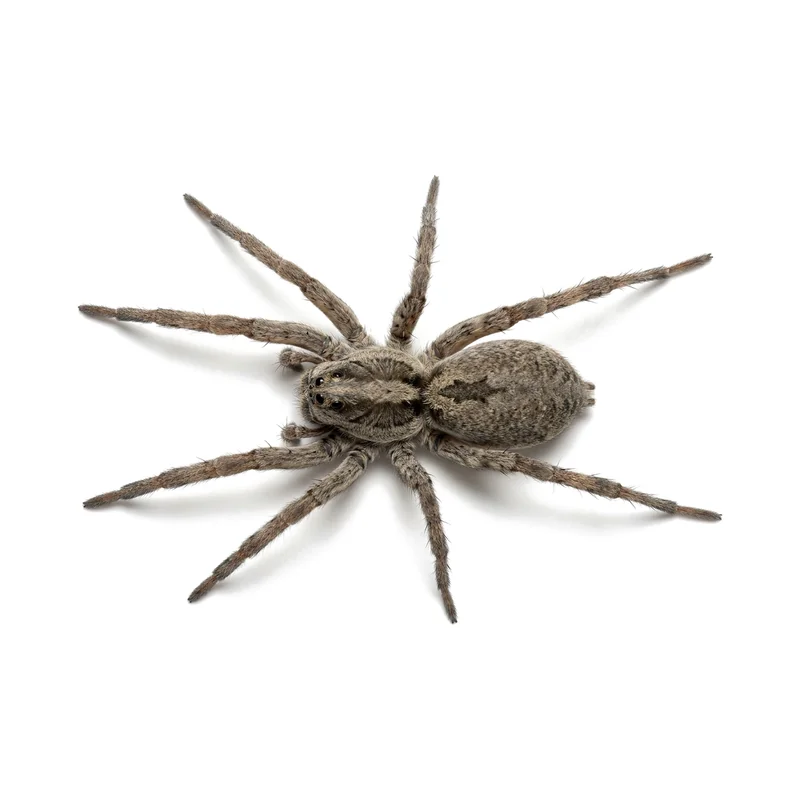
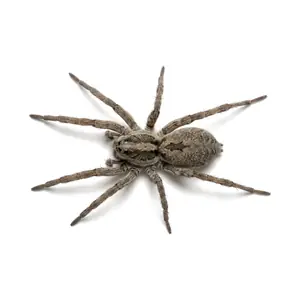
Wolf Spider
AKA: Hairy Spider, Ground Spider
Hogna carolinensis, Rabidosa spp.
|
0.5 to 1.5 in body, leg span up to 4 in. Stocky, heavily built, densely hairy. Far more body mass than a cellar spider. | 8 eyes with a large middle pair that glows green under a flashlight at night. Distinct stripes on the front body section. Builds no web and runs on floors. Dark mottled brown, not pale. | Open garage floors, under exterior doors. Ground hunter, never in ceiling cobwebs. Comes in during fall through gaps and does not live indoors year-round. |
Daddy Long Legs Spider vs Brown Recluse
The Cellar Spider in Three Numbers
2 in
Clemson Cooperative Extension measures the female long-bodied cellar spider’s legs at about 2 inches, on a body just 1/4 to 5/16 inch long.
Clemson Cooperative Extension
13 to 60
Clemson Cooperative Extension says each egg sac of a long-bodied cellar spider holds 13 to 60 eggs, and a female makes about three sacs in her life.
Clemson Cooperative Extension
2 years
Clemson Cooperative Extension says an adult cellar spider may live about 2 more years after the roughly one year it takes to grow from egg to adult.
Clemson Cooperative Extension
Are Daddy Long Legs Poisonous or Dangerous?
No. Daddy long legs are not dangerous to people, whichever of the two animals with that name you found. The cellar spider has venom, as nearly every spider does, but it works on insects and other spiders, and no peer-reviewed study has found it significantly toxic to mammals.
No cellar spider bite has been documented as medically significant in any reported case in the United States, and the cellar spider identification and management guide from University of Minnesota Extension confirms their low-risk classification. The harvestman, the other daddy long legs, has no venom glands at all.
The claim that daddy long legs are the most venomous spider in the world but cannot bite you is false in both directions. The venom is not potently toxic, and the fangs can occasionally pierce very thin skin. The claim mixes up cellar spiders with harvestmen and has no peer-reviewed backing.
Do Cellar Spiders Bite?
Rarely, and a cellar spider bite does little. The fangs are generally too short to reliably break adult human skin. Thin skin, such as between the fingers or on the inner wrist, can occasionally be pierced, and the result is brief local pain and a small red mark, like a mosquito bite, that fades without treatment.
A bite needs the spider pinched against skin, which almost never happens in normal household contact. Cellar spiders do not seek out people. They hang in ceiling corners and retreat when disturbed.
Do Daddy Long Legs Eat Brown Recluse Spiders?
Yes. Cellar spiders invade other spiders’ webs, tangle the resident in their own silk, then kill and eat it. Documented prey includes brown recluse, black widows and other cellar spiders. They cannot wipe out a recluse infestation, because the numbers do not work at that scale, and they are no substitute for professional recluse treatment.
They do remove recluse that wander through their corner, so in a home with recluse concern a cellar spider population in the garage ceiling is a net benefit.
When Cellar Spider Presence Is Worth Addressing
Visible Cobwebs in Living Areas
Cellar spider webs gather dust and look worse over time. In a bedroom, bathroom or main living area it is reasonable to vacuum the webs and the spiders. The reason is looks, not health.
Many Spiders in One Damp Room
Cellar spiders gather where moisture and small insects do, so a crowd of them in one bathroom or utility room can point to a leaking pipe, poor drainage or condensation. Those are worth fixing for the building’s sake anyway.
Cellar Spiders in Garage Corners
A cellar spider in a garage ceiling corner is almost certainly not worth treating. It is eating flies, small insects and any spider that wanders into its web. Vacuum it if the cobweb bothers you, leave it if you do not mind.
Children or Pets in the Same Space
Cellar spiders do not bite dogs, cats or children under normal circumstances. A child reaching into a cellar spider web is more likely to set the spider vibrating than to provoke any defensive bite.
Why You Found Cellar Spiders in Your House
Cellar spiders in the house are normal, not a sign that something is wrong. They live alongside people, and in Collin County they live mainly indoors, where the climate suits them all year. They come in through the same gaps flies and small insects use: utility openings, weep holes, gaps around window frames, and open doors and windows. Once inside they stay, because nothing in a climate-controlled home pushes them out with the seasons.
They settle wherever there is low traffic, some humidity and a supply of small flying insects. That is why the garage ceiling and the bathroom corner are where most people first notice them.
Where Cellar Spiders Come From in Collin County
Cellar spiders set up in ceiling corners, garage rafters, bathroom walls, closet ceilings and under stairs, anywhere with low traffic, moderate humidity and small flying insects to catch. They are not responding to seasonal pressure. They have found a stable home and they stay.
Cellar Spider Presence in Collin County Homes
Cellar spiders are present in virtually every home in Collin County at some level. They are more visible in McKinney and older Allen and Plano homes, where settled moisture patterns in garages and bathrooms support steady year-round numbers. Newer homes in Prosper, Celina and Frisco see them move into garages and bathrooms as soon as there is enough humidity and prey.
The most common call about cellar spiders is not a treatment request but an identification question. Homeowners see the long-legged pale spider in a ceiling corner and want to know it is not something dangerous.
Cellar spiders are one of the few spiders that stay active all year here. Pest Me Off service records and iNaturalist observations from 2023 to 2026 show cellar spiders active in all 12 months in Collin County homes, at roughly the same level every month. Indoor temperature control removes the cold that sends outdoor spiders into a winter rest, so expect them in garage rafters, bathroom ceilings and utility closets in January as much as in July.
Pattern from iNaturalist observation records and Pest Me Off service call data across Collin County, 2023 to 2026.
Cellar Spider Biology That Explains Year-Round Presence
How Pest Me Off Handles Cellar Spiders
Pest Me Off does not treat cellar spiders as a primary target. When we find them during a broader spider service, we tell you what they are and what they are doing, and we decide with you whether removing them serves you. In nearly every case the garage ceiling population stays and the living area webs get vacuumed. We do not sell chemical treatment for cellar spiders alone, because it is not warranted.
Decide Whether Removal Is Needed
Garage ceiling corners, utility closets and under-stair spaces are low-traffic areas where the spider is catching other pests. Living rooms, bedrooms and bathrooms in everyday view are the sensible places for cosmetic web removal.
Vacuum Spider, Web and Egg Sac Together
Use a vacuum with a hose attachment to take the web, the spider and any egg sac in one pass. Empty the bag or canister outside straight away so nothing escapes.
Reduce Moisture in High-Population Areas
Where cellar spiders crowd one bathroom or garage area, find the moisture source: condensation on pipes, a slow drip or poor ventilation. Fixing a leaking pipe or adding a bathroom exhaust fan reduces their numbers faster than any spray.
No Chemical Treatment in Standard Cases
Residual pesticide for cellar spiders is not recommended. It does not control the population well, since new spiders easily replace the ones that die, and the spider poses no medical or structural risk to justify the cost and exposure.
& Quick Fixes
How to Get Rid of Daddy Long Legs Yourself
Managing cellar spiders yourself is mostly deciding where you want them and where you do not, then removing them from the places you want clear. No chemicals are needed for any of it.
Why Some DIY Approaches Backfire for Cellar Spiders
Most DIY attempts that backfire make one of the four mistakes below. Each one either leaves the spider alive or spends money and chemicals on a spider that was never a threat.
Knocking Down the Web Without the Spider
A broom removes the cobweb but not the spider, which drops to a nearby surface and rebuilds in the same corner within 24 to 48 hours. If she escapes with her egg sac in her jaws, the next generation hatches there too. If you still see the spider after cleaning, the job is not finished.
Spraying for a Harmless Spider
Residual insecticide or spray cans aimed at cellar spiders bring pesticide exposure for no medical or structural benefit. A vacuum does the job without chemicals. Using pesticides for cellar spiders is the pest control equivalent of calling an ambulance for a paper cut.
Removing Spiders Without Fixing the Moisture
Vacuuming without fixing the moisture that draws their prey gives a short-lived result. New spiders come in through the same gaps the prey insects use. The moisture feeds the prey and the prey feeds the spiders.
Treating for Brown Recluse When It Is a Cellar Spider
The pale color and small body of a cellar spider can raise a brown recluse worry, especially seen from a distance in a ceiling corner. Treating for recluse on the strength of a cellar spider sighting is an unnecessary expense with unnecessary chemical exposure.
Common Cellar Spider Questions
Is that a daddy long legs in my ceiling corner?
Can cellar spiders bite humans?
Are cellar spiders the most venomous spider in the world?
Do cellar spiders eat brown recluse spiders?
What is that spider that vibrates when I get near it?
Should I vacuum the cobwebs in my garage ceiling corners?
Why do I see more cellar spiders in my bathroom?
Are cellar spiders dangerous to dogs or cats?
What is the difference between a cellar spider and a daddy long legs?
How long do cellar spiders live?
Do I need pest control for cellar spiders?
How do I get rid of daddy long legs in my home?
Cellar Spiders in Every Corner. We Tell You the Truth About What They Are.
If a cellar spider is harmless and eating your recluse, we tell you that. If you have a real spider problem in Collin County, such as brown recluse, black widows or wolf spiders coming in, we find it, treat it properly and seal the entry routes. No unnecessary services, and no treating spiders that are working for you.