
American Dog Ticks in Collin County, TX | Identification and Control
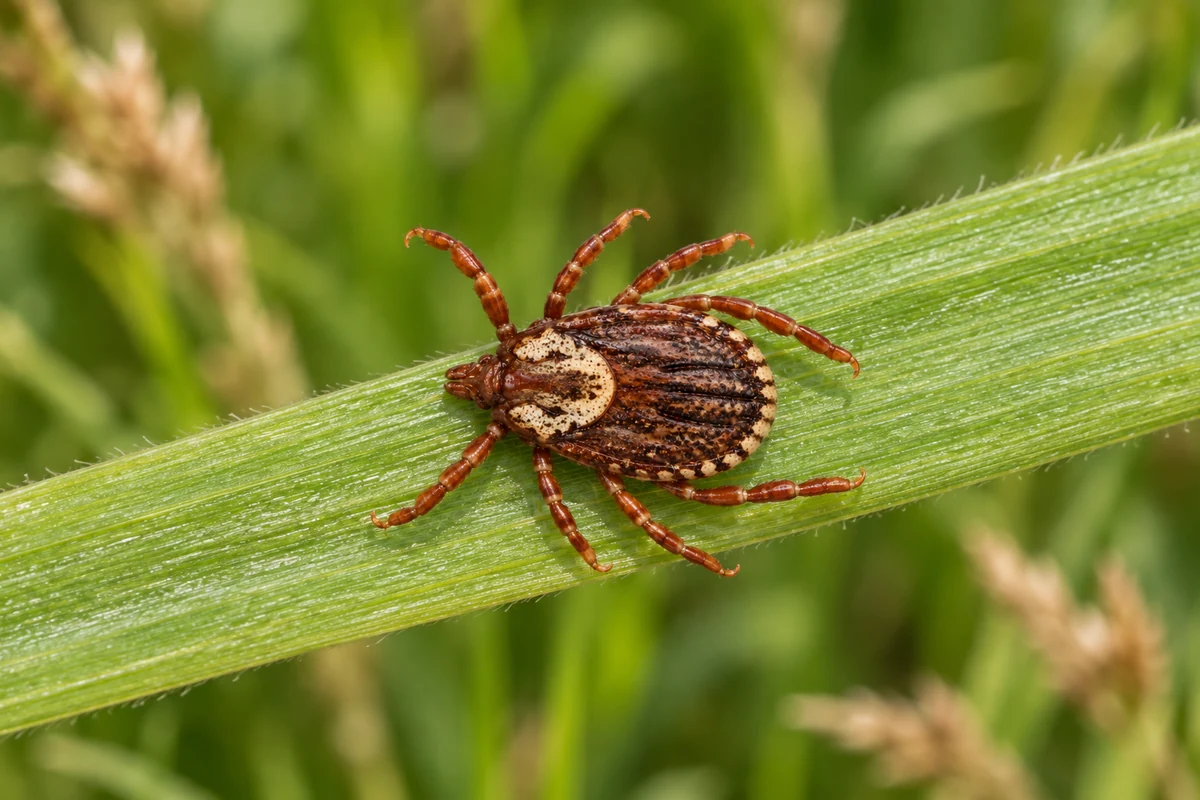
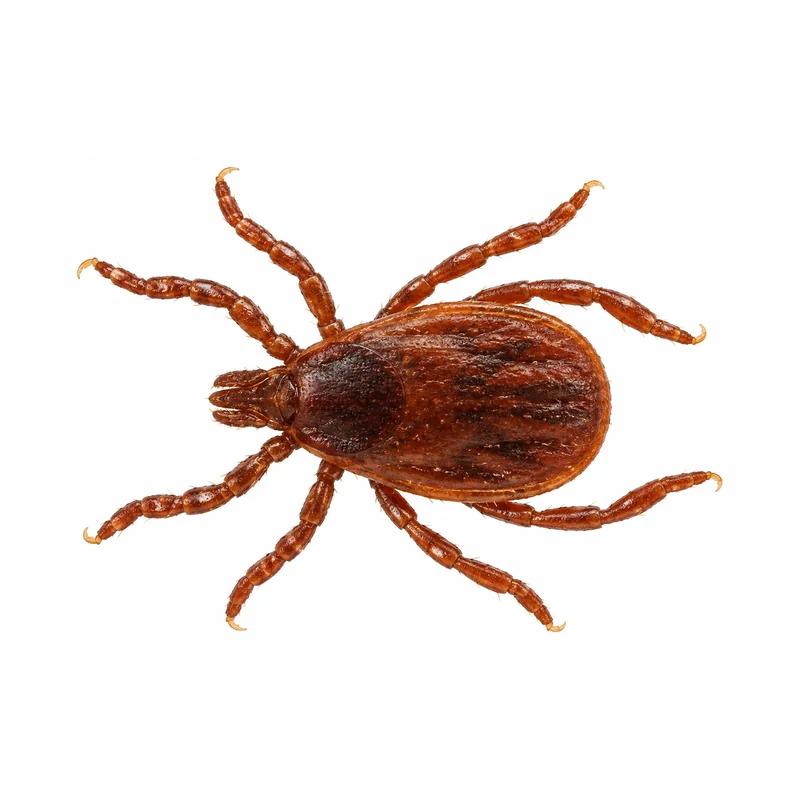
The American dog tick (Dermacentor variabilis) is the large brown tick with creamy gray markings that dogs and people pick up in tall grass along fences, paths and creeks. Texas A&M AgriLife’s Tick App calls it the primary carrier of Rocky Mountain spotted fever in the eastern, central and southern US. Even so, Ohio State University Extension reports that less than 2 percent of these ticks carry the germ. It lives outdoors and cannot settle into a home.
Pulling ticks off the dog every week? Our office sits where McKinney, Plano, Frisco and Allen meet, 5 to 10 minutes from most homes in those four cities. Call and we will find the yard edges where they are waiting.
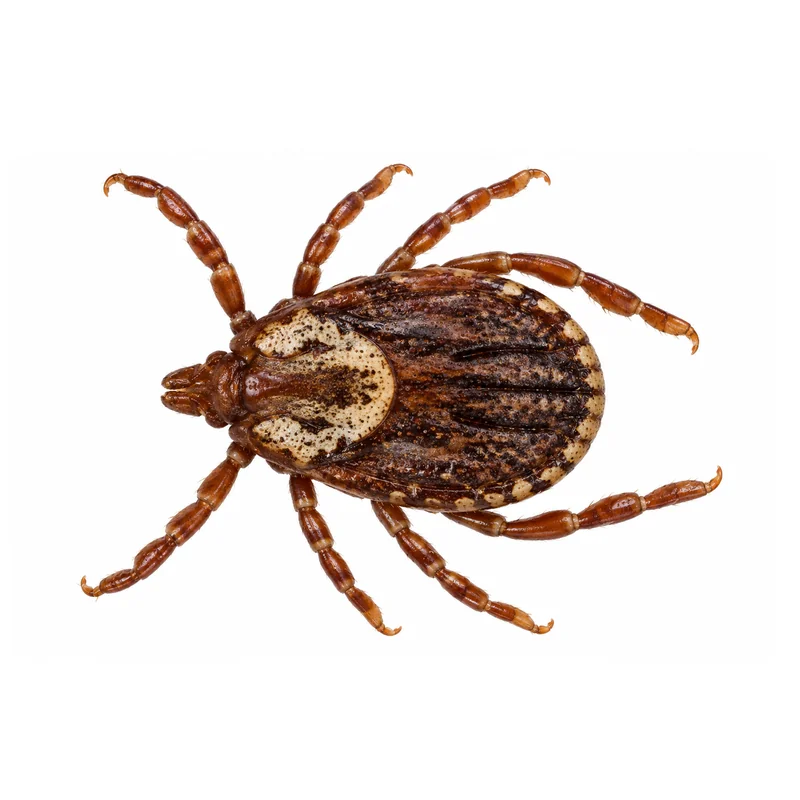
American Dog Tick
The American dog tick is a hard tick that waits on grass and weeds for a dog, a raccoon or a person to brush past. Texas A&M AgriLife’s Tick App says its range runs from the Atlantic coast west as far as the Texas Panhandle and Trans-Pecos.
Risk Assessment
Choose a row for the full detail- Color
- Brown, with creamy gray marbling on the shield behind the head
- Diet
- Blood, from mice and rabbits when young, dogs, raccoons and people as adults
- Threat level
- Moderate
- Defining behavior
- Waits on grass tips for a passing host to brush against it
- Habitat
- Tall grass along fences, paths, fields and creeks
- Eggs
- 4,000 to 6,500 in one batch, then the female dies
- Size
- About 3/16 inch, swelling to about 5/8 inch once fed
What Does an American Dog Tick Look Like?
A flat brown tick with creamy gray marbling behind the head, swelling into a gray bean once it feeds
An unfed adult is flat, oval and brown, with eight legs and short mouthparts. The shield on its back is marbled with creamy gray, covering most of the back on a male and only a patch behind the head on a female. Ohio State University Extension puts an unfed adult at about 3/16 of an inch, which makes it one of the larger ticks people find, and says a fed female grows to about 5/8 of an inch and turns mostly gray.
The young are hard to see. Texas A&M AgriLife’s Tick App describes the newly hatched young as pin-head sized and straw colored, and the next stage up as pale yellow brown with a brick red shield, both far smaller than the adults. Almost every American dog tick a homeowner finds is an adult, crawling on a dog’s head and neck or on a pant leg after time in tall grass.
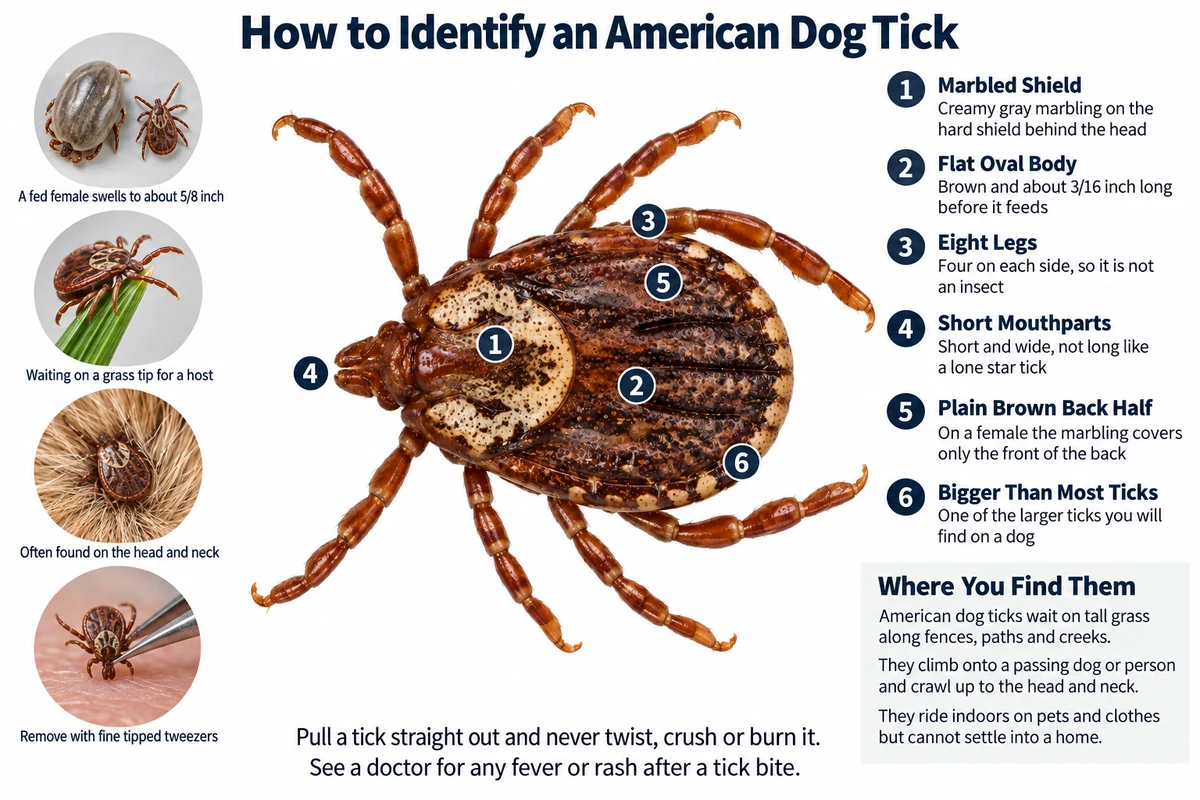
How to identify an American dog tick by the creamy gray marbling on its shield, its short mouthparts and the gray bean shape of a fed female
- Creamy gray or white marbling on the shield, not a single white dot
- A flat brown tick about 3/16 inch long, larger than most ticks you find
- A swollen gray tick the size of a pea or bean on the dog’s head, neck or ears
- Found after a walk through tall grass, a field edge or along a creek
- Ticks show up in spring and early summer, then fall off later in the year
- One or two ticks at a time, not dozens climbing the walls indoors
Other Names for the American Dog Tick
The name comes from its favorite adult host, the dog, though it bites coyotes, raccoons, opossums, cattle, horses and people as well. Purdue University’s public health entomology page on ticks notes it is also known as the eastern wood tick, and many people simply call any large tick a wood tick. In Spanish it is the garrapata americana del perro.
Two names cause confusion. The brown dog tick is a different tick that can live inside a house, and the Rocky Mountain wood tick is a close cousin that the CDC’s guide to where ticks live places in the Rocky Mountain states, not Texas.
| Name | What it means |
|---|---|
| Dog tick | The everyday short name, after the host it likes best. |
| Wood tick | A common name for any large tick found outdoors. |
| Eastern wood tick | The name Purdue University gives it as well. |
| Garrapata americana del perro | The Spanish name, the American dog tick. |
| Brown dog tick | A different tick that can live indoors, not this one. |
How to Tell an American Dog Tick from a Lone Star or Brown Dog Tick
All three turn up on Collin County dogs, and the right fix depends on which one it is. An American dog tick or a lone star tick comes from the yard edges, while a brown dog tick can breed inside the house. The markings on the shield tell them apart.
| Species | Size and Color | Key Feature | Where Found |
|---|---|---|---|
|
American Dog Tick
AKA: Dog Tick, Wood Tick
Dermacentor variabilis
This species
|
About 3/16 inch unfed, about 5/8 inch and gray once fed. Brown. | Creamy gray marbling on the shield and short mouthparts. | Outdoors, in tall grass along fences, paths, fields and creeks. |
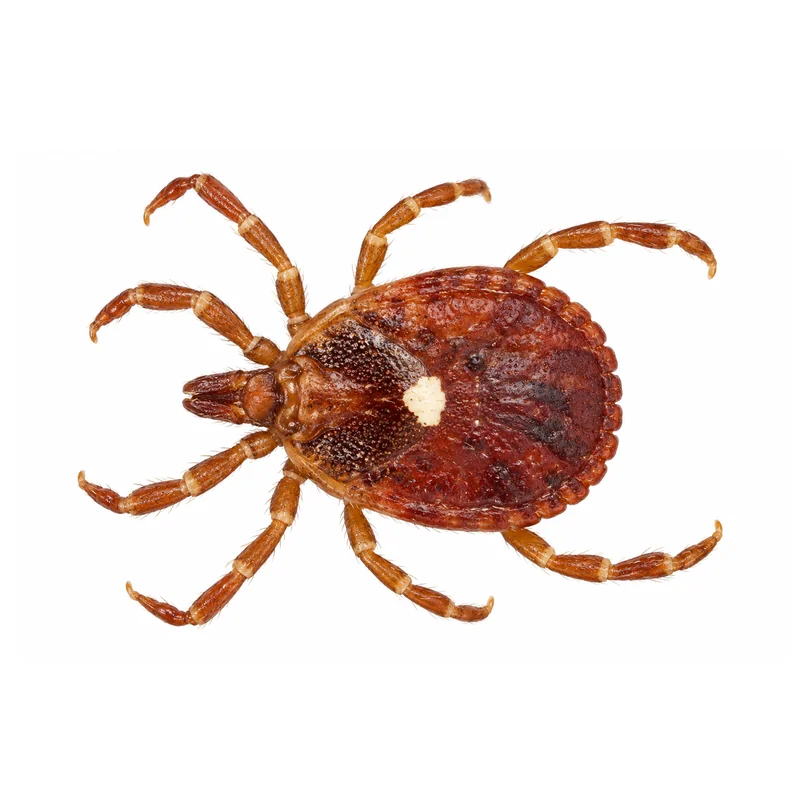
Lone Star Tick
AKA: Seed Tick (the young)
Amblyomma americanum
|
About 3/16 inch unfed, about 7/16 inch and round once fed. Brown. | The female has one silvery white spot on her back and long mouthparts. | Outdoors, in shady grass, brush and woods, and it bites people readily. |
Brown Dog Tick
AKA: Kennel Tick
Rhipicephalus sanguineus
|
Smaller, about 1/8 inch unfed, about 1/2 inch and bluish gray once fed. Reddish brown. | No markings at all on its back. | On dogs and inside homes and kennels, in cracks near where the dog sleeps. |
American Dog Tick vs Lone Star Tick
The American Dog Tick in Three Numbers
Under 2%
Ohio State University Extension reports that less than 2 percent of American dog ticks carry the germ that causes Rocky Mountain spotted fever, which is why relatively few people who are bitten get sick.
Ohio State University Extension
1 day
The same fact sheet says an infected American dog tick must stay attached for at least 1 day to pass on Rocky Mountain spotted fever, so a tick found on a daily check is caught early.
Ohio State University Extension
3 to 12 days
The CDC says signs of Rocky Mountain spotted fever begin 3 to 12 days after the bite of an infected tick, starting with a sudden fever and headache.
CDC, Rocky Mountain Spotted Fever
Are American Dog Ticks Dangerous?
They can be, mostly because of what a small share of them carry. The CDC’s guide to where ticks live says the American dog tick spreads tularemia and Rocky Mountain spotted fever, that the highest risk of a bite is in spring and summer, and that adult females are the ones most likely to bite people. The bite itself is usually painless, which is why the tick is often found only once it has swollen. Purdue’s tick page adds that the evidence so far does not tie it to Lyme disease.
Can an American Dog Tick Give You Rocky Mountain Spotted Fever?
Yes, and it is the tick the CDC names first. The CDC’s page on Rocky Mountain spotted fever lists fever, headache, rash, nausea, stomach pain and muscle pain, says it can be deadly if not treated early with the antibiotic doxycycline, and says doctors should start that treatment before test results come back. Its symptoms page says signs begin 3 to 12 days after the bite. Texas A&M AgriLife Extension’s Insects in the City gives a 20 percent fatality rate for people who go untreated, which is why a fever after a tick bite is a same-day call to the doctor.
Can an American Dog Tick Hurt My Dog?
Yes. Ohio State University Extension says toxins in the saliva of a feeding American dog tick have been known to cause tick paralysis in dogs and people, a weakness that usually clears quickly once the tick is removed. Texas A&M AgriLife’s Tick App says Rocky Mountain spotted fever affects companion animals as well as people. The same Ohio State fact sheet lists what a sick dog shows, tiredness, anemia, going off its food, losing weight and sometimes limping, and says any dog with those signs should see a veterinarian.
When an American Dog Tick Bite Needs Fast Action
A Fever or Rash After a Tick Bite
Fever, headache or a rash in the 2 weeks after a bite can be Rocky Mountain spotted fever. Call your doctor that day and mention the tick.
Sudden Weakness in a Child or Dog
Sudden weakness or trouble walking can be tick paralysis. Search the scalp, neck and ears for a tick and pull it off at once.
A Swollen Tick Already Attached
A gray, swollen tick has been feeding for days. Remove it with tweezers, keep it in a sealed bag, and watch for fever for the next few weeks.
Ticks on the Dog Every Week
A steady run of ticks means they are waiting somewhere the dog goes every day, usually a fence line or an unmowed edge of the yard.
Why You Found an American Dog Tick in Your House
It rode in. The CDC’s tick prevention page says ticks ride into the home on clothing and pets and can attach to a person later, and that many people pick up ticks in their own yard or neighborhood. A dog that runs the fence line, a walk along a greenbelt trail or an afternoon pulling weeds is enough. The CDC suggests tumbling dry clothes on high heat for 10 minutes after coming in to kill any ticks still on them.
One American dog tick indoors does not mean the house is infested. Ohio State University Extension says the brown dog tick is the only tick that can settle into a home, so an American dog tick inside came in from the yard. Ticks found in numbers on walls, curtains or the dog’s bed point to the brown dog tick instead.
Where Are American Dog Ticks Found?
In tall grass at the edge of something wilder. Ohio State University Extension says they prefer grassy areas along roads and paths, especially next to woods or shrubs, and that an adult waits on grass and weeds for a host to brush past, then climbs up looking for a place to feed, often the scalp and the hairline at the back of the neck. The Insects in the City article says ticks in Texas are found mostly in fields and wooded areas, especially along the edges, and are seldom seen in town except the brown dog tick.
American Dog Tick Pressure Across Collin County
Flea and tick yard work shows up in our service notes in Farmersville, McKinney and Allen, usually for homes with dogs, along fence lines and the edges of the lawn. Our notes do not record which tick it was, so treat any large marbled tick on the dog as an American dog tick until you have looked at its back.
The homes most likely to see them back onto creeks, greenbelts, pastures or empty lots, the grassy edges the Ohio State and Texas A&M references describe. That includes the newer streets of Anna, Princeton and Celina as much as the trails and parks of Plano and Frisco.
In the warm south, Texas A&M AgriLife’s Tick App says all three stages can be found on animals all year, with a sharp rise in spring. Adults are out in force from April into early summer, and the CDC puts the highest bite risk in spring and summer.
Pattern from Texas A&M AgriLife’s Tick App, the CDC’s note that bites peak in spring and summer, and Pest Me Off flea and tick calls from spring into fall.
Why American Dog Ticks Keep Coming Back
How Pest Me Off Gets Rid of American Dog Ticks
American dog tick control is four steps, every job. The ticks you pull off the dog are only the ones that found it, so the work goes where the rest are waiting.
Inspect and Identify
A free inspection of the yard, the fence lines, the dog’s favorite spots and the edges of the lawn. We confirm it is a tick and not fleas, and which tick, before anything is applied.
Treat the Edges Where They Wait
Our Scorched Earth Barrier goes across fence lines, tall-grass edges, shaded pet runs, leaf litter and the soil under decks and shrubs, with granules worked into the shaded beds a spray cannot reach. Pets and kids can go back out once it dries, in 1 to 2 hours.
Time It With the Dog’s Treatment
We line up the yard work with the tick treatment your vet puts on the dog, so the yard and the pet turn over together.
Defend Through the Season
On a recurring plan we come back about 30 days after the first visit, then keep the Scorched Earth Barrier going each quarter through the warm months, the Defend step of our Remove, Install and Defend process.
& Other Companies
How to Get Rid of American Dog Ticks Yourself
Most DIY tick work is keeping the yard edges short and finding ticks before they settle in. The CDC’s page on what to do after a tick bite says to remove an attached tick as soon as possible.
Why Some DIY Responses Fail for American Dog Ticks
Most DIY tick trouble comes from treating the house for a tick that lives outside, or from home remedies that make an attached tick worse. The CDC warns against several of them by name.
Smothering or Burning a Tick
The CDC says not to use petroleum jelly, nail polish or heat to make a tick let go, because it can push infected fluid into the skin. Crushing it with your fingers carries the same risk.
Bug Bombs in the House
American dog ticks do not live indoors, so a fogger in the living room misses every one waiting along the fence and puts chemicals where the family sits.
Spraying Once and Relying on It
The CDC says spraying can cut ticks in the treated part of a yard, but you should not rely on spraying alone to protect against tick diseases. Daily checks and quick removal still matter.
Common American Dog Tick Questions
What is an American dog tick, and what does it look like?
Is an American dog tick bite dangerous?
Are American dog ticks dangerous to dogs?
How long does a tick have to be attached to make you sick?
Do American dog ticks carry Lyme disease?
Can American dog ticks live in my house?
How do I remove an American dog tick?
When are American dog ticks most active in Texas?
What is the difference between an American dog tick and a lone star tick?
Is an American dog tick the same as a wood tick?
How do I get rid of American dog ticks?
Ticks on the Dog Again? We Treat the Edges Where They Wait.
We find the fence lines and grassy edges the ticks use, treat them, time the work with your dog’s vet treatment and keep the yard covered through tick season. Flea and tick control across McKinney, Allen, Frisco, Plano, and all of Collin County.