Home Pest Library Cockroaches American Cockroaches
American Cockroaches (Palmetto Bug, Water Bug, Sewer Roach)

American Cockroaches in Collin County, TX | Identification and Control

Last updated 2026

American cockroaches (Periplaneta americana), known throughout North Texas as palmetto bugs, water bugs, and sewer roaches, are the largest cockroach species homeowners encounter in Collin County. Unlike German cockroaches that live and breed inside heated structures, the American cockroach is primarily an outdoor pest that enters your home through drains and foundation entry points during heat and rain pressure. The fix is different from what most homeowners try first.

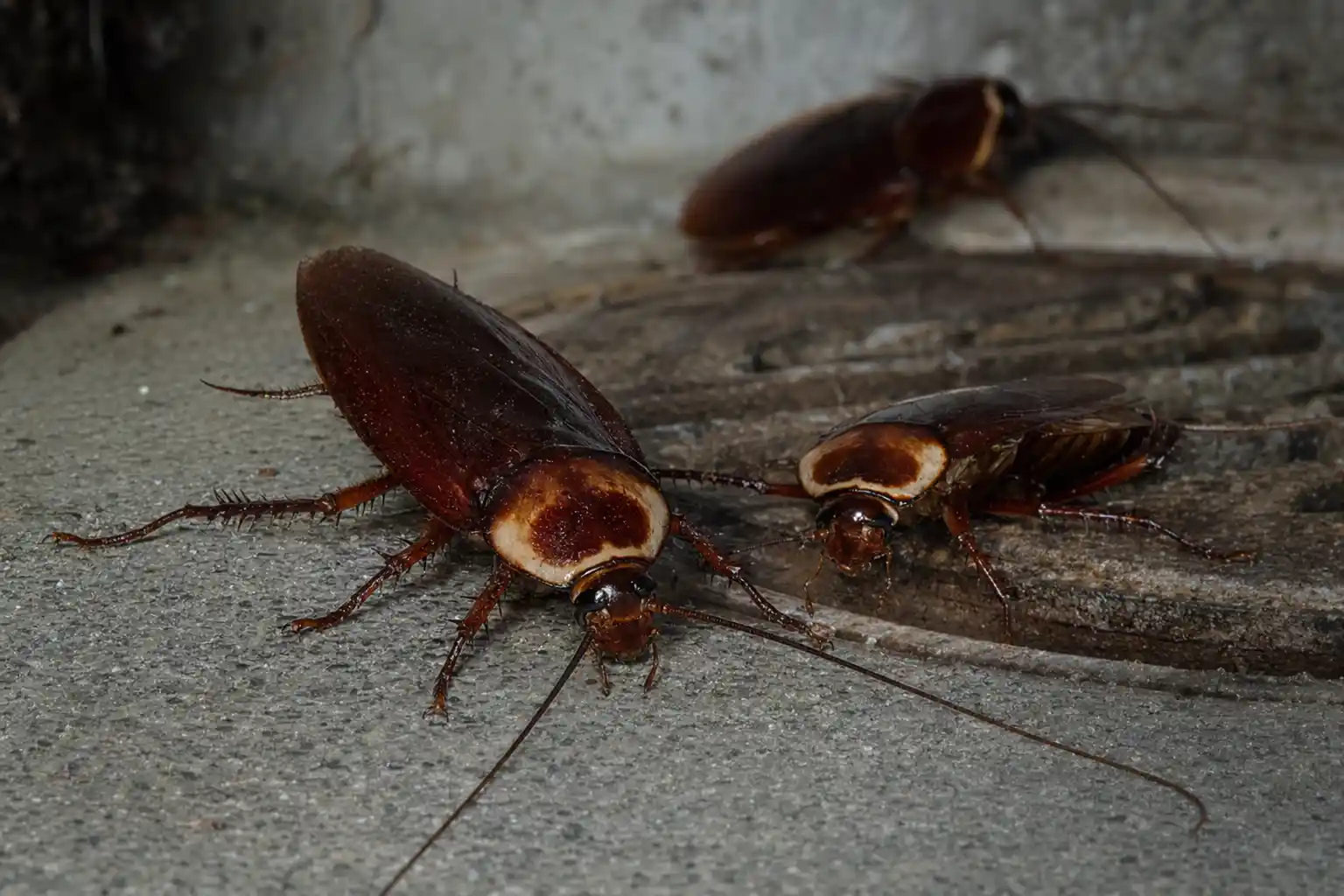
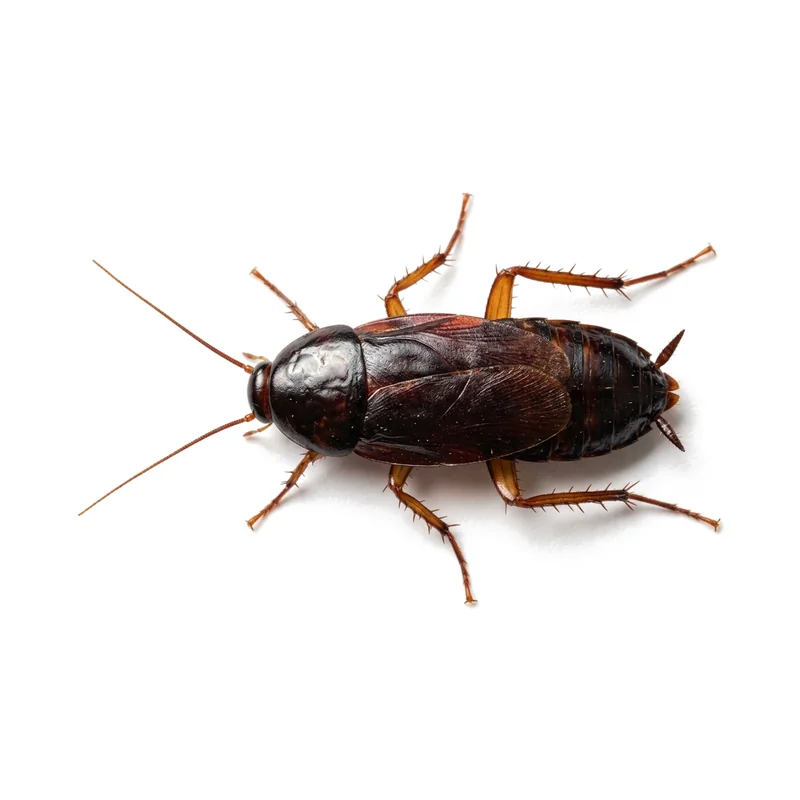
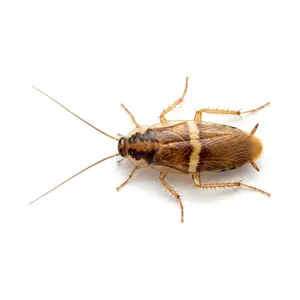
American cockroach adult on garage floor in McKinney Texas home
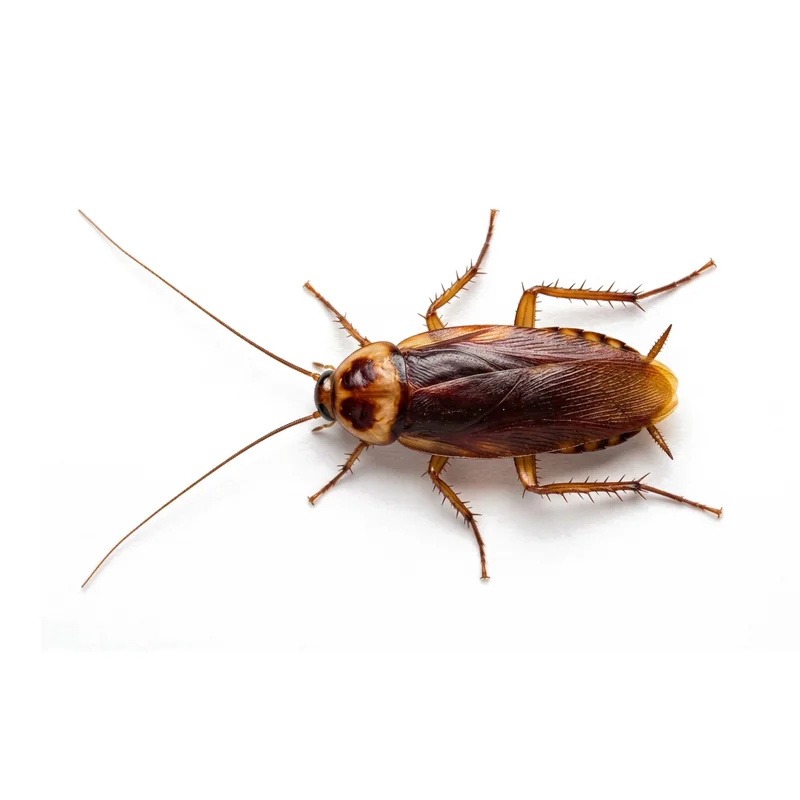
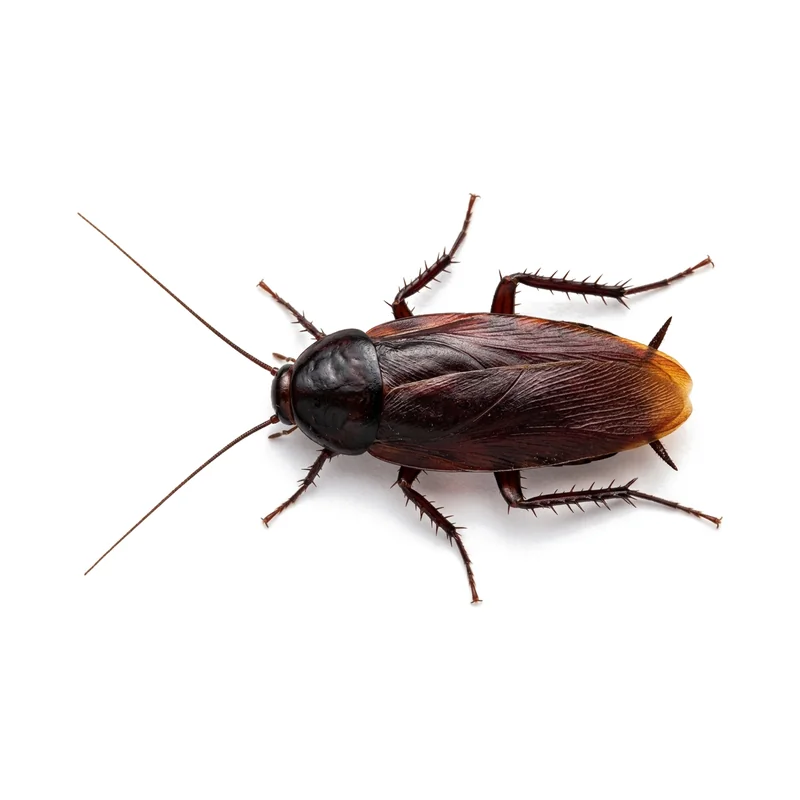
American cockroach specimen showing reddish-brown body and yellow pronotal halo
American Cockroach
Periplaneta americana
AKA Palmetto Bug · Water Bug · Sewer Roach
Adult body length35 to 50 mm (1.5 to 2 in)
ColorReddish-brown with a yellow halo outlining the shield behind the head
Eggs per case14 to 16
Egg cases per female10 to 15 over lifetime
Development time470 to 600 days (nymph to adult)
Adult lifespanApproximately 1 year
Peak seasonJuly through October
Primary habitatMunicipal sewer system, storm drains, mulch beds, exterior foundation perimeter

The largest cockroach species in the Collin County service area and the dominant cockroach in the DFW sewer system. Primarily outdoor; enters structures through floor drains and foundation gaps during heat and rain pressure rather than establishing permanent indoor colonies.

PEST ME OFF | PEST LIBRARY | AMERICAN COCKROACH pestmeoff.com
North Texas Pest Calendar
American Cockroach Activity in Collin County by Month

Outdoor populations pressure structures hardest from late summer through fall when heat and drought push them indoors toward cooler, conditioned spaces. Winter reduces but does not eliminate activity; the DFW sewer system stays warm year-round and continues producing pressure on drain entry points.

Jan
Low
Feb
Low
Mar
Emerging
Apr
Emerging
May
Active
Jun
Active
Jul
Active
Aug
Peak
Sep
Peak
Oct
Peak
Nov
Slowing
Dec
Low
Dormant / Low
Emerging
Active
Peak
Slowing

Confidence CONFIRMED. Pattern from Pest Me Off service call records across Collin County 2023 to 2026 cross-referenced with American cockroach seasonal biology documentation for the North Texas climate zone.

Identification

What American Cockroaches Look Like

Large, reddish-brown, yellow halo behind the head

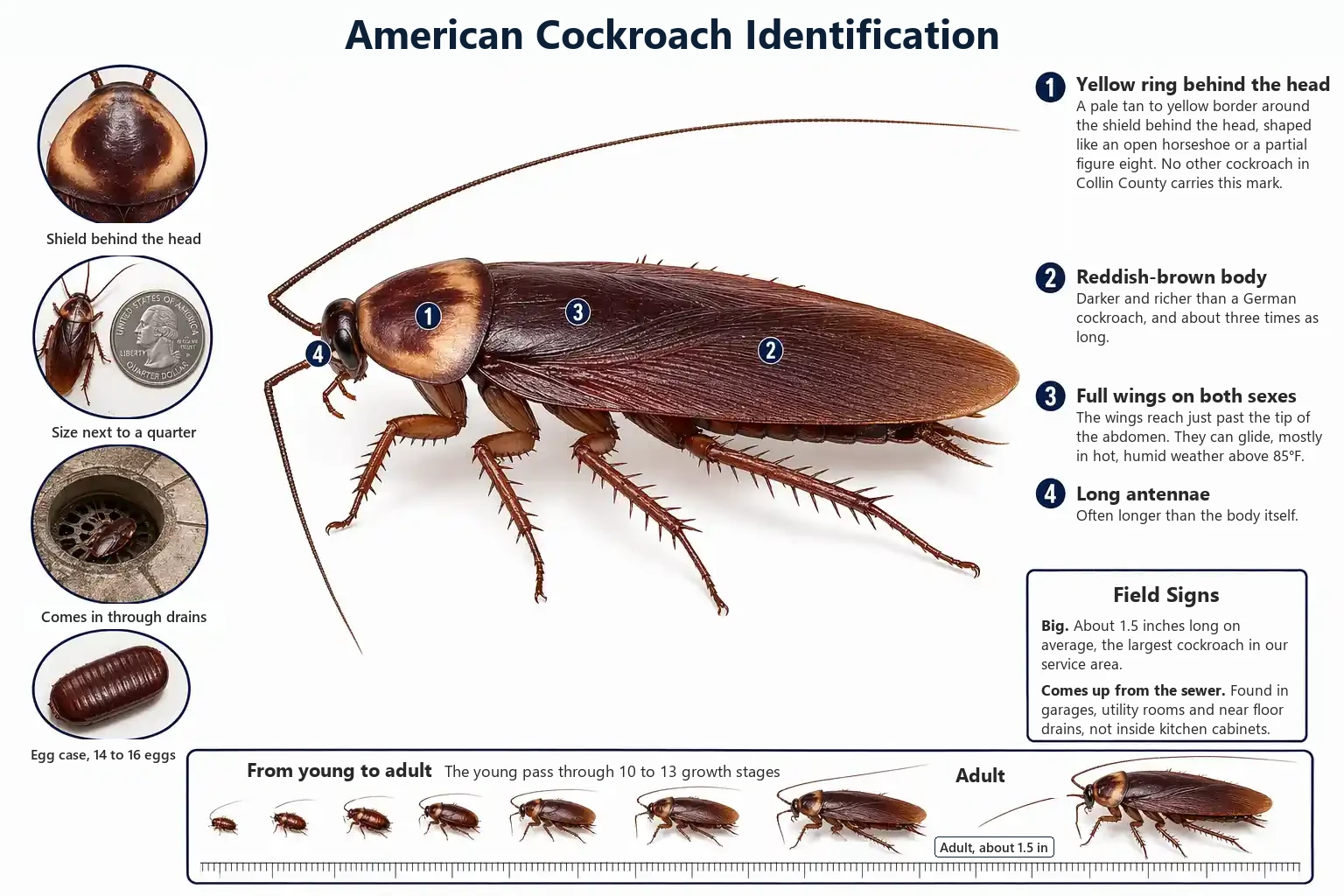
American cockroach adults run 35 to 50 mm long (1.5 to 2 inches). The body color is reddish-brown, noticeably darker and richer than German cockroach. The single fastest visual confirmation is the yellow halo: a pale tan to yellow border outlining the pronotum behind the head, forming an open horseshoe or partial figure-eight shape. No other cockroach species in Collin County carries that marking. If you are looking at a large reddish roach with a pale yellowish marking behind its head, the ID is settled. American cockroach species documentation includes close-up reference photos at multiple life stages for cross-confirmation.

Both males and females have fully developed wings that extend slightly past the tip of the abdomen. Both sexes can fly, though flight is erratic and more common in hot, humid weather above 85°F. Nymphs are wingless, grayish-brown, and pass through 10 to 13 growth stages before reaching adulthood. The most common first-sighting error is assuming a large roach in the garage must be German cockroach; size alone rules that out immediately. American cockroach is roughly three times the length of a German cockroach.

American cockroach identification diagram showing yellow pronotal halo, wing structure, and size comparison

American cockroach identification: yellow pronotal halo, reddish-brown wings, long antennae

Dead GiveawaysFastest visual cues, no microscope required
  • Reddish-brown body, 1.5 to 2 inches long: the biggest cockroach in our service area by a wide margin
  • Yellow halo or partial figure-eight pattern outlining the pronotum behind the head
  • Both wings fully developed, extending slightly past the abdomen on both sexes
  • Can fly; more likely to glide than sustained flight, especially in warm weather above 85°F
  • Long antennae, often longer than the body itself
  • Found in garages, utility rooms, near floor drains, or emerging from sewer access points, not in kitchen cabinets
The Name

Why It Has Three Names: Palmetto Bug, Water Bug, Sewer Roach

All three names describe real characteristics of the same insect. Palmetto bug is most common in the southeastern United States, where this species shelters in palmetto palm fronds and is found outdoors year-round. Water bug stuck because it favors moist environments and enters homes through drain systems. Sewer roach is the most technically accurate nickname for North Texas specifically: in Collin County, the municipal sewer system is the primary outdoor population center these roaches come from when they push into residential structures during late summer pressure.

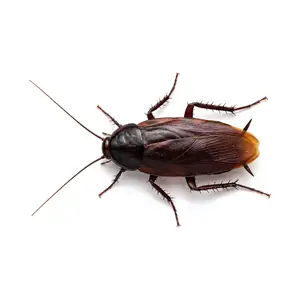
None of the three names changes what the pest is or how to treat it. When a homeowner calls about a “water bug,” we ask about the color first. Reddish-brown with a yellow marking behind the head is American cockroach. Dark brown to black with no yellow markings is Oriental cockroach, which also goes by water bug. The species determination changes the treatment plan entirely.

Confusion Matrix

American Cockroach vs. Similar Species

Large cockroaches trigger more alarm calls than small ones, and more misidentifications. The species below are the ones most often confused with American cockroach in Collin County service calls.

Species Size & Color Key Feature Where You Find It
American Cockroach
American Cockroach AKA: Palmetto Bug, Water Bug, Sewer Roach Periplaneta americana This species
35 to 50 mm (1.5 to 2 inches), the largest cockroach in our service area. Reddish-brown body with a yellow halo outlining the pronotum behind the head. Adults look dramatic enough that homeowners who have never seen one often mistake it for a flying beetle or a giant water bug. Capable of gliding flight in warm weather, which sets it apart from every other cockroach species on this table. Both sexes have fully developed wings. The yellow pronotal halo is the fastest visual confirmation of the species. Garages, utility rooms, floor drains, plumbing voids, and the slab perimeter. Outdoor in mulch beds and around the foundation through the warm months. Comes inside through floor drains and expansion joint gaps, especially after heavy rain and during extreme summer heat.
German Cockroach
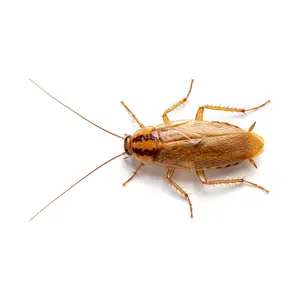
German Cockroach AKA: Croton Bug, Kitchen Cockroach Blattella germanica
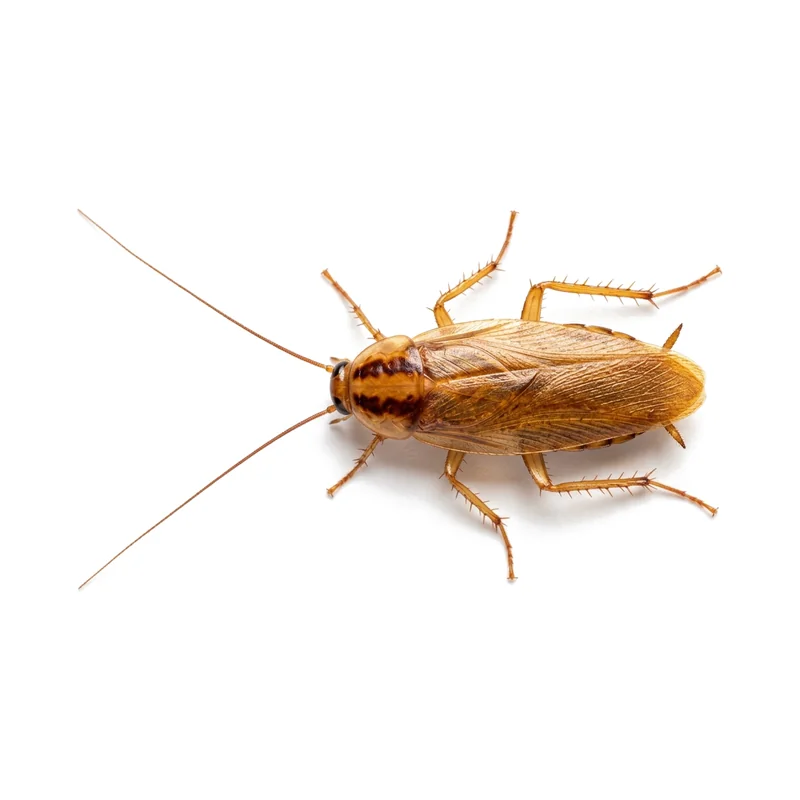
12 to 15 mm (about half an inch), roughly one-third the size of an American cockroach. Light brown to tan with a darker rear section. The size difference alone is usually enough to rule it out immediately when a homeowner describes a large roach. Two dark parallel stripes running lengthwise on the pronotum. Lives exclusively indoors in heated structures; never found outdoors in Collin County. If you found the roach in a kitchen cabinet or behind an appliance, this is far more likely than American cockroach. Kitchens and bathrooms, behind refrigerators and dishwashers, under sinks, inside cabinet hinge pockets. Active year-round indoors. Finding one in a garage or near a drain points strongly away from this species.
Oriental Cockroach
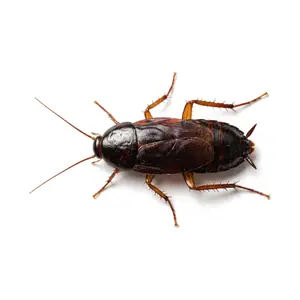
Oriental Cockroach AKA: Black Beetle, Water Bug, Shiny Black Roach Blatta orientalis
22 to 27 mm (about 1 inch), roughly half the size of a large American cockroach. Dark brown to shiny black all over, often described as greasy-looking. Both species share “water bug” as a nickname, which causes persistent homeowner confusion in Collin County calls. Neither sex can fly, which is the clearest behavioral differentiator from American cockroach. The uniformly dark, almost beetle-like color with no yellow markings rules out American cockroach immediately. Gives off a strong musty odor distinctly different from American cockroach. Garage floors, utility rooms, slab edge, floor drains. Prefers cooler and damper areas than American cockroach. In Collin County, most common in newer construction in Celina and Prosper where utility pipe gaps remain unsealed.
Smoky Brown Cockroach
Smoky Brown Cockroach AKA: Tree Roach, Tree Cockroach, Flying Cockroach Periplaneta fuliginosa
25 to 40 mm, similar size range to American cockroach but uniformly dark mahogany brown with no yellow pronotal halo. The color difference is the fastest field separator: if the roach has no yellow markings behind the head, it is not American cockroach. Enters homes from the roofline through attic vents and soffit gaps, not from the sewer system below. Strongly attracted to exterior lighting at night. In Collin County, documented in southern areas (Plano, Allen, south McKinney) where mature tree canopy provides outdoor habitat close to structures. Attic spaces, around exterior lighting, on porches and near entry doors after dark, near mature trees and mulched foundation beds. Enters high rather than low, which is the clearest behavioral separator from American cockroach.
Why American Cockroaches Score 2 of 3 on People Risk

Health Considerations

American cockroaches travel through sewer systems and decaying organic matter before entering your home. That travel history means they can carry bacteria onto food prep surfaces and utensils. The health concern is real, though it is lower in intensity than German cockroach, which lives at higher indoor densities and produces allergens in greater concentrations.

People Risk
2/ 3
Moderate
Health Context

What American Cockroaches Carry From Outside

American cockroaches live in municipal sewer systems, storm drains, and decaying organic matter in the outdoor environment. When they enter your home through floor drains or foundation gaps, they are walking directly from those environments onto your garage floor, kitchen counter, or any surface they cross. Studies on cockroach-associated pathogens and allergens document their capacity to mechanically transport bacteria including Salmonella, Staphylococcus, and enteric organisms picked up from sewage environments. The primary concern in Collin County is the contamination window during the seasonal entry period from late summer through fall, when outdoor populations push indoors most aggressively.

The documented American cockroach allergen proteins are triggers for sensitized individuals. Sensitization rates are lower than for German cockroach populations that live at sustained high indoor densities. For most Collin County households with a seasonal or occasional American cockroach problem, the allergen concern is secondary to the contamination risk from their sewer-environment origin.

Food Safety
When to Discard Food After a Sighting

American cockroaches travel directly from sewer and drain environments onto any surface they cross. If you see one on a kitchen counter, cutting board, or inside a pantry cabinet, discard any open or loosely sealed food items that were in the same space. Sealed containers are generally safe; anything in paper, open bags, or soft packaging should be treated as potentially contaminated. This applies especially to pet food stored in open bowls or loosely sealed bags, which attract American cockroaches more reliably than any other food source in Collin County homes.

Why American Cockroaches Score 2 of 3 on Property Risk

Property and Home Impact

American cockroaches do not establish indoor colonies the way German cockroaches do, which limits their direct property damage. The ongoing cost is more operational: contaminated pantry items, persistent entry from outdoor populations that regenerate from the municipal sewer system, and the sustained re-service pressure when entry points are not addressed alongside treatment.

Property Risk
2/ 3
Moderate
Where They Live

Outdoor-First: Where American Cockroaches Actually Come From

The American cockroach is primarily an outdoor pest that enters homes opportunistically rather than living and breeding inside. The North Texas municipal sewer system is the most significant population reservoir. From the sewer main, cockroaches move upward through drain pipes when P-traps dry out from infrequent use. Floor drains in garages, utility rooms, and mechanical rooms are the most vulnerable because those drains often go months without water flow, letting the trap evaporate. Plano and Carrollton homes near older storm drain networks see higher call volume as a result. American cockroach biology and management research documents the species’ strong dependence on high humidity, which explains why the sewer system functions as a year-round reservoir even through North Texas winters, and why call volume never fully drops to zero in our service area. Field observations for American cockroach in Texas confirm year-round sightings across the Dallas-Fort Worth region.

In the outdoor zone, they concentrate in the same moisture-rich environments that border the foundation perimeter: mulch beds, leaf litter accumulation, wood piles against the house, dense foundation plantings, and in North Texas, exterior sewer cleanout caps (the white PVC caps in the yard) that are loose or cracked. They are nocturnal and primarily ground-level, which is why the first sign is usually one or two individuals discovered at night in the garage or utility room rather than a trail of activity during the day.

Local Pressure

Where American Cockroach Pressure Is Highest in Collin County

Plano and Carrollton have the highest consistent American cockroach call volume in the service area, driven by older storm drain infrastructure with more access points near residential foundations. Allen and McKinney see significant summer pressure in garages and utility rooms, with seasonal peaks corresponding to August and September heat driving sewer populations upward. Craig Ranch and Stonebridge Ranch in McKinney both see outdoor American cockroach pressure from large populations in the surrounding landscape and mulch beds during the warm months. The American cockroach’s documented range and habitat confirms it as the dominant large cockroach species across all of North Texas, which is consistent with the call volume pattern we see across the 14 cities in our service area.

Newer construction in Celina, Prosper, and Anna has a different but related problem: gaps around utility pipes at the slab penetration points that were not sealed during construction. These are less common as an American cockroach entry route compared to drain systems, but they provide direct low-resistance access to the interior and are often present for one to two years after construction before a homeowner notices.

Why American Cockroaches Score 2 of 3 on Persistence

How Persistent Are They?

American cockroaches are persistent not because of rapid indoor breeding, but because their source population is the municipal sewer system, which no single residential treatment can eliminate. Treat the visible individuals and more push in through the same drain. Until the entry pathway is addressed, the source keeps producing pressure.

Persistence
2/ 3
Moderate
Biology

Why They Keep Coming Back After Treatment

Egg Cases per Female 10 to 15 over a lifetime Each case holds 14 to 16 eggs. She carries it briefly, then glues it near food and moisture outdoors. Unlike German cockroach, indoor breeding is rarely the main driver of re-infestation. The outdoor sewer and mulch-bed population is the engine, and it keeps running regardless of what happens inside the house.
Nymph Development Time 470 to 600 days through 10 to 13 growth stages The lifecycle is much longer than German cockroach, which means the indoor population does not rebuild at the same exponential rate. The re-infestation pattern is a steady flow from outside, not an indoor population explosion.
Winter Activity in North Texas Reduced but not eliminated in DFW sewer systems Warm North Texas winters mean the sewer population does not experience a significant cold-season die-off the way it would in northern states. Call volume drops in winter but does not reach zero. This is an entry-point management problem year-round, not a seasonal one.
Primary Pressure Source Municipal sewer system and outdoor mulch beds No single residential treatment can eliminate the municipal sewer source population. Treating the visible individuals inside without sealing the entry point and treating the perimeter produces results that last exactly as long as the perimeter product stays active, then the same entry point produces the same call.
Key Entry Routes in Collin County Slab Construction Floor drains (P-trap evaporation), expansion joints, utility pipe gaps Slab-on-grade construction throughout Collin County puts the foundation perimeter at grade level with no crawl space buffer. Every unsealed pipe penetration through the slab and every floor drain with an evaporated P-trap is a direct path from the outdoor population to the interior.
Flight and Entry from Above Both sexes can fly; warm weather above 85°F triggers flight behavior During peak summer heat in Collin County, American cockroaches are more likely to enter through upper-level gaps, garage door thresholds, and exterior doors left open briefly. The combination of flight capability and sewer pressure makes August through October the highest-volume call period across the service area.

The key insight for American cockroach persistence is this: unlike German cockroach where indoor breeding rate is the core problem, American cockroach persistence is almost entirely an entry-point management problem. Seal the drain, treat the perimeter, and the re-infestation rate drops sharply. Leave either untreated and the call comes back on the same schedule every summer.

Why American Cockroaches Score 2 of 3 on Difficulty to Treat

Treating American Cockroaches

American cockroach is a moderate-difficulty pest compared to German cockroach. Treating indoors without addressing the outdoor source and entry points produces short-term results followed by reinvasion on the same timeline as the next weather event that drives outdoor populations inside. Interior and exterior work are both required on the same service call.

Difficulty to Treat
2/ 3
Moderate
Treatment COCKROACH CRACKDOWN

How Pest Me Off Treats American Cockroach Infestations

American cockroach treatment is a 4-step protocol that addresses the outdoor source and indoor entry pathway at the same time. Treating only where you see them does not solve the problem. The population outside the structure is the engine; this protocol shuts it down at the point of entry.

Step 1

Inspect & Map Entry Points

Confirm species and walk the full entry-point inventory: all floor drains (garage, utility room, laundry), sewer cleanout cap condition in the yard, gaps around main water line entry, gas line penetration, electrical conduit into garage, and door thresholds. Document which drains show P-trap dryout risk.

Why this step: American cockroach treatment without entry-point identification is treating symptoms. The roaches you see inside are scouts from an outdoor population. Every open drain and unsealed gap is a door they use again the moment the exterior treatment fades.
Step 2

Exterior Perimeter Barrier

Apply detailed bait around the full foundation perimeter and into mulch beds within 10 feet of the structure. Follow with a non-repellent residual spray (the kind cockroaches walk right through and carry back to the population) at the foundation band, weep holes, and around all utility entry points. Address sewer cleanout cap condition.

Why this step: The outdoor population needs to be reduced at the foundation perimeter before individuals can reach the entry points. Non-repellent products do not scatter the population the way repellent products do; cockroaches walk through the treatment zone and carry it back to their population in the mulch and sewer.
Step 3

Drain and Interior Management

Treat floor drains and sink drains with drain treatment product. Install screened drain covers on any floor drain in a rarely-used room. Apply a larger-format gel bait along interior baseboards in garage and utility zones. Treat interior cracks at the slab edge where it meets the wall.

Why this step: The drain is the primary entry route from the sewer system. Treating the perimeter without addressing the drain leaves the main door open. Drain treatment and screened covers work together: the product kills what is in the pipe, the cover stops movement while the product is working.
Step 4

Follow-Up at 30 Days

30-day reinspection to evaluate reinvasion rate from the sewer system. Reapply exterior detailed bait if seasonal pressure is still elevated. Confirm drain management is holding. During peak season (August through October), exterior barrier reapplication may be needed at 60 days.

Why this step: The municipal sewer population keeps producing pressure on the drain entry points regardless of what we did on the perimeter. The 30-day check catches any population that found a new path before it becomes the next service call you did not expect.
Pest Me Off
Map every entry point before any product goes down. Exterior detailed bait reduces the outdoor population at the foundation. Barrier treatment that cockroaches walk through without detecting carries the product back to the outdoor population. Drain management addresses the sewer pathway directly. 30-day reinspection confirms the entry routes are closed. Re-entry drops sharply because the source is cut off at the point of access.
Store Products
& Other Companies
Spray the ones you see and leave. The exterior population was never addressed, the drain is still open, and the P-trap in the rarely-used floor drain is still evaporated. Two weeks later, the next wave comes in through the same drain, the homeowner thinks the treatment failed, and they spray again. The cycle repeats every time it rains hard or temperatures spike. The source was never touched.
Do It Yourself
American Cockroach: What You Can Do and Where DIY Falls Short
Entry-point prevention steps that work, and the two DIY approaches that keep homeowners on a call-every-summer cycle
DIY Prevention

What Homeowners Can Do Before and Between Treatments

American cockroach prevention is primarily entry-point management and exterior moisture control. Most of the effective steps cost nothing and reduce pressure significantly between professional service visits.

1
Pour water down every floor drain monthly. P-traps work only when they have water in them. The trap evaporates over several weeks in any drain that sees infrequent use. A floor drain in a utility room you visit twice a month is often completely dry. One cup of water per drain per month keeps the seal intact and blocks the sewer pathway.
2
Check your sewer cleanout caps. The white PVC caps in your yard connect directly to the main sewer line. If a cap is cracked, tilted, or seated improperly, it is an open door at ground level. Walk your yard and press on each cap to confirm it is sealed tight. A loose cap is the highest-risk ground-level entry point for American cockroach that most homeowners never inspect.
3
Reduce foundation moisture. Clear clogged gutters so downspouts direct water away from the slab. Fix leaking exterior hose bibs. Confirm irrigation heads do not saturate the foundation perimeter. Replace thick organic mulch (3 or more inches deep) within 12 inches of the foundation with river rock or stone. Sustained soil moisture against the slab is the primary exterior condition that concentrates American cockroach populations near your entry points.
4
Seal utility penetrations. Walk the exterior of your garage wall and look at every pipe, conduit, and wire that enters the structure. Gaps around those penetrations are common in Texas construction and most have never been sealed. A tube of foam sealant or weatherstripping applied to a gap you can see through eliminates an entry point that might be behind a call you get every summer.
DIY Pitfalls

Why DIY Can Fail for American Cockroaches

American cockroach is more approachable than German cockroach for DIY treatment because it does not have the same resistance and indoor breeding complexity. But the two most common DIY approaches fail in predictable ways that keep homeowners on a call-every-summer cycle.

Fails

Interior-Only Spray Treatment

The cockroaches you see inside your garage or utility room are arrivals from an outdoor population, not residents that bred inside your house. Spraying them eliminates the individuals you found, but the outdoor sewer and mulch-bed population sends more through the same drain the following week. Interior-only treatment is addressing the symptom. The outdoor population is the actual problem, and it is never touched by a spray inside the garage.

Fails

Repellent Sprays at the Foundation

Most hardware-store spray concentrates intended for outdoor perimeter use are repellent-based. These create a barrier that cockroaches detect and walk around, routing them toward unsprayed gaps rather than through the treated zone. In practice, repellent perimeter sprays often move American cockroaches from the treated side of the foundation to a different entry point on the untreated side. Professional exterior treatment uses products that cockroaches walk through without detecting and carry back to the outdoor population, which is the reason the professional approach works where store products do not.

Fails

Ignoring the Drain

The floor drain in a utility room or garage is the single most common entry point for American cockroaches in Collin County slab construction. It connects directly to the municipal sewer through a P-trap that only works when it contains water. Homeowners who treat the perimeter, treat indoors, and still see cockroaches almost always have a dry floor drain they did not know about. Screened drain covers and monthly water pours into infrequently used drains eliminate the entry point that makes every other treatment effort temporary.

Fails

Single Treatment Without a Follow-Up

The municipal sewer system keeps producing American cockroach pressure on drain entry points regardless of what was applied at the perimeter. A single exterior treatment reduces population numbers at the foundation, but the sewer source is not eliminated. As the product breaks down over four to six weeks (faster in Texas summer heat), reinvasion pressure climbs back toward baseline. American cockroach control requires a 30-day reinspection to catch any rebound before it becomes the next service call. One application without a follow-up is an incomplete treatment for this species.

Fails

Missing the Sewer Cleanout Cap

The white PVC sewer cleanout caps in the yard connect directly to the main sewer line at or near ground level. A cracked, tilted, or improperly seated cap is an open tube from the sewer to the soil around the foundation. Most homeowners never inspect these caps, and many have been loose or cracked for years. A thorough American cockroach treatment that does not check the sewer cleanout caps leaves the highest-risk ground-level entry point untouched. This is one of the most common reasons a professionally treated home still sees American cockroaches within two weeks of service.

Common Questions

American Cockroach FAQ

All three names refer to the same insect: Periplaneta americana, the American cockroach. Palmetto bug originated in the southeastern United States where this species shelters in palmetto palm fronds. Water bug stuck because it favors moist, wet environments and enters through drain systems. Sewer roach is the most geographically accurate nickname for North Texas, where the DFW municipal sewer system is the primary outdoor population center. The softer-sounding names do not change what the pest is or how to treat it.
American cockroaches have fully developed wings and are capable of short gliding flight, though sustained flight is uncommon. Flight is most likely to occur in warm, humid weather when temperatures are above 85°F. In North Texas, this corresponds to July through September, which is also peak season for entry into structures. Most flight is erratic and away from people rather than toward them, but the capability is real. Seeing a large cockroach fly in your garage on a hot August night in McKinney is almost certainly this species.
A single American cockroach in the kitchen is almost always a scouting individual that entered from the sewer or exterior, not evidence of an established indoor population. American cockroaches live primarily outdoors and enter homes opportunistically, unlike German cockroaches which live and breed inside your walls. One individual in the kitchen does not confirm a kitchen infestation the way it would with German cockroaches. It does mean there is an open entry pathway somewhere between the exterior and your kitchen, and that pathway should be identified and addressed before more scouts use the same route.
Two seasonal drivers push American cockroaches into structures every summer in Collin County. First: extreme heat and drought reduce outdoor moisture, and the sewer system below the slab becomes comparatively cooler and more humid than the surrounding soil. Cockroaches follow the moisture gradient upward through drain lines into conditioned structures. Second: August and September are the months when seasonal outdoor population density is highest after a full warm-season breeding cycle, so the number of individuals pushing toward the foundation perimeter is at its annual peak. Both factors resolve on their own when temperatures drop in October, but the same cycle repeats next year unless entry points are addressed.
No. American cockroach entry has nothing to do with kitchen cleanliness or housekeeping standards. They enter from the municipal sewer system and from outdoor populations in your mulch beds and foundation perimeter. A spotless house with a dry floor drain and a gap around the water pipe entry is equally attractive to an American cockroach as a house with food on the counter. Sanitation does not reduce American cockroach pressure in the way it does for German cockroaches. Entry-point management and exterior population reduction are the effective interventions.
Fundamentally different approaches. German cockroach treatment is bait-focused and targets an indoor breeding population concentrated in kitchen appliances and cabinet hinges. The work happens inside the structure, primarily in the kitchen. American cockroach treatment is perimeter-focused and targets the outdoor population and its entry pathways. The work happens at the foundation perimeter, at the drains, and at the slab entry points. Using a German cockroach protocol (gel bait in kitchen cabinets) on an American cockroach problem accomplishes nothing. Using an American cockroach protocol (exterior perimeter spray) on a German cockroach problem spreads the indoor colony without eliminating it. Species identification before treatment is the first step for exactly this reason.
P-traps work by holding a water seal that blocks air (and anything in the air, including cockroaches) from moving upward through the drain pipe. When a drain goes unused for several weeks, the water in the trap evaporates. In a dry North Texas summer, a garage floor drain that nobody uses loses its water seal in two to four weeks. Once the trap is dry, the drain pipe is essentially an open tube from the municipal sewer to your garage floor. Pouring one cup of water into every rarely-used floor drain monthly restores the seal and is the single most effective and inexpensive prevention step available.
Different kind of difficult. German cockroaches are harder because of their rapid indoor breeding rate, resistance to common products, and the complexity of reaching their hiding spots. American cockroaches are harder in a different way: their source is the municipal sewer system, which regenerates pressure indefinitely. You can eliminate every American cockroach in and around your house and have new ones arrive through the same floor drain the following week. German cockroach elimination is a war against an indoor colony. American cockroach control is a perimeter and entry-point management problem. Both require professional treatment, but the strategies are completely different.
What's Bugging You?

The Sewer Roach That Comes Back Every August. Exterior Barrier, Drain Management, Entry Points Closed.

We confirm the species, map every drain and foundation entry point, apply a perimeter barrier that cockroaches walk through and carry back to the outdoor population, treat the drains, and come back at 30 days to confirm reinvasion pressure dropped. If you are on a call-every-summer cycle with these, the entry point was never addressed. Cockroach Crackdown across McKinney, Allen, Frisco, Plano, and all of Collin County.

12Stops Per Day
Other companies run 20+ stops a day. We cap at 12. That is the difference between treating the visible roaches and closing the actual entry point. Other companies do not leave time to walk floor drains, check sewer cleanout caps, identify the utility pipe gap, apply exterior detailed bait, treat the drains, and come back at 30 days. That is how the call-every-summer cycle ends.