
What to Know About Centipede Bites in Collin County
A centipede bite is the thing people worry about, and the centipede people find indoors in Collin County, the house centipede, wants nothing to do with you. It is hunting roaches and silverfish, not people, and its mouthparts are too weak to matter. One species is different. The Texas redheaded centipede delivers real venom and real pain, and knowing which centipede you found is the first step to knowing whether a bite is nothing or something to treat carefully.

- Only one of Collin County’s two centipedes can hurt you. The house centipede’s mouthparts are too weak to matter. The Texas redheaded centipede’s are not.
- Size tells them apart fast. The Texas redheaded centipede runs six to eight inches with a red or orange head. The house centipede is one to one and a half inches.
- A Texas redheaded centipede bite causes immediate, intense pain, similar to or worse than a wasp sting, with burning that can last four to six hours.
- House centipede bites almost never happen and barely register when they do. There is no reason to worry about the fast one on the bathroom wall.
- For a healthy adult, a Texas redheaded centipede bite is painful but not life-threatening. Clean it, ice it, and take an over-the-counter pain reliever.





Do Centipedes Bite People?
Yes, both of Collin County’s centipedes can bite, but whether it matters depends on which one, and the real dangers of a centipede bite are far narrower than the reputation suggests. Centipedes do not bite with their mouths. They deliver venom through forcipules, modified front legs that work like a pair of pincers just behind the head.
The house centipede has forcipules and can technically use them. The Texas redheaded centipede has them too, and its forcipules are large enough to break human skin reliably.
For people in McKinney who only meet them indoors, that means a house centipede bite is a non-event, if it happens at all. For anyone reaching into landscaping, stacking firewood, or working barefoot in the yard in Allen or Frisco, the Texas redheaded centipede is the one worth knowing on sight. Both species are most active on warm nights, which is when bites of either kind tend to occur, simply because that is when people and centipedes are both moving around outside.
The Two Centipedes Collin County Homeowners Meet
Which one bit you changes the whole answer, so start with identification. The big one goes by other names too, including the eastern red centipede and the giant redheaded centipede, and they all point at the same animal.
The house centipede (Scutigera coleoptrata) is the fast-moving one that turns up indoors, with a body one to one and a half inches long carrying long banded legs that extend well past it. It hunts roaches, silverfish, spiders, drain flies and other small insects inside the structure. It can technically bite if handled, but the mouthparts are weak and would barely register on an adult, which is why it earns a spot on the quick facts list above rather than the medical section below.
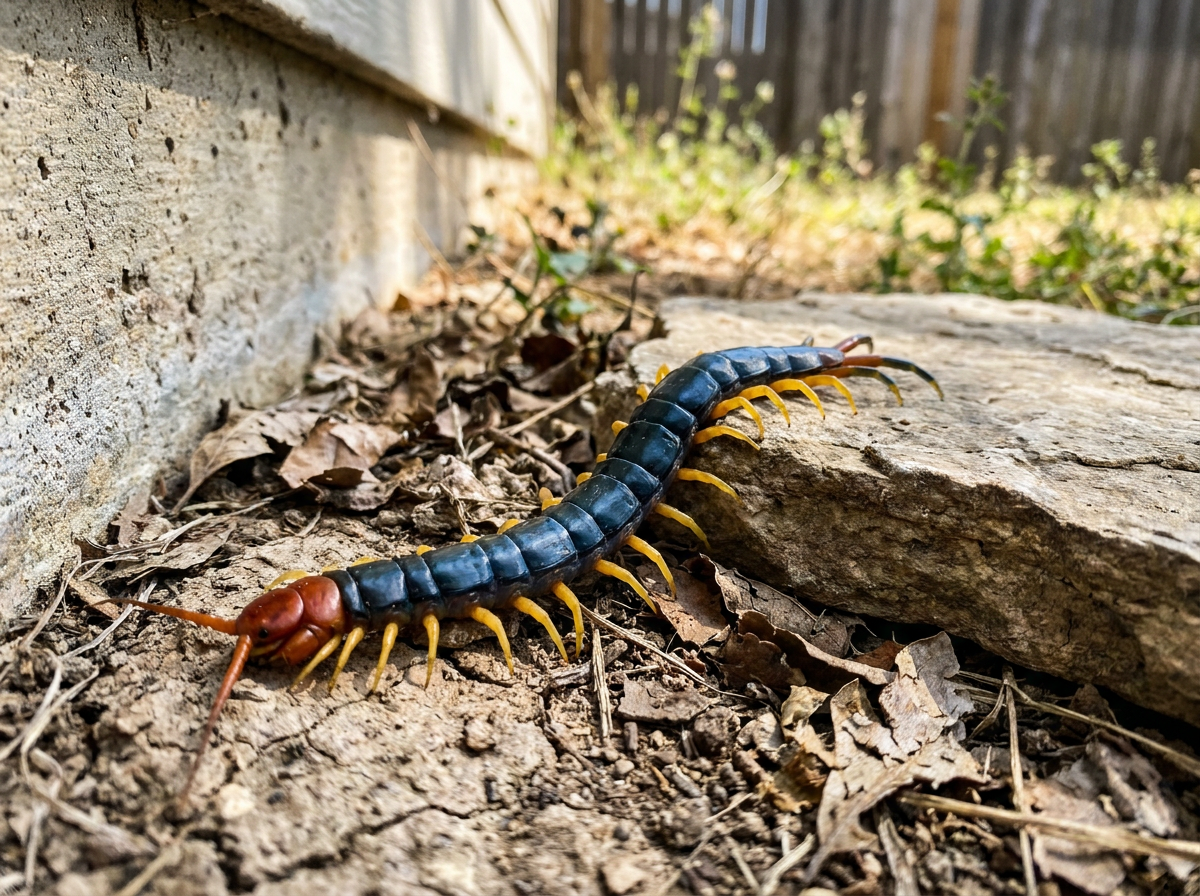
The Texas redheaded centipede (Scolopendra heros) is the large one, six to eight inches long, with a black body, a red or orange head, and yellow legs. It lives outdoors in landscaping, under rocks, in woodpiles and under decking across Plano and the rest of Collin County, and it rarely comes inside on its own. Some people search for it as the Texas centipede, the red headed centipede, or the giant redheaded centipede, and by the common names uhipan or gayaman used elsewhere. Whatever the name, the size and coloring above are how to tell if this is the one in front of you.
| Trait | House Centipede | Texas Redheaded Centipede |
|---|---|---|
| Body length | 1 to 1.5 inches | 6 to 8 inches |
| Color | Dirty yellow body with dark stripes | Black body, red or orange head, yellow legs |
| Where found | Indoors: bathrooms, drains, damp rooms | Outdoors: landscaping, woodpiles, under rocks |
| Bite | Weak, usually not even felt | Immediate, intense pain and swelling |
What Does a Centipede Bite Feel Like?
A house centipede bite, on the rare occasion it happens, feels like almost nothing. Some people never notice it at all. That is the honest answer to the small centipede bite question. There usually is not much to feel, and no lasting mark.
A Texas redheaded centipede bite is a different experience entirely. It produces immediate, intense pain at the site, often compared to or worse than a wasp sting. Redness and swelling develop quickly, and a burning sensation can persist for four to six hours. Some people also get a headache, nausea, or swelling of the nearby lymph nodes. Calling it a centipede sting is not quite right, since it is a bite from forcipules rather than a true stinger, but the pain reports back the same either way, and the symptoms above are what bite reports typically describe.
What Happens If a Centipede Bites You?
Almost every Texas redheaded centipede bite happens the same way: the centipede was threatened. Someone reaches under a landscaping stone, steps on one with bare feet, or picks up a piece of firewood where one is resting. They do not hunt people, and the risk is incidental contact, not pursuit.
That pattern holds across McKinney, Allen, Frisco and Plano alike, since it is about yard work and firewood, not location.
The University of California page on centipedes and millipedes puts it the same way. When provoked, some large centipedes can inflict a painful bite that may cause local swelling, discoloration and numbness.
Is a centipede bite dangerous? For a healthy adult, no, not in the sense of being life-threatening. It is painful, sometimes very painful, but a Texas redheaded centipede bite causing death is not something the record supports in Collin County or in Texas generally. The real danger is an allergic reaction to the venom, which is uncommon but serious when it happens, and it is covered in the section below.
When Should You Seek Medical Care After a Centipede Bite?
For a healthy adult, treat a Texas redheaded centipede bite like a bad sting. Clean the wound, apply ice, and take an over-the-counter pain reliever. The worst of the pain fades within the same day, though the burning sensation at the site can take four to six hours to ease.
Seek emergency care if you experience difficulty breathing, a rapid heart rate, hives, or swelling that spreads well beyond the bite site. Those are signs of an allergic reaction to the venom, not the bite itself, and they need attention faster than the bite does. A bite on a small child, or on anyone with a known venom allergy, is worth a call to a doctor regardless of how mild it looks at first.
How to Avoid a Centipede Bite
Since almost every bite happens on contact, avoiding one is mostly about where you put your hands and feet. Wear gloves when moving firewood, landscaping stone or stacked lumber, and shake out boots or gloves that have been sitting outside before putting a hand or foot in. Keep grass trimmed and stone or wood piles away from the house, since both give a Texas redheaded centipede somewhere to hide close to where people walk.
Indoors, the goal is different: fewer insects for a house centipede to hunt means fewer house centipedes to find. Reducing moisture in bathrooms, utility rooms and garages, and sealing gaps at ground level, addresses both the insects and the centipedes that follow them.
Will Pest Control Seal Centipede Entry Points?
Yes, sealing the entry points is part of our RID Method, along with treating the source and defending the home so pests do not return. The University of Kentucky says centipedes crawl in under doors and where pipes or wires enter, and advises sealing foundation cracks and fitting tight door sweeps.
Centipedes Indoors Are a Signal, Not the Problem
Both species are predators, and both follow their prey. House centipedes inside a McKinney or Allen home mean there are enough roaches, silverfish, drain flies, or other small insects to sustain them. The centipede is not the infestation. It is evidence of one.
A Texas redheaded centipede found inside is less common and more worth checking into. These are outdoor animals, so one indoors usually means it rode in on firewood or found a gap at ground level. Check the firewood stack and the exterior at slab level before assuming it is a one-off.
Both species want moisture and darkness, so damp utility rooms, garages and bathrooms with poor ventilation support the insects that feed the centipedes as much as the centipedes themselves. Fixing a slow drip or improving ventilation removes what supports both. If centipede activity stays consistent room after room, professional treatment aimed at the underlying insect population works better than chasing individual centipedes.
Centipede bites or centipede activity indoors? Same-day pest control in McKinney and the surrounding cities when you call before noon.
We find what is feeding them, treat the source, and help you keep them out long-term.