
Smoky Brown Cockroaches in Collin County, TX | Identification and Control
The smoky brown cockroach (Periplaneta fuliginosa), called the tree roach across Collin County, is the large dark mahogany roach that flies toward your porch light on summer nights. It lives in trees, mulch beds and gutters, and it comes in high, through attic vents and soffit gaps, not up through the drains. Texas A&M’s smoky brown cockroach guide describes that attic route and its need for moisture, and both shape how we treat it. Oklahoma State University Extension reports that an average of 20 young hatch from each smoky brown cockroach egg case.
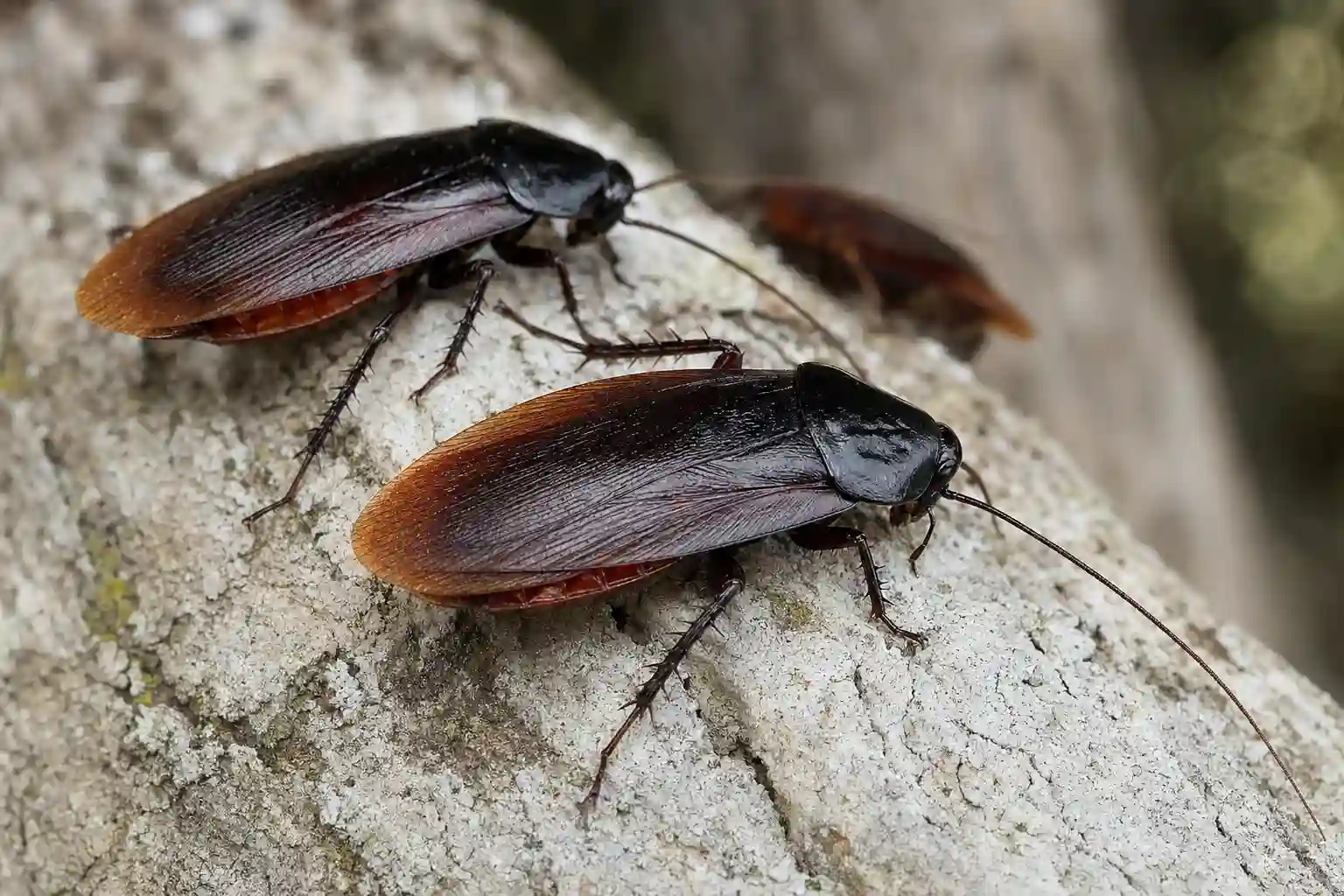
Found a big dark roach on your porch or in your attic in Collin County? Our office sits where McKinney, Plano, Frisco and Allen meet, 5 to 10 minutes from most homes in those four cities. Send us a photo or call, and we will tell you which cockroach it is.
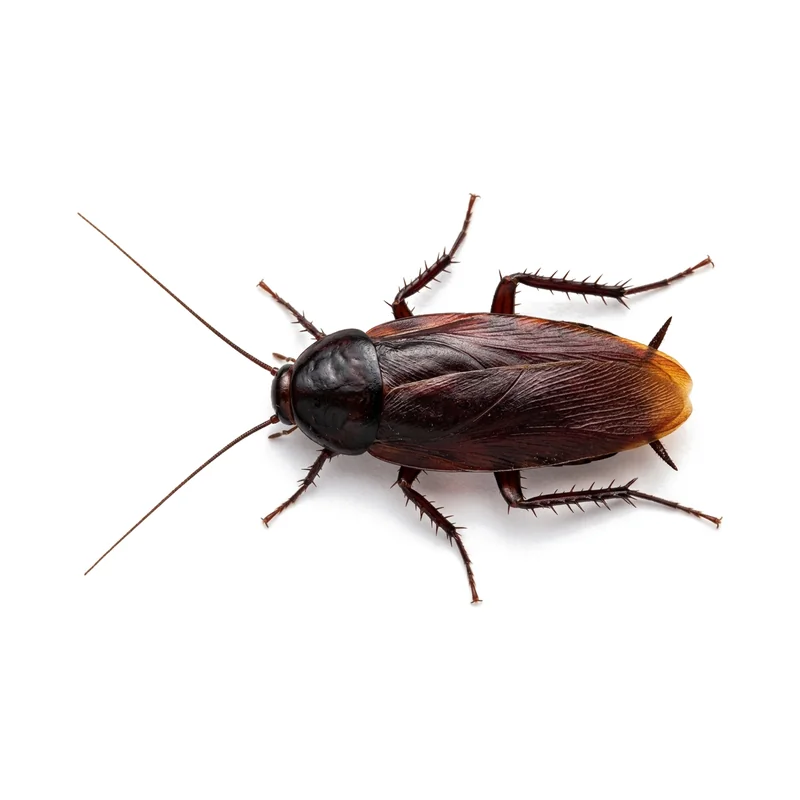
Smoky Brown Cockroach
Penn State Extension’s guide to common urban pests confirms the even, unmarked color as the feature that separates this species from every similar-sized cockroach in our service area.
Risk Assessment
Choose a row for the full detail- Color
- Even, shiny dark mahogany to dark brown with no light markings anywhere
- Wings
- Reach past the tip of the body in both sexes, and both fly readily
- Adult lifespan
- A few months
- Active season
- May through October in Collin County, peak in August and September
- Eggs
- 20 to 24 per egg case, several cases in a female’s life
- Egg to adult
- About 45 days to hatch, then most of a year or more to grow up
- Body length
- 1 1/4 to 1 1/2 in, the size of an American cockroach
What a Smoky Brown Cockroach Looks Like
Smoky brown cockroach adults are large, 1 1/4 to 1 1/2 inches long according to Texas A&M AgriLife Extension, the same size class as the American cockroach. What identifies them is what is missing. The American cockroach has a pale yellow border around the shield-like plate behind the head (the pronotum). The smoky brown has none, and its whole body is one even, shiny dark mahogany to dark brown.
Both males and females have wings that reach past the tip of the body, and both fly readily. The young look different. Texas A&M AgriLife Extension describes the younger ones as black, with white bands across the body and white-tipped antennae, and the older ones as an even reddish brown with no white. The last molt turns them into the dark winged adult. Finding both together leads many homeowners to think they have two species.
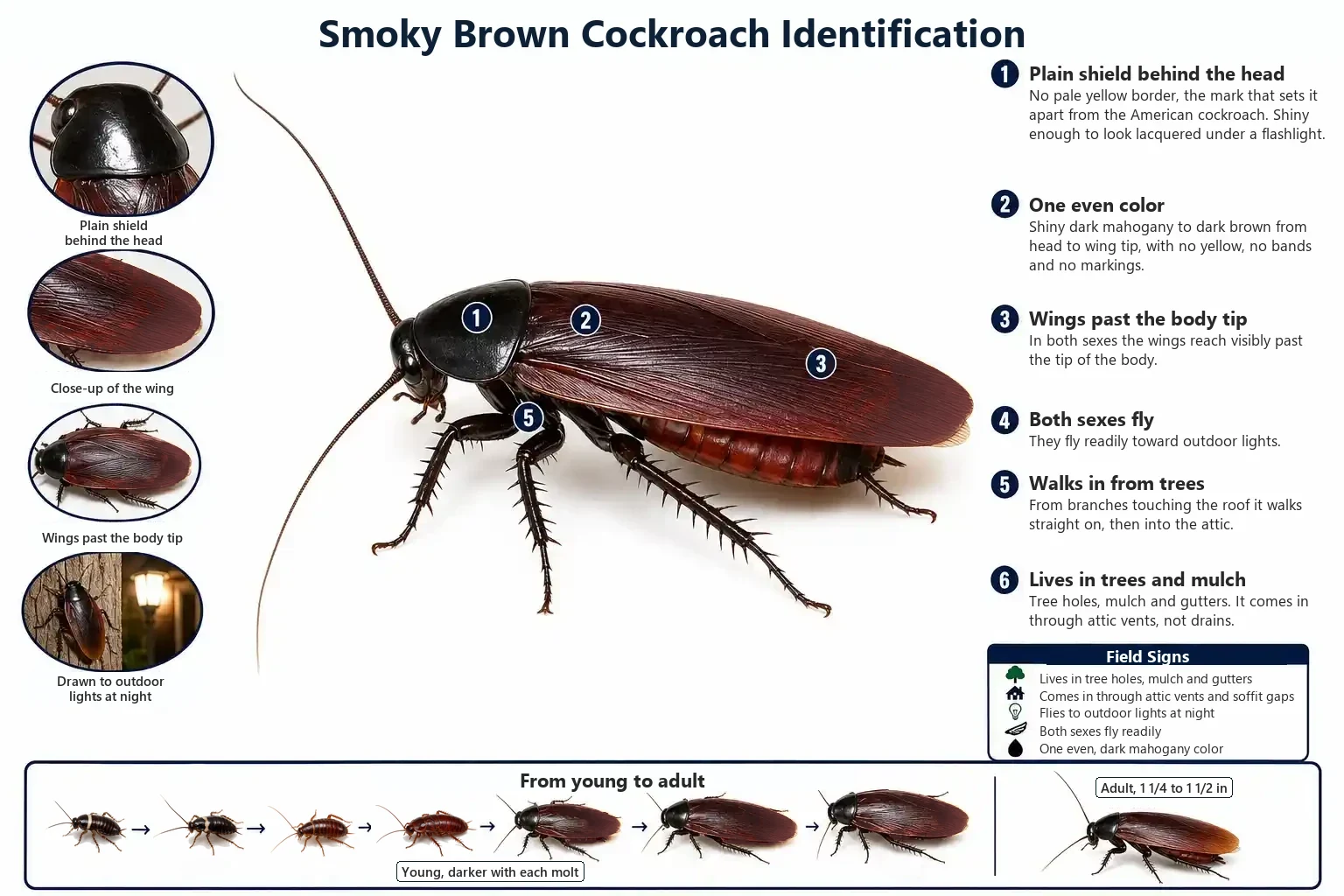
How to identify a smoky brown cockroach by its even mahogany color, wings past the body tip and the plain plate behind its head
- Even dark mahogany color with no light markings anywhere on the body
- No pale yellow border on the plate behind the head
- Wings reach visibly past the tip of the body in both sexes
- Flies toward porch and outdoor lights at night
- Found in the attic near ridge vents or soffit gaps, not at floor drains
- Young with white bands across the middle and white-tipped antennae, in mulch or the attic
Tree Roach and Other Names for the Smoky Brown Cockroach
A tree roach is a smoky brown cockroach. Most of its names describe a real habit. It nests in tree holes, especially in live oaks and pecans, it flies readily, and it settles in attics rather than kitchens. Every name in the table means the same insect, Periplaneta fuliginosa, so if you searched for any of them, this is your roach.
Where Are Smoky Brown Cockroaches Found?
Smoky brown cockroaches are found throughout the Dallas-Fort Worth area, Collin County included. iNaturalist field observations from Texas record the species across the Dallas-Fort Worth area in all 12 months of the year. It is quiet in winter rather than gone, sheltering in tree holes and attic spaces until the warm months.
| Name | What it means |
|---|---|
| Tree roach, or Texas tree roach | The most common name in Collin County, from its nests in tree holes, especially in live oaks and pecans. |
| Smokybrown or smokey brown roach | The same name written as one word, the way several extension guides spell it, or with an extra e. |
| Flying cockroach | It really flies, unlike the American and Oriental cockroaches, which rarely or never do. |
| Mahogany roach | Named for the even dark reddish-brown color of the whole body. |
| Attic roach | The attic is where it settles indoors, coming in through ridge vents and soffit gaps. |
| Porch roach | Named for where most people first see it, on a lit porch on a summer night. |
| クロゴキブリ (kuro gokiburi) | The Japanese name for this species, meaning black cockroach. It is also written 黒ゴキブリ. |
| Big dark brown roach | Not a name, but how most people describe it before they know one. One even dark color with no yellow mark behind the head is the identification. |
| Periplaneta fuliginosa | The scientific name. Every name above means this one species. |
How to Tell Smoky Brown Cockroaches from Other Collin County Cockroaches
Size alone does not identify a large cockroach. Color and flight settle it fastest, so the table compares the smoky brown cockroach with the three cockroaches it is most often confused with in Collin County.
| Species | Size | Key Feature | Where Found |
|---|---|---|---|
Smoky Brown Cockroach
AKA: Tree Roach, Flying Cockroach, Mahogany Roach
Periplaneta fuliginosa
This species
|
1 1/4 to 1 1/2 in. Even shiny dark mahogany to dark brown with no light markings, no bands and no yellow border anywhere. Shiny enough to look almost lacquered under a flashlight. | Wings reach past the tip of the body in both sexes, and it flies readily. Strongly drawn to outdoor lights at night. The plain plate behind the head separates it from every similar-sized cockroach here. | Outdoors in tree holes, thick mulch beds, gutters full of leaves, wood piles and debris near the foundation. Indoors in attic spaces next to ridge vents, gable vents and soffit gaps. Almost never settles in a kitchen or bathroom. |
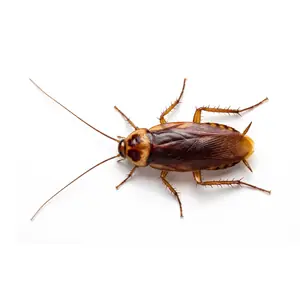
American Cockroach
AKA: Water Bug, Palmetto Bug, Sewer Roach
Periplaneta americana
|
35 to 50 mm (1.4 to 2 in). Reddish-brown, slightly larger on average than the smoky brown and clearly lighter in color. | A pale yellow to cream border around the plate behind the head, the single fastest separator. The male’s wings reach the body tip and the female’s fall short. A reluctant flier that does not seek out lights. | Sewers, storm drains and damp places below ground. Comes in at ground level through floor drains, water line gaps and foundation gaps, not through the attic. Favors utility rooms and garage floors. |
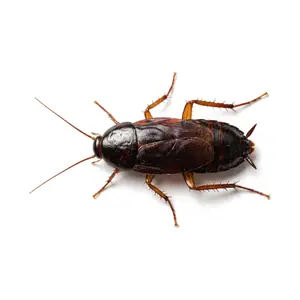
Oriental Cockroach
AKA: Water Bug, Black Beetle, Shad Roach
Blatta orientalis
|
22 to 27 mm (about 1 in). Dark brown to nearly black and often matte rather than shiny. Smaller and squatter than the smoky brown, though the dark color confuses people in poor light. | Cannot fly. The male’s short wings cover about two-thirds of the body and the female has only wing pads. A dark roach flying or sitting by an outdoor light is not this species. Slow-moving. | Sewers, storm drains, rotting plant matter and cool damp soil under slabs. Comes in through floor drains and low gaps, and favors garage floors, utility room drains and crawl spaces. Never through attic vents. |
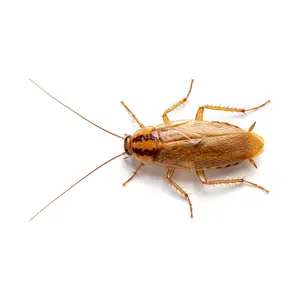
German Cockroach
AKA: Croton Bug, Kitchen Cockroach
Blattella germanica
|
13 to 16 mm (0.5 to 0.625 in). Light brown to tan, about one third the length of a smoky brown adult, though a young smoky brown can be close to an adult German cockroach in length. | Two dark parallel stripes running lengthwise on the plate behind the head. Does not fly in any practical sense, never goes to outdoor lights and is never found in attic insulation. | Indoors only, in kitchens and bathrooms, appliance voids, cabinet hinge pockets and plumbing chases. Keeps no outdoor population and never comes in at roof level. |
Smoky Brown Cockroach vs American Cockroach
The Smoky Brown Cockroach in Three Numbers
About 20
Oklahoma State University Extension reports that an average of 20 young hatch from each smoky brown cockroach egg case.
Oklahoma State University Extension
About 45 days
Oklahoma State University Extension reports that smoky brown cockroach eggs take about 45 days on average to hatch.
Oklahoma State University Extension
1.25 to 1.5 in
Texas A&M AgriLife Extension puts the adult smoky brown cockroach at 1.25 to 1.5 inches long, the same size class as the American cockroach.
Texas A&M AgriLife Extension
Are Smoky Brown Cockroaches Dangerous?
Moderately, in two ways. They walk through gutters full of bird droppings, tree holes and wet debris, and can carry those bacteria onto kitchen surfaces, though less often than the German cockroach, which lives in the kitchen. Their body proteins are also allergens that can set off asthma and allergy symptoms in people already sensitive to cockroaches.
Because they settle in attic spaces that connect to the return air path, allergen particles from droppings and shed skins can travel through the HVAC system into rooms where no roach has ever been seen. For most homes without a known cockroach allergy the risk is modest, but nobody wants a roach from the gutter walking across the counter.
Do Smoky Brown Cockroaches Bite?
No. Smoky brown cockroaches do not bite people under normal circumstances and are not venomous. The same goes for the white-banded young, since they are the same species. The concern is what they carry, the bacteria they bring in from gutters and tree holes, not any injury from contact.
Can Smoky Brown Cockroaches Fly?
Yes, and readily. Both males and females have wings longer than the body and fly short distances without much prompting, which sets them apart from the American and Oriental cockroaches. They fly toward bright lights at night, which is how they end up on porches, lit walls and the roofline.
From branches that touch or hang over the roof they simply walk on.
When Smoky Brown Cockroach Activity Warrants Action
Attic Activity and Someone With Asthma
If anyone in the home has asthma or a known cockroach allergy, attic activity is more than a nuisance. Treat it on the same timeline as a German cockroach problem, check the HVAC filters, and ask your doctor about allergy testing for cockroaches if breathing symptoms have increased.
Attic Activity With No Allergies at Home
Without a known allergy the health risk is lower than with German cockroaches. It is still worth treating on basic sanitation grounds, and the longer they stay, the more of the attic insulation and stored items they foul.
Why You Found a Smoky Brown Cockroach in Your House
A smoky brown cockroach in the house came in from above. It is mostly an outdoor insect, but not only one. The main population lives in tree holes, mulch beds and gutters, and the indoor part settles in the attic, coming through ridge vents, gable vents and soffit gaps. One in a bedroom or kitchen has usually dropped down from there. It almost never settles in a kitchen or bathroom, and it does not come up through the drains.
It cannot live long in dry air. A dry attic kills an indoor population quickly, so the ones that hang on are near an HVAC condensate leak or roof moisture. The fix is screening the vents it used, fixing that moisture, and trimming the branches and changing the lights that lead it to the roof.
Where Smoky Brown Cockroaches Come From in Collin County
Outdoors they live where it stays damp: tree holes, especially in live oaks and pecans, thick mulch beds, gutters clogged with leaves, leaf litter and wood piles near the foundation. A single large live oak with several tree holes within 20 feet of the roofline can hold dozens of them within easy flying distance of the attic vents. Indoors they settle in the attic insulation next to the vents they came through. In a home with a finished attic or attic storage this is worth treating early. Where the attic is purely mechanical space, the property impact is small.
Smoky Brown Cockroach Presence Across Collin County
Smoky brown cockroach activity is confirmed in southern Collin County, in Plano, Allen and south McKinney. In the north of the county, in Celina, Anna and Farmersville, pressure is lower and less documented.
Within any of these cities, the homes that see the most are those with heavy tree canopy within 30 feet of the house, branches touching or hanging over the roof, and bright white outdoor lights left on all night.
Smoky brown cockroaches are most active when it is warm and humid. Activity drops sharply in winter, when they shelter in tree holes, attic spaces and damp spots near the house, though they do not die off in a typical Collin County winter. The August and September peak is when they press hardest on homes, moving toward buildings for moisture as conditions outside get harsher.
Pest Me Off service records from southern Collin County, 2023 to 2026, show 6 months of activity, May through October, with the peak in August and September, matching the species’ biology.
Smoky Brown Cockroach Life Cycle
How Pest Me Off Treats Smoky Brown Cockroaches
Our smoky brown cockroach treatment works on the outdoor source, the attic and the ways in at the same time, in four steps.
Inspect and Map Entry Points
Confirm the species, then walk the roofline. Check the ridge vent screens (present, missing or torn), soffit gaps at panel joints, gable vent screens, and gaps around plumbing vent pipes and chimney flashing. Then walk the yard for thick mulch within 6 feet of the foundation, wood piles, leaf litter, and branches touching or hanging over the roof.
Outdoor Perimeter and Landscape
Place bait in mulch beds and around tree bases near the house. Apply a residual spray that roaches walk through without detecting and carry back to their hiding spots, on the foundation, eaves and soffits. Then cut the hiding spots back: clear leaf litter, thin mulch to under 2 inches, move firewood at least 20 feet from the house, and prune branches that touch or hang over the roof.
Attic Treatment and Screening
Apply insecticide dust in the attic spaces next to ridge vents, gable vents and soffit joints, and place bait in the nearby attic corners. Fit fine mesh over unscreened or torn soffit and ridge vents, which blocks entry while keeping the airflow the attic needs, and seal gaps where plumbing vent pipes pass through the roof deck.
Lighting and 30-Day Follow-Up
We recommend swapping bright white outdoor lights for yellow bulbs or motion-activated fixtures. At 30 days we check the attic openings, confirm the bait is being taken in the mulch, and look for missed hiding spots. Homes under heavy tree canopy may need a second perimeter treatment before the August peak.
& Other Companies
How to Get Rid of Smoky Brown Cockroaches Yourself
These steps will not clear a population already in the attic, but they cut the pressure that brings this roach back on the same schedule every year, and most of them cost nothing.
Why Some DIY Responses Fail for Smoky Brown Cockroaches
Most failed DIY attempts put the product in the wrong place. People reach for drain and baseboard products because that is what cockroach control usually means, and this species uses the attic instead.
Drain, Baseboard and Kitchen Treatments
Drain gels, drain covers and baseboard sprays target the ground-level routes of American and Oriental cockroaches. Kitchen gel bait targets the German cockroach. The smoky brown uses neither route and almost never settles in a kitchen or bathroom, so these products are correct for the wrong pest.
Repellent Sprays Near Lights and Entry Points
Most store sprays repel. Used near outdoor lights, doors and the roofline, they push the roach into wall voids and gaps instead of keeping it out. Oklahoma State University Extension’s smoky brown cockroach guidance stresses products roaches cannot detect, plus screening and sealing, over perimeter spray for this species.
Killing the Ones You See, Once
A contact spray or a single perimeter treatment kills the roaches there that day. The open vents, torn soffits and the breeding population in the trees and mulch remain, so new adults arrive the same way every warm season. Cutting back the hiding spots and closing the roof openings is what breaks the cycle.
Common Smoky Brown Cockroach Questions
What is the big dark brown roach flying toward my porch light?
What is a tree roach, and is it the same as a smoky brown cockroach?
How do I tell a smoky brown cockroach from an American cockroach?
Is the smoky brown cockroach an outdoor-only pest?
Why do smoky brown cockroaches appear on the porch at night but not inside the house?
How do I keep smoky brown cockroaches from coming in through vents?
Do smoky brown cockroaches come up through drains?
What is the difference between young smoky brown cockroaches and adult brown-banded cockroaches?
Why do I keep seeing roaches even after my attic was treated?
When is smoky brown cockroach season in Collin County?
Do smoky brown cockroaches bite?
How do I get rid of smoky brown cockroaches?
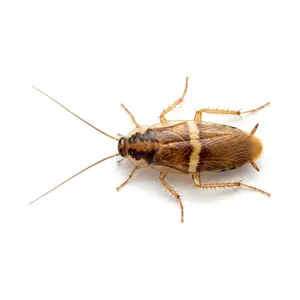
Flying Roaches From Your Oak Tree Landing in Your Attic. We Find the Way In and Close It.
We confirm the species first so the work matches the way in. The smoky brown comes in through your attic, not your drains, so we treat the outside, the attic and the hiding spots in the yard on one visit, then screen the vents that keep letting them back in. Cockroach Crackdown across McKinney, Allen, Frisco, Plano, and all of Collin County.