Eastern Subterranean Termites in Collin County, TX | Identification and Control
The eastern subterranean termite (Reticulitermes flavipes), also called the wood termite, is the most destructive pest in Collin County and the main termite across the eastern United States. Its colonies live underground and eat wood from the inside, so most homes show nothing until the damage is serious. The University of Florida puts US spending on termite control and repairs at $20 billion a year, 80 percent of it on subterranean termites like this one. Most people first meet it as a spring swarm of winged termites indoors.
Found flying termites or mud tubes in Collin County? Our office sits where McKinney, Plano, Frisco and Allen meet, 5 to 10 minutes from most homes in those four cities. Send us a photo or call, and we will tell you whether it is termites.
Eastern Subterranean Termite
The main wood-destroying pest across the eastern United States and all of Collin County. It never comes to the surface by choice and eats structural wood from the inside out.
Risk Assessment
Choose a row for the full detail- Colony size
- 60,000 to several hundred thousand, and mature colonies can pass 1 million
- Diet
- Wood and plant fiber, including framing lumber, drywall paper backing and cardboard
- Travel range
- Up to 250 to 300 feet from the central nest
- Habitat
- Underground, entering homes through soil contact, mud tubes and slab cracks
- Swarm season
- Late winter into spring, in daylight
- Soldiers
- 1 to 2 percent of the colony
- Size
- Workers 3 to 4 mm, winged termites 10 to 12 mm
What Eastern Subterranean Termites Look Like
The Texas A&M Urban and Structural Entomology Program describes subterranean termites as social insects that live in colonies in the soil, with three castes: reproductives, workers and soldiers. Workers and soldiers spend their whole lives underground, so knowing which one you are looking at tells you whether you have active feeding or a swarm from a colony nearby. Texas A&M AgriLife Extension says subterranean termites are usually found in the top 4 to 6 inches of soil, out of sight (Texas A&M AgriLife Extension).
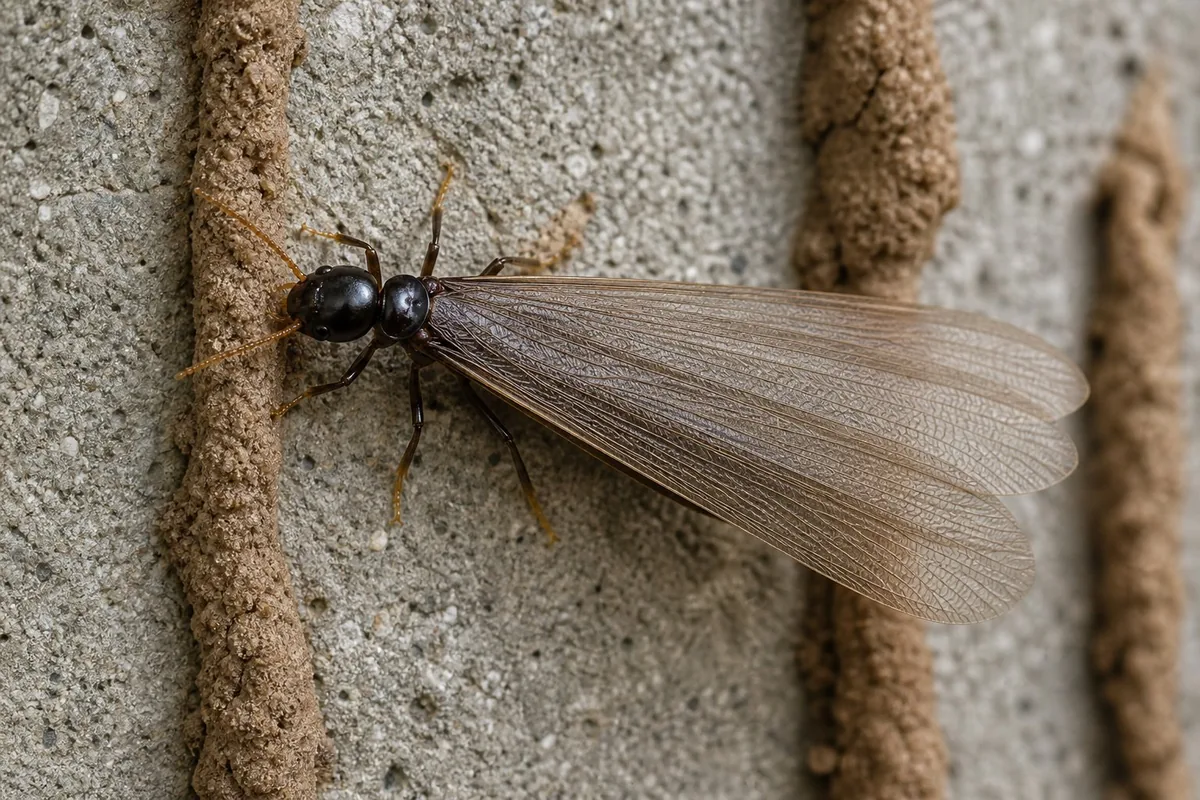
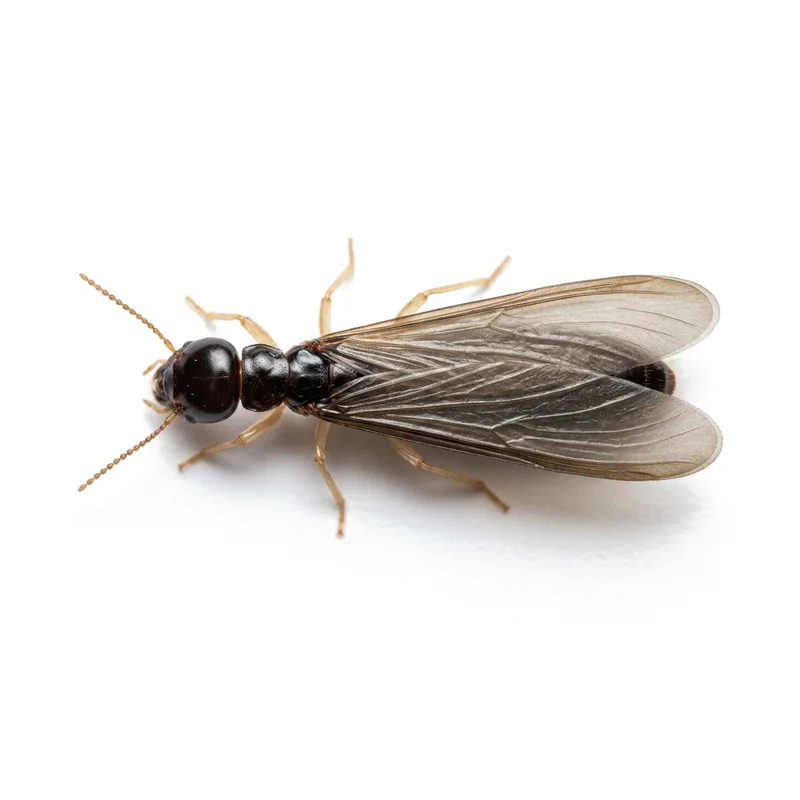
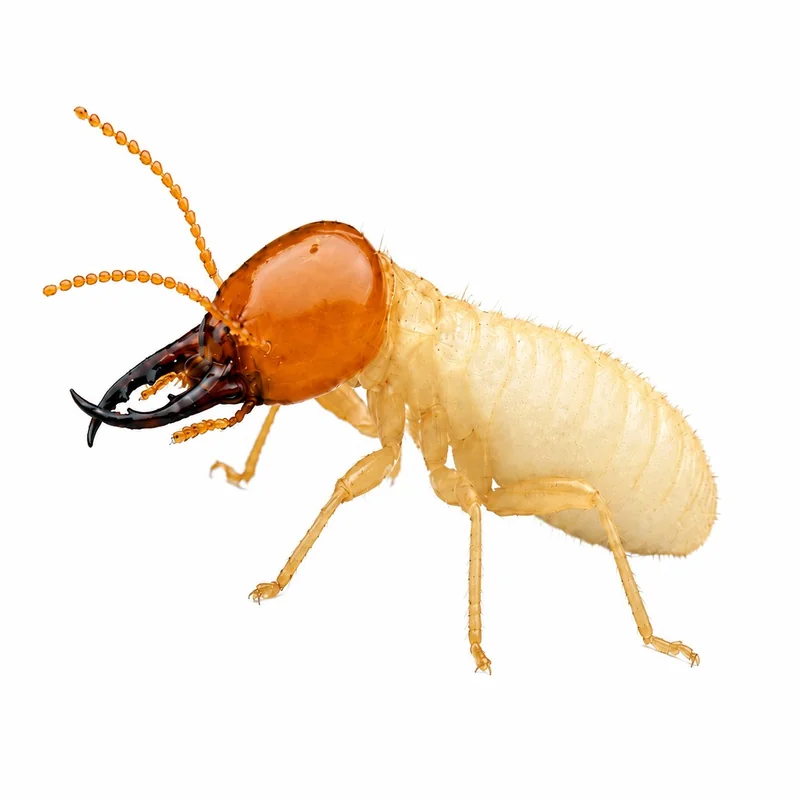
Workers do the damage. They are soft, creamy white, eyeless and 3 to 4 mm long, the pale insects you see moving when you pull back damaged wood. Soldiers are a little larger, with a rectangular amber head and curved black jaws, and only defend the colony. The winged reproductives have dark bodies and four long wings of matching size.
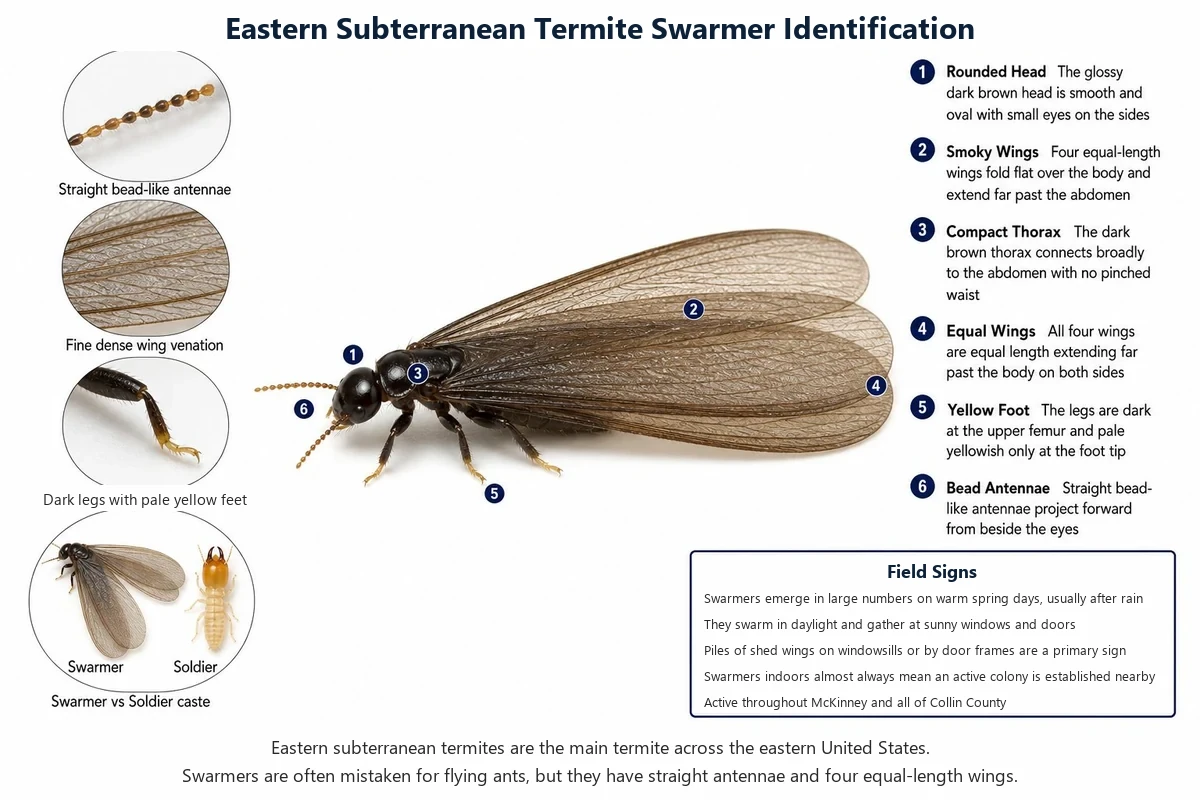
How to identify a flying eastern subterranean termite by its antennae, waist, wings and pale yellow feet
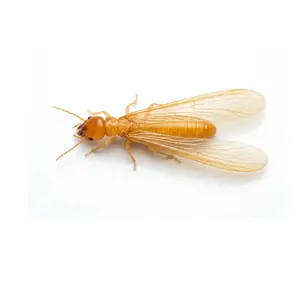
- Flying termites have four wings of equal length, a dark body, a thick straight waist and straight beaded antennae
- Each front wing carries two dark veins running side by side along its leading edge
- Soldiers have a rectangular amber head with curved black jaws and come to the surface when wood is broken open
- Workers are creamy white and eyeless, seen only when damaged wood is opened or a mud tube is broken
- Mud tubes are pencil-wide brown tunnels running up foundation walls, piers or the inside of crawl spaces
- Discarded wings piled near windowsills and door frames are left by flying termites after they land
Other Names for the Eastern Subterranean Termite
Wood termite is the everyday name most homeowners use, and it is accurate enough, because the species eats wood for a living. Subterranean is the important part of the formal name. This termite lives in the ground, travels underground to reach a house, and builds mud tubes as covered roads from the soil into the wood above. Any termite in Collin County that is not living inside dry wood above the foundation is almost certainly this one.
Where Are Eastern Subterranean Termites Found?
Eastern subterranean termites are found across the eastern half of North America, which is where the eastern in the name comes from, and they are the dominant termite of the eastern United States. In Texas, the Texas A&M Urban Entomology Program documents R. flavipes as the dominant subterranean termite throughout Collin County.
It is confirmed and widespread in every part of the county.
| Name | What it means |
|---|---|
| Wood termite | The informal name most homeowners use, after what it eats. |
| Subterranean termite | Subterranean means underground. When people in Collin County say subterranean termite without saying which one, they almost always mean this species. |
| Eastern termite | A short form of the full name. Eastern marks its range across the eastern half of North America. |
| Reticulitermes flavipes | The scientific name, roughly yellow-footed net termite, after the pale coloring on the legs of the workers. |
| Termita subterránea | Spanish for subterranean termite, the same insect. |
| Flying or winged termite | Not a separate kind of termite. It is the winged reproductive form that leaves a mature colony in spring to start new ones. |
How to Tell Eastern Subterranean Termites from Their Look-Alikes
Three insects get mistaken for eastern subterranean termites in Collin County. The stakes are high, because a flying ant swarm needs no structural treatment while flying termites mean a colony is already inside. The table separates them without a microscope.
| Species | Waist and Wings | Antennae and Body | Swarm Timing and Habitat |
|---|---|---|---|
|
Eastern Subterranean Termite
AKA: Wood Termite, Subterranean Termite
Reticulitermes flavipes
This species
|
Thick, straight waist with no pinch. Four smooth, clear wings of one size, with two dark veins running side by side along the front edge of each front wing. | Straight, beaded antennae with no elbow. Winged adults are dark brown, 10 to 12 mm. Workers are creamy white, eyeless, 3 to 4 mm. | February through April in Collin County, in daylight, usually the day of or after a warm rain. Comes out of soil or structural wood, not trees or wood trim. |
Formosan Subterranean Termite
AKA: Super Termite, Formosan Termite
Coptotermes formosanus
|
Thick, straight waist, no pinch. Four equal wings with a yellowish tint and fine hairs across them, where eastern wings are smooth and clear. Winged adults are larger, 12 to 15 mm. | Straight, beaded antennae like the eastern. The soldier’s head is the field tell, a rounded teardrop with a small pore on top that oozes white fluid when the colony is disturbed. The eastern soldier’s head is rectangular and amber with no pore. | Confirmed in Collin County. Swarms April through July, at dusk and into the night near lights. Eastern swarms happen by day, the fastest separation in the field. |
Carpenter Ant
AKA: Big Black Ant, Large Black Ant
Camponotus pennsylvanicus
|
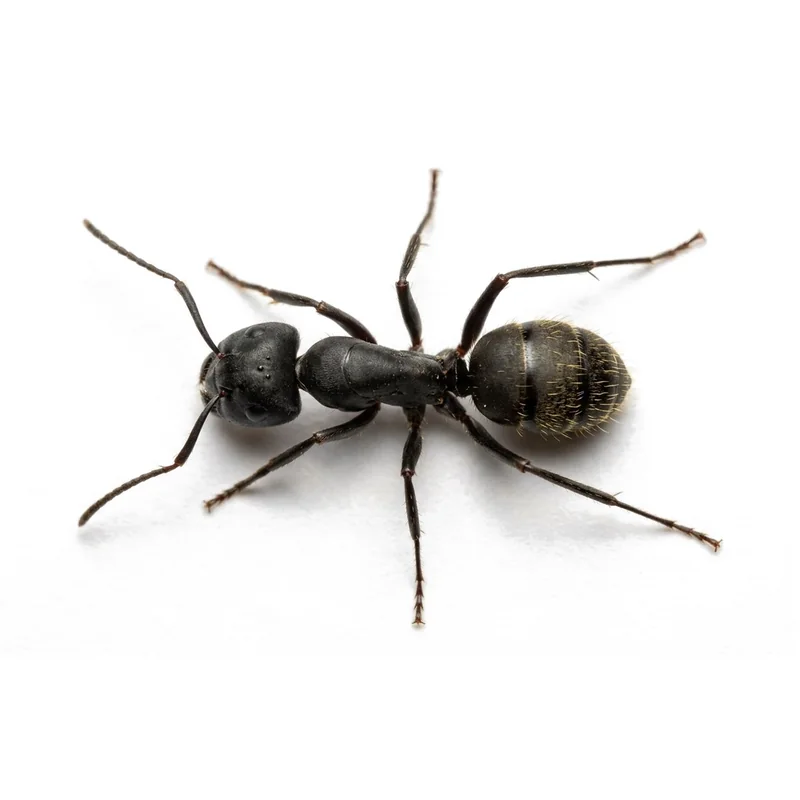
Pinched, narrow waist. Front wings visibly larger than back wings, the opposite of a termite, and the fastest single tell between the two. | Elbowed antennae that bend at a joint. Large body, 12 to 25 mm, all black or red and black. Carves wood to nest but does not eat it, leaving clean, smooth-walled tunnels. | Late spring, often at night or dawn, in small scattered swarms. No mud tubes. Sawdust-like shavings mixed with dead insect parts near door frames, window trim or soffits point to carpenter ants. |
Odorous House Ant (winged)
AKA: Sugar Ant, Stink Ant
Tapinoma sessile
|
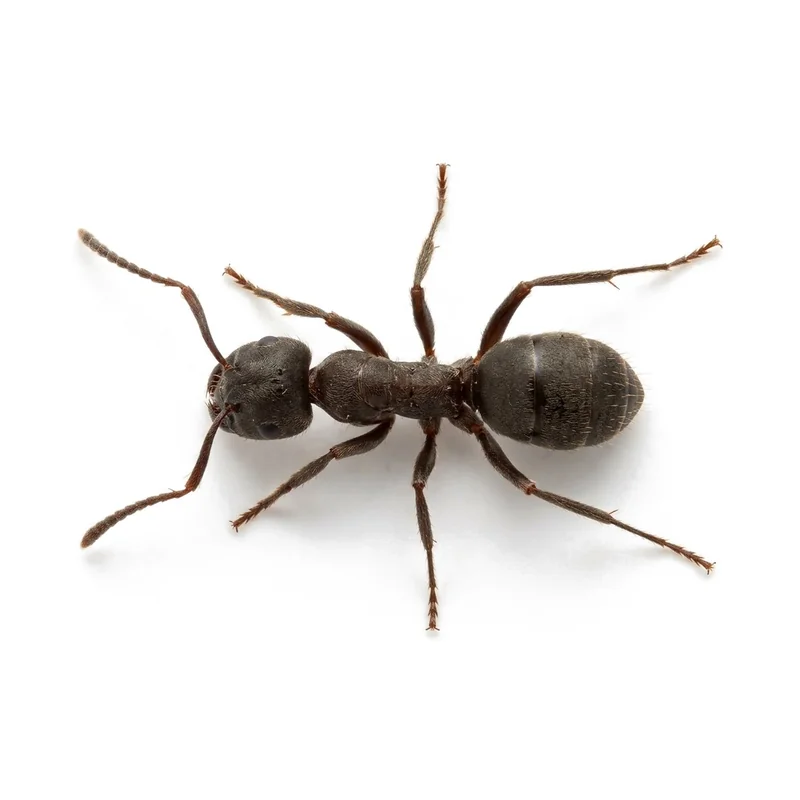
Pinched, narrow waist like all ants. Front wings larger than back wings. Sheds its wings soon after landing, leaving piles on windowsills that look like termite wings until you compare the wing sizes. | Elbowed antennae. Body 2.4 to 3.3 mm, much smaller than a flying termite. Crushed ants smell of rotten coconut or blue cheese, while termites have no smell, so the sniff test alone separates them. | Spring and summer, small swarms often coming out of wall voids or from under flooring indoors. Check the waist and wing sizes before calling for a termite inspection. |
Eastern Subterranean Termite vs Flying Ant
The Eastern Subterranean Termite in Three Numbers
3
The Texas A&M Urban and Structural Entomology Program counts 3 castes in a subterranean termite colony, reproductives, workers and soldiers, and of an eastern subterranean termite colony usually only the winged ones are seen.
Texas A&M Urban and Structural Entomology Program
Top 4 to 6 inches
Texas A&M AgriLife Extension says subterranean termites are usually found in the top 4 to 6 inches of soil, out of sight.
Texas A&M AgriLife Extension
About 250,000
Texas A&M AgriLife Extension says a mature subterranean termite colony usually has about 250,000 workers, though some stay small.
Texas A&M AgriLife Extension
Are Eastern Subterranean Termites Dangerous to People?
Not to your health. Eastern subterranean termites carry no disease and no venom, and no allergic reaction to them is documented. The danger is to the house and to the money it takes to repair it. Their colonies live underground and eat wood from the inside, so most homes show nothing until the damage is serious.
Do Eastern Subterranean Termites Bite?
Not in any way that matters. Workers are defenseless. Soldiers can pinch a finger if handled, but leave no venom, no rash and no lasting mark. Flying termites that end up indoors do not bite or sting and die within hours without soil moisture.
The only contact most homeowners ever have is sweeping dead flying termites off a windowsill in March.
What Termite Damage Costs a Homeowner
Every month of feeding adds to the repair bill, not just the treatment bill. Across the country, the University of Florida puts spending on termite control and repairs at $20 billion a year, citing a 2012 estimate by Rust and Su, with 80 percent of it going to subterranean termites such as this one. A colony active for one year typically means $3,000 to $8,000 in structural repair, and one active for three to five years before discovery routinely runs $15,000 to $30,000. Homeowner insurance almost never pays, because carriers class termite damage as maintenance rather than a sudden loss. A tree falling on the house is covered, and four years of termites eating the floor joists is not. A monitoring program costs a fraction of first-year repair on even a modest infestation, and it is the only financial protection there is.
When Eastern Subterranean Termites Warrant Action
Flying Termites, Wings or Mud Tubes at the House
Flying termites indoors, discarded wings on a windowsill, or a pencil-wide mud tube on the foundation all mean workers are already feeding on the structure. Book an inspection the same day.
Damage in a Load-Bearing Member
If damage turns up in a floor joist, sill plate, wall stud, beam or post, have a structural engineer assess it before repair begins. Pest Me Off handles the termites. The engineer protects you from a contractor who patches the surface without confirming the wood can still carry its load.
Why You Found Flying Termites in Your House
A swarm inside your home is not a warning that termites might come. It confirms a colony is already inside the structure. Flying termites only leave colonies that have been established for 3 to 5 years, so if you are sweeping them off a windowsill in March, that colony has been eating your wood for years.
Those that come out indoors cannot reach soil, so they die within hours and leave piles of discarded wings near windows and door frames. The swarm is not the start of the problem, it is proof the problem is well established. Call for an inspection the same day.
Where Eastern Subterranean Termites Feed Inside Your Home
Workers reach wood from the underground nest in one of three ways: direct soil-to-wood contact at a slab edge or foundation opening, mud tubes built up foundation walls or piers, or cracks in the slab and its expansion joints. Inside, they go for wood with any moisture, such as sill plates, rim joists, subfloor near plumbing, framing behind stucco or brick, and any wood within 12 inches of the ground. Penn State research on eastern subterranean termite feeding shows workers also eat drywall paper backing, cardboard and any paper packing that touches a damp path from the soil.
The hidden damage is the real hazard. Workers hollow a stud or joist along the grain and leave a thin outer shell, so a baseboard that sounds hollow may cover a joist that has lost 70 percent of its wood, and a slightly springy floor is an early sign of subfloor damage. Across Pest Me Off service records from 2024 to 2026, a colony had usually been feeding for 3 to 5 years before the homeowner noticed anything.
Eastern Subterranean Termite Pressure Across Collin County
Collin County’s heavy clay soil holds the underground moisture that keeps large colonies going year-round. The county sits in Termite Infestation Probability Zone 1, the highest risk category under the International Residential Code, which is why new construction here must include termite-resistant measures by code.
Pressure is highest in older neighborhoods where soil touches wood at the foundation and mature tree roots carry moisture straight to the sill plates. In newer slab homes, expansion joints are the main way in. Activity runs highest in McKinney neighborhoods east of US 75, Plano homes near Spring Creek with mature landscaping, and anywhere drip irrigation or poor drainage keeps the yard wet.
Termites feed year-round below ground, and what changes by season is what you can see. Monitoring data from the Texas A&M Urban Entomology Program and Pest Me Off service records from 2023 to 2026 put the Collin County swarm season at 3 months, February through April, in daylight and usually the day of or after a warm rain. Damage then builds quietly through summer, when colonies are largest and hungriest.
Underground feeding continues year-round, whatever the activity at the surface.
How Eastern Subterranean Termite Colonies Grow and Spread
How Pest Me Off Treats Eastern Subterranean Termites
Termite Takedown is our program for eastern subterranean termites. It starts with an inspection that finds active feeding without opening walls, then matches the treatment to where the termites actually are. NC State research on eastern subterranean termite control found that a single method, bait alone or liquid alone, gives lower long-term colony control than combining both. We combine both every time.
Termite Inspection with In-Wall Detection
A licensed technician inspects the crawl space, attic, garage and every outside foundation surface. Termatrac T3i in-wall detection finds termite activity through finished walls by sound, radar and heat, with no cutting or drilling. Every active mud tube and entry point is mapped. Current customers get a free general termite check, and anyone not yet a customer books a paid termite inspection.
In-Ground Bait Station Installation
Trelona annual bait stations go into the soil every 10 feet around the house. Each holds a bait cartridge of cellulose, the plant fiber termites eat, which workers find, feed on and carry back to the colony. Every station is checked about every 120 days in the first year, about every 60 days while termites are feeding, and about every six months after a clear year, and at each check the cartridge is opened, checked and replaced if eaten.
Liquid Treatment for Active Infestations
When the inspection finds termites feeding inside, a liquid termiticide goes into the soil in a continuous band along the outside of the foundation. It is non-repellent, meaning workers walk through it without detecting it and carry it back to the colony.
Scheduled Station Checks
A technician checks every station on that schedule and replaces eaten cartridges, and once a year re-inspects the foundation and the rooms we can reach for new mud tubes. In Collin County these termites are a permanent pressure, so the checks are the program, not an extra.
& Quick Fixes
How to Get Rid of Eastern Subterranean Termites Yourself
You cannot get rid of an established colony yourself. These four steps cut the moisture and easy access that draw termite workers to a house in the first place.
Why DIY Termite Treatment Does Not Work
Real termite treatment needs a licensed applicator and equipment no hardware store sells. Each common shortcut below leaves the colony alive and still feeding somewhere in the house.
Repellent Spray Around the Foundation
Hardware store termite sprays repel. Workers sense the treated soil and route around it within 24 to 48 hours, often through another crack or utility opening, and keep feeding. You paid for a treatment and the colony moved instead of dying.
Orange Oil, Borate Spray or Essential Oils
Borates protect bare lumber as a preventive finish but do not soak into painted or coated wood. Orange oil and essential oils have no documented effect on subterranean termites in published research. They may kill the workers they touch, but they never travel through the colony.
Removing Visible Mud Tubes
Breaking a mud tube closes that one route, and workers build a new one alongside it within 24 to 48 hours. A broken tube tells you a colony is active at that spot, which makes it a useful check, but it does nothing to the colony.
Store Bait Stations Without Follow-Up
Store bait kits need checking every 3 months, fresh cartridges when eaten, and stations every 10 feet around the whole house. Most get installed unevenly and checked rarely, and a station that runs out of bait is just an empty tube in the ground.
Buying Termidor or Other Pro Products Online
Professional liquid termiticides need a licensed applicator to buy and apply in Texas. Products sold online as professional grade are counterfeit, watered down, or need equipment and training to apply. A patchy application leaves gaps that workers pass straight through.
Common Eastern Subterranean Termite Questions
What is a wood termite, and is it the same as a subterranean termite?
What does an eastern subterranean termite look like?
I found winged insects swarming inside my house in March. Are those termites?
What is the difference between eastern subterranean termites and Formosan termites?
My neighbor has termites. Do I need to be worried?
Will my homeowner insurance cover termite damage?
How long does a termite inspection take and what does it cost?
How long do bait stations take to work?
How do you handle termite treatment around my family and pets?
How do I get rid of eastern subterranean termites?
Termites Are Inside Your Walls. We Find Them and Stop Them.
We inspect with in-wall detection, install bait stations around your foundation, and check the stations on a schedule to confirm the colony is gone and nothing new has started. McKinney, Allen, Frisco, Plano, and all of Collin County.