
Honey Bees in Collin County, TX | Swarm or Colony? Identification and Treatment
The honey bee (Apis mellifera) is the one bee in Collin County where the first job is working out what you are looking at. A swarm resting on a branch is calm and usually moves on within 24 to 48 hours. A colony going in and out of a gap in your wall builds wax comb, stores honey and stays, and the National Pest Management Association puts a mature colony at 20,000 to 80,000 bees. Treating one like the other is where the cost and the damage start.
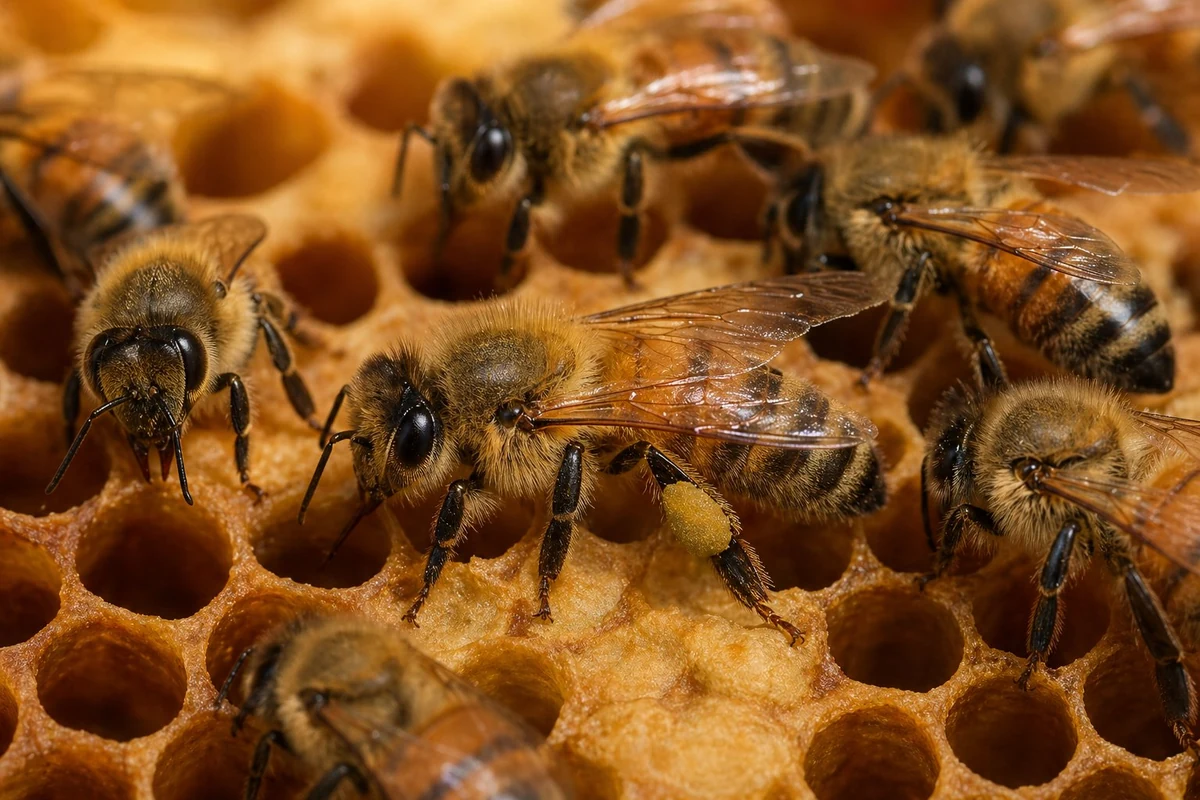
Bees going in and out of your wall in Collin County? Our office sits where McKinney, Plano, Frisco and Allen meet, 5 to 10 minutes from most homes in those four cities. Send us a photo or call, and we will tell you whether it is a swarm or a colony.
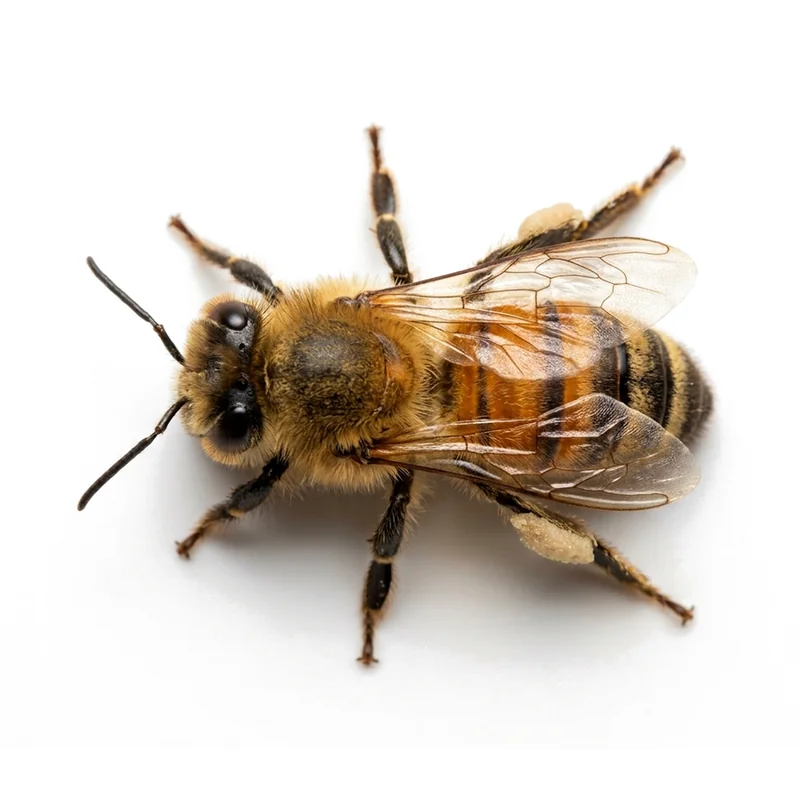
Honey Bee
University of Florida honey bee documentation covers the full biology and management of this species.
Risk Assessment
Choose a row for the full detail- Color
- Golden-brown to dark brown with pale and dark bands, and a fuzzy body covered in branched hairs
- Colony size
- Up to 80,000 bees in a mature colony
- Colony type
- Lives through winter, unlike wasp colonies that die off each year
- Africanized bees
- Confirmed in Collin County and identical to European bees by eye
- Stinger
- Barbed and stays in the skin, so remove it at once
- Swarm season
- March through May, peaking in April, with some late-summer swarms
- Size
- 12 to 15 mm (about 1/2 inch)
What a Honey Bee Looks Like
A honey bee is about half an inch long, golden-brown to dark brown, with pale and darker bands on a rounded, tapering abdomen. Its whole body is covered in branched hairs, so it looks fuzzy up close, and workers coming home carry orange or yellow balls of pollen on their hind legs. It is duller in color than a yellowjacket.
How the bees are gathered matters as much as the bee. A swarm is a dense cluster of thousands of bees on a branch, fence or mailbox, with no cavity entrance. A colony shows as bees going in and out of one fixed gap in siding, a soffit, a chimney or a meter box, day after day. The difference between the two decides everything that follows.
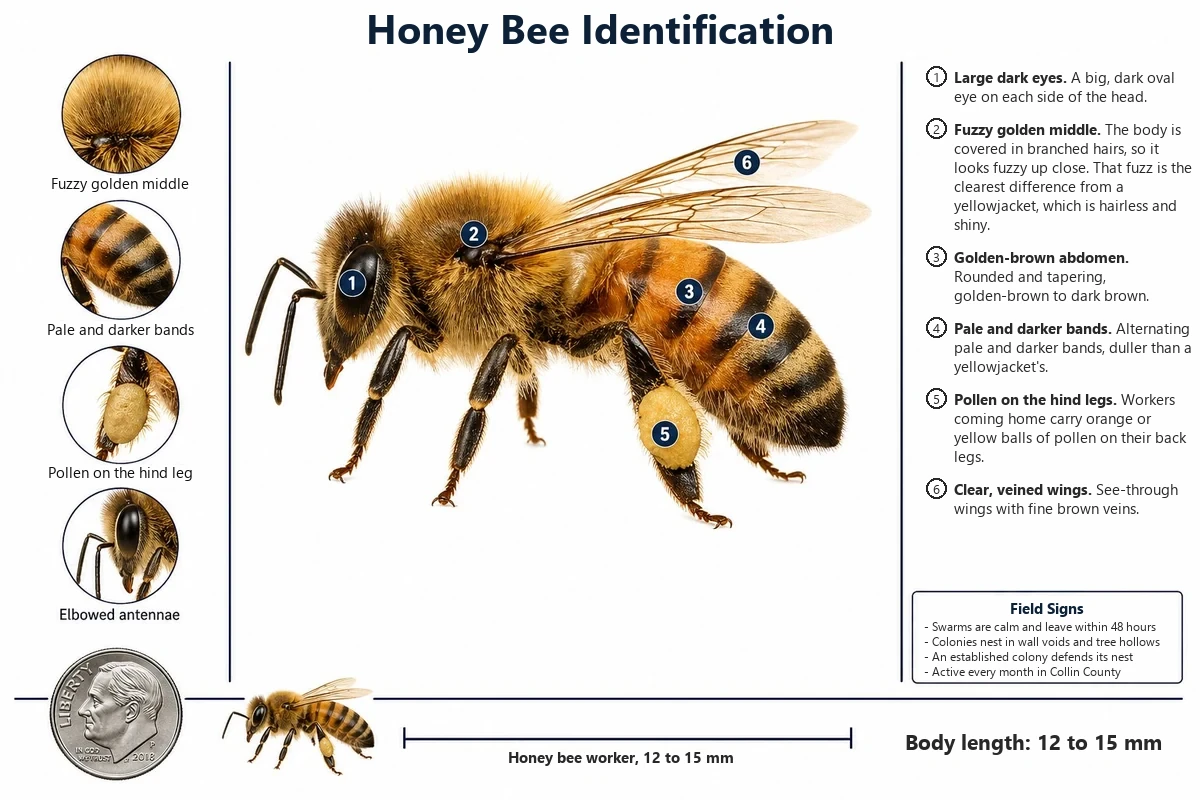
How to identify a honey bee by its fuzzy body, pollen-carrying hind legs and banded abdomen
- A fuzzy body, the clearest difference from a yellowjacket, which is hairless and shiny
- Duller than a yellowjacket, with alternating pale and darker bands
- Orange or yellow pollen balls on the hind legs of workers returning home
- 12 to 15 mm long, about the size of a yellowjacket but with a rounder, more tapered abdomen
- A swarm is a dense cluster on a branch, fence or other surface with no cavity entrance
- A colony is bees using one fixed gap in siding, a soffit, a chimney or a meter box
Other Names for the Honey Bee
European honey bee and western honey bee are the formal common names for Apis mellifera, the species European colonists brought to North America in the 1600s. Most Collin County homeowners simply say honey bee for any bee going into their walls, and that works as the identification on a service call. The name that matters most here is Africanized honey bee, because those hybrids look exactly the same and are confirmed in the county.
| Name | What it means |
|---|---|
| European honey bee | The formal common name, after where the species was brought from. |
| Western honey bee | The other formal common name for the same species. |
| Honeybee | The same bee written as one word. Both spellings are correct. |
| Africanized honey bee | A hybrid of the same species that looks identical and only a laboratory test can tell apart. |
How to Tell Honey Bees from Other Collin County Bees and Wasps
If you are asking what kind of bee this is, the table below compares the honey bee with the three insects it is most often mistaken for. Most people confuse it with a yellowjacket after seeing yellow and black and stopping there.
| Species | Size | Key Feature | Nesting Habit |
|---|---|---|---|
|
Honey Bee
AKA: European Honey Bee
Apis mellifera
This species
|
12 to 15 mm. Pale bands on a rounded, tapered abdomen. Looks fuzzy next to any wasp. Workers often carry orange or yellow pollen on the hind legs. | Fuzzy body is the fastest separator from every wasp. Barbed stinger stays in the skin and keeps pumping venom after the bee pulls away. Colony lives through winter. Builds wax comb, not paper. Swarms in spring when crowded. | Tree hollows or building cavities (wall voids, soffits, chimneys, meter boxes, irrigation boxes) reached through a small fixed gap. Swarms rest on any raised surface while in transit. Established colonies stay unless removed. |
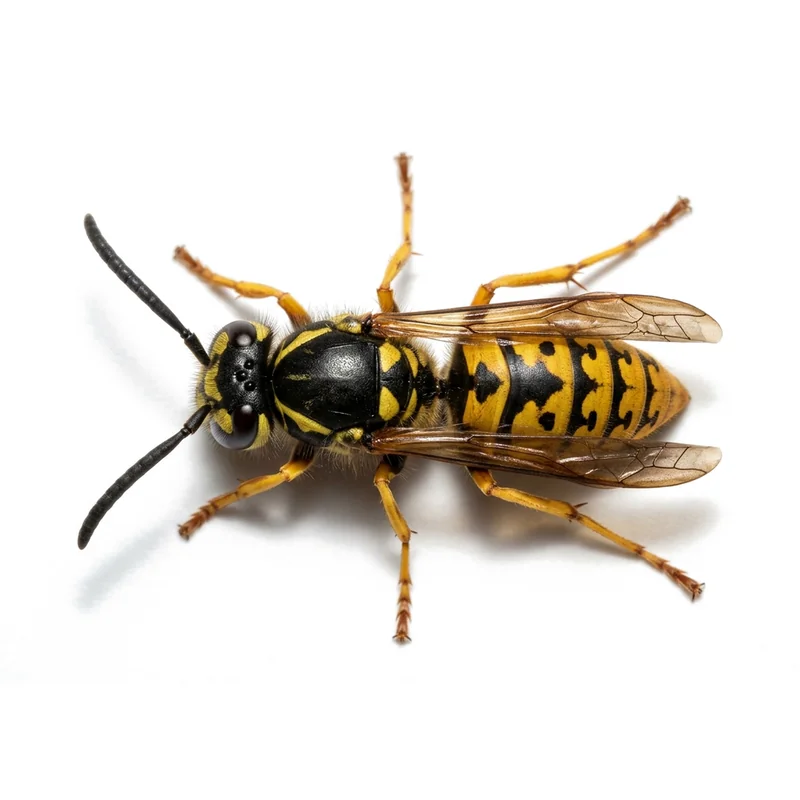
Yellowjacket
AKA: Ground Hornet, Ground Wasp
Vespula spp.
|
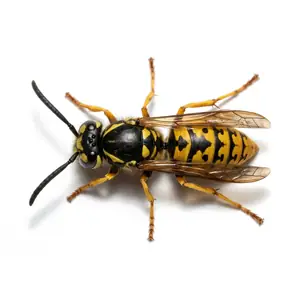
10 to 16 mm. Bright yellow and black, sharply banded. Hairless and shiny, the reverse of a honey bee. Compact, stocky build, with legs held close to the body in flight. | Hairless and shiny. Smooth stinger, so it can sting many times. Carries no pollen and scavenges meat and sugary drinks in late summer. Builds paper nests, not wax comb. The colony dies after the first hard freeze. | Most Collin County colonies nest in the ground or in wall voids reached through a crack or weep hole. A hole in the ground with fast traffic, or workers entering a low wall crack, points to yellowjackets. |
Bald-Faced Hornet
AKA: White-Faced Hornet
Dolichovespula maculata
|
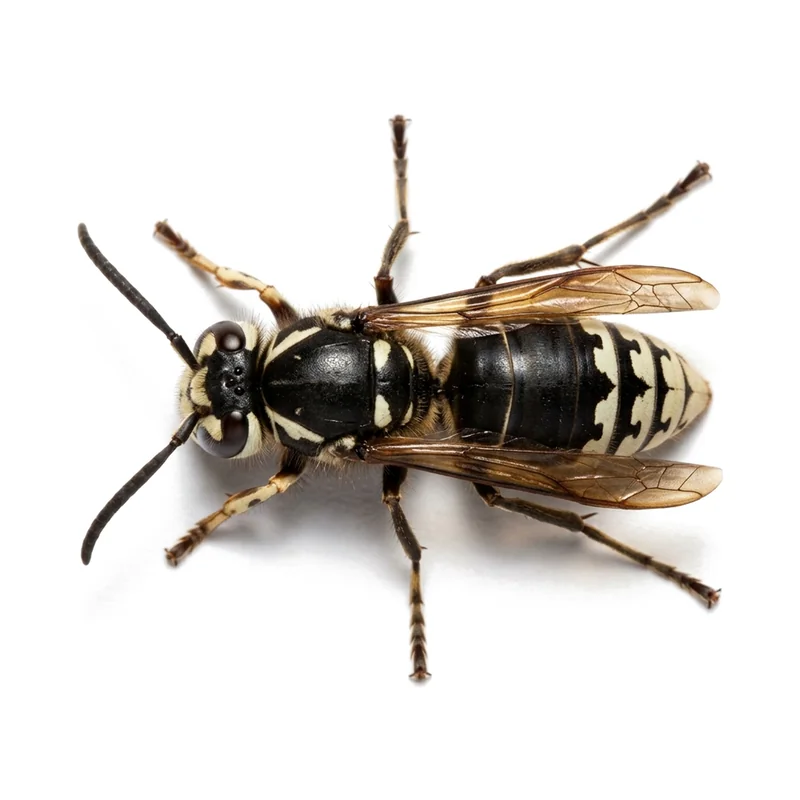
15 to 20 mm. Black with bold white or ivory markings on the face, upper body and abdomen tip. Larger and heavier than a honey bee, smooth-looking like all wasps, with a strong, heavy flight. | The white-on-black pattern separates it from a honey bee at once. Smooth stinger, stings many times and can spray venom toward the eyes. The colony dies off each year. | A large gray paper ball hanging in a tree, a big shrub or from an overhang, with one entrance at the bottom. No ground nests and no wall-void colonies. |
Carpenter Bee
AKA: Wood Bee
Xylocopa spp.
|
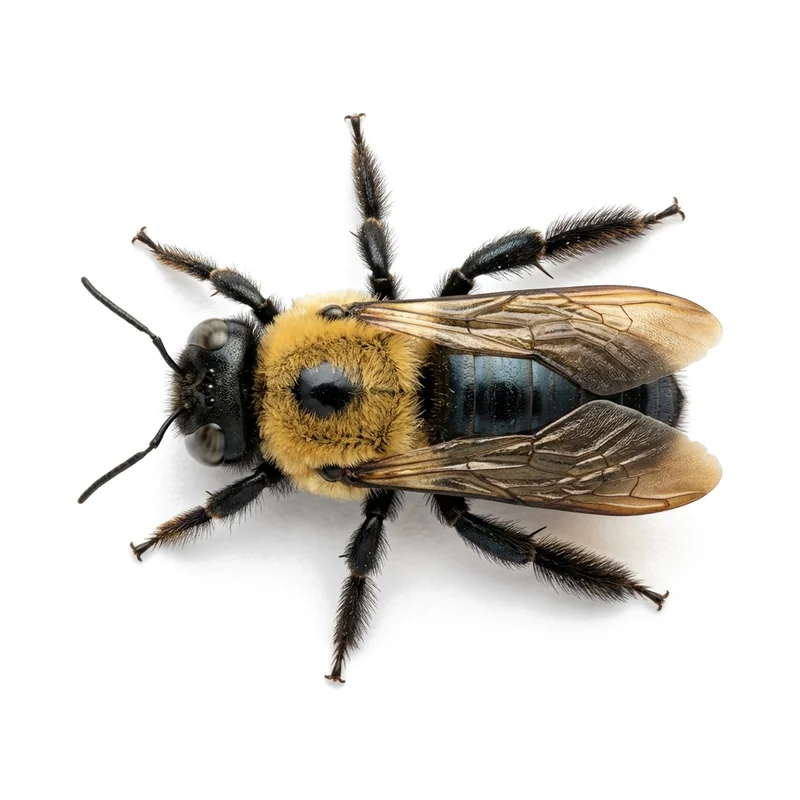
20 to 25 mm, larger than a honey bee. Black with a shiny, hairless abdomen, though the upper body may carry yellow-orange hair. Solitary, so no colony, no workers and no swarm. | Shiny hairless abdomen. No colony and no mass defense. Drills perfectly round holes in unpainted wood such as fascia boards, pergolas and cedar fences. A bee going into a round drilled hole is a carpenter bee. | Single tunnels drilled into unpainted wood, one or two bees to a tunnel. No comb, no honey, and no entry into wall voids through building gaps. |
Honey Bee vs Yellowjacket
The Honey Bee in Three Numbers
100 to 1,000
The University of Florida says a disturbed Africanized honey bee colony may deliver 100 to 1,000 stings, against 10 to 20 from a disturbed European colony.
University of Florida
5 to 6 weeks
University of California Agriculture and Natural Resources says worker honey bees live about five to six weeks in spring and summer.
University of California Agriculture and Natural Resources
45 to 60 seconds
The University of California pest management program says venom keeps entering the skin for 45 to 60 seconds from a honey bee stinger left in place, so remove it at once.
University of California, pest management program
Are Honey Bee Stings Dangerous?
For most people, no. A honey bee sting causes pain, redness and swelling at the spot that clears within hours to a day. The serious risk is anaphylaxis in someone already sensitized, which a single sting can trigger, and honey bee sting guidance from the National Pest Management Association covers the precautions for households with a known venom allergy.
Anyone who has had a whole-body reaction to any bee or wasp sting should carry an epinephrine auto-injector and leave any colony near the home to a professional.
What to Do After a Honey Bee Sting
Get the stinger out at once. The stinger is barbed, so it stays in the skin when the bee pulls away, and the University of California pest management program notes that venom keeps entering the skin from a stinger left in place for 45 to 60 seconds after a sting. Scrape it or pull it, whichever is quicker, because speed matters and the method does not. Then wash the spot with soap and water and hold a cold pack on it.
Call 911 or go to an emergency room right away if a sting is followed by difficulty breathing, wheezing or throat tightening. Hives or flushing that spread beyond the sting, a racing pulse, dizziness or nausea also need emergency care. Anyone with a known venom allergy should get checked after any sting without waiting for symptoms. Fifty or more stings can cause a toxic reaction even in someone with no allergy and need emergency care whatever the person’s history.
Africanized Honey Bees in Collin County
Africanized hybrids are confirmed in Collin County and look identical to European honey bees. They react faster, in larger numbers, and have been recorded chasing a threat for a quarter mile in severe cases. Their venom is no stronger than a European bee’s, so the danger is the number of stings. The University of Florida says a disturbed Africanized colony may answer a disturbance up to 120 feet away and deliver 100 to 1,000 stings, against up to 20 feet and 10 to 20 stings for a European colony. Only a laboratory test tells them apart, which is why every established wild colony is handled as if it could be Africanized.
When Honey Bees Warrant Action
Bees Going In and Out of One Gap
Bees using one fixed gap in a wall, soffit or meter box for more than two days is a colony, not a swarm. It will not leave, and every week adds comb and honey inside the wall.
A Cluster Resting on a Branch or Fence
A swarm has no comb, no young and no honey to defend, so it is calm. Keep people and pets away and give it 24 to 48 hours, because it almost always moves on by itself.
Why You Found Honey Bees in Your House
Honey bees inside a room almost always come from a colony living in a wall or ceiling void. They reach the living space through electrical chase openings, ceiling drywall seams and any gap in the interior wall. The most common trigger is an outside entrance that someone sealed while the colony was still alive, which leaves the workers looking for another way out, often within hours.
Other signs of bees in a house wall are buzzing you can hear through the drywall, a honey smell, or honey-colored staining on the inside of an outside wall. Do not seal the gap the bees use. Call, so the colony can be confirmed and handled in the right order.
Where Honey Bees Get Into Collin County Homes
Honey bees get into slab-on-grade homes through gaps in siding and soffits, fascia gaps at the roofline, chimney flashing, gaps around HVAC line sets, failed gable vent screens, weep holes, water meter boxes and any other unsealed opening. Once inside, workers start attaching wax comb to the framing within hours. One summer can fill several stud bays with comb, and a colony left for two or more seasons can store a large amount of honey.
What Happens When a Wall Colony Dies in Collin County
The honey melt follows a set pattern in homes across McKinney, Allen, Frisco, Plano and the rest of Collin County. A wall colony is killed by insecticide or dies from queen failure, disease or cold. Without the workers fanning the comb, the wax softens in summer heat within days to weeks and the stored honey runs down through the wall.
The first signs are honey-colored stains on interior drywall, something sticky on the outside siding, or a sudden rise in yellowjackets, ants and other pests drawn to the smell. Opening the wall shows honeycombed stud bays and honey soaked into framing and insulation, and repair by a contractor is usually needed at that stage.
A colony inside a heated wall void is active every month of the year, so the calendar shows swarm season rather than survival. Swarms peak March through May, when crowded colonies split, and a colony already in a wall is a risk to the structure in any month.
Field observations of honey bees across Texas on iNaturalist show colonies active year-round throughout the Dallas-Fort Worth region.
Honey Bee Biology Worth Knowing
How Pest Me Off Handles Honey Bee Calls
Every honey bee call starts with swarm or colony, because the right answer for one is the opposite of the right answer for the other. A spring swarm gets 24 to 48 hours and a beekeeper if it stays. A wall colony gets action now.
Swarm or Colony, Confirmed Before Anything Else
A swarm is a cluster resting on a surface with no cavity entrance, there for less than 48 to 72 hours. A colony shows steady traffic through a fixed gap, has been there more than a few days, and may show buzzing through the wall or honey smell or staining at the entrance. A swarm in a low-risk spot gets a 24 to 48 hour wait. A confirmed colony goes straight to assessment.
Beekeeper Assessment for Live Removal
Where opening the wall is practical, live removal (a cut-out) by a registered beekeeper is the preferred first step. The beekeeper opens the wall, takes out the comb, moves the queen and workers into a hive box and cleans the cavity. We coordinate the beekeeper referral when a cut-out is right, which it is for most ground-floor colonies in reachable walls.
Chemical Treatment When Live Removal Is Not Possible
For colonies in walls that cannot be reached, second-floor voids, or spots where opening the wall is not practical, we apply insecticidal dust into the entry gap. We allow 48 to 72 hours, confirm there is no worker activity left before sealing anything, and then open the wall and take the comb out ourselves, as Step 4 describes.
Comb Removal and Entry Sealing
Once the colony is confirmed gone, the comb has to come out. In a reachable wall this can be part of the cut-out in Step 2. After chemical treatment it usually means opening the wall section over the colony to take out all the wax and honey. Pest Me Off does this work itself, as part of our pest exclusion work: we open the wall section, take out all the wax and honey, clean the cavity, and seal the entry gap and any other gaps nearby.
& Quick Fixes
How to Get Rid of Honey Bees Yourself
What a homeowner can safely do is wait out a swarm, close the gaps a swarm would use, and spot a colony early. Each step below costs little or nothing and keeps the comb out of your walls.
Why Honey Bee DIY Fails
Most failed attempts make one of the four mistakes below. Each one deals with the bees you can see and leaves the comb, the gap or the risk that brings the problem back.
Sealing the Entry While Bees Are Still Inside
Blocking the hole of a live colony does not end it. The workers inside look for another way out, and in Collin County slab homes that is through electrical chase openings, ceiling drywall seams or any gap in the interior wall, often within hours. The entry is sealed only after all activity has stopped.
Killing the Colony and Leaving the Comb
Killing the bees is half the job. A sealed wall in Collin County summer heat can melt the comb within weeks of the colony dying, honey soaks the drywall and framing, and the smell draws ants, cockroaches, carpet beetles, wax moths, rodents and next spring’s swarm. Comb removal follows every colony treatment.
Waiting Too Long on a Confirmed Colony
A colony that moves into a wall in June has built far more comb by September. It is building a permanent home and will not leave the way a swarm does. The same job done in June is simpler and cheaper than in September, when far more of the wall has to be opened to get all the comb out.
Assuming Calm Bees Are European Bees
A colony that looks calm from a distance can react very differently up close during a DIY attempt, and an Africanized colony can sting in larger numbers and chase well past the yard. Because nobody can tell the two apart by eye, every established wild colony is a professional job, whatever its temper looks like.
Common Honey Bee Questions
What does a honey bee look like?
What is the difference between a swarm and a colony?
Why is comb removal mandatory after treatment?
Are the bees in my wall Africanized?
Should honey bees be killed instead of relocated?
What should I do if I am stung?
How long can a honey bee colony live in my wall?
I had bees treated last year but they are back in the same spot. Why?
How do I get rid of honey bees in my wall?
Bees in Your Wall. We Confirm Swarm or Colony, Coordinate the Beekeeper, and Get the Comb Out.
We tell you whether it is a swarm or a colony, coordinate live removal when the wall makes a cut-out practical, and make sure all the comb comes out so the call does not repeat next April. Stinger Smackdown across McKinney, Allen, Frisco, Plano and all of Collin County.