
Orb Weaver Spiders in Collin County, TX | Identification and Control
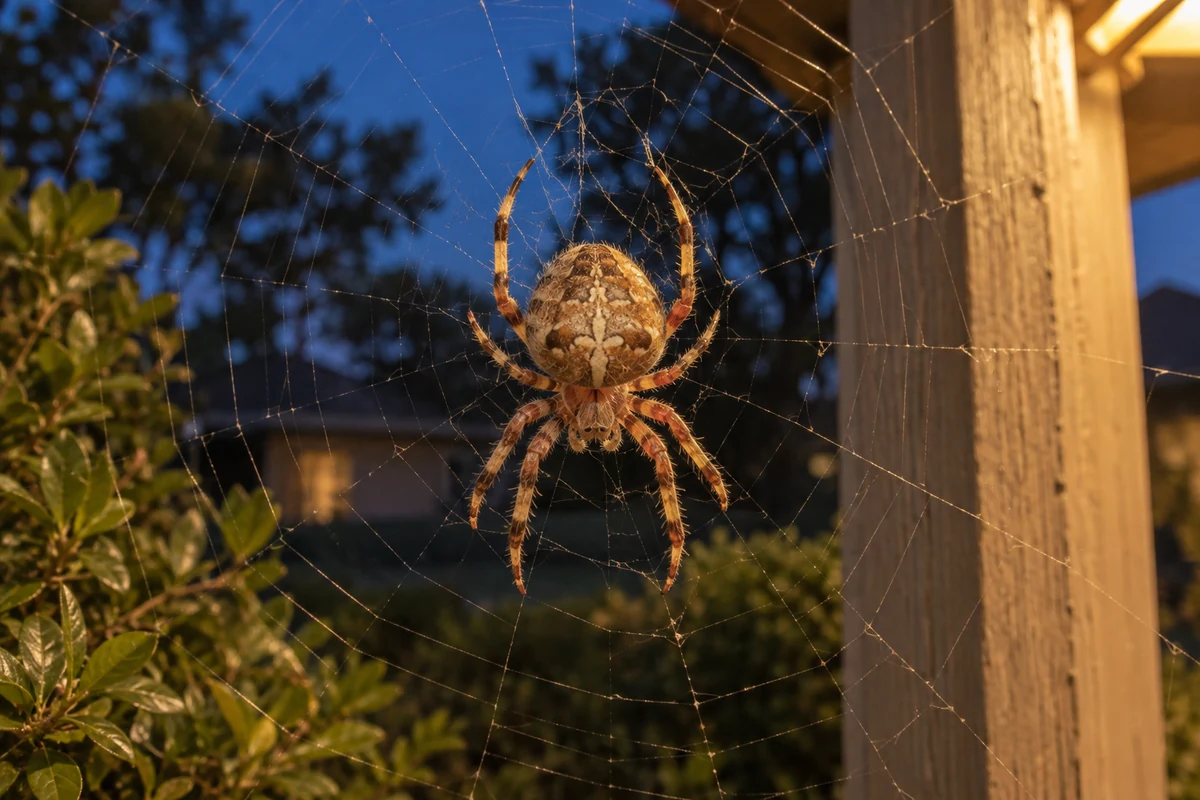
The orb weaver most people meet on a Collin County porch is the spotted orbweaver, or barn spider, a brown, hairy spider that spins a big round web at dusk and hides by day. The University of Florida puts an adult female at up to about 3/4 inch long. It shows up in late summer and fall, often beside an outdoor light, and it is not dangerous to people.
Walked into a big web on your porch in Collin County? Our office sits where McKinney, Plano, Frisco and Allen meet, 5 to 10 minutes from most homes in those four cities. Send us a photo or call, and we will tell you what the spider is.
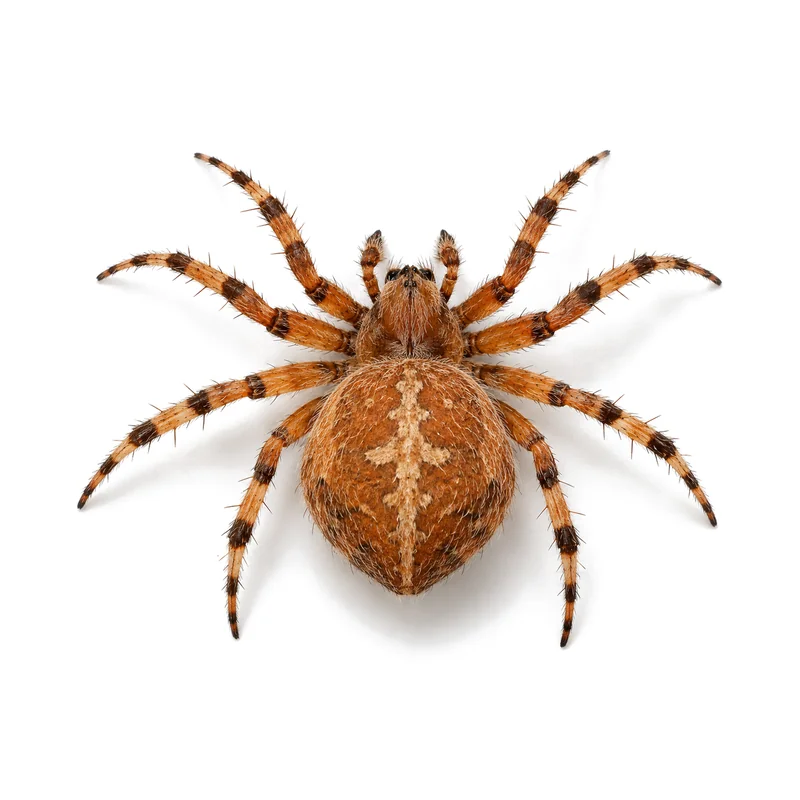
Orb Weaver
A brown, night-working orb weaver that strings a large wheel-shaped web from eaves, trees and shrubs, then eats it at dawn and hides. The Missouri Department of Conservation calls it a widespread species that often builds on the eaves of houses and barns.
Risk Assessment
Choose a row for the full detail- Color
- Reddish brown to brown, hairy, with legs banded light and dark
- Prey
- Flying insects, mostly moths and crane flies
- Threat level
- Low
- Web type
- Round orb web up to nearly 2 feet across, built at dusk
- Lifespan
- One season, the adults die when it freezes
- Eggs per sac
- Up to 1,000, in fluffy yellow silk inside a rolled leaf
- Body length
- Female 1/3 to 3/4 in (8.5 to 19.7 mm), male smaller
What Does an Orb Weaver Spider Look Like?
A brown, hairy spider with a big round abdomen, banded legs and a wheel-shaped web
The female spotted orbweaver is reddish brown to brown, with a large, hairy, roughly round abdomen and legs banded in reddish brown and pale yellow. The University of Florida’s fact sheet on Neoscona orb weavers gives females at 8.5 to 19.7 millimeters, about 1/3 to 3/4 inch, and males at 4.5 to 15 millimeters, and notes a double row of black slash marks on the back half of the abdomen. Mississippi State University Extension adds the two marks that name it, two white spots on the underside and a raised cross shape on top.
The web is usually seen before the spider. It is a classic wheel of spokes and sticky rings, which the University of Florida says can be nearly 2 feet across, often hung from the edge of an eave with its bottom lines tied to a shrub or the ground. There is no thick zigzag band through the middle. The spider builds it at dusk, sits in the center at night, and spends the day in a silk retreat in a corner nearby.
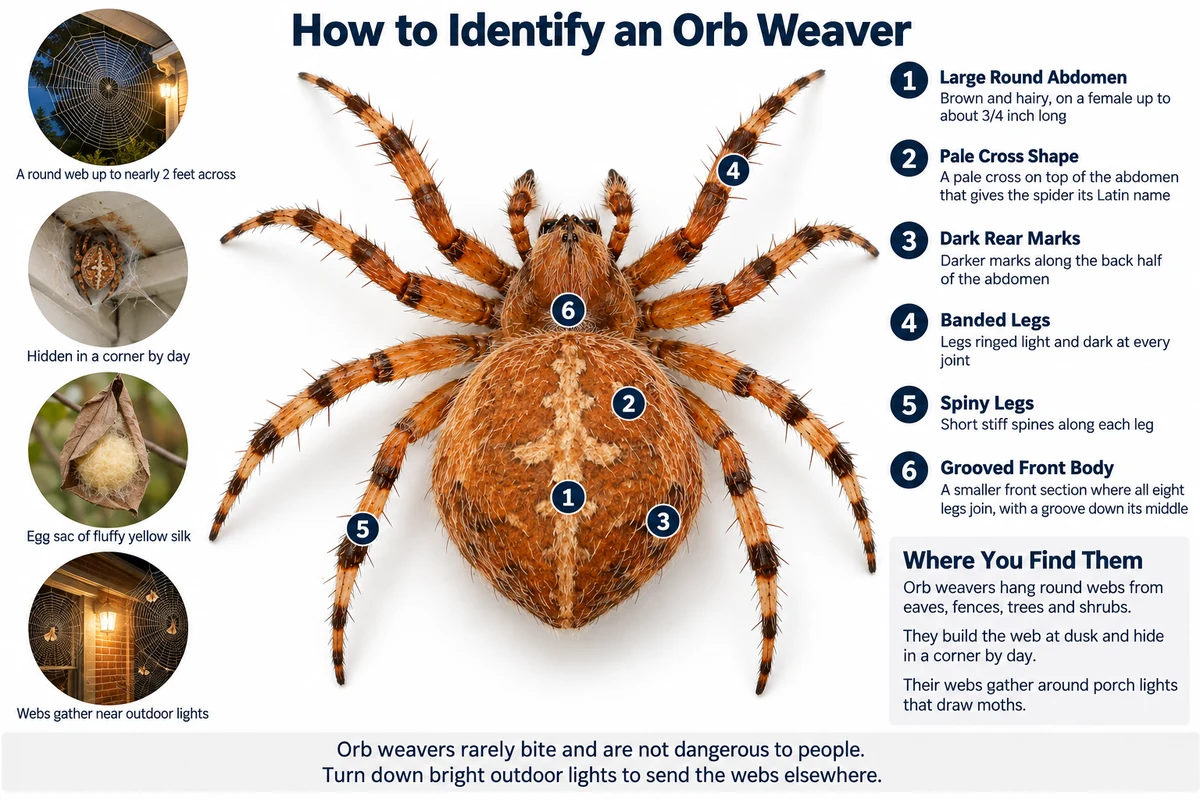
How to identify an orb weaver by its round brown abdomen, its banded legs and the big round web it builds at dusk
- A large round web with spokes and rings, strung from an eave, a fence, a tree or a shrub
- The web appears at dusk and is gone or shrunk by morning
- A brown, hairy spider sitting head down in the center at night
- No thick zigzag band of silk through the middle of the web
- Webs clustered around porch lights and lit windows
- Spiders easiest to see in late summer and fall, when the females are full size
Other Names for the Orb Weaver
Orb weaver is the name for a whole family of spiders that build round webs, and the spotted orbweaver is the one most often found on homes here. Missouri’s conservation department lists barn spider, Hentz orbweaver and arboreal orbweaver as other names for the same spider, and notes that many kinds of spiders build on barns, so barn spider is a loose name. The yellow garden spider is also an orb weaver, but it is a different species with its own page.
Where Are Spotted Orbweavers Found?
A University of Arkansas museum species account gives its range as the eastern United States from Massachusetts and Minnesota to Florida, Texas and central Mexico, so Collin County sits inside it. iNaturalist records from in and around Collin County show far more spotted orbweavers than any other Neoscona.
| Name | What it means |
|---|---|
| Spotted orbweaver | For the two white spots on the underside of the abdomen. |
| Barn spider | For its webs on barns, houses and other buildings. |
| Hentz orbweaver | From its old scientific name, Neoscona hentzii. |
| Arboreal orbweaver | For its habit of building webs in trees. |
| Garden spider | Usually the yellow garden spider, a different orb weaver. |
How to Tell an Orb Weaver from a Yellow Garden Spider, Wolf Spider or Black Widow
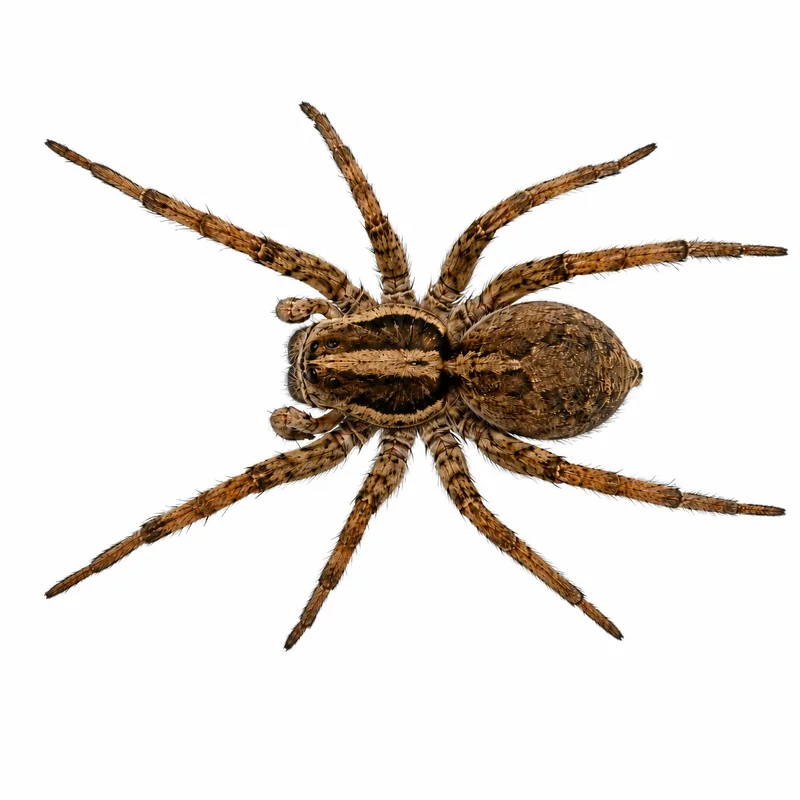
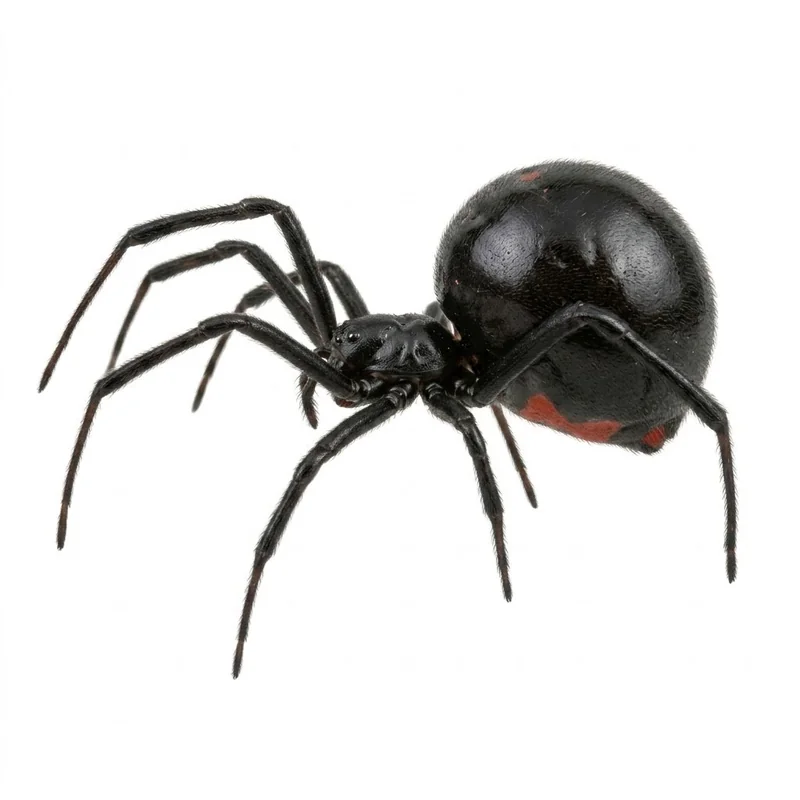
A big spider near the door is usually one of these four, and only one of them is a real health worry. The web tells you most of what you need. A round web up high means an orb weaver, no web at all means a wolf spider, and a messy tangle low in a sheltered spot means a black widow.
| Species | Size and Color | Key Feature | Where Found |
|---|---|---|---|
|
Orb Weaver
AKA: Spotted Orbweaver, Barn Spider
Neoscona crucifera
This species
|
Female body 1/3 to 3/4 inch. Reddish brown to brown and hairy, with banded legs. | Large round web with no zigzag band. Built at dusk, taken down at dawn, spider hidden in a corner by day. | Eaves, porches, fences, trees and shrubs, often beside an outdoor light. |
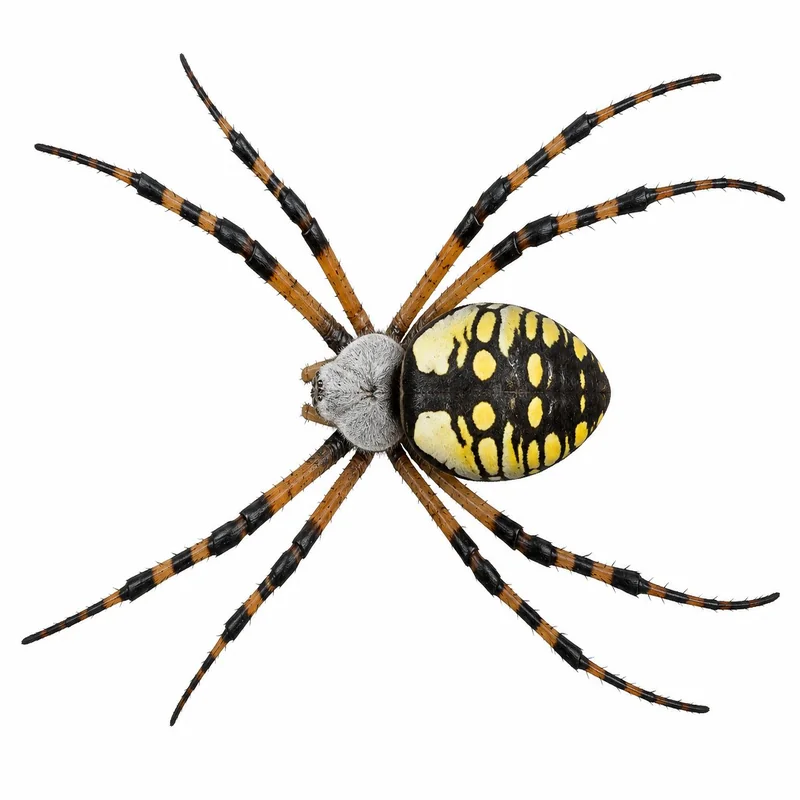
Yellow Garden Spider
AKA: Writing Spider
Argiope aurantia
|
Female body more than 1 inch, legs longer still. Bold black and yellow. | A thick zigzag band of silk through the center of its round web, and it sits in the web by day. | Sunny gardens, tall plants and porches, out in plain view. |
Wolf Spider
AKA: Ground Spider
Lycosidae
|
1/2 to 3 inches. Hairy, mottled brown, gray and black, often with two dark stripes behind the eyes. | Builds no catching web. Hunts on the ground at night and runs fast. | Lawns, mulch and the base of walls, and indoors under door gaps. |
Black Widow
AKA: Southern Black Widow
Latrodectus mactans
|
Female glossy black and rounded, often with a red hourglass underneath. | An untidy tangled web, never a neat round wheel. Its bite is medically significant. | Low, sheltered spots such as woodpiles, meter boxes and garage corners. |
Orb Weaver vs Yellow Garden Spider
The Orb Weaver in Three Numbers
1 year or less
The University of Kentucky says many orb weavers live for 1 year or less, hatching from the egg sac in spring and dying as winter comes.
University of Kentucky
Up to 3/4 in
The University of Florida puts an adult female spotted orbweaver at 8.5 to 19.7 millimeters, up to about 3/4 inch long, with the male smaller.
University of Florida
2 types
Texas A&M AgriLife Extension says only 2 types of spiders in Texas are medically significant, the recluses and the widows, and calls orbweavers harmless to people.
Texas A&M AgriLife Extension
Are Orb Weavers Poisonous or Dangerous?
No. Texas A&M AgriLife Extension’s guide to Texas spiders says only 2 types of spiders in Texas are medically significant, the brown recluse and the widow spiders, and calls orbweavers harmless to people, with large webs that can be a nuisance. The University of Florida says bites from spotted orbweavers are not known to cause serious effects in people.
Do Orb Weaver Spiders Bite?
Rarely, and only when handled. The Missouri Department of Conservation says orbweavers do not bite unless molested, and that their bites are not dangerous anyway. Mississippi State University Extension says the spotted orbweaver is not seriously venomous and rarely bites. The University of Kentucky’s orb weaver page notes that many orb weavers can give a painful bite and that the rare person with a severe allergy to insect and spider bites is the exception, so anyone with that allergy who is bitten should call a doctor.
When an Orb Weaver Is Worth Moving
A Web Across a Door or Walkway
A web rebuilt every evening across the front door, a gate or a path at face height is worth moving, because people walk straight into it after dark.
Several Webs Around Porch Lights
A cluster of webs on the eaves around a porch light means the light is feeding them. Changing the lighting does more than taking the webs down.
One Web in a Tree or Shrub
An orb weaver in the trees or garden, away from where people walk, is catching moths and flies for free. It can be left alone.
A Shiny Black Spider in a Messy Web
A glossy black spider in a tangled web low in a woodpile, meter box or garage corner is not an orb weaver. That is where black widows live, and it needs a closer look.
Where Orb Weavers Live Around Collin County Homes
Orb weavers need tall supports to hang a web between, so the Missouri Department of Conservation finds them on trees, shrubs and buildings, and often beside dusk to dawn lights, where they catch the insects the light draws in. The University of Florida describes the edge of an eave as a favorite top anchor, with the bottom lines tied to a shrub or the ground and a small silk retreat under the eave for the day. Homes beside trees, creeks and greenbelts see the most.
Orb Weaver Pressure Across Collin County
Orb weavers come up in our service notes most in Princeton, Melissa and McKinney, usually on back fences and eaves in late summer, and most often in yards with fruit trees, shrubs and other places to hang a web.
In Plano and Frisco our fall visits record heavy webbing on eaves and around windows, the season when the female orb weavers are full size and easiest to see.
Orb weavers hatch in spring and spend the summer growing, too small to notice. The females reach full size in late summer and early fall, which is when the big webs and the calls arrive, and the adults die when it freezes.
Pattern from the published life cycle of the spotted orbweaver (the Missouri Department of Conservation and the University of Arkansas) and Pest Me Off service notes, which mention orb weavers most in August and September.
How Long Do Orb Weavers Live?
About a year at most. The University of Kentucky says many orb weavers live for 1 year or less, and the Missouri Department of Conservation describes the spotted orbweaver’s year. The young leave the egg sac early in the growing season, grow through summer, reach full size by late summer and early fall, slow down as the nights cool, and die when it freezes. The eggs carry the next generation through winter, so the spider on your porch in October is not the one you will see next August.
Why Orb Weavers Keep Coming Back
How Pest Me Off Handles Orb Weavers
Orb weaver work follows the same order as all our spider control. Many calls end at the first step, once the homeowner knows the spider is harmless, and the rest are about webs in the wrong place.
Confirm the Spider
From a photo or a free inspection, we confirm it is an orb weaver and not a black widow or another spider, and find where the webs are anchored.
Clear the Webs and Egg Sacs
We knock down the webs at the eaves, windows, entryways and fence lines and pull the egg sacs we can find.
Install the Scorched Earth Barrier
A perimeter treatment around the foundation and eave lines, aimed at the spiders and at the flying insects they feed on.
Cut the Light and Keep It Clear
We point out the bright outdoor lights pulling insects to your siding. Homes that want the eaves held clear through summer and fall can add a quarterly plan.
& Other Companies
How to Get Rid of Orb Weavers Yourself
Mississippi State University Extension says control of these spiders is not usually needed, and suggests a broom to move any that build too close for comfort. These steps make your doorway a poor place to build.
Why Some DIY Responses Fail for Orb Weavers
Most DIY trouble with orb weavers comes from spraying the spider and not the light, mistaking it for a dangerous spider, or treating in the wrong season of the year.
Spraying the Spider and Leaving the Light On
The light keeps drawing insects to the same eave, so another orb weaver soon takes the spot. Change the light and the web site loses its pull.
Mistaking It for a Black Widow
A big brown spider in a round web up high is not a black widow. Check the web first, so the effort goes where the real risk is.
Treating in Spring for a Fall Spider
In spring the young are still tiny and hidden. Heavy spraying then does not stop the full-size females that show up in late summer.
Common Orb Weaver Questions
What is an orb weaver spider?
How big do orb weavers get?
How long do orb weavers live?
Do orb weaver spiders bite, and are they poisonous?
Is an orb weaver the same as a barn spider?
What is the difference between an orb weaver and a yellow garden spider?
Where do orb weavers lay their eggs, and how many?
Why is there a new spider web on my porch every morning?
Are orb weavers good to have around?
How do I get rid of orb weavers?
Webs Across the Porch Every Night? We Clear Them and Cut What Feeds Them.
We confirm the spider, clear the webs and egg sacs from your eaves, windows and fences, and treat the insects that keep drawing new ones in. Spider control across McKinney, Allen, Frisco, Plano, and all of Collin County.