
Earwigs in Collin County, TX | Identification and Control
The earwig is the slim brown insect with a pair of pincers on its tail that turns up in bathrooms, by back doors and under every pot in the flower bed. It breeds in damp mulch and soil, comes out at night, and walks indoors when the weather turns hot and dry. Penn State Extension counts 22 earwig species in the United States, and only four or five of them commonly invade homes. It can pinch, but it has no venom and carries no disease.
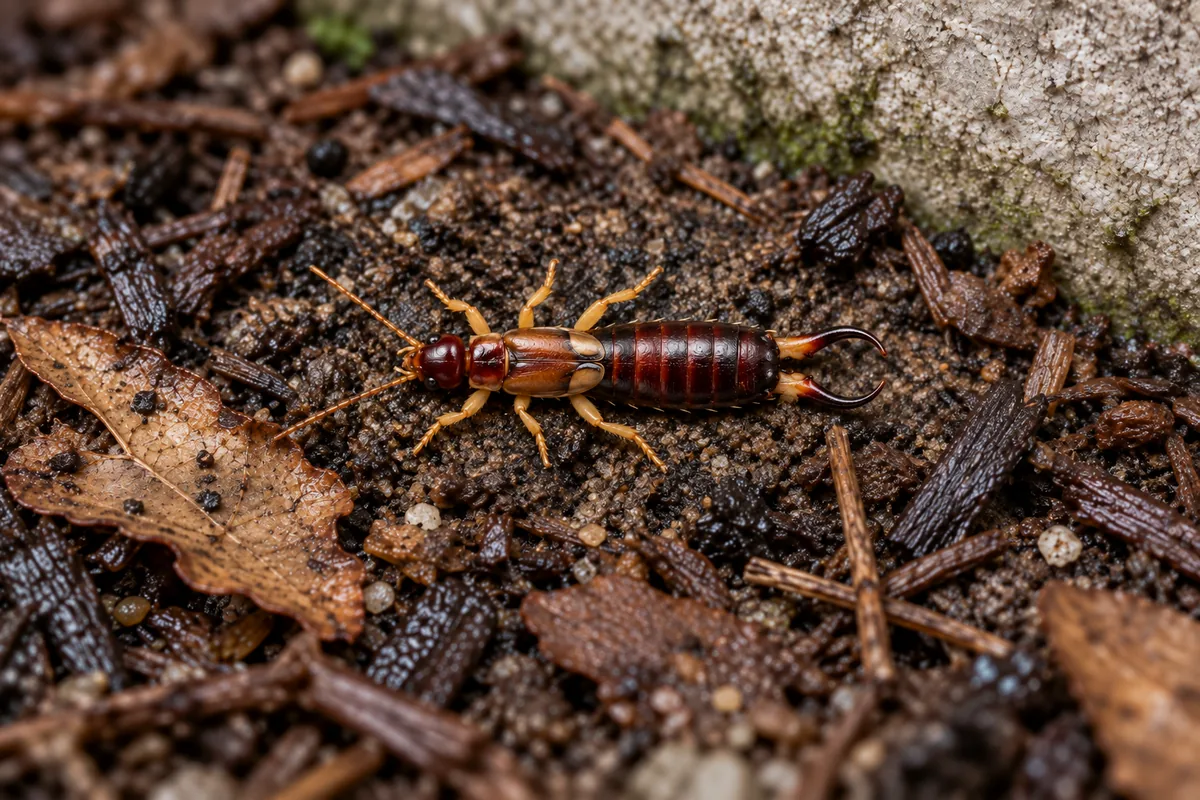
Pincher bugs in the bathroom or under the mulch? Our office sits where McKinney, Plano, Frisco and Allen meet, 5 to 10 minutes from most homes in those four cities. Call and we will find the wet spot they breed in and the gaps they use to get inside.
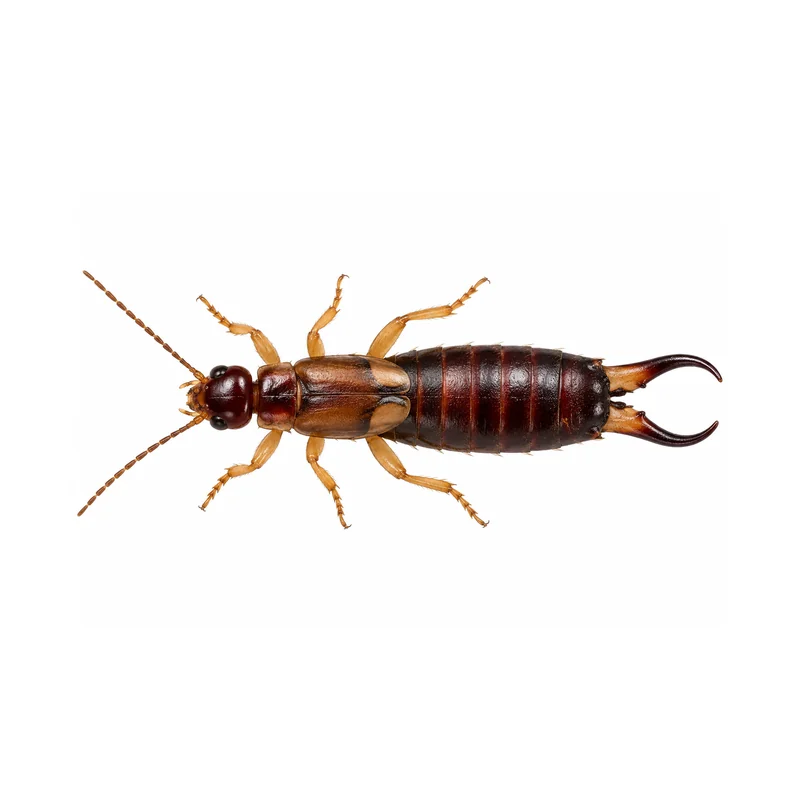
Earwig
The earwig is a night-active scavenger that hides by day in damp, dark spots and wanders indoors toward water. Penn State Extension notes that despite the name, earwigs do not crawl into the human ear.
Risk Assessment
Choose a row for the full detail- Color
- Dark brown or reddish brown, with paler legs
- Diet
- Dead plant matter, small insects, seedlings and soft fruit
- Threat level
- Low
- Smell when crushed
- A foul odor when disturbed or crushed
- Where it hides
- Damp mulch, and under boards, pots and stones
- Eggs
- 40 to 50 a clutch, guarded by the mother
- Size
- About 1/2 to 3/4 inch long
What Does an Earwig Look Like?
A long, flat brown insect with a pair of pincers on the tip of its tail
An earwig is long, flat and shiny, dark brown or reddish brown, with long thin feelers and a pair of pincers at the end of its body. NC State Extension describes the European earwig as about 1/2 to 3/4 inch long with a reddish head, and says that when wings are present the front pair are hard and very short, barely covering the start of the body. The pincers tell male from female. They are strongly curved on a male and only slightly curved on a female.
The earwig in our photos is the European earwig, the best-known kind. The University of Florida’s Featured Creatures sheet on the European earwig says it prefers cooler climates but survives where yards are watered. The same collection’s ringlegged earwig sheet calls that kind widespread in the southern states. It has no wings at all, a dark brown body about 1/2 to 2/3 inch long, and pale legs, each with a dark band around it.
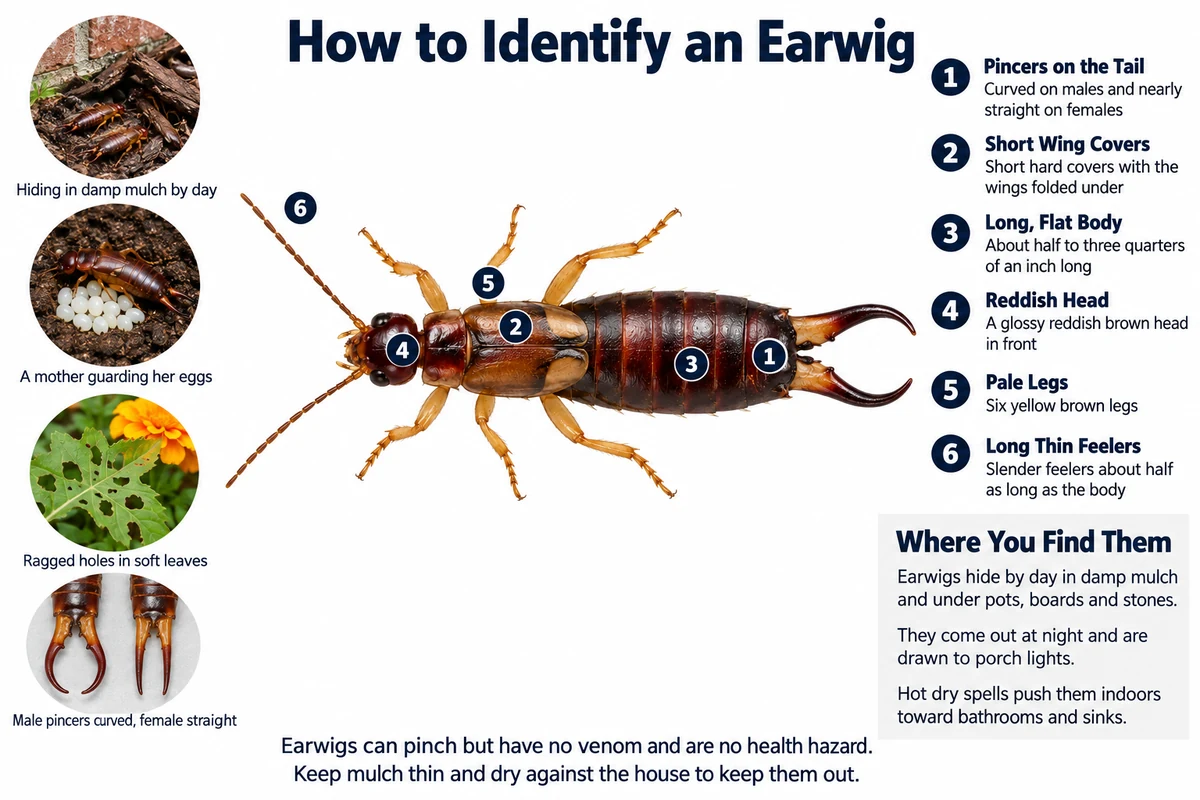
How to identify an earwig by the pincers on its tail, its long flat body and its short wing covers, with the places it hides and the holes it chews
- A pair of pincers on the tail end, held up when the insect is disturbed
- Several hiding together under a pot, a stone or a board in a damp bed
- Earwigs in the tub, by a floor drain or under the sink, found at night
- A sharp, unpleasant smell when one is crushed
- Ragged holes chewed in seedlings, soft leaves and flower petals
- Dead earwigs along door thresholds and windowsills in the morning
Other Names for the Earwig
The name comes from an old European superstition. Penn State Extension says earwig literally means ear creature, from the belief that these insects crawl into the ears of sleeping people and bore into the brain. They do not. Around Collin County most people simply call them pincher bugs, after the pincers on the tail. In Spanish the earwig is the tijereta, the little scissors.
Earwig is not one species. Penn State Extension counts 22 earwig species in the United States, 12 of them brought in from other countries, and the two names below are the kinds homeowners meet most. They live, breed and are controlled the same way.
| Name | What it means |
|---|---|
| Pincher bug | The everyday name, for the pincers on its tail. |
| Pincer bug | The same name, spelled the other way. |
| European earwig | The winged kind in our photos, common where yards are watered. |
| Ringlegged earwig | A wingless kind with a dark ring on each pale leg. |
| Tijereta | The Spanish name, meaning the little scissors. |
How to Tell an Earwig from a Silverfish or Springtail
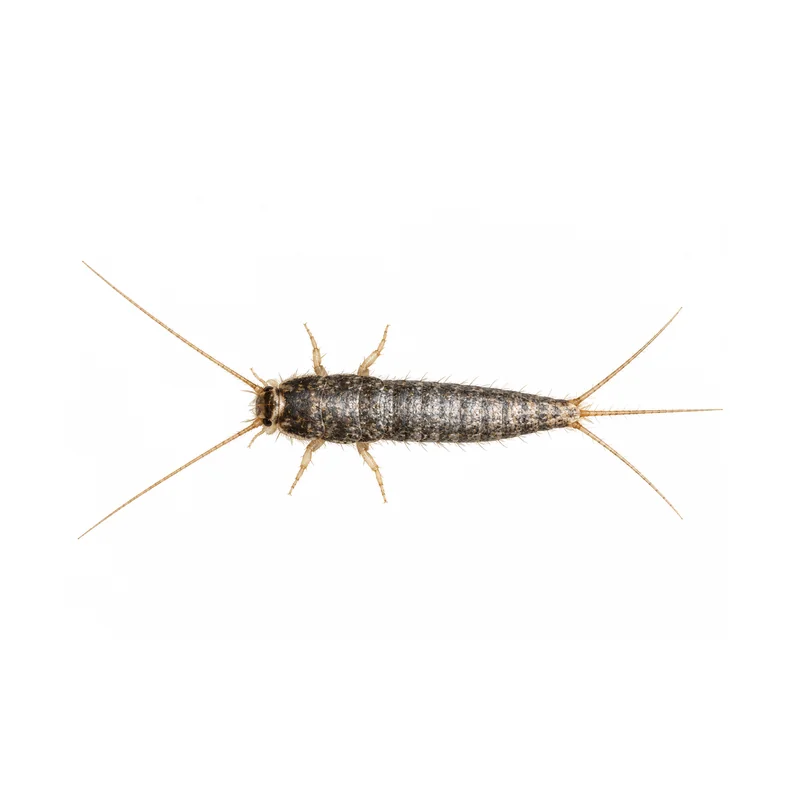
All three turn up in damp bathrooms and along baseboards in Collin County homes, and our office has taken calls where a homeowner could not tell which one it was. The tail end settles it. Only the earwig carries pincers.
| Species | Size and Color | Key Feature | Where Found |
|---|---|---|---|
|
Earwig
AKA: Pincher Bug, Pincer Bug
Order Dermaptera
This species
|
About 1/2 to 3/4 inch. Dark brown or reddish brown with paler legs. | A pair of pincers at the tail, curved on males and straighter on females. Short wing covers or no wings. | Damp mulch, under pots, boards and stones, and indoors near drains, tubs and sinks. |
Silverfish
Lepisma saccharina
|
About 1/2 to 3/4 inch. Covered in silver or gray scales. | Carrot-shaped and wingless, with three long tail-like strands and no pincers. Moves with a wiggle like a fish. | Bathrooms, basements and shelves of stored books, papers and boxes. |
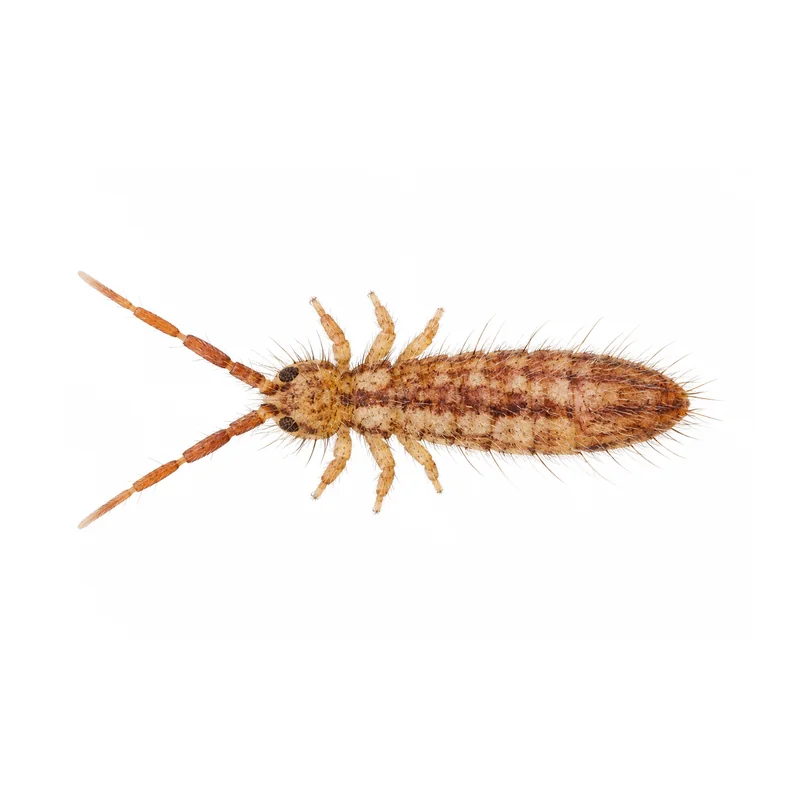
Springtail
AKA: Snow Flea
Collembola
|
Tiny, about 1 to 2 mm. White, gray or black. | Jumps when disturbed, using a forked tail folded under its body. No pincers. | Damp mulch and soil, and humid bathrooms and basements, often in large numbers. |
Earwig vs Silverfish
The Earwig in Three Numbers
22
Penn State Extension counts 22 earwig species in the United States, and only four or five of them commonly invade homes.
Penn State Extension
40 to 50
The University of Florida’s Featured Creatures sheet gives the ringlegged earwig an average clutch of 40 to 50 eggs, which the mother guards in a small cell in the soil.
University of Florida, Featured Creatures
12 to 18 inches
NC State Extension advises a clean, dry gravel border 12 to 18 inches wide against the foundation wall as a barrier to earwigs and other invading pests.
NC State Extension
Do Earwigs Bite or Pinch?
They can pinch, but only in defense. The University of California’s pest notes on earwigs say that despite their ferocious look, earwigs generally do not attack people, though they can bite if trapped in clothing or sat upon, and that even large numbers indoors present no health hazard. Penn State Extension says the pincers are used mainly as protective weapons and to catch prey. A pinch may sting for a moment. Wash it with soap and water. There is no venom involved.
Do Earwigs Crawl Into Your Ears?
No. The name comes from an old superstition that earwigs crawl into the ears of sleeping people and bore into the brain, and Penn State Extension states plainly that these insects do not crawl into the human ear. An earwig in the bedroom is looking for a damp, dark gap to hide in, the same as one under a flowerpot.
When Earwig Activity Needs Fast Action
Earwigs Inside Every Night
Several a night means a steady path in from a wet bed outside, usually through a weep hole in the brick or a gap under a door. The source outside is what needs fixing.
Earwigs at a Sink or Tub
Earwigs gather where there is water. Check under the sink, the dishwasher and the tub for a slow leak, which keeps drawing them in.
A Pinch on the Hand
Wash it with soap and water. An earwig has no venom, and a pinch only happens when one is pressed against skin or caught in clothing.
One Earwig by the Back Door
A single earwig on a dry floor has usually wandered in and will die there, with little to eat. Sweep it up and watch for more.
Why You Have Earwigs in Your House
Earwigs come in from outside, looking for water and shelter. NC State Extension says they are drawn to the moisture around homes, especially when the weather turns hot and dry, that they migrate indoors in dry spells, and that they are drawn to lights. A mulch bed watered every day against the slab, a downspout emptying beside the wall, a dripping outdoor faucet or an air conditioner draining onto the ground gives them a place to breed a few steps from the house.
From there they walk in through weep holes in the brick, gaps under doors and sliding door tracks, and cracks along the slab, then head for the wettest rooms, the bathrooms, the kitchen sink and the laundry. The University of California’s pest notes add that earwigs die indoors because there is little for them to eat, so a steady supply of new ones means a steady source outside. It is not a sign of a dirty home.
Where Earwigs Live Around Collin County Homes
Earwigs need cool, moist places. NC State Extension lists flower beds near the home, mulch, compost piles, trash, the ground under boards and wood piles, and damp crawl spaces. The University of California’s pest notes add dense vines, ground cover and weeds, and warn that mulch often harbors them. In the garden they chew ragged holes in seedlings and flowers such as zinnias, marigolds and dahlias, though they also eat aphids.
Earwig Pressure Across Collin County
Earwig calls show up in our service notes most often in McKinney, Frisco and Plano, usually as earwigs in a bathroom, by a drain or along the baseboards, with wet mulch or heavy watering outside the same wall.
In Prosper, Allen, Princeton and Melissa we see the same pattern, and our notes tie the worst cases to landscape watering, a yard that drains toward the house, or a gap at a porch or door seal.
Earwigs are out from spring to late fall in Collin County. New young appear in spring and again in fall, and the hot, dry end of summer drives the most of them indoors toward water, which is when our earwig calls run heaviest.
Pattern from published earwig biology (NC State Extension and the University of Florida) and Pest Me Off earwig calls, which run heaviest from August through October.
Why Earwigs Keep Coming Back
How Pest Me Off Gets Rid of Earwigs
Earwig control is four steps, every job. Killing the earwigs you can see is only part of the fix, because the rest are breeding in the damp bed outside the same wall.
Inspect and Find the Source
A free inspection of the mulch beds, the foundation, the weep holes, door thresholds and the rooms where you see them. We confirm they are earwigs and not silverfish or springtails, and find the wet spot keeping them there.
Treat the Beds They Breed In
A granular treatment worked into the mulch and soil where they hide and breed, and a knockdown treatment for the earwigs active indoors and out.
Close the Way In
The Scorched Earth Barrier at the slab edge, and the weep holes, door thresholds and slab cracks earwigs use treated and sealed, on the same visit.
Fix the Moisture and Defend
We show you the moisture to fix, deep mulch, sprinklers hitting the brick or a bed that never dries. Quarterly visits keep the barrier working through each season if you want the home held.
& Other Companies
How to Get Rid of Earwigs Yourself
Most DIY earwig work happens outside. NC State Extension says that for best control indoors you must first control earwigs outdoors, starting with the moisture and the ways in.
Why Some DIY Responses Fail for Earwigs
Most DIY earwig trouble comes from treating inside while the beds outside stay wet, so new earwigs keep walking in no matter how many are killed.
Spraying Only Indoors
NC State Extension says indoor sprays kill earwigs easily but the control is short-term, because more keep coming from outdoors. Indoor spraying alone does not stop the next wave.
Deep Mulch Watered Daily
A thick bed of mulch against the slab, watered every day, stays cool and wet all summer, which is exactly where earwigs breed.
Bright White Porch Lights
Earwigs are drawn to lights. NC State Extension suggests yellow bulbs by the doors and windows, which draw fewer insects than white ones.
Common Earwig Questions
What is an earwig, and what does it look like?
Do earwigs bite or pinch people?
Do earwigs really crawl into your ears?
Are earwigs dangerous to people or pets?
Why do I have earwigs in my bathroom?
What do earwigs eat?
Can earwigs fly?
Do earwigs damage plants or the house?
Is it an earwig or a silverfish?
How do I get rid of earwigs?
Pincher Bugs in the Bathroom? We Stop Them at the Mulch Bed.
We find the bed they breed in and the gaps they use, treat the mulch and the slab edge, treat and seal the weep holes and door thresholds, and show you the wet spot to fix. Earwig control across McKinney, Allen, Frisco, Plano, and all of Collin County.