Paper Wasps in Collin County, TX | Identification and Control
Paper wasps (Polistes species), also called umbrella wasps for their open, umbrella-shaped paper nests, are the wasp and hornet call Pest Me Off gets most often every spring in McKinney, Allen, Frisco and Plano. They build on eaves, porch ceilings, door frames and light fixtures, right where people walk. Texas A&M AgriLife Extension puts a typical mature nest at 20 to 30 adult paper wasps. They leave people alone away from the nest, but each one can sting more than once when the nest is bumped.
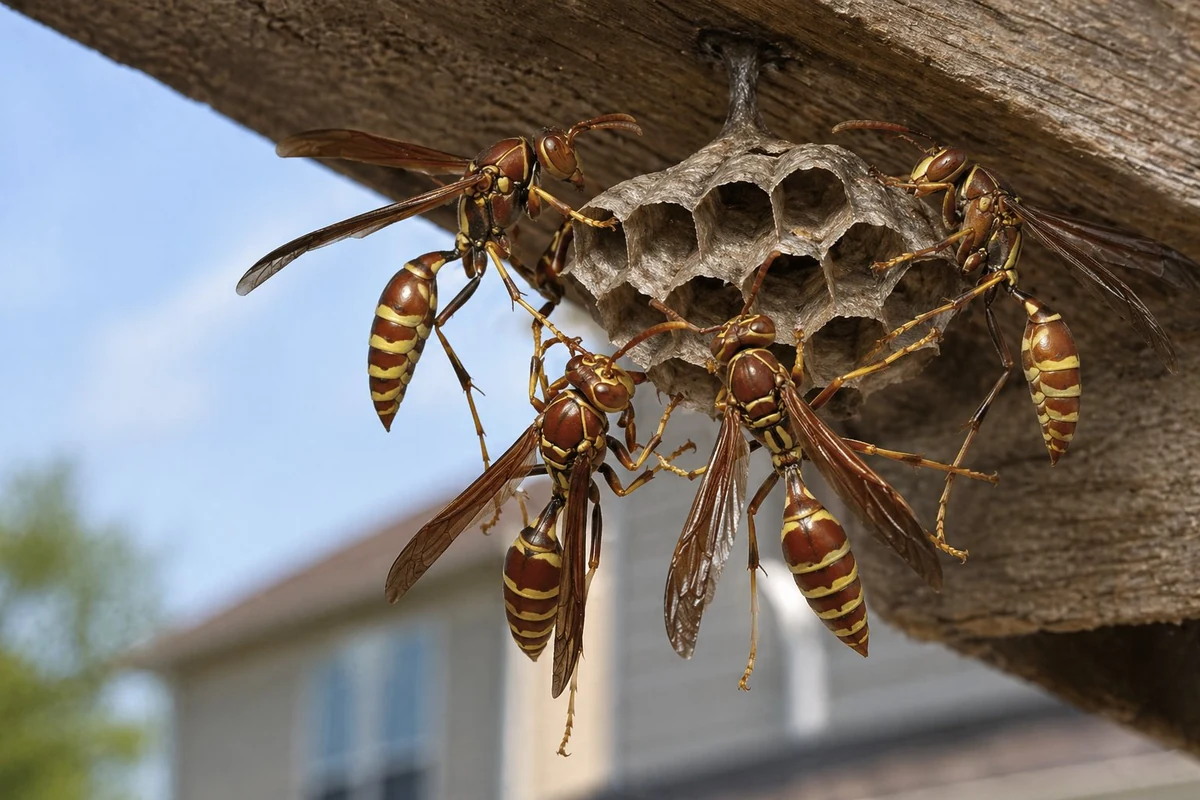
Found a nest on your eave or porch in Collin County? Our office sits where McKinney, Plano, Frisco and Allen meet, 5 to 10 minutes from most homes in those four cities. Send us a photo or call, and we will tell you what the wasp is.
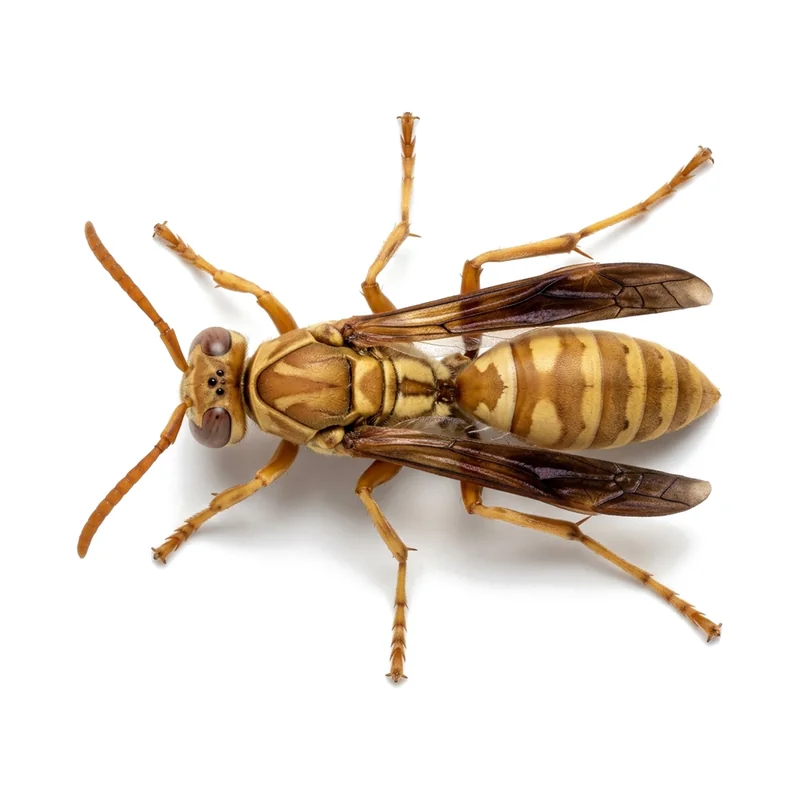
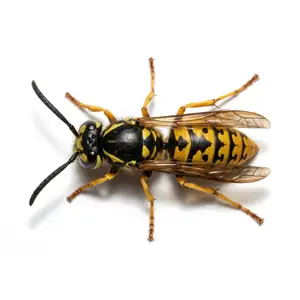
Paper Wasp
Several Polistes species are active across Collin County, and all of them get the same treatment.
Risk Assessment
Choose a row for the full detail- Color
- Brownish-orange with yellow markings, or reddish-brown to dark in some species
- Colony size
- 20 to 75 adults at peak
- Can sting
- Yes, more than once, because the stinger is not barbed
- Threat level
- Moderate
- Nest
- Open umbrella-shaped paper comb with no outer cover
- Active season
- March through October in Collin County
- Body length
- 16 to 25 mm, about 0.6 to 1 in
What a Paper Wasp Looks Like
Paper wasps run 16 to 25 mm long, from the size of a large paper clip to just under an inch. The color changes by species but is always some mix of brown, orange, red and yellow, on a slender body with a narrow, pinched waist. Texas A&M AgriLife Extension says paper wasps are 3/4 to 1 inch long and reddish-orange to dark brown (Texas A&M AgriLife Extension), and the Missouri Department of Conservation says they fly with their legs dangling (Missouri Department of Conservation).
The quickest tell is in flight. The long hind legs hang down below the body, and no other common Collin County wasp flies that way. The nest settles it. Its six-sided cells face down in plain view, with no paper wrapper around them.
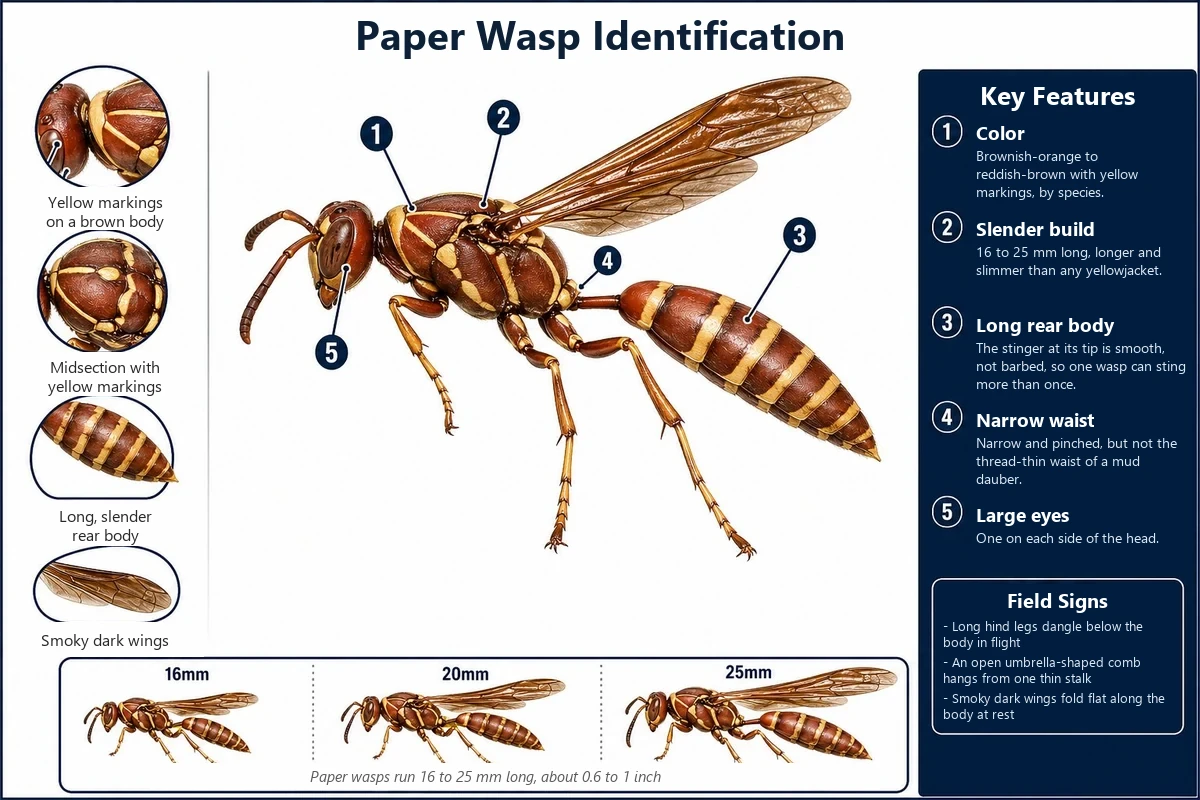
How to identify a paper wasp by its narrow waist, dangling legs and open comb nest
- Long hind legs dangle below the body in flight, which no other common Collin County wasp does
- Open six-sided cells in the comb are fully visible from below, with no paper envelope
- The nest hangs from one thin central stalk attached to a sheltered surface
- Slender body with a very narrow wasp waist between the middle and rear sections
- Wings fold lengthwise along the body at rest
- The nest is the size of a silver dollar to a dinner plate, never football-sized
Other Names for the Paper Wasp
Paper wasp, umbrella wasp, red wasp and guinea wasp all name the same group of wasps, Polistes. They build the same open paper comb and are treated the same way. The different names are regional habit, not different insects, so if you searched for any of them, this is your wasp.
Which Paper Wasp Species Live in Collin County?
Several, and the two most common are the red wasp, Polistes carolina, a reddish-brown species with purple-black wings, and the guinea wasp, Polistes exclamans, a brownish-orange species with yellow markings. Telling Polistes species apart takes an expert, and it is not needed to confirm a paper wasp or to start treatment.
| Name | What it means |
|---|---|
| Umbrella wasp | The most descriptive name. Seen from below, the rounded comb looks like an open umbrella hanging from its handle. |
| Red wasp | What most Collin County homeowners call Polistes carolina, the reddish-brown species with purple-black wings. |
| Guinea wasp | The name for Polistes exclamans, the brownish-orange species with yellow markings, just as common here. |
| Paper wasp | The standard name in pest control, for the paper comb it builds. |
How to Tell Paper Wasps from Other Collin County Wasps
The open comb is the one feature that rules out every other wasp. If the nest is wrapped in a paper cover, or the wasps fly in and out of a hole, it is not a paper wasp. The table compares it with the three wasps it is most often mistaken for.
| Species | Size | Key Feature | Nesting Habit |
|---|---|---|---|
|
Paper Wasp
AKA: Umbrella Wasp, Red Wasp, Guinea Wasp
Polistes species
This species
|
16 to 25 mm. Slender build with a very narrow waist. Brownish-orange, reddish-brown or dark depending on species. Longer and slimmer than any yellowjacket worker. | Long hind legs dangle below the body in flight, visible at a distance. Open-celled nest with no paper envelope. Smoky dark wings fold flat along the body at rest. Ignores people unless the nest is approached or disturbed. | Only on exposed, sheltered surfaces such as eaves, porch ceilings, door and window frames, shutters, outdoor furniture and equipment housings. Never in the ground or inside a wall. The comb always hangs from one central stalk. |
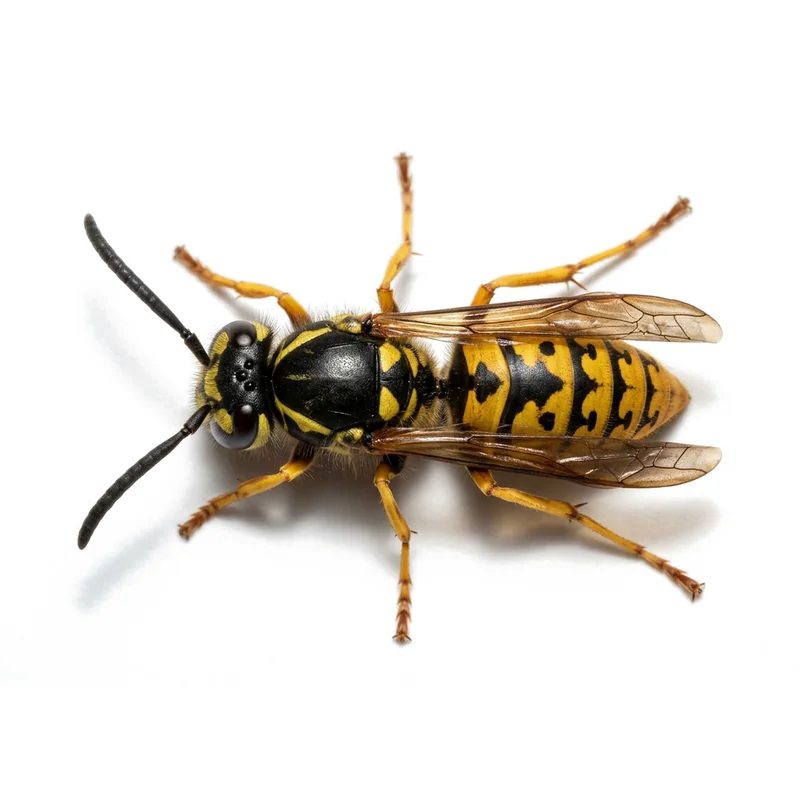
Yellowjacket
AKA: Ground Hornet
Vespula species
|
10 to 16 mm. Stocky and compact. Bright yellow and black bands. Legs held close to the body in flight. Shorter and heavier than a paper wasp seen at the same distance. | Yellow and black pattern brighter and sharper than the paper wasp’s brownish-orange. Far more aggressive defense, with workers chasing and stinging well away from the nest. No nest visible on the house, only an entry hole or crack. | Most Collin County colonies nest underground or inside wall voids reached through a crack, weep hole or expansion joint. A hole with fast in-and-out traffic is the sign. Never an open comb on an eave. |
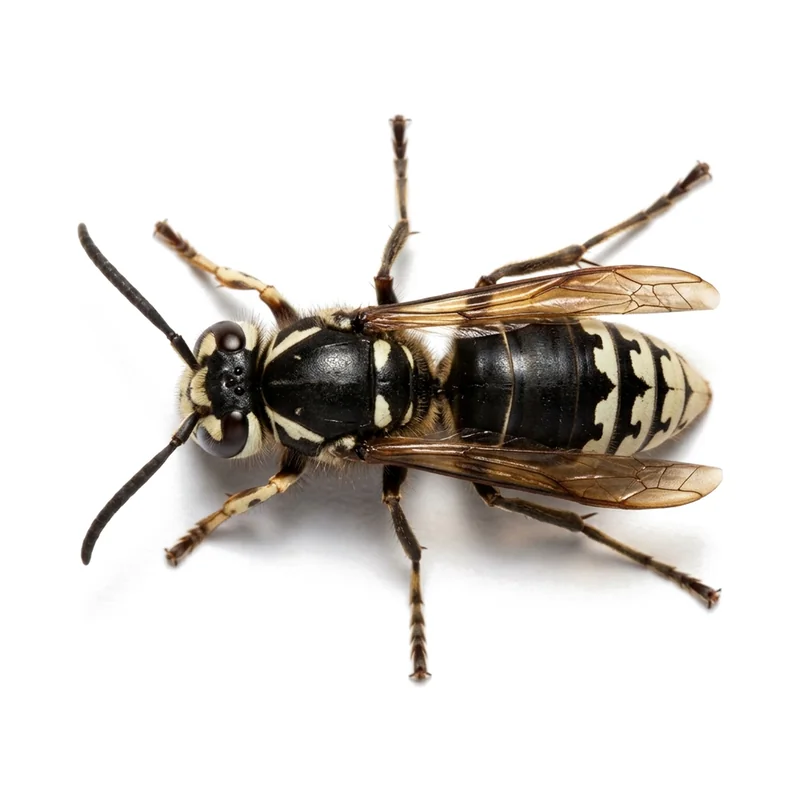
Bald-Faced Hornet
AKA: White-Faced Hornet
Dolichovespula maculata
|
15 to 20 mm. Solid, heavy build, larger than a yellowjacket. Black body with white markings on the face, the tip of the abdomen and the upper body. Looks much heavier in flight than a paper wasp of the same length. | White markings on a black body, a pattern no other common Collin County wasp shares. Builds a large enclosed gray paper nest shaped like a football. One of the most defensive wasps in the area, and it can spray venom toward an intruder’s eyes. | Enclosed gray paper ball hanging in a tree, a shrub or from an overhang, with one entry hole at the bottom. Grows month by month and can pass basketball size by September. Never an open comb, never in the ground. |
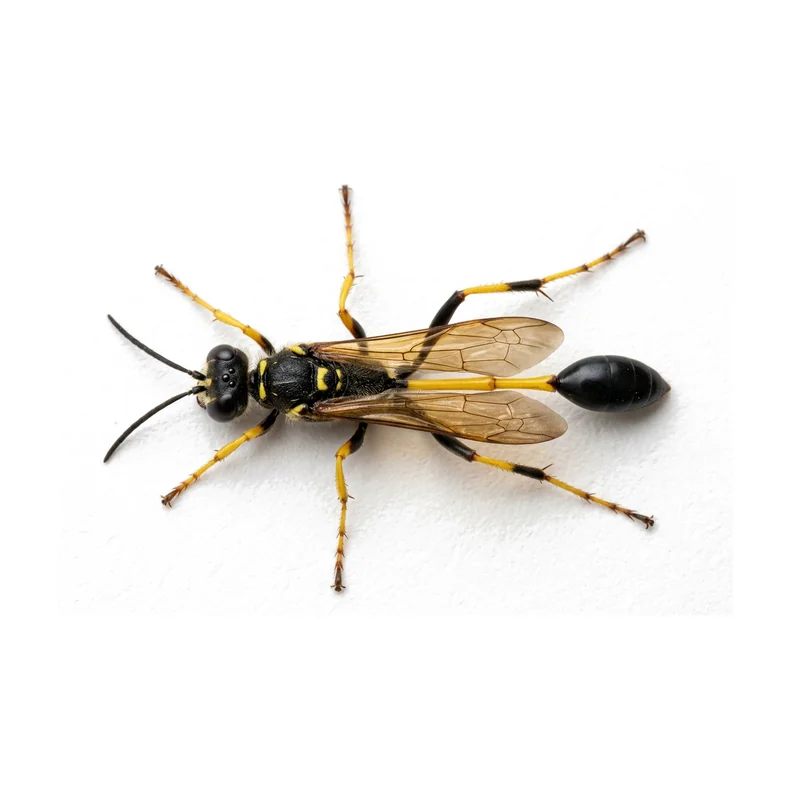
Mud Dauber
AKA: Dirt Dauber, Mud Wasp
Sceliphron caementarium
|
21 to 25 mm. Extremely slender, with a long thread-like waist between the middle and rear body. Black with yellow on the legs and middle body. Longer and more angular than a paper wasp. | The thread-thin waist is unlike any other common Collin County wasp. Solitary, with no colony, no workers and no nest defense. Rarely stings and flies slowly. Builds mud tubes, not paper combs. | Clusters of mud tubes on sheltered walls and ceilings in garages, porches, eaves and sheds. Each tube is stocked with paralyzed spiders and sealed. No paper and no colony living on the house. |
Paper Wasp vs Yellowjacket
The Paper Wasp in Three Numbers
20 to 30
Texas A&M AgriLife Extension puts a typical mature paper wasp nest at 20 to 30 adults, small next to a yellowjacket colony of thousands.
Texas A&M AgriLife Extension
3/4 to 1 inch
Texas A&M AgriLife Extension says paper wasps are 3/4 to 1 inch long, reddish-orange to dark brown.
Texas A&M AgriLife Extension
200 cells
Texas A&M AgriLife Extension says a mature paper wasp nest rarely holds more than 200 cells, the open comb you can see from below.
Texas A&M AgriLife Extension
Are Paper Wasps Dangerous or Aggressive?
Paper wasps are dangerous mainly to people allergic to wasp venom, and they are defensive rather than aggressive. They ignore people more than three or four feet away. Touching the nest or reaching right up to it brings an immediate sting. Wasps away from the nest sting only when trapped against skin.
Colonies are most defensive in August and September, when they are largest and guarding new queens.
Paper Wasp Sting Symptoms and What to Do
A paper wasp sting causes sharp pain right away, then redness and swelling that usually clears within a few hours for a single sting. The stinger is smooth, not barbed, so one wasp can sting several times in one encounter. Several stings from a disturbed colony bring a bigger local reaction and, in some people, nausea.
The serious risk is anaphylaxis in people with a known or undiagnosed wasp venom allergy. A past sting without trouble does not rule it out, because sensitivity can build over later stings. Anyone who has had hives, throat tightening, dizziness or trouble breathing after a sting should carry an epinephrine auto-injector and leave paper wasp nests to a professional.
Call 911 or go to an emergency room right away if a sting is followed by difficulty breathing, wheezing or throat tightening. Hives or flushing that spread beyond the sting, dizziness or a racing pulse, and multiple stings on a child or an elderly person also need emergency care. Anyone with a known venom allergy should not wait for symptoms to get worse. These are signs of anaphylaxis and do not clear up on their own.
When a Paper Wasp Nest Warrants Action
Nest Near a Door, Light or Seat
A nest right beside a door handle, porch light or chair back puts people within stinging range every day. That contact zone makes professional removal the right call.
Nest Away From Foot Traffic
A nest well away from where people walk, sit or play can be left alone. The wasps hunt caterpillars, flies and other soft-bodied insects in the garden.
Where Paper Wasps Nest Around Your Home
Paper wasps build only on the outside of a house, on surfaces sheltered from rain but open to the air. Eaves, porch ceilings, door and window frames, shutters, soffit vents, light fixtures, outdoor furniture, the underside of deck boards and equipment housings are all common spots. For nest material they scrape fiber from weathered, unpainted wood such as fence posts, deck railings, pergola beams and raw fascia boards. The scraping does not weaken the wood, but it speeds up weathering on bare surfaces.
Paper Wasp Pressure Across Collin County
New construction in Prosper, Celina, Anna, Melissa and Fairview sees the heaviest pressure. Fresh, unweathered eaves and soffits draw founding queens, raw lumber nearby supplies wood fiber, and no older colonies hold the territory yet. Pest Me Off service records show new homes in Prosper, Celina and Anna regularly carry 4 to 6 active nests across a single roofline. The same home usually sees fewer by year three, as colonies settle territory and raw wood is painted or weathers.
Established neighborhoods in McKinney, Allen, Frisco and Plano see less first-spring activity, because resident colonies already compete for the space.
Queens start moving in late February during warm stretches, and activity builds through spring. The worker population peaks in August and September. The colony dies off after the first hard freeze in November.
Seasonal pattern documented by iNaturalist observations of paper wasps across North America.
Paper Wasp Colony Cycle and Why the Same Spot Gets Reused
How Pest Me Off Treats Paper Wasps
We treat paper wasps in four steps, each one closing a gap that a one-time spray leaves open. Texas A&M Extension treatment guidance points to nighttime application and treating the surface as the steps that failed self-treatment most often skips.
Full Perimeter Survey
We walk the whole house in daylight and mark every active nest before any product goes down. Paper wasps often build satellite nests within 10 to 20 feet of the main one, inside a soffit vent, behind a shutter, under a deck board or under outdoor furniture.
Nighttime Direct Application
We treat after dark, when the workers out looking for food are back and the whole colony is at rest on the comb, so every worker meets the product in one application. Daytime treatment misses up to half the workers, who return to a disrupted nest and stay defensive for hours.
Comb Removal
Once the colony is confirmed dead, we take the comb off the surface. Queens scouting in February and March can pick up the scent even from a dead, crumbling comb and start a new nest in the same place.
Surface Residual Treatment
We apply a residual insecticide to the attachment point and the eave around it. It breaks the scent signal on the surface and leaves a barrier for early-spring queens that check the same spot.
& Quick Fixes
How to Get Rid of Paper Wasps Yourself
A small nest away from doors can be a DIY job if you do it in the right order. Spray after dark, take the dead nest down, clean the spot, then make the house less inviting to next spring’s queens.
Why DIY Paper Wasp Control Often Fails
Paper wasps look like an easy DIY job. Can of spray, wait for night, done. In practice the common mistakes either set off the colony or guarantee the wasps come back to the same spot next spring.
Spraying During the Day
In daylight a large share of the workers are out foraging. Spray at 2 in the afternoon and you miss them all, and they come back to a disturbed nest ready to sting anyone near it for hours.
Spraying Without Removing the Nest
The spray kills the colony but leaves the comb and its scent, and a queen scouting in February or March picks the same spot. The spray did its job and leaving the comb undid it. Treatment and removal go together, followed by a scrub of the surface.
Getting Close on a Ladder Without Protection
Wasp spray is sold on a 20-foot range, yet most people end up 6 to 8 feet away on a ladder under the eave. Paper wasps sting anyone who comes right up to the nest, and on a ladder there is nowhere to go. A face shield, gloves and covered skin are not overcaution, because a fall caused by a sting often does more harm than the sting.
Treating an August Nest Like a March One
A spring starter nest has 5 to 10 wasps. By August the same nest can hold 30 to 75, with a faster and bigger defensive response. What worked on a palm-sized nest in March can set off a mass defense in late summer.
Common Paper Wasp Questions
What is the wasp with long dangling legs building an open nest under my eave?
What is the difference between a paper wasp, an umbrella wasp and a red wasp?
Are paper wasps aggressive?
How many times can a paper wasp sting?
Do paper wasps do anything useful?
Are the paper wasps building a nest inside my wall or attic?
Why do paper wasps come back to the same spot every spring?
I had paper wasps treated last year and they are back. What happened?
Why do I have so many paper wasps on my new home in Prosper or Celina?
Can I just knock the nest down myself?
How do I get rid of paper wasps?
Paper Wasps on Your Eaves and Porch. We Find Every Nest and Keep Them From Coming Back.
Most wasp treatments spray the obvious nest and leave. We find every nest, treat after dark, take the comb down and treat the spot so it is not claimed again next March. Stinger Smackdown covers McKinney, Allen, Frisco, Plano and all of Collin County.