
Southern House Spiders in Collin County, TX | Identification and Control
The southern house spider is the most common brown recluse look-alike in Texas. The tan, wandering males cause most of the scares, and the dark females live for years in a crack in the wall behind a flat, woolly web. Both are harmless. University of Florida Extension calls the bite not dangerous, and in the two bite cases it cites, the pain and swelling lasted up to 2 days. A close look at the eyes tells it apart from a brown recluse in seconds, without touching the spider.
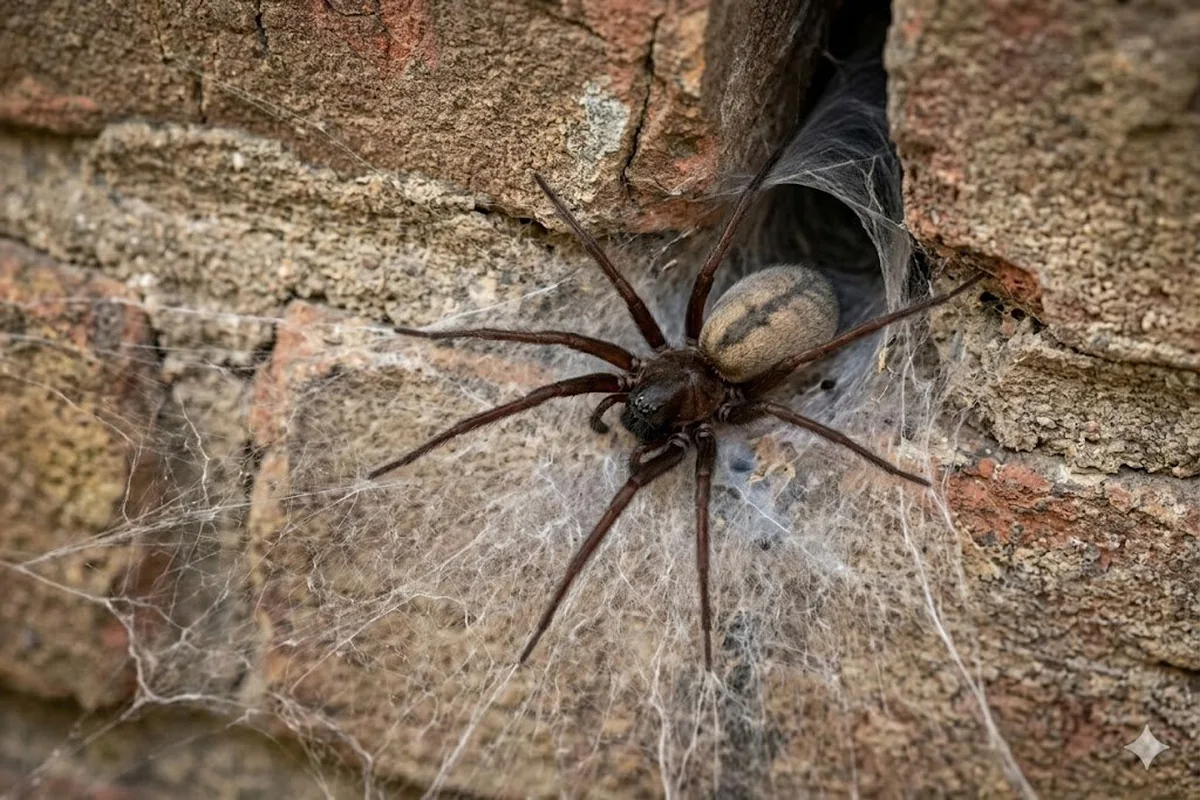
Worried it is a brown recluse? Our office sits where McKinney, Plano, Frisco and Allen meet, 5 to 10 minutes from most homes in those four cities. Send us a photo or call, and we will tell you what the spider is.
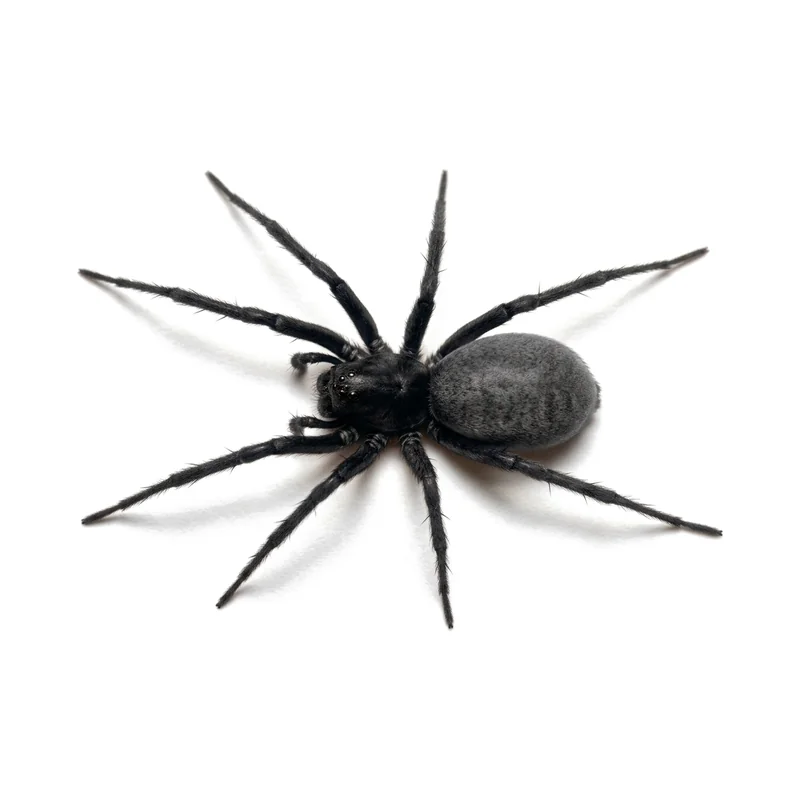
Southern House Spider
Texas A&M’s guide to the southern house spider notes that it causes concern when it is mistaken for a recluse spider, and that it is the larger of the two.
Risk Assessment
Choose a row for the full detail- Color
- Female dark charcoal-gray to near-black, male khaki to amber
- Primary prey
- House flies, cockroaches, beetles and wasps caught in a woolly web from a crack
- Threat level
- Low
- Eye arrangement
- Eight eyes grouped on one raised bump, unlike the brown recluse’s six eyes in three pairs
- Lifespan
- Female up to 8 years (University of Florida Extension), male 1 to 2 years
- Active season
- Year-round, with males wandering most from May through August
- Body length
- Female 0.51 to 0.75 in (13-19 mm), male 0.35 to 0.5 in (9-13 mm)
What a Southern House Spider Looks Like
The female southern house spider (Kukulcania hibernalis) is dark charcoal-gray to near-black, heavy-bodied, with a round, velvety abdomen. University of Florida Extension gives the female’s length as 1/2 to 3/4 in (13 to 19 mm). A large one is sometimes taken for a small tarantula. She lives in a tube of silk inside a wall crack, window frame gap or brick weep hole and rarely leaves it. The flat, woolly web fanning out from that crack is the sign she is there.
The male is smaller, khaki to amber, and wanders in late spring and summer looking for females. His pedipalps, the two small feelers beside the mouth, are very long and thin and point forward, so he seems to have ten legs. A plain tan body, a wandering habit and a similar size are why he passes for a brown recluse at first glance.
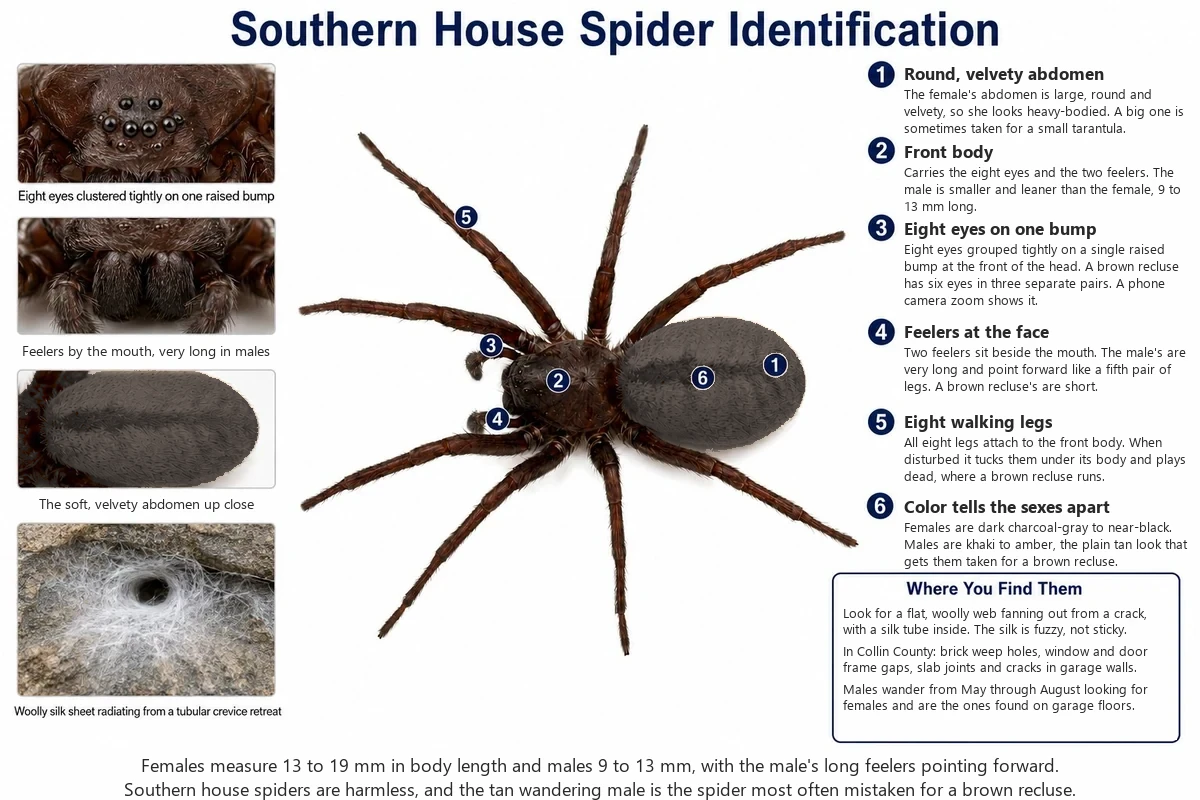
How to tell a male southern house spider from a female
- Eight eyes grouped tightly on a single raised bump at the front of the head. A brown recluse has six eyes in three separate pairs
- Male pedipalps so long and thin they look like an extra pair of legs
- A flat, fuzzy web fanning out from a crack in a wall, window frame or weep hole
- Female dark charcoal-gray to near-black, where a brown recluse is matte tan to medium brown
- Curls up and plays dead when disturbed, where a brown recluse runs
- Female stays in her crack, where a brown recluse wanders at night
Other Names for the Southern House Spider
The southern house spider belongs to the family Filistatidae, the crevice weavers, named for the cracks they live in. Its genus, Kukulcania, comes from Kukulkan, the feathered serpent of Mayan belief. Nicholas Marcellus Hentz, the French-American spider expert who named several of the South’s most familiar spiders, described it in 1842. Every name in the table means the same spider.
Where Are Southern House Spiders Found?
Southern house spiders are found across the American South, as the name says, and Texas sits well inside the range. Confirmed iNaturalist sightings show how widespread it is, and it turns up throughout Collin County. It lives on and in buildings, which is why it is the Texas house spider most often mistaken for a brown recluse.
| Name | What it means |
|---|---|
| Kukulcania hibernalis | The scientific name, given by Hentz in 1842. |
| Kukulkania | A common spelling of the genus name, closer to the Mayan Kukulkan it comes from. |
| Crevice weaver | The name for its whole family, which builds webs out of cracks. |
| Crevice spider | The same idea, and the name pest guides use for the group. |
| Woolly web spider | Named for the fuzzy, flat web around its crack. |
| Brown recluse impostor | Not a real name, but the job the wandering male does in most Texas garages. |
How to Tell Southern House Spiders from Other Collin County Spiders
The male is the right size, the right tan color and turns up in garages and on outside walls, so he passes the first look for a brown recluse. The traits that rule him out, the eye cluster and the long pedipalps, need a closer look than most people take before calling for treatment. Pest Me Off technicians estimate that most McKinney brown recluse emergency calls turn out to be southern house spider males. The table compares it with the three spiders it is confused with most.
| Species | Size | Key Feature | Where Found |
|---|---|---|---|
|
Southern House Spider
AKA: Crevice Weaver, Woolly Web Spider
Kukulcania hibernalis
This species
|
Female 0.51 to 0.75 in body, charcoal-gray and heavy-bodied. Male 0.35 to 0.5 in, khaki to amber. | Eight eyes grouped on a raised bump. Male has very long pedipalps that look like an extra pair of legs. Flat woolly web fanning from a crack, its silk fuzzy rather than sticky. Plays dead when disturbed. | Wall cracks, window and door frames, brick weep holes. Female stays in her retreat year-round. Male wanders May through August looking for females. |
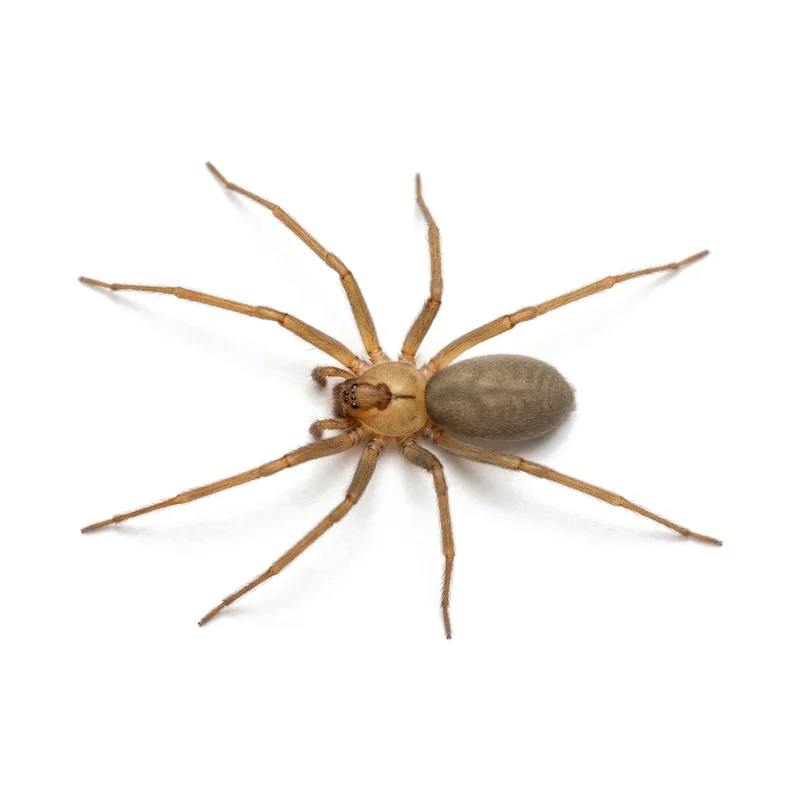
Brown Recluse
AKA: Violin Spider, Fiddleback
Loxosceles reclusa
|
0.25 to 0.5 in body, leg span 1 to 1.5 in. Slender and lightly built. Matte tan to medium brown, with plain, unbanded legs. | Six eyes in three separate pairs in a semicircle. Short, ordinary pedipalps. Violin-shaped mark on the front body section. Small, messy retreat silk, never a woolly fan web. Runs rather than playing dead. Medically significant. | Dark, undisturbed storage such as closets, shoe boxes, stacked boxes and garage shelving. Not in fan webs at wall cracks. |
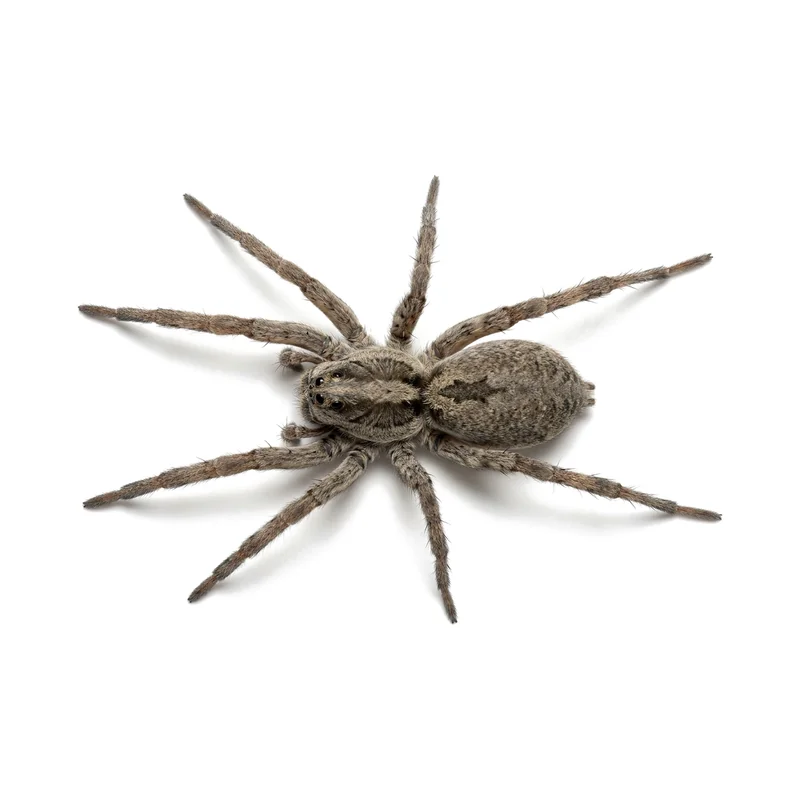
Wolf Spider
AKA: Hairy Spider, Ground Spider
Hogna carolinensis, Rabidosa spp.
|
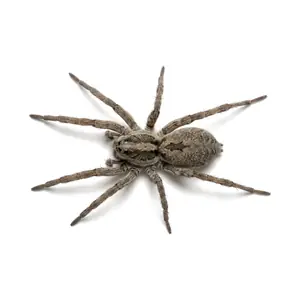
0.5 to 1.5 in body, leg span up to 4 in. Stocky, heavily built and hairy, much bulkier than a southern house spider male. | Eight eyes in three rows, with a large middle pair that shines green in a flashlight at night. Stripes running lengthwise on the front body section. Runs across floors. No crack retreat or fan web. Ordinary pedipalps. | Open garage floors and under outside doors. A ground hunter that comes in as fall turns cool, peaking in September and October. |
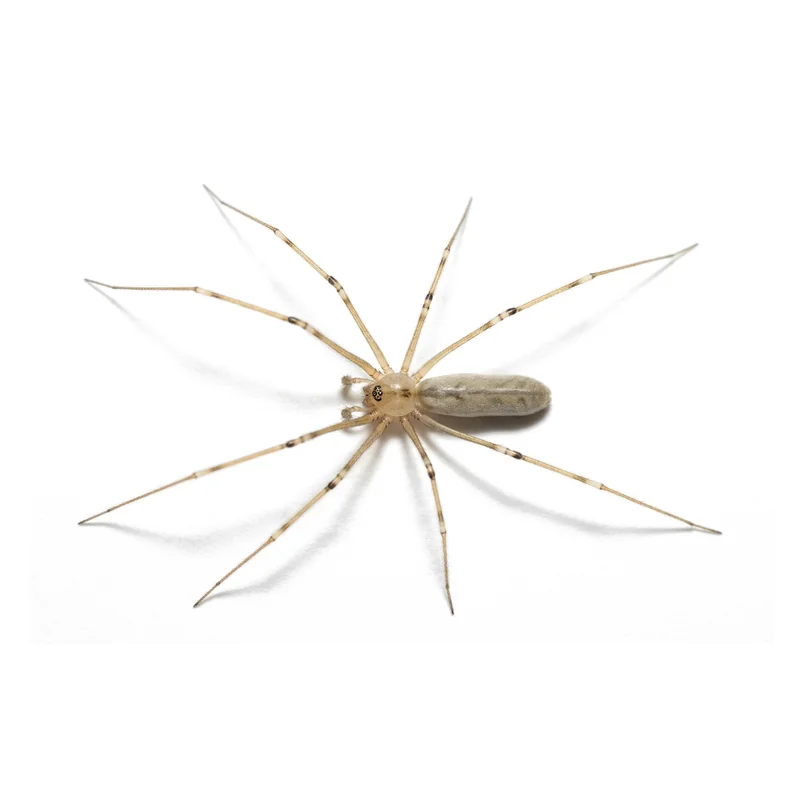
Cellar Spider
AKA: Daddy Long Legs, Vibrating Spider
Pholcus phalangioides
|
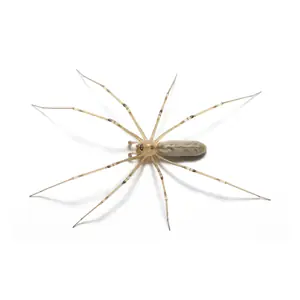
0.25 in body, leg span up to 2 in. A tiny pale or see-through body on thread-thin legs, far lighter than any southern house spider. | Hangs upside down in a loose, messy ceiling cobweb. Pale, never dark. Shakes its body fast when disturbed. The female carries her egg sac in her jaws. | Ceiling corners, garage rafters and bathroom walls, indoors all year in quiet spots. Not in wall cracks or flat woolly webs. |
Southern House Spider vs Brown Recluse
The Southern House Spider in Three Numbers
Up to 8 years
University of Florida Extension reports that a female southern house spider can live up to 8 years, usually hidden in one nest crack.
University of Florida Extension
1/2 to 3/4 in
University of Florida Extension puts an adult female southern house spider at 1/2 to 3/4 inch long and charcoal gray.
University of Florida Extension
Up to 2 days
University of Florida Extension calls the southern house spider bite not dangerous, and in the two bite cases it cites, the pain and swelling lasted up to 2 days.
University of Florida Extension
Are Southern House Spiders Poisonous or Dangerous?
No. Southern house spiders carry no venom known to harm people. There is no tissue damage, no body-wide cramping and no medical emergency from this species. The danger is panic. Someone who sees a male and believes it is a brown recluse may blame the recluse for an old skin sore or insect bite.
The ER visit, the wound care and the emergency spraying that follow all come from a mistaken identity. In a home with a confirmed brown recluse problem, clearing southern house spiders from the garage and storage areas is still worth doing, so every later sighting is read correctly.
Do Southern House Spiders Bite?
Rarely, and with little effect. Their mouthparts often cannot get through adult skin. A bite almost always comes from a female pressed against skin, and it feels like a bee sting, with mild swelling and redness that clear within 24 to 48 hours without any medical treatment.
University of Florida Extension cites two bite cases in which the pain and swelling lasted up to 2 days. To move one, use gloves or a cup and a piece of card rather than a bare hand.
When Southern House Spider Presence Warrants Action
Woolly Webs Rebuilding in Living Areas
A woolly web at a window or door frame in a room you use, which comes back within days of being cleaned, means a female is settled in that crack. Cleaning alone starts a cycle of removal and rebuild that never ends.
Males Turning Up Indoors Every Week
Finding a wandering male once or twice a year means nothing. Finding them weekly from May through August means the population around the house is large enough to keep sending them inside.
A Single Male Found Indoors Once
One wandering male is not a reason to treat. He is looking for females and leaves the way he came. Move him outside with a cup and a card, or let him go.
Webs on Outside Brick, Fences or Weep Holes
A female in a weep hole, a fence crack or under a porch overhang is in her natural home and eats house flies, beetles and wasps. Unless the webs pile up at a door you use, it is cosmetic.
Why You Found a Southern House Spider in Your House
A tan southern house spider walking across the garage or a floor is almost always a male looking for a mate. Males leave their cracks in late spring and summer and come in through weep holes, door gaps and gaps around frames. Their eyesight is poor, so one can walk right across a hand without noticing it. He is lost or passing through, not hunting and not settling in.
A dark female indoors lives in a crack in a garage wall, a utility room or near an attic opening, with her woolly web around it. For a male, a cup and a card are all it takes. For a female, the crack she lives in is what needs treating and then sealing.
Where Southern House Spiders Come From in Collin County
Southern house spiders are built for life on buildings. They want a narrow crack with a steady temperature, shade and passing insects: weep holes in brick, gaps around window and door frames, spaces under siding, joints in the slab, and cracks in garage and utility room walls. The web spreads from the crack mouth and catches insects by tangling them in fine woolly loops rather than with glue, which is why it looks fuzzy and fills with wings and beetle parts over time. The University of Florida’s southern house spider guide covers the web and the retreat in more detail.
Southern House Spider Presence Across Collin County
Southern house spiders live throughout Collin County and are thickest where there is older masonry: the older parts of McKinney, historic Allen, the stone buildings of Adriatica and Stonebridge Ranch. Brick weep holes there give them permanent shelter. New homes in Prosper, Celina and Frisco fill up fast too, as spiders pushed off cleared land move into fresh weep holes.
Pest Me Off service records from 2024 to 2026 show calls about wandering males peak for 4 months, May through August, with June the busiest. Most of those calls end with the identification. A smaller share are females whose webs keep coming back in plain sight however often they are cleaned.
Females stay active in their cracks all year. The season you notice is the males: they leave their retreats in late spring and summer to find mates, which is when people meet them in the open and take them for brown recluse.
Pattern from iNaturalist observation records and Pest Me Off service call data across Collin County, 2023 to 2026.
Southern House Spider Biology Worth Knowing
How Pest Me Off Handles Southern House Spiders
The web is the symptom and the crack is the cause. We confirm the species first, so you know whether you have a harmless southern house spider or a brown recluse, then treat where the female lives and seal it afterward.
Find Every Active Retreat
Walk the outside of the house and check every weep hole, window and door frame gap and slab joint for a flat woolly web. White, fuzzy web means a female is home. Gray web full of debris is old. Then check inside the garage, utility closets and near attic openings.
Treat Inside the Crack
Puff silica gel or diatomaceous earth dust into the crack with a bellows duster to reach the spider in her retreat. At outside cracks, weep holes and window frames, apply a long-lasting pyrethroid liquid, a synthetic insecticide, into and around the crack mouth.
Wait 5 to 7 Days, Then Seal
Give the treatment 5 to 7 days to work and confirm no web has come back. Then seal each treated crack with caulk or mortar and fit covers on the brick weep holes.
Perimeter Treatment Before the Males Wander
Apply a long-lasting perimeter treatment along the foundation and across doorways in late April, before male wandering peaks in May. Fewer males reach the doors and get inside.
& Quick Fixes
How to Get Rid of Southern House Spiders Yourself
Close the cracks and gaps the spider needs for a retreat. Sealed, it cannot settle. Left open, the spiders around the house keep filling them.
Why Some DIY Responses Fail for Southern House Spiders
Most failed attempts make one of the four mistakes below. Each one goes after the web or the spider in sight and leaves the female safe in her crack.
Spray Cans at the Crack Mouth
A spray can of pyrethroid at the opening drives the female deeper into the wall instead of killing her. She may be out of reach for weeks, then comes back to rebuild once the product wears off.
Bug Bombs and Foggers
Fog fills open air but not the cracks where females live, and it pushes wandering males deeper into the walls. Sightings drop for a while, then return at the same level or higher, with the spiders now further inside.
Sealing Cracks Before Treating Them
Sealing a weep hole or frame crack with the female still inside traps her in the wall with whatever insects are there, and she can live for years. Treat first, wait 5 to 7 days, confirm, then seal.
Emergency Recluse Treatment for a Harmless Spider
A wandering male sets off a recluse emergency, and products get sprayed through the whole house. The harmless spider is gone, and whether a brown recluse was ever there is still unanswered. Identifying the spider first prevents all of it.
Common Southern House Spider Questions
What is the spider with long front feelers that looks like it has ten legs?
Is the large dark gray spider in my garage dangerous?
Is the woolly web spreading from my window frame from a southern house spider?
How do I tell a southern house spider from a brown recluse?
Are southern house spiders dangerous?
Do southern house spiders bite?
Can I tell males from females without picking them up?
How big do southern house spiders get?
How long do southern house spiders live?
Why does the spider curl up and play dead when I touch it or spray it?
Why does the woolly web keep coming back after I clean it up or spray it?
How does Pest Me Off treat southern house spiders differently than DIY products?
How do I get rid of southern house spiders?
Woolly Webs Rebuilding in Your Cracks. We Treat the Retreat, Not Just the Web.
Most companies spray the surface and leave the female in the crack. We treat inside it, wait for confirmed control and seal it. We also tell you whether that tan wandering spider is a harmless southern house spider male or a real brown recluse, because the two call for very different plans. McKinney, Allen, Frisco, Plano, and all of Collin County.