Carpenter Ants in Collin County, TX | Identification and Control
Carpenter ants (Camponotus species) are the big black ants most Collin County homeowners find indoors at night, and the largest ant you will see in a Texas home. They do not eat wood. They hollow out wood that moisture has already softened, and the nest inside your wall is usually an outpost of a colony whose queen lives outside in a stump or dead tree. University of Florida Extension reports mature colonies of 4,000 to 10,000 workers for most carpenter ant species, enough to run several nests in one house.
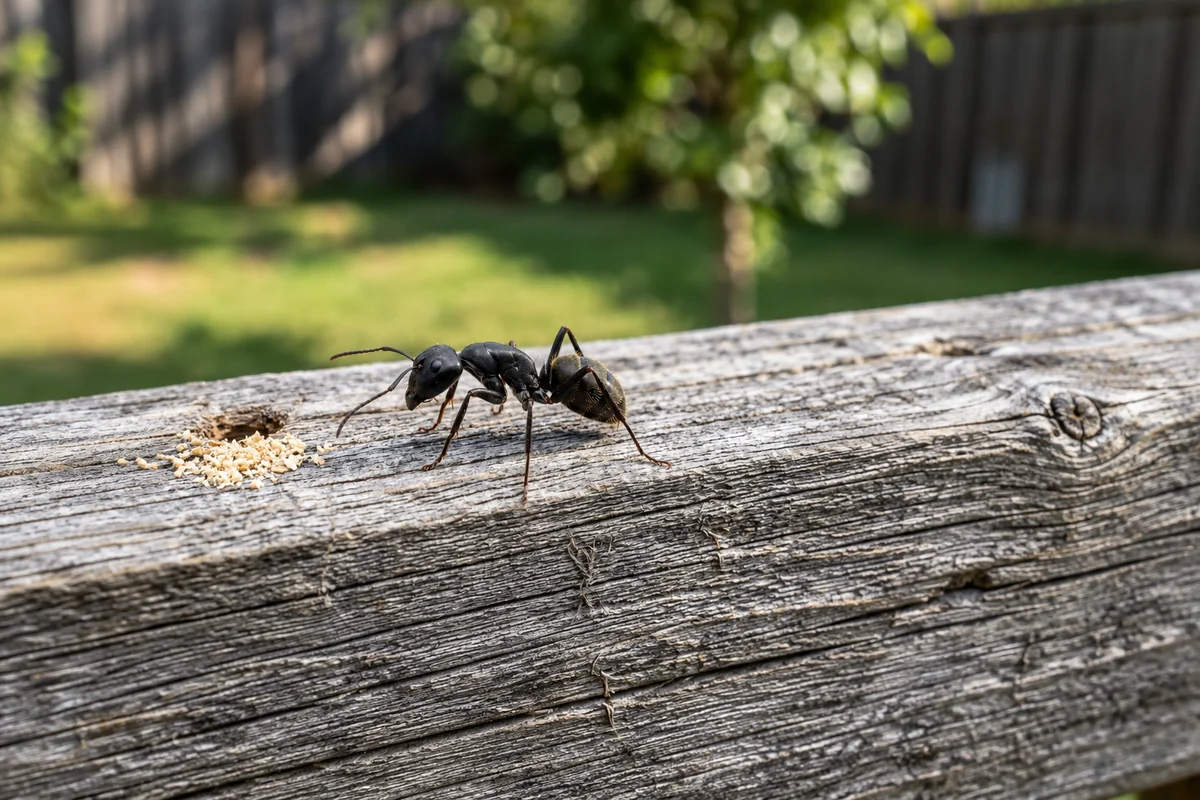
Found big black ants in your Collin County home? Our office sits where McKinney, Plano, Frisco and Allen meet, 5 to 10 minutes from most homes in those four cities. Send us a photo or call, and we will tell you which ant it is.
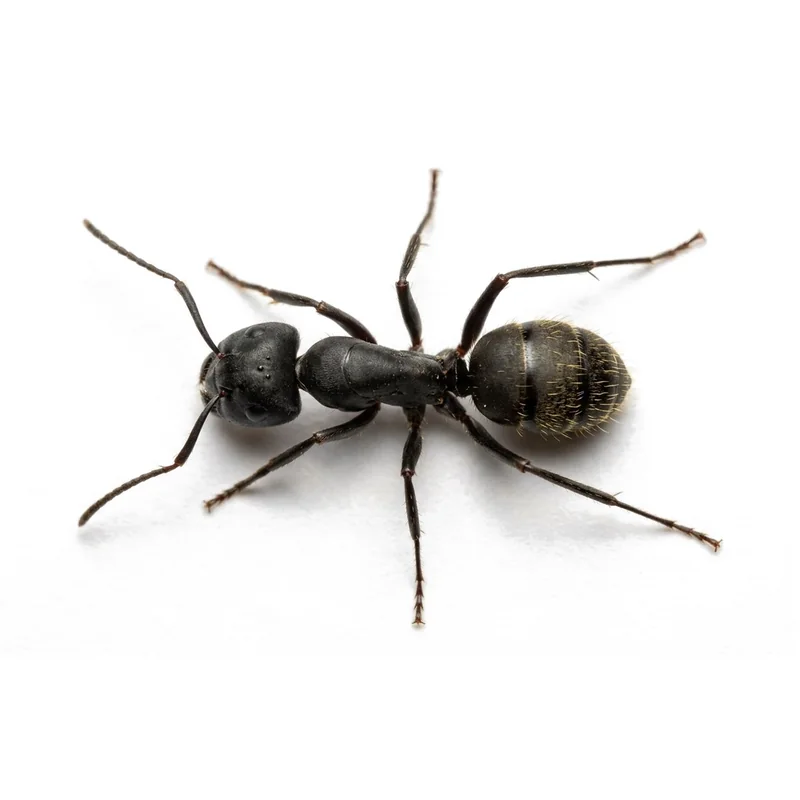
Carpenter Ant
Texas’s largest commonly encountered ant, and the ant behind most calls about big black ants in the house.
Risk Assessment
Choose a row for the full detail- Color
- All black, or a red-orange head and midsection with a dark rear
- Colony size
- 4,000 to 10,000 workers at maturity
- Diet
- Omnivorous, eating insects, sweets and honeydew
- Waist
- One node (a single petiole segment), with an evenly arched midsection
- Nesting material
- Moisture-softened wood only, in dead trees, stumps, trim and decking
- Active season
- March through October in Collin County, foraging mostly at night
- Worker size
- 6 to 13 mm, with workers of several sizes in one colony
What Carpenter Ants Look Like
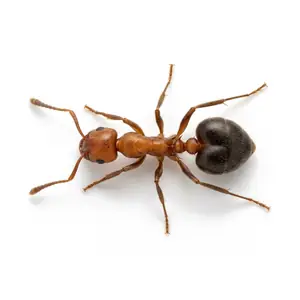
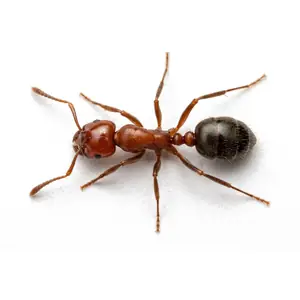
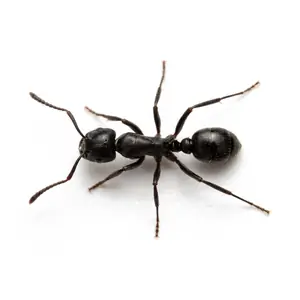
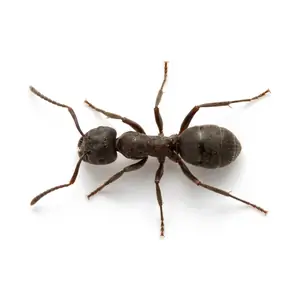
Carpenter ants are the largest ant you are likely to see in a Collin County home. Workers run 6 to 13 mm, and one colony produces workers at several sizes in the same body pattern. The most common Texas species is all black, though some workers have a red-orange head and midsection with a dark rear. Oklahoma State University Extension names the single-node waist as the most reliable way to separate them from other large dark ants in the Southern Plains. Texas A&M AgriLife Extension puts winged carpenter ants at up to 3/4 inch long, and its Insects in the City sheet says winged ants indoors generally mean a nest is located in the structure.
How they move gives them away as much as size. Carpenter ants travel in steady single-file lines after dark, and they do not swarm or sting. Workers found on a kitchen counter or windowsill at night are almost never a random encounter. They are walking an established route from a nest in the wall or trim.
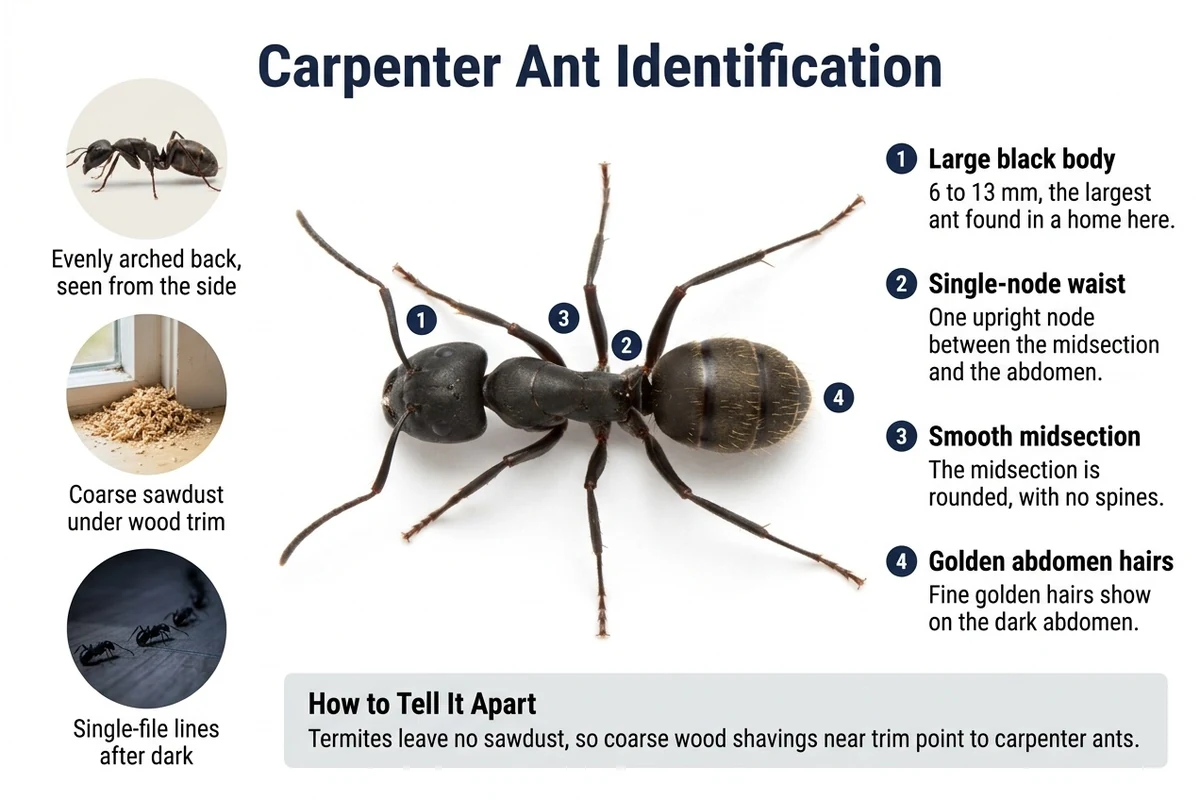
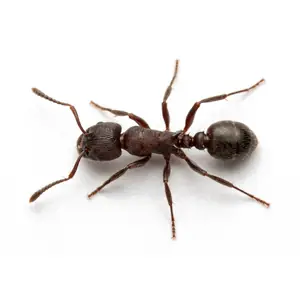
How to identify a carpenter ant from above, by its large black body, single-node waist and golden abdomen hairs
- The largest ant in a Collin County home at 6 to 13 mm, nearly always all black or red and black
- Single-node waist (one petiole segment, not two)
- Fine golden hairs on the dark abdomen
- Evenly arched midsection with no spines
- Coarse, sawdust-like wood shavings near window frames, door frames or deck boards
- Faint ticking or rustling inside a wall at night when the house is quiet
- Workers indoors after dark, moving in deliberate single-file lines
Other Names for the Carpenter Ant
Most people call it what it looks like, the big black ant, and when someone calls us about a big black ant problem it turns out to be carpenter ants about 90 percent of the time. The formal name comes from what the ant does. It clears and shapes tunnels in wood the way a carpenter works material, pushing the shavings out rather than eating them. Every name in the table points to the same ant.
Where Are Carpenter Ants Found in Texas?
Carpenter ants are found across Texas wherever there is dead or damp wood to nest in, and they are the state’s largest commonly encountered ant. Collin County carries substantial populations on wooded and creek-side properties. Outdoors they nest in stumps, dead trees and log piles.
Indoors they turn up in window frames, door frames, fascia and deck lumber that water has softened.
| Name | What it means |
|---|---|
| Big black ant | The name most Collin County homeowners use, because it is the largest ant they ever find indoors and nearly always black. |
| Large black ant | The same description in different words. |
| Black carpenter ant | The common name of Camponotus pennsylvanicus, the all-black species homeowners in McKinney and Allen find in the kitchen at midnight. |
| Texas carpenter ant | Not one species. It is how people name the carpenter ants they find in Texas, all black or red and black. |
| Wood ant | A plain description of an ant nesting in wood. The big black one tunneling in damp trim is the carpenter ant. |
| Fat black ant | Not a name, but how many people describe it before they know one. The size is most of the identification. |
How to Tell Carpenter Ants from Other Ants in Collin County
Size gets you most of the way. Carpenter ants are far larger than any other ant found indoors here, so the confusion usually comes from color or from finding a dark ant and assuming the worst. The table compares it with the four ants it is most often mistaken for.
| Species | Size | Key Feature | Where It Nests |
|---|---|---|---|
|
Carpenter Ant
AKA: Big Black Ant, Large Black Ant
Camponotus spp.
This species
|
6 to 13 mm, with workers at several sizes in one colony. All black or red and black. The largest ant homeowners find indoors in Collin County by a wide margin. | Single-node waist with an evenly arched, spine-free midsection. No sting, bites only with its jaws. Moves in slow, deliberate single-file lines after dark. | Tunnels along the grain of moisture-softened wood in door frames, window trim, fascia boards and deck lumber. A coarse shavings pile at a gap marks the exit. No outdoor mound. |
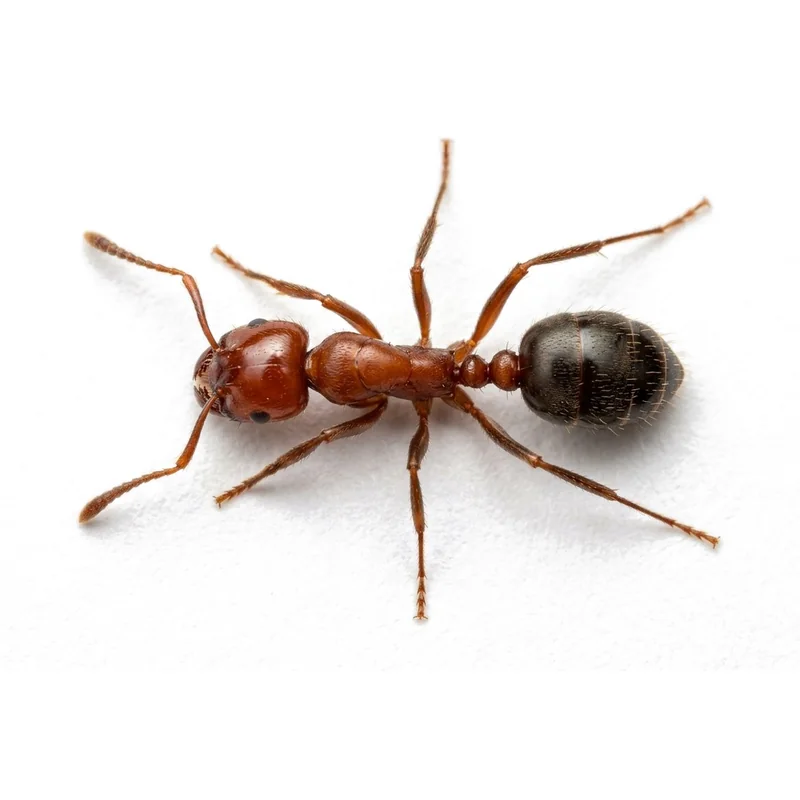
Fire Ant
AKA: Red Ant, Mound Ant
Solenopsis invicta
|
1.6 to 6 mm with mixed sizes in one colony, all smaller than the smallest carpenter ant worker. Reddish-brown with a darker rear, not all black. | Stings. Fire ants swarm and sting within seconds of a mound being disturbed, with a burning feeling and a white pustule within 24 hours. Carpenter ants never do this. | Dome-shaped outdoor mound with no opening visible from above, fluffy and loose after rain. Never excavates wood and never leaves shavings. |
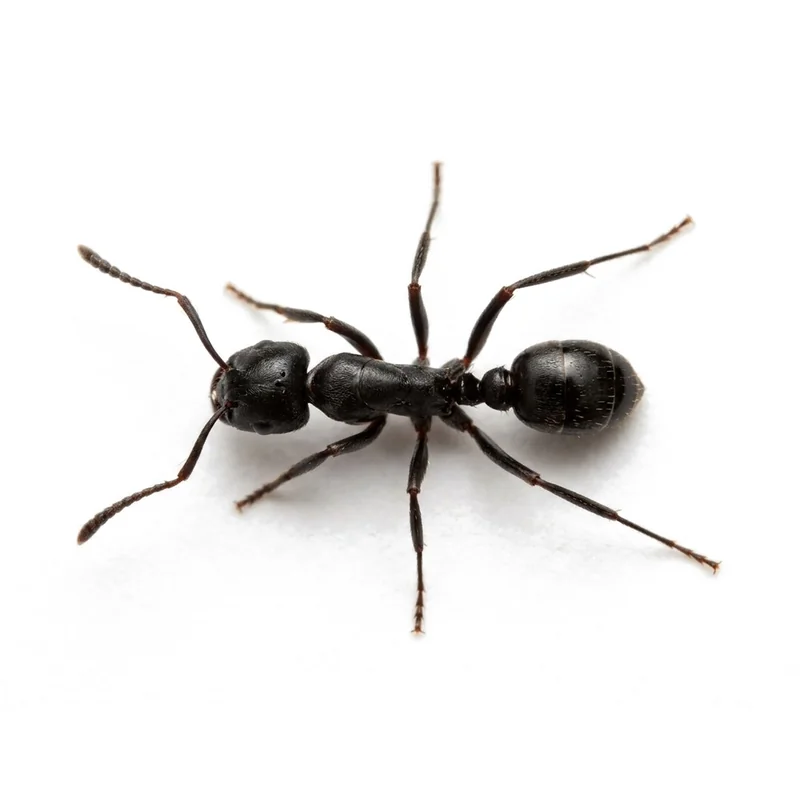
Little Black Ant
AKA: Black Ant, Tiny Black Ant
Monomorium minimum
|
1.5 to 2 mm, all workers the same size, jet black. About one-eighth the size of the largest carpenter ant workers, so the contrast is obvious side by side. | Two-node waist, the structural separator from the carpenter ant. Forages in slow trails indoors and causes no wood damage of any kind. | Outdoor soil, rotting wood debris, and now and then a wall void near moisture. Does not excavate structural wood and leaves no shavings. |
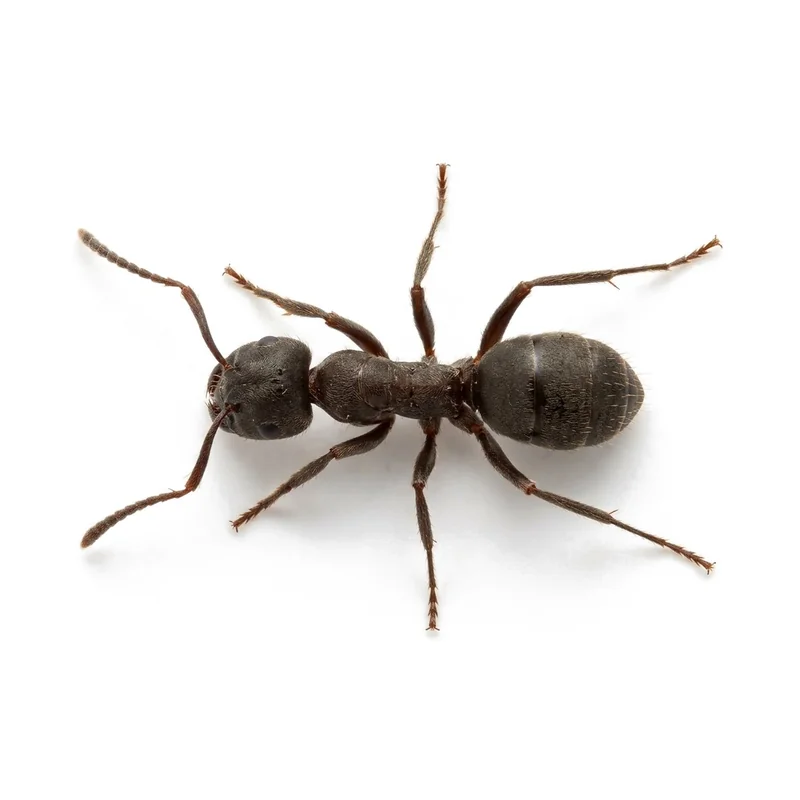
Odorous House Ant
AKA: Sugar Ant, Stink Ant
Tapinoma sessile
|
2.4 to 3.3 mm, all workers the same size. Dark brown to black, like a miniature carpenter ant, but much smaller. | One-node waist, the same as the carpenter ant. The crush test separates them, because a crushed worker smells strongly of blue cheese or rotten coconut. No shavings, no structural damage. | Wall voids, insulation and under flooring, moving often when disturbed. Trails run along wall edges and kitchen countertops. |
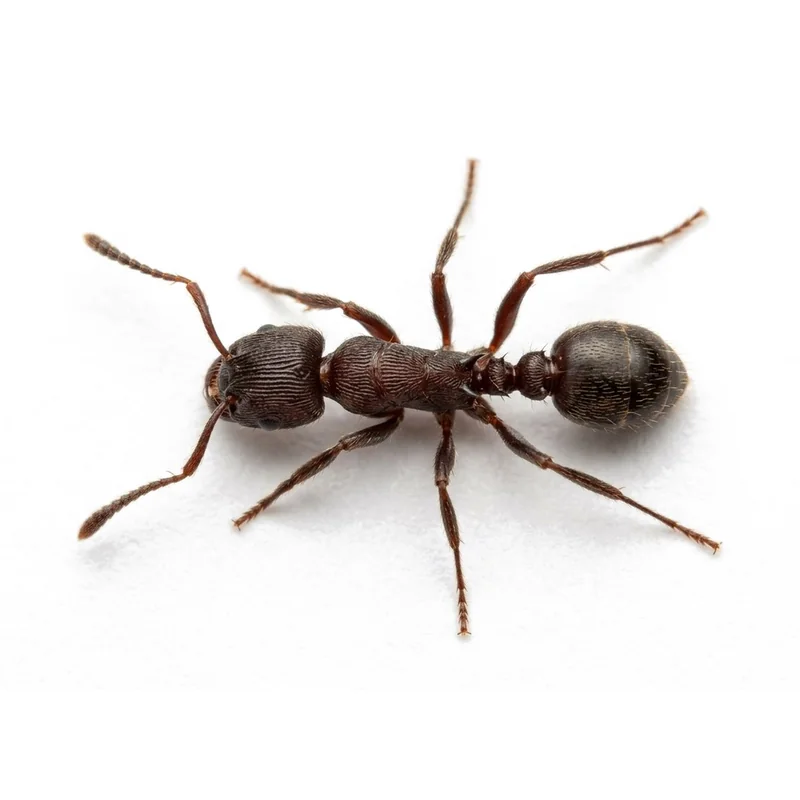
Pavement Ant
AKA: Sidewalk Ant
Tetramorium immigrans
|
2.5 to 3 mm, all workers the same size. Uniformly dark brown to black. Less than half the size of the largest carpenter ant workers. | Two-node waist and a midsection with fine parallel grooves visible up close, which carpenter ants lack. Does not sting and does not excavate wood. | Under concrete slabs, sidewalk edges and pavement cracks, with fine soil pushed up at the entry. No tunnels in structural wood. |
Carpenter Ant vs Little Black Ant
The Carpenter Ant in Three Numbers
3/4 inch
Texas A&M AgriLife Extension says winged carpenter ants grow up to 3/4 inch long, and that winged ants indoors generally mean a nest is located in the structure.
Texas A&M AgriLife Extension
Up to 15 years
NC State Extension says a carpenter ant queen can live up to 15 years, producing workers the whole time.
NC State Extension
4,000 to 10,000
University of Florida Extension reports mature carpenter ant colonies of 4,000 to 10,000 workers for most species, enough to run several nests in one house.
University of Florida Extension
Are Carpenter Ants Dangerous?
No, not to people or pets. Carpenter ants carry no disease and have no documented role in passing illness to people or animals. Children and pets that startle a worker indoors may get a pinch, but it is not a medical event.
Do Carpenter Ants Bite?
Yes, carpenter ants bite, but only when they are handled or pinned. They have no sting, so the bite is a sharp pinch from the jaws (mandibles) with no venom injected, no pustule and no follow-on reaction to watch for. Wash the spot with soap and water.
If a dark ant in your Texas yard stung you and left a white pustule within a day, it was a fire ant, not a carpenter ant.
When Carpenter Ants Indoors Warrant Action
Ants at the Same Spot Night After Night
Workers on the same counter, wall or windowsill after dark, or coarse shavings at a frame, mean a nest in the wood nearby. That is a property problem, and the time to find the nest is before the tunnels grow.
A Few Ants and No Shavings Anywhere
Workers indoors with no shavings at any frame or deck board may be foraging through existing gaps rather than excavating. That is a lower property risk. Watch for shavings, and for the same trail night after night.
Why You Found Carpenter Ants in Your House
Large black ants in the house almost always got there along a route. Workers walk in from a colony outside along a tree branch touching the roof or fascia, along a utility line, or where wood touches the ground at the foundation. Once a colony has settled a nest inside a wall, window frame or trim, the ants you see at night are walking out of it to find food.
Before you spray or seal anything, look for coarse shavings below the nearest window and door frames, listen at the wall at night for faint ticking, and check where branches touch the roof. Spraying or sealing first pushes the trail somewhere harder to find, which the DIY section below explains.
Where Carpenter Ants Nest and Excavate
Carpenter ants need wet wood first. The National Pest Management Association confirms that dry, structurally sound wood is not at risk. The tunnels inside a home are almost always in wood that was already damaged: fascia where a gutter backed up, a window frame where caulk failed, a door frame where water sat after rain, a deck post base holding moisture, a soffit soaked by sprinkler overspray, or roof trim under a small leak that went unnoticed for a season. The framing behind the trim is the next target once that entry is open.
The earliest sign is coarse, fibrous shavings pushed out of a tunnel opening, like damp sawdust mixed with insect parts. NC State Extension describes how this differs from termite droppings, which are hard pellets. Carpenter ant tunnels themselves are smooth-walled channels following the grain of the softer wood.
Carpenter Ant Presence Across Collin County
Carpenter ant pressure in Collin County gathers around two conditions: mature trees close to the roofline and older wood-frame construction. Historic Downtown McKinney draws steady calls because of its pre-1960 homes with aging window and door frames. Properties in Allen and Fairview with large oaks reaching over the roof are a repeating pattern in our service records.
Creek corridor properties along Slayter Creek and Rowlett Creek hold the most standing dead wood in the county, which sustains parent colonies and year-round pressure on nearby homes. New construction in Prosper, Anna and Frisco is less affected unless mature trees were kept on the lot. Homes with wood decks anywhere in the county are a target when post bases or ledger boards hold moisture against the house.
Carpenter ants are active about 8 months of the year in Collin County, March through October, according to Texas A&M AgriLife and Pest Me Off service call records. Workers come out in March as the weather warms, forage hardest at night through May and June, and keep going through fall until the colony slows down in November.
Pattern from Texas A&M AgriLife extension data on carpenter ant seasonal behavior and Pest Me Off service call records across Collin County, 2023 to 2026.
How Carpenter Ant Colonies Start and Spread
A carpenter ant colony starts outdoors. The queen digs her first tunnel in a stump, a dead limb, a log pile or any standing dead wood damp enough to excavate, and the colony grows slowly over several years. Each queen lives as long as 15 years, according to NC State Extension, and University of Florida Extension reports colonies of 4,000 to 10,000 workers as common for most carpenter ant species. Once a colony passes a few hundred workers, it sends groups out to start satellite nests in buildings along steady travel routes: branches touching the roof, utility lines, or wood touching the ground at the foundation. University of Minnesota Extension documents the branch-to-roofline route as the main entry pattern in homes. NC State Extension adds that the nest can be as far as 300 feet from where the workers are seen looking for food.
How Pest Me Off Handles Carpenter Ants
Ant-Nihilation is our ant program, combining bait aimed at the queen with a foundation barrier we call the Scorched Earth Barrier. For carpenter ants it starts with an inspection to find both the satellite nest inside and the likely parent colony outside, because knowing the route between them is what separates lasting treatment from killing a few workers.
Full Property Inspection
We check the outside of the house and the reachable roof trim for shavings and tunnel openings, every branch touching the roof or fascia, stumps and log piles within 50 feet of the foundation, and deck post bases and ledger boards. The inspection maps the likely route between satellite and parent colony before any product goes down.
Treating the Tunnels with a Non-Repellent Product
Active tunnels, their openings and confirmed trail surfaces get a non-repellent product, the kind workers cannot detect and carry back to the colony instead of routing around. The parent colony outdoors is treated directly where we can reach it.
Scorched Earth Barrier
A non-repellent perimeter application around the foundation, along irrigation lines and at property edges. Scout workers from neighboring yards cross it, carry it home and share it with their colony. We reapply it quarterly because foraging pressure from next door never stops.
Moisture Source Documentation
Every inspection records the wet wood that made the house hospitable: failing caulk at windows or doors, gutter problems at the fascia, deck post bases and roof trim leaks. The written notes go with the service record so the repair can happen.
& Quick Fixes
How to Get Rid of Carpenter Ants Yourself
Carpenter ants need two things from your property, wet wood to nest in and a route from the parent colony to the house. Both shrink with maintenance that costs more time than money.
Why Some DIY Responses Fail for Carpenter Ants
Big black ants indoors at night trigger the same three instincts: spray them, block the gap, call it solved. With carpenter ants each one makes treatment harder and leaves the queen untouched.
Spraying the Workers You Can See
A contact spray kills the workers in sight and leaves the satellite nest and the outdoor queen alone. Workers come back within 2 to 4 weeks along the same route, because the source was never reached. Finding the parent colony takes an outdoor inspection, not just following the trail inside.
Repellent Sprays at Entry Points
A repellent pushes the trail to a different wall gap instead of ending the colony. The new route is harder to find because workers stop using the treated gap, so an inspection after a repellent takes longer.
Sealing Gaps Before Treatment
Sealing while the nest is still active traps workers inside the wall, and they dig new tunnels looking for another way out. Seal entry gaps only after treatment has shown the colony is inactive.
Common Carpenter Ant Questions
How do I identify the big black ants in my house?
Why do people call carpenter ants big black ants?
Are all large black ants carpenter ants?
Are carpenter ants nocturnal?
How do you tell carpenter ants from termites?
How do you know if carpenter ants are causing structural damage?
Do you still need carpenter ant treatment if you haven’t seen ants in months?
When should I start carpenter ant treatment?
Will carpenter ant treatment harm my pets or kids?
Can carpenter ants be controlled if the parent colony is on a neighbor’s property?
Can you treat carpenter ants yourself and have a professional handle the rest?
Is there a permanent way to get rid of carpenter ants?
The Tunnels Don't Stop Growing on Their Own.
We find the satellite nest, trace and treat the parent colony, and put down the Scorched Earth Barrier across McKinney, Allen, Frisco, Plano and the rest of Collin County.