Formosan Subterranean Termites in Collin County, TX | Identification and Control
The Formosan subterranean termite (Coptotermes formosanus), called the super termite, is the most destructive termite established in the United States. A colony can hold several million workers, eats wood faster than any native termite, and can build a nest above the ground inside a damp wall or attic where soil treatment never reaches. The University of Florida puts its yearly economic cost in the United States at more than $4 billion, citing a 2023 estimate. It is established in Collin County, though most termite jobs here are still the Eastern subterranean termite.
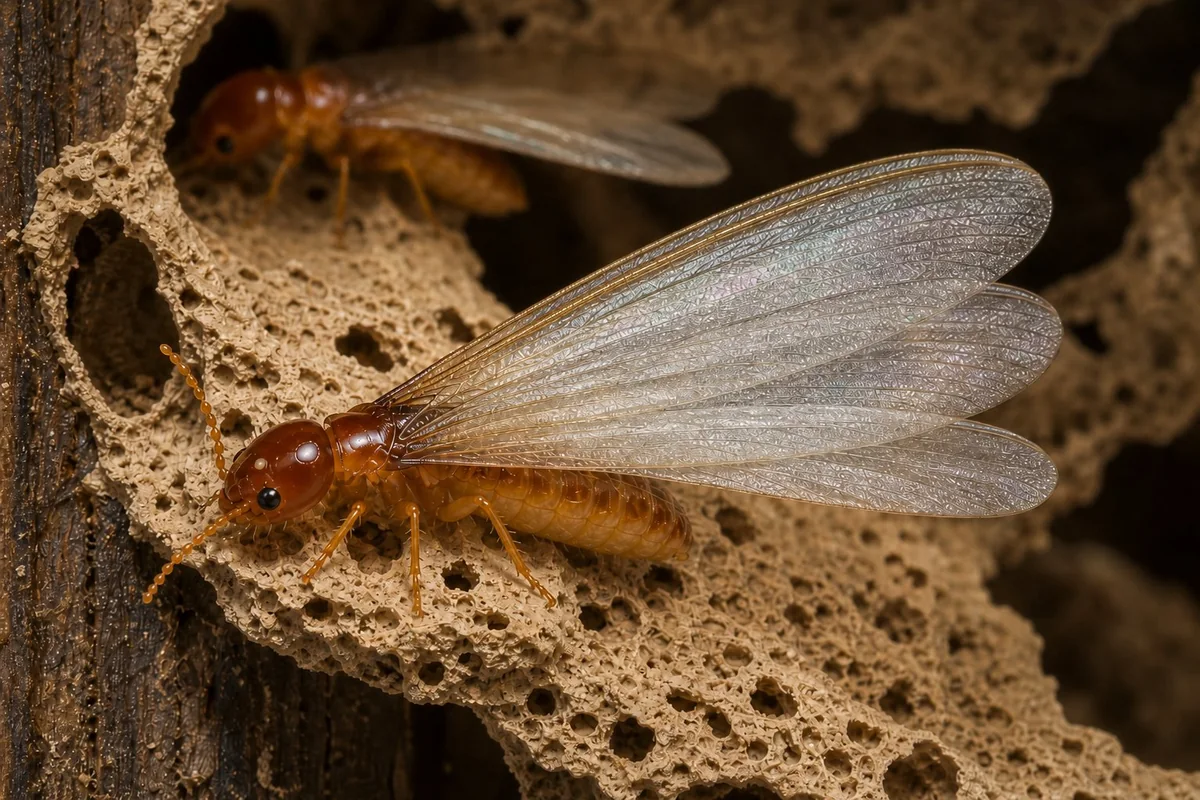
Winged termites around your lights at dusk in Collin County? Our office sits where McKinney, Plano, Frisco and Allen meet, 5 to 10 minutes from most homes in those four cities. Bag a few of the insects and call, and we will tell you which termite it is.
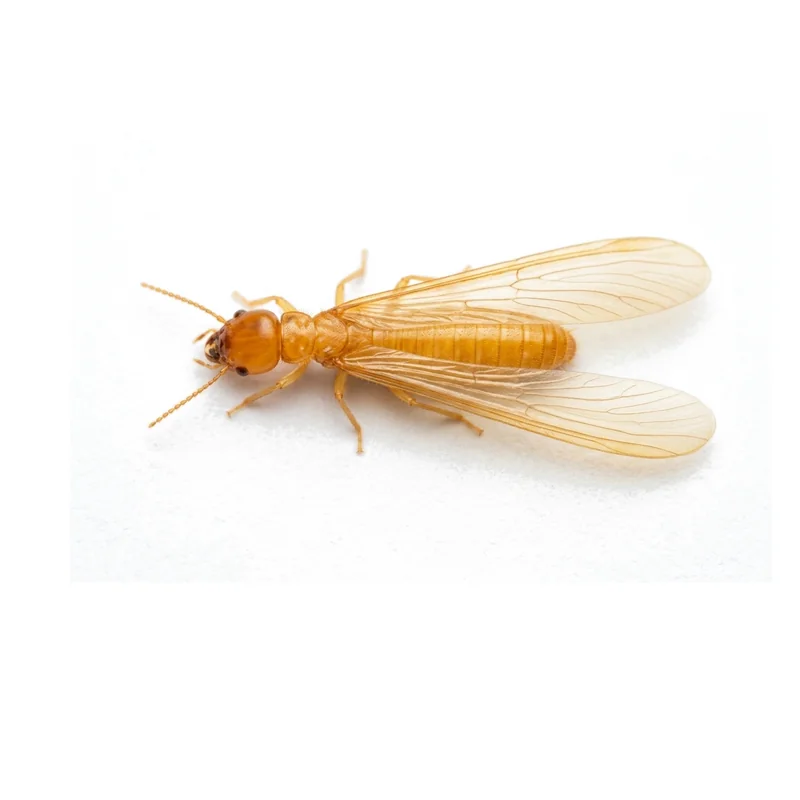
Formosan Subterranean Termite
A Texas invasive species profile of the Formosan termite records its workers chewing through thin lead, copper sheeting and asphalt in search of food, which Eastern termites do not commonly do.
Risk Assessment
Choose a row for the full detail- Winged adult color
- Yellowish-brown body with near-clear wings that look hairy under a magnifying glass
- Colony size
- Up to several million workers, about 10 times a mature Eastern colony
- Diet
- Wood and other cellulose, and it chews through thin lead, copper and asphalt in its way
- Foraging range
- Up to 300 feet from the central nest
- Swarm season
- April through July in Collin County, dusk into night, drawn to lights
- Soldiers
- 5 to 10 percent of the colony
- Body length
- Workers 3 to 4 mm (about 1/8 in), winged adults 12 to 15 mm (about 1/2 in) with wings
What a Formosan Termite Looks Like
US Department of Agriculture research service work on Formosan termites describes three castes in every colony, workers, soldiers and winged adults, the same as any termite. Workers are 3 to 4 mm long and look nearly identical to Eastern subterranean termite workers, so a worker alone cannot tell you which termite you have.
Soldiers settle it. The Louisiana State University AgCenter termite identification guide describes the Formosan soldier head as rounded, oval or teardrop-shaped, where an Eastern soldier’s head is rectangular. A Formosan soldier also has a small pore on the front of its head that oozes a milky white droplet when it is disturbed. Winged adults are 12 to 15 mm, larger and more yellowish-brown than winged Eastern termites.
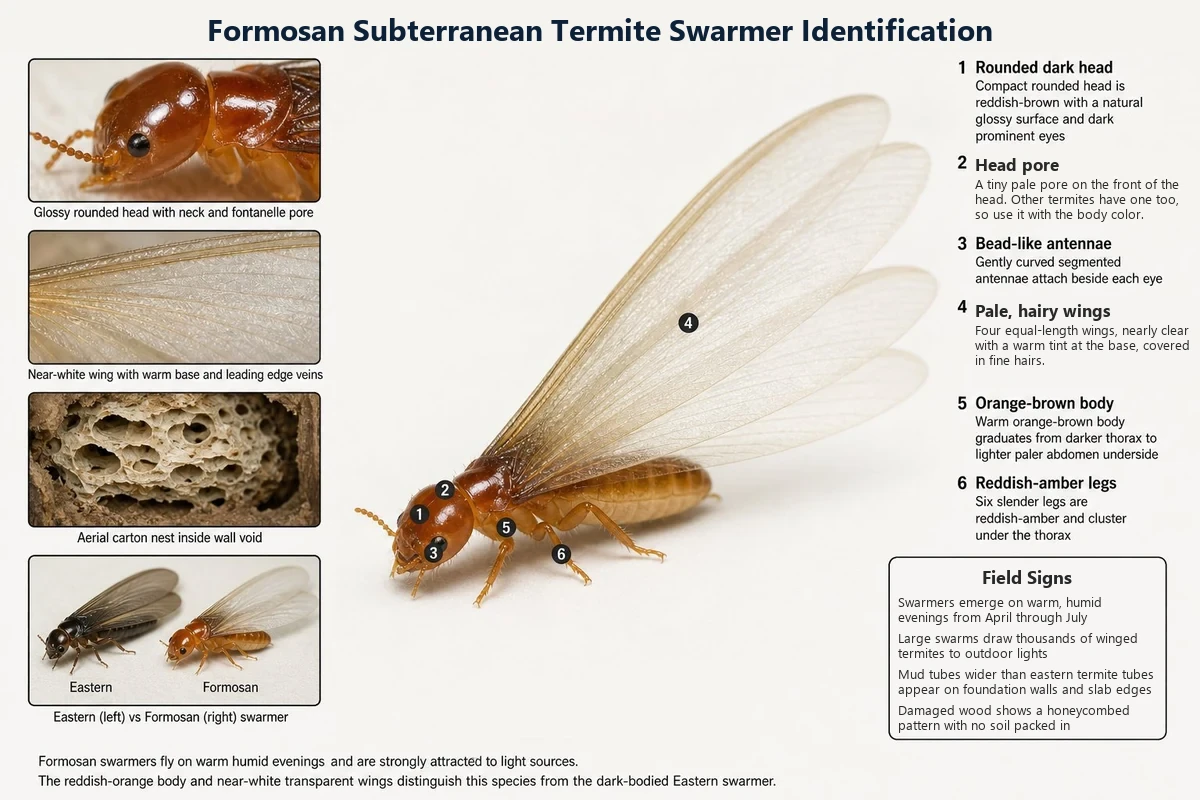
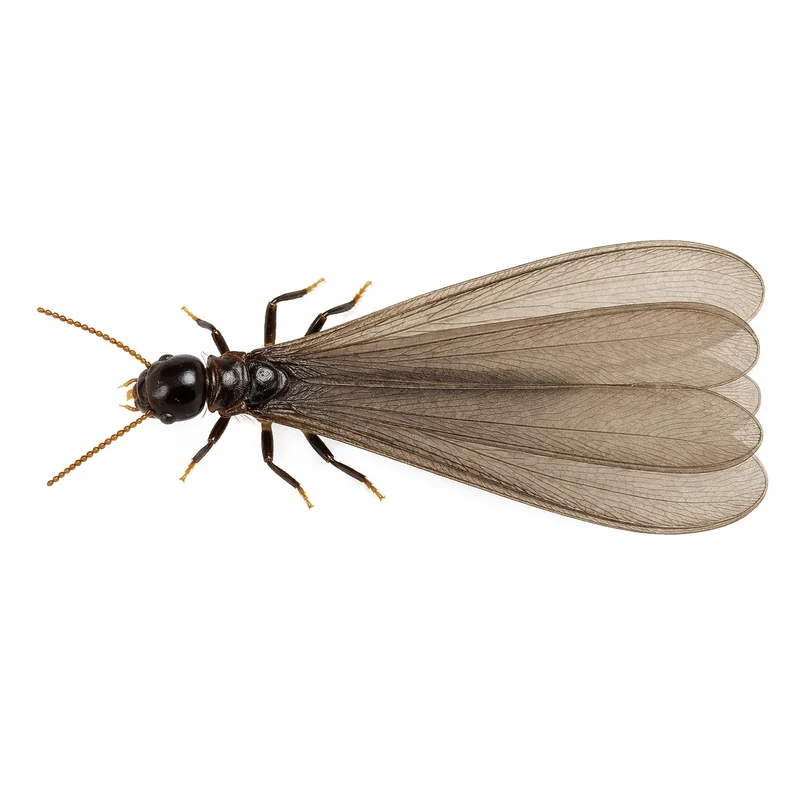
How to identify a winged Formosan termite by its rounded head, bead-like antennae, four equal wings and orange-brown body
- A swarm of thousands at dusk or after dark on a calm, humid May or June evening, piling up around porch and outdoor lights
- Wings that look hairy under a magnifying glass. Eastern termite wings are bare and smooth
- A soldier head that is rounded or teardrop-shaped, not the rectangular amber head of an Eastern soldier
- A milky white droplet on a soldier’s head when it is disturbed. Eastern soldiers make no fluid
- Crumbly soil-and-wood material packed inside an opened wall or attic cavity
Other Names for the Formosan Subterranean Termite
Super termite is the informal name, and it describes what separates Coptotermes formosanus from every other subterranean termite in the United States, colony size and damage rate. Where an Eastern colony might hold a few hundred thousand workers, a mature Formosan colony can hold several million, all feeding at once. Every name in the table means the same insect, so if you searched for any of them, this is your termite.
Are Formosan Termites Subterranean?
Yes. The Formosan termite is a subterranean termite. Its main colony nests in the soil and its workers reach wood through soil contact and mud tubes, like the Eastern subterranean termite. What sets it apart is a second nest it can build above the ground, inside a damp wall or attic, with no soil contact at all.
Where Are Formosan Termites Found?
In Texas, Formosan termites spread north from the coast. Formosan was first documented in Texas around the Houston Ship Channel in 1956 and has moved northward since, largely in mulch and timber shipped inland. The Texas A&M Urban Entomology Program documents Formosan termites in 31 Texas counties, Collin among them.
Collin County is also listed in the Formosan termite quarantine zone of the Texas Plant Protection Regulations as of October 2025.
| Name | What it means |
|---|---|
| Super termite | The informal name, earned by its colony size and the speed of its damage. |
| Formosan termite | The short form of the full common name. |
| Coptotermes formosanus | The scientific name, given by Shiraki in 1909 and often shortened to C. formosanus. |
| Subterranean termite | The group name for termites whose colony nests in soil. Formosan is one, and the Eastern subterranean termite is the other common one in Collin County. |
| イエシロアリ (ie-shiroari) | The Japanese name. It means house termite, literally house white ant. |
| Formosa termite | A common misspelling. It points to the same insect. |
How to Tell Formosan Termites from Other Termites and Flying Ants
Winged Formosan termites fly on summer nights, the same nights flying ants do, and Formosan soldiers look like Eastern soldiers at a glance. The table separates it from its three most common look-alikes in Collin County without a lab or a microscope.
| Species | Head Shape and Wings | Body and Antennae | Swarm Timing and Habitat |
|---|---|---|---|
|
Formosan Subterranean Termite
AKA: Super Termite, Formosan Termite
Coptotermes formosanus
This species
|
Soldier head rounded or teardrop-shaped, with a pore that oozes a milky white fluid. Wings hairy, yellowish, all four the same length. | Straight beaded antennae and a thick waist with no pinch. Winged adult 12 to 15 mm. Workers look the same as Eastern workers, so a soldier or winged termite is needed to confirm the species. | April through July, dusk into night, drawn to lights. Builds carton nests above the ground in damp wall voids and attics. |
Eastern Subterranean Termite
AKA: Wood Termite, Subterranean Termite
Reticulitermes flavipes
|
Soldier head rectangular, yellowish-brown to amber, with no pore and no fluid. Wings bare, with two dark veins along the front edge, all four the same length. | Straight beaded antennae and a thick waist. Winged adult 10 to 12 mm, a little smaller than Formosan, and dark brown to black rather than yellowish-brown. | February through April, in daylight. Builds no carton nests above the ground. The colony lives in the soil and enters through mud tubes or wood touching soil. The most common termite in Collin County. |
Carpenter Ant
AKA: Big Black Ant, Large Black Ant
Camponotus pennsylvanicus
|
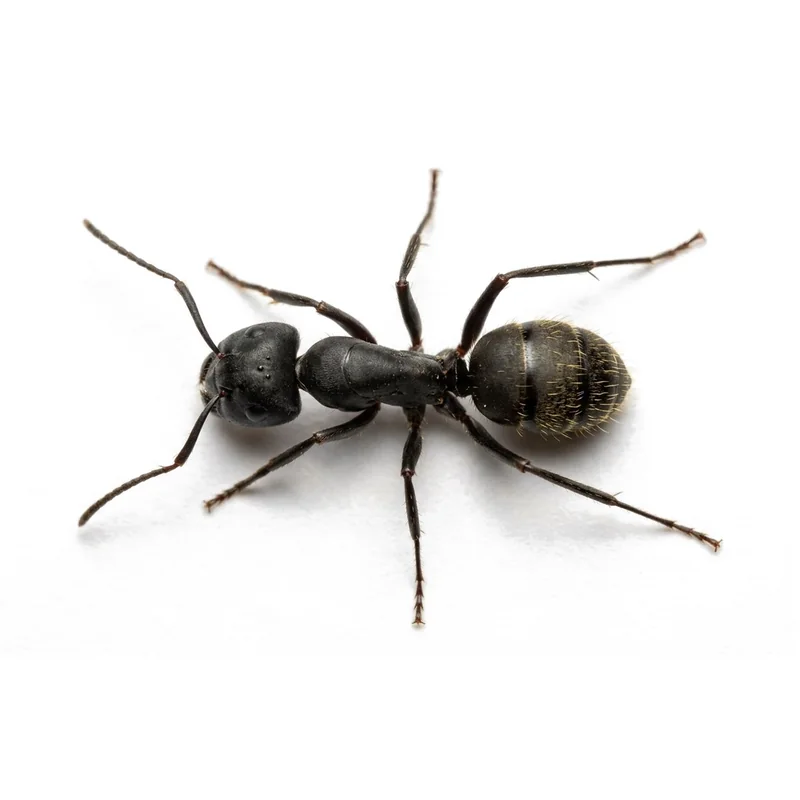
Ant head with compound eyes and no pore. Front wings clearly larger than back wings, the opposite of a termite, and the fastest single tell between a winged carpenter ant and a winged termite. | Elbowed antennae with a distinct bend, and a pinched, narrow waist. Body 12 to 25 mm, all black or red and black. Digs into wood to nest but does not eat it. | Late spring, often at night or dawn. Leaves sawdust-like shavings mixed with dead insect parts near door frames or soffits. No mud tubes and no carton material. Its tunnels are clean and smooth-walled, not packed with mud and wood. |
Odorous House Ant (winged)
AKA: Sugar Ant, Stink Ant
Tapinoma sessile
|
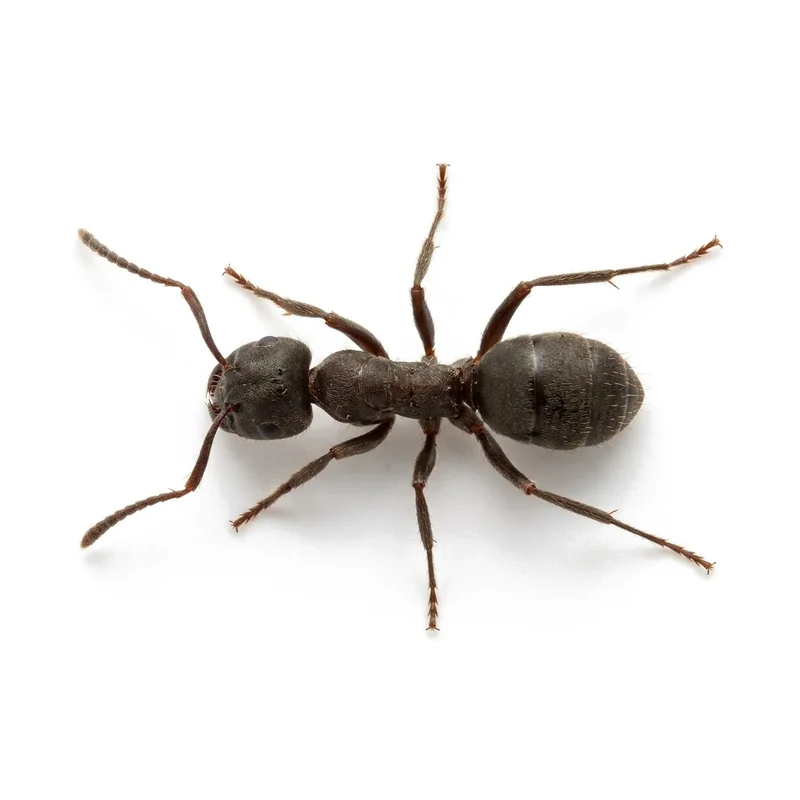
Front wings larger than back wings, like all ants. Sheds its wings soon after landing, leaving piles on windowsills that look like termite wing piles. The wing sizes tell them apart. | Elbowed antennae and a pinched waist. Body 2.4 to 3.3 mm, far smaller than a winged Formosan termite. A crushed ant smells like rotten coconut. Crushed termites have no smell. | Spring and summer, small swarms, often indoors from wall voids. Its night pull toward lights can overlap the Formosan swarm, so check the wings and the waist before calling for a termite inspection. |
Formosan Termite vs Eastern Subterranean Termite
The Formosan Subterranean Termite in Three Numbers
31
The Texas A&M Urban Entomology Program reports Formosan termites detected in 31 Texas counties since the first Texas find near Houston in 1956, and Collin County is among them.
Texas A&M Urban Entomology Program
3 to 4 mm
The University of Florida Institute of Food and Agricultural Sciences Extension measures a Formosan termite worker at about 3 to 4 mm long.
University of Florida Institute of Food and Agricultural Sciences Extension
3
US Department of Agriculture research service work describes 3 castes in every Formosan termite colony, workers, soldiers and winged adults, and only the soldiers and winged adults show the features that set Formosan apart.
US Department of Agriculture research service
Are Formosan Termites Dangerous to People?
No. Formosan termites do not sting, carry no human disease and have no documented allergy profile. The danger is to the house. Nationally the University of Florida puts the yearly economic cost of the Formosan subterranean termite in the United States at more than $4 billion, citing a 2023 estimate by Su and Lee.
For a household, it is the cost of repairing the damage a colony does to the house that hurts.
Do Formosan Termites Bite?
Only if you handle a soldier. Soldiers have working jaws and will pinch a finger, but the pinch carries no venom and leaves no rash or lasting irritation. Winged termites that end up inside on a summer night do not bite or sting, and they die within hours without moist soil.
Sweep them up, but save a few in a sealed bag so the species can be confirmed.
When Formosan Termite Signs Warrant Action
A Dusk Swarm Around Your Lights
A swarm of winged insects around porch or outdoor lights on a May or June evening is a Formosan sign until proven otherwise, and a swarm near the house means a mature colony within about 300 feet. Bag several and call for an inspection that day.
Damage in a Joist, Sill Plate or Stud
If termite damage reaches a load-bearing member (floor joists, sill plates, wall studs, beams or posts), have a structural engineer assess it before repair begins. We treat the termites. The engineer confirms the member is sound, so a contractor cannot simply patch it. Formosan reaches upper-floor studs more often than Eastern does.
Where Formosan Termites Feed in Your Home
Formosan workers come up from the underground nest the same ways Eastern termites do, through wood touching soil at slab edges and foundation openings, mud tubes up foundation walls and piers, and cracks or expansion joints in the slab. Inside, they feed on sill plates, rim joists, subflooring near plumbing, and wall framing behind stucco or brick.
What Does a Formosan Termite Nest Look Like?
A Formosan termite nest above the ground, called a carton nest, looks like crumbly, soil-colored material packed into a wall void or attic space. Workers build it from chewed wood, soil and saliva wherever a roof leak, plumbing leak or wet wall keeps the cavity damp.
The main nest stays underground, but a carton nest lets part of the colony live with no soil contact, which is why soil treatment alone never reaches it.
Formosan Termite Pressure Across Collin County
Most Pest Me Off termite calls in Collin County are still the Eastern subterranean termite. Formosan is established here but nowhere near as widespread. Pressure is higher in older McKinney and Plano neighborhoods with mature landscaping, and on any property with a history of Houston-area mulch or recycled railroad ties.
We treat every subterranean termite job as Eastern by default and confirm Formosan when soldiers or winged termites are recovered for identification. Once it is confirmed, the inspection grows to cover upper-floor walls, attic framing and anywhere with a history of moisture.
Formosan colonies feed all year under heated homes, but they swarm only from late spring through summer, at dusk and after dark. Texas A&M Urban Entomology Program and Pest Me Off service call records put the Collin County swarm season at 4 months, April through July, with the peak in May, June and July.
Pattern from Texas A&M Urban Entomology Program termite monitoring data and Pest Me Off service call records across Collin County, 2023 to 2026. Feeding underground continues all year, whatever the surface shows.
How Formosan Termite Colonies Grow
How Pest Me Off Treats Formosan Termites
Termite Takedown for Formosan is the same program we use for Eastern, with one more step when the inspection finds a nest inside a wall. Trelona product data on Formosan termite control confirms that the bait stations that work on Eastern also work on Formosan, and the difference is time and scope. A bigger colony takes longer to collapse, so we tell every Formosan customer up front that visible improvement is measured in months, not weeks.
Termite Inspection with In-Wall Detection
A licensed technician inspects the crawl space, attic, garage and every outside foundation surface. On a Formosan job the inspection adds upper-floor walls with a moisture history, attic framing, soffits, HVAC condensate lines and the spaces behind shower and tub access panels. A Termatrac T3i scanner finds termite activity through finished walls by sound, radar and heat, and every mud tube, carton nest and entry point is mapped. Current customers get a free general termite check, and anyone not yet a customer books a paid termite inspection.
In-Ground Bait Stations
Trelona annual bait stations go into the soil every 10 feet around the house. Workers find the cellulose bait, feed on it, and pass the active ingredient through the colony by mouth-to-mouth food sharing, all the way to the queen. The bait does not repel them, so workers keep coming back to it. Trelona is labeled and tested for the Formosan subterranean termite.
Liquid Perimeter Treatment for Active Infestations
When the inspection finds termites feeding inside the house, a continuous treated zone goes along the outside of the foundation using a non-repellent fipronil termiticide (Termidor SC, Termidor HE or Agenda SC, depending on the site). Non-repellent means workers cannot detect the treated soil, so they keep crossing it and carry the active ingredient back to the colony.
Foam in the Wall and Ongoing Monitoring
When a carton nest is confirmed in a wall void, attic or other cavity, we inject Termidor Foam through small drilled holes. It expands 30 to 1, fills the cavity and reaches the colony directly. The leak keeping the cavity wet is fixed at the same time, or the void fills again. Every bait station is checked about every 120 days in the first year, about every 60 days while termites are feeding, and about every six months after a clear year, and once a year a technician re-inspects every treated void and confirms the moisture fix held.
& Quick Fixes
How to Get Rid of Formosan Termites Yourself
You cannot get rid of an established Formosan colony yourself, least of all one nesting inside a wall. What you can do is take away the moisture, the wood and the entry routes that let a colony move in.
Why DIY Formosan Termite Treatment Fails
Every common DIY approach leaves a Formosan colony alive. The colony is too large to stop with a spray, and a nest inside a wall never touches anything put down around the foundation.
Repellent Spray Around the Foundation
The colony detects a repellent and reroutes within 24 to 48 hours. With so many more workers than an Eastern colony, it finds the gaps faster and more thoroughly.
Treating the Ground Without Checking the Walls
Ground spray or bait reaches only the colony in the soil. A carton nest in a second-floor wall or attic keeps feeding on its own while the homeowner believes the job is done. Checking the walls first is the step a Formosan job cannot skip.
Pulling Off Mud Tubes or Carton Material
Workers rebuild a broken mud tube within 24 to 48 hours by a nearby route. Breaking into a carton nest without a treatment plan scatters workers into the next wall cavities and can spread the infestation.
Treating the Termites but Not the Leak
A nest inside a wall exists because the cavity stays wet. Treat it without fixing the leak and new workers from the ground nest or a neighboring colony move back in within one to two seasons.
Buying Professional Termiticides Online
Professional liquid termiticides need a licensed applicator to buy and apply legally in Texas, and products sold online as professional-grade are often counterfeit or diluted. A patchy application leaves gaps the workers walk straight through.
Common Formosan Subterranean Termite Questions
What is a super termite and is it the same as a Formosan termite?
I saw a large swarm of insects around my porch lights in May. Could that be Formosan termites?
What is a carton nest and how do I know if I have one?
How is Formosan treatment different from Eastern Subterranean Termite treatment?
Will my homeowner insurance cover Formosan termite damage?
Is Collin County really at risk for Formosan termites?
How do I know if I have Formosan or Eastern Subterranean Termites?
I found crumbly brown material inside my wall. Is that a Formosan carton nest?
Can Formosan termites spread from my neighbor’s property to mine?
How do I get rid of Formosan termites?
Termites Are Inside Your Walls. We Find Them and Stop Them.
We scan your walls with in-wall detection, put bait stations around the house and treat any nest we find above the ground. If it is Formosan, we tell you what changes before any product goes down. McKinney, Allen, Frisco, Plano, and all of Collin County.