
Millipedes in Collin County, TX | Identification and Control
Millipedes are slow, many-legged crawlers that live in damp mulch and leaf litter and turn up by the dozen at doors, in garages and along baseboards after heavy rain or the first cool nights. They do not bite or sting, but a crushed one stains. Penn State Extension notes that migrating millipedes climb walls, fences and trees to about 6 feet, which is how they reach doors and windows.
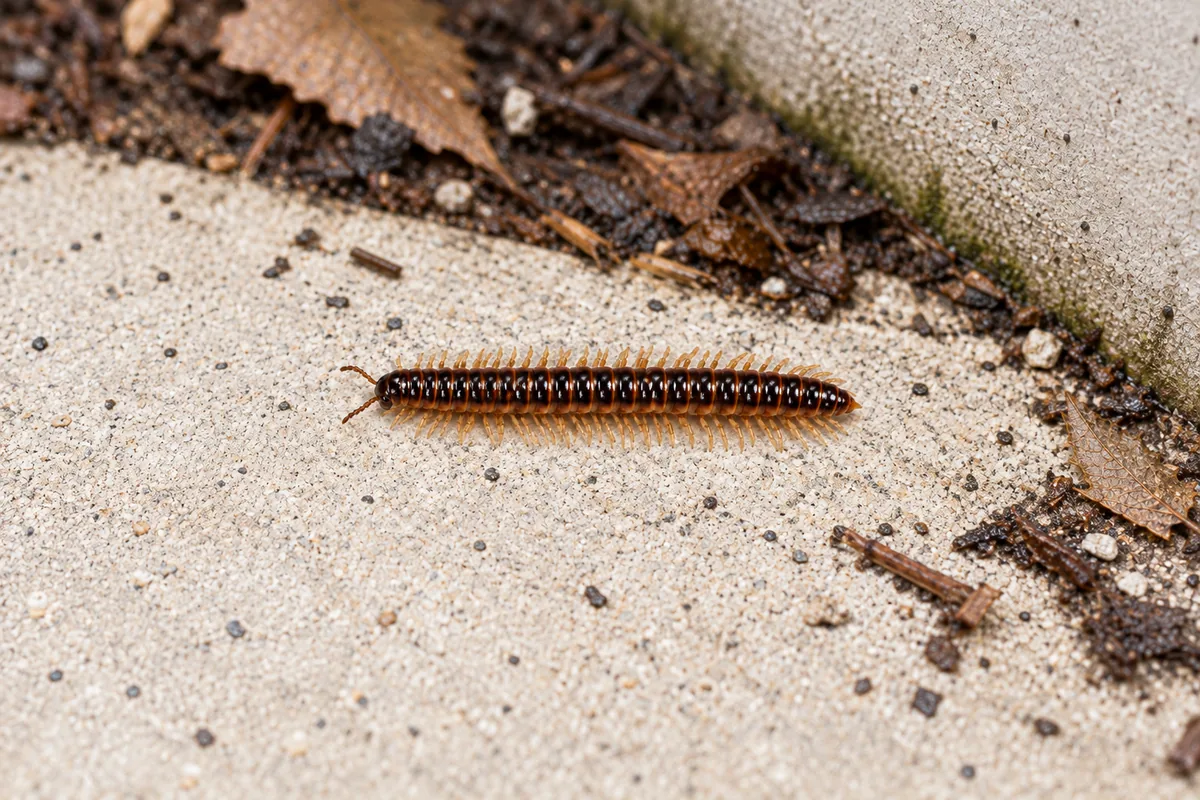
Millipedes at the door after every rain? Our office sits where McKinney, Plano, Frisco and Allen meet, 5 to 10 minutes from most homes in those four cities. Call and we will find where they are coming from and stop them outside.
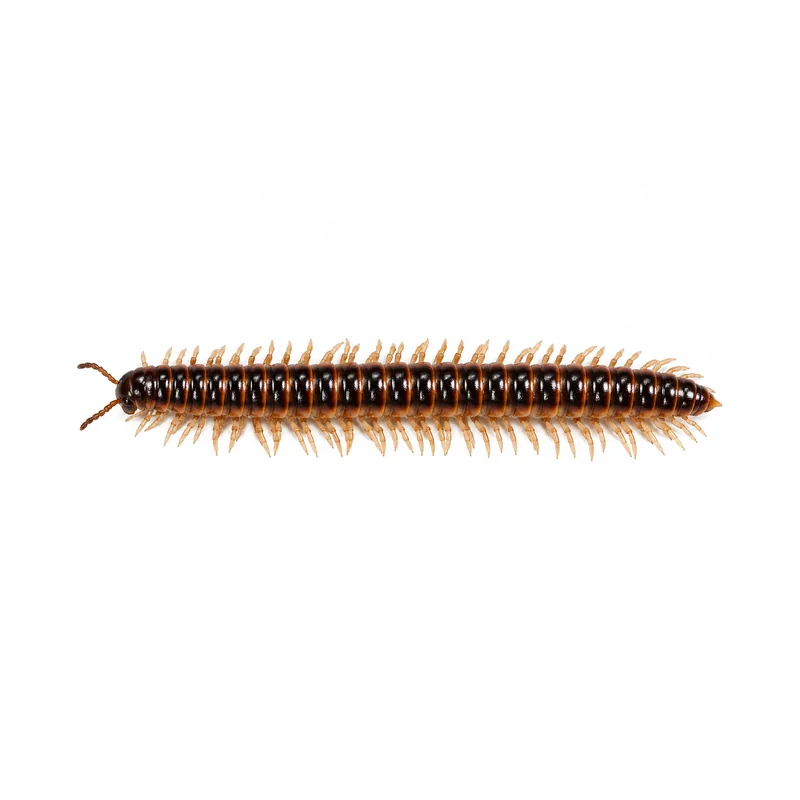
Millipede
The millipede is a slow, harmless crawler that eats dead leaves and rotting plant matter and lives wherever the ground stays damp. Texas A&M’s Field Guide to Common Texas Insects says millipedes do not bite, though they can release an irritating fluid when disturbed.
Risk Assessment
Choose a row for the full detail- Color
- Gray, brown or nearly black
- Diet
- Dead leaves, rotting mulch and decaying plants
- Threat level
- Low
- Defining behavior
- Curls into a tight coil when touched
- Where it hides
- Damp mulch, leaf litter, compost and under stones
- Young to adult
- About seven stages over 21 to 25 weeks
- Size
- Most under 1 1/2 inches, the garden millipede 1/2 to 3/4 inch
What Does a Millipede Look Like?
A long, hard, worm-shaped body with two pairs of short legs on almost every segment
A millipede is long and slim, made of many hard, ring-shaped segments, and most are gray, brown or nearly black. The Penn State Extension fact sheet on millipedes says they carry two pairs of legs on each body segment except the first three, which have one pair each, and that most people meet a dark brown one about an inch long. Texas A&M’s field guide adds that most species are under 1 1/2 inches long, with short legs that move in a slow, rippling wave.
The one that pours into homes is usually the garden millipede. Clemson’s Home and Garden Information Center describes it as gray to brown and 1/2 to 3/4 inch long. Iowa State University Extension calls it the flat-backed millipede, a little flatter and lighter in color than the common kind, with small ridges along the sides of each segment. Touch any millipede and it curls into a coil, and most also curl up when they die.
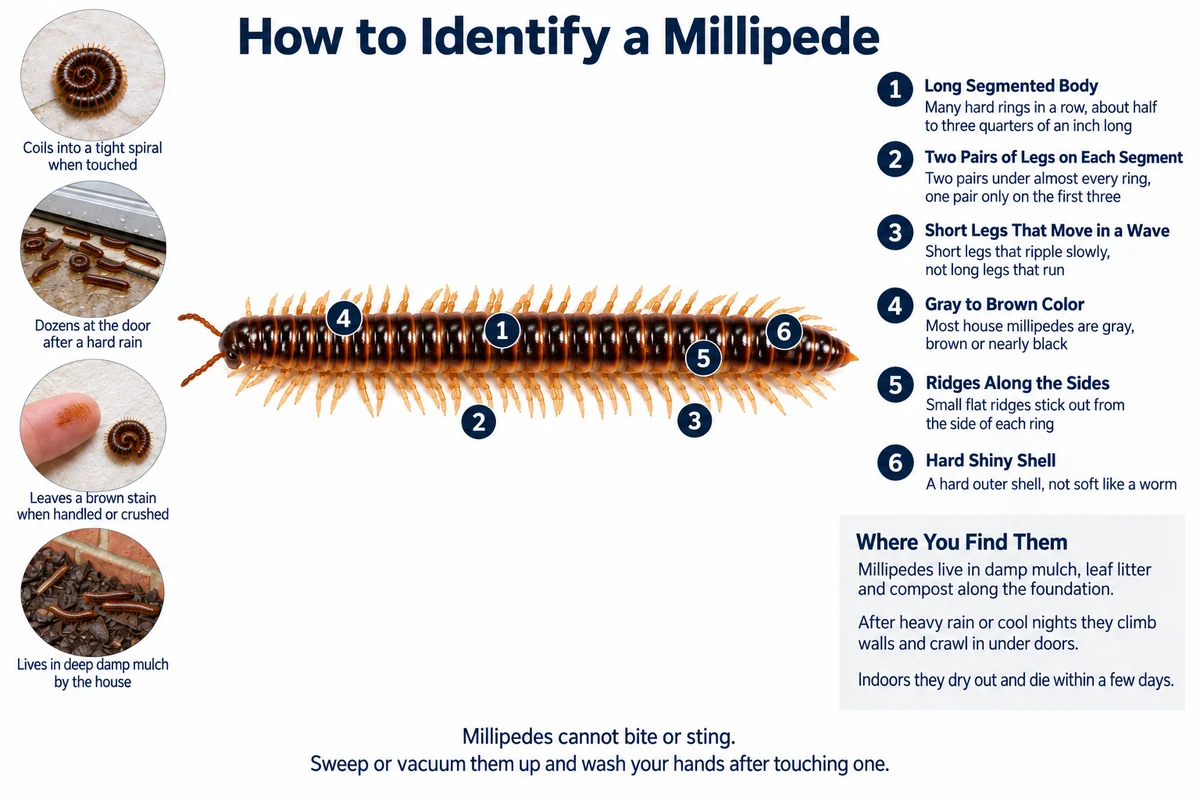
How to identify a millipede by its long segmented body, its two pairs of legs on each segment and the way it coils when touched
- Dozens of small brown curled shapes at the garage door or back door the morning after a hard rain
- A slow crawler with rows of short legs that ripple in a wave, not long legs that run
- It coils into a tight flat spiral when touched, not into a round ball
- Dead ones curled up along baseboards near outside doors
- A brown stain left on the floor, or on your fingers, where one was crushed or picked up
- Small brown crawlers in the soil of indoor house plants
Other Names for the Millipede
Millipede means a thousand feet, and the common name thousand-legger says the same. No millipede you will find in a Collin County garage has anywhere near that many. Clemson’s fact sheet notes that the record, from a millipede found in the Australian desert, is 1,306 legs. Penn State adds that the round, wire-like body earns some the name wire worm, which is easy to mix up with the wireworm, a beetle grub with only six legs.
Millipedes are not insects and not worms. Scientists group them as Diplopoda, meaning double legs, after the two pairs on each segment. The garden millipede, the greenhouse millipede and the flat-backed millipede are three names for the same small species that invades homes. In Spanish a millipede is a milpiés.
| Name | What it means |
|---|---|
| Thousand-legger | For its many legs, though none have a thousand in a home. |
| Garden millipede | The small gray to brown kind that invades homes. |
| Greenhouse millipede | The same species, common in greenhouses and house plants. |
| Flat-backed millipede | The same species again, for its flatter back. |
| Milpiés | The Spanish name, meaning a thousand feet. |
How to Tell a Millipede from a Centipede or Pill Bug
All three come in from the same damp beds along the foundation, and they are often found together. The legs, the speed and the way each one curls up tell them apart in a few seconds.
| Species | Size and Color | Key Feature | Where Found |
|---|---|---|---|
|
Millipede
AKA: Thousand-Legger, Garden Millipede
Diplopoda
This species
|
Usually 1/2 inch to about an inch. Gray, brown or nearly black. | Two pairs of short legs on almost every segment. Slow, and coils into a flat spiral when touched. | Damp mulch, leaf litter and compost, then in mass at doors and garages after rain. |
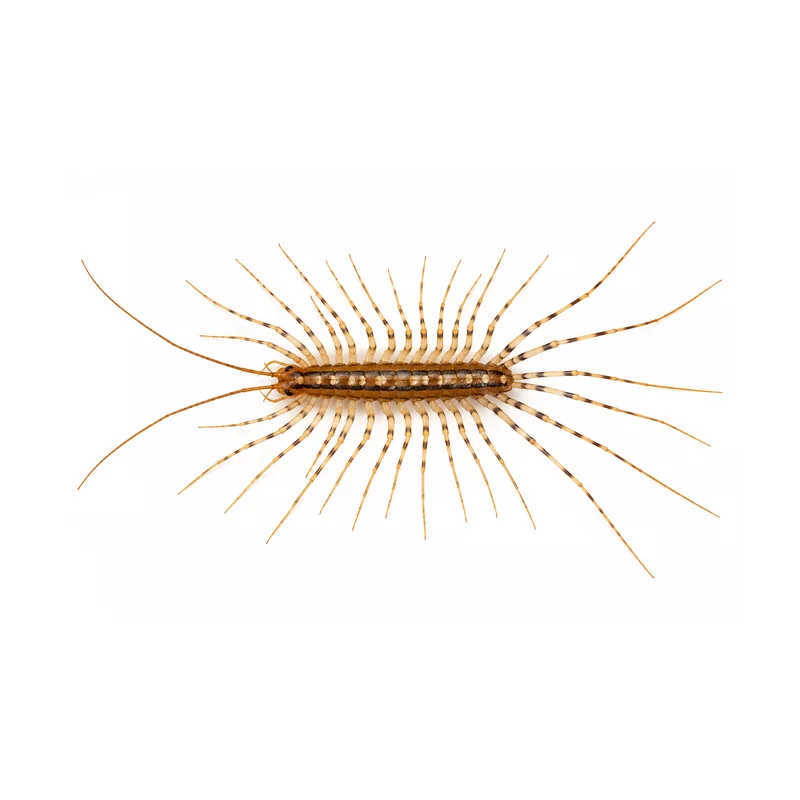
Centipede
AKA: House Centipede
Chilopoda
|
About 1 to 6 inches. Usually brownish. | One pair of legs on each segment, the first pair turned into fangs. Flat and fast, and it runs rather than curls. | Damp spots under rocks and logs, now and then indoors, hunting insects and spiders at night. |
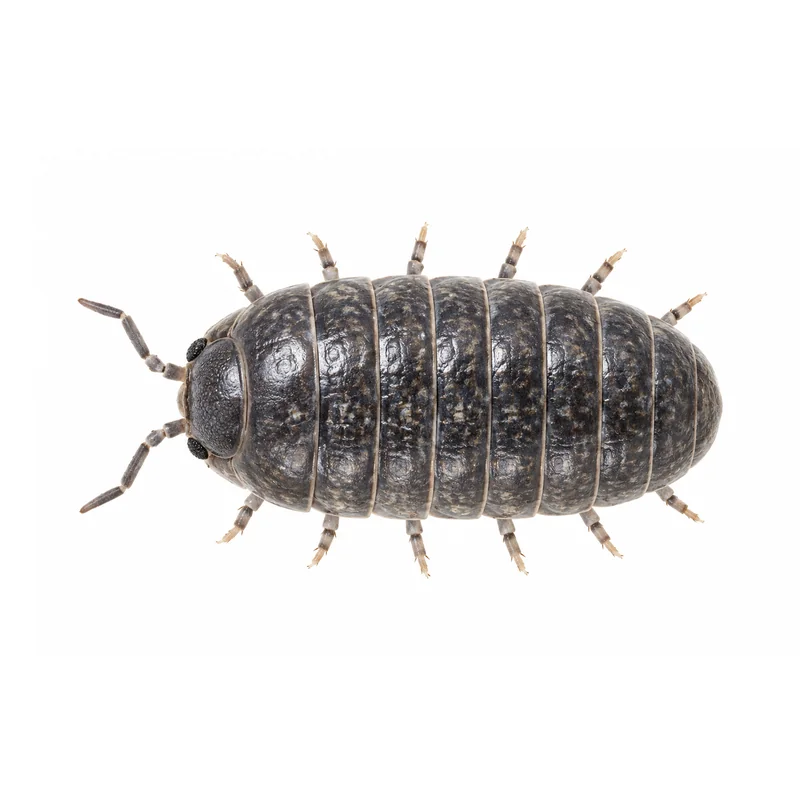
Pill Bug
AKA: Roly Poly
Armadillidium vulgare
|
About 1/2 inch. Slate gray. | A short oval body of armored plates, not a long one. Rolls into a tight round ball. | The same damp mulch and leaf litter, wandering indoors now and then without causing damage. |
Millipede vs Centipede
The Millipede in Three Numbers
50 feet
Iowa State University Extension reports that millipedes can invade homes from 50 feet or more away, coming out of woodland and open fields in very large numbers.
Iowa State University Extension
6 feet
Penn State Extension notes that migrating millipedes climb trees, fences and buildings to a height of about 6 feet.
Penn State Extension
20 to 300
University of Florida Extension reports that a female millipede lays from 20 to 300 eggs in the soil, singly or in clusters.
University of Florida Extension
Do Millipedes Bite or Sting?
No. Millipedes have no fangs and no stinger. Iowa State University Extension says they cannot bite or sting and do not attack people, property, possessions or pets, and Clemson’s fact sheet adds that they carry no serious diseases. What they do have is glands along the body that release a fluid when the millipede is grabbed or squeezed. Texas A&M’s field guide says this fluid can irritate the eyes, blister the skin, smell unpleasant and cause allergic reactions in people sensitive to it, and that some kinds can squirt it several inches. Clemson notes it can stain your hands. Pick them up with a paper towel or a dustpan, wash your hands with soap and water after touching one, and keep your fingers away from your eyes until you do.
Are Millipedes Poisonous to Dogs and Cats?
They will not bite or chase a pet. The risk runs the other way, when a curious dog or cat mouths one and gets the fluid in its mouth or eyes. The same fluid Texas A&M describes can irritate those tender spots, so a pet that picks one up may drool or paw at its face. Rinse the mouth and face gently with water, and call your vet if it keeps drooling, vomits, or squints and rubs at an eye.
When Millipede Contact Needs Fast Action
Fluid in an Eye
Flush the eye with clean running water for several minutes. Call your doctor if it stays red, painful or blurry afterward.
A Blister or Rash After Handling
Wash the skin with soap and water. A brown stain fades on its own, but swelling, blisters or a spreading rash are worth a call to your doctor.
A Pet That Chewed One
Rinse its mouth and face with water. Drooling that does not stop, vomiting or a sore eye means a call to your vet.
Dozens at the Door After Rain
A nuisance, not a danger. It does mean a large group is living in the beds around the house, so that is where to look.
Why You Have Millipedes in Your House
Millipedes come indoors by accident. They live outside in cool, damp places, under mulch, stones, compost, grass clippings and leaf litter, and at certain times they leave those spots in large numbers. Penn State’s fact sheet ties these moves to cooler weather and heavy rain, and Clemson’s says garden millipedes migrate in huge numbers after heavy spring rains, climbing walls easily and getting in through any small opening. A slab home’s garage door seal, a worn door sweep, a gap at the threshold and the weep holes in the brick are the usual ways in.
Once inside they do not last. Penn State says millipedes do not live more than a few days indoors because the air is too dry, and Iowa State adds that they cannot breed indoors, so every one you find walked in from outside. Dead ones curled along the baseboards are a sign of the group outside, not of a nest in the house. The one exception is a house plant. The greenhouse millipede can live in the damp soil of a potted plant, which is why the University of Florida Extension fact sheet on millipedes and their relatives advises checking potted plants for pests before bringing them indoors.
Where Millipedes Live Around Collin County Homes
Millipedes live where dead plant matter stays wet. Texas A&M’s field guide places them under rocks, logs and other objects lying on the ground, active at night, and the University of Florida’s fact sheet says they are more of a problem in wooded or newly built areas, where decaying vegetation gives them plenty to eat and breed in. Around a house that means deep mulch against the brick, leaf litter behind shrubs and along the fence, compost piles, and soil kept wet by sprinklers or a downspout.
Millipede Pressure Across Collin County
Millipede calls show up in our service notes in Prosper, Frisco, McKinney and Allen, most often in late summer and fall, and usually as millipedes found inside, in bathrooms, around house plants and along the floors.
In Melissa and the other growing towns to the north, new yards with fresh, deep mulch and homes that back onto creeks, greenbelts and wooded lots give them the damp, leafy ground the University of Florida describes.
Millipedes spend the winter tucked away as adults and become active in spring. Mass moves toward houses come after heavy spring rains and again as fall nights cool, with quieter but steady activity through the summer whenever a storm soaks the beds.
Pattern from published millipede biology (Texas A&M, Penn State, Clemson and Iowa State) and Pest Me Off millipede calls, which come mostly in late summer and fall.
Why Millipedes Keep Coming Back
How Pest Me Off Gets Rid of Millipedes
Millipede control is four steps, every job. Almost all of the work happens outside, because the millipedes in the house are already dying and the ones that matter are still in the beds.
Inspect and Identify
A free inspection of the beds, the lawn edge, the fence line, the garage and the rooms where they turn up. We confirm they are millipedes and not centipedes or pill bugs, and find the damp spots feeding them.
Treat Where They Live
Granules worked down through the mulch, shrub and flower beds and along the lawn and fence line, so the product reaches the damp layer where the millipedes hide.
Guard the Way In
A treatment along the base of the house, the weep holes, the door thresholds and the garage, the spots millipedes cross on their way inside.
Dry Out the Edge
We show you what is holding the moisture, from deep mulch against the brick and leaves behind the shrubs to sprinklers hitting the wall and a worn door sweep, and what to change.
& Other Companies
How to Get Rid of Millipedes Yourself
Most DIY millipede work is drying out the edge of the house. Clemson’s millipede fact sheet calls removing their shelter the most important step, ahead of any spray.
Why Some DIY Responses Fail for Millipedes
Most DIY millipede trouble comes from treating the house instead of the beds, or from spraying where the product cannot reach the damp layer underneath.
Spraying Inside the House
Iowa State says household insecticides used indoors give little if any benefit, because the millipedes inside die from the dry air on their own.
Spraying on Top of Mulch or Rock
Penn State warns that under rock or mulch laid over plastic sheeting, a spray never reaches the millipedes, which thrive in the damp layer the plastic holds in.
Stepping On Them
Crushed millipedes leave brown stains on tile, grout and concrete, and on skin. A broom and dustpan or a vacuum is cleaner.
Common Millipede Questions
What is a millipede?
What is the difference between a millipede and a centipede?
Do millipedes bite or sting?
Are millipedes poisonous to dogs and cats?
Why are there so many millipedes in my house after it rains?
Why do I keep finding millipedes in my bathroom?
Can millipedes live in my house plants?
Do millipedes damage your house or belongings?
How many legs does a millipede have?
Why do millipedes curl up?
How do I get rid of millipedes?
Millipedes After Every Rain? We Stop Them Before They Reach the Door.
We find the damp beds feeding them, treat down into the mulch and along the foundation, doors and garage, and show you what to change so the next storm does not bring them back. Pest control across McKinney, Allen, Frisco, Plano, and all of Collin County.