
German Cockroaches in Collin County, TX | Identification and Control
The German cockroach (Blattella germanica), the croton bug or kitchen roach to many Collin County homeowners, is the most common indoor cockroach in our service area. It is small, light brown and marked with two dark stripes behind the head. It lives and breeds inside heated homes all year, and the store spray most people reach for first tends to spread it. Getting rid of it takes bait, the right timing and follow-up. In the Inner-City Asthma Study, published in 2005, 78.5 percent of children with moderate to severe asthma at the Dallas site tested sensitive to cockroach allergen, the allergen German cockroaches leave in house dust.
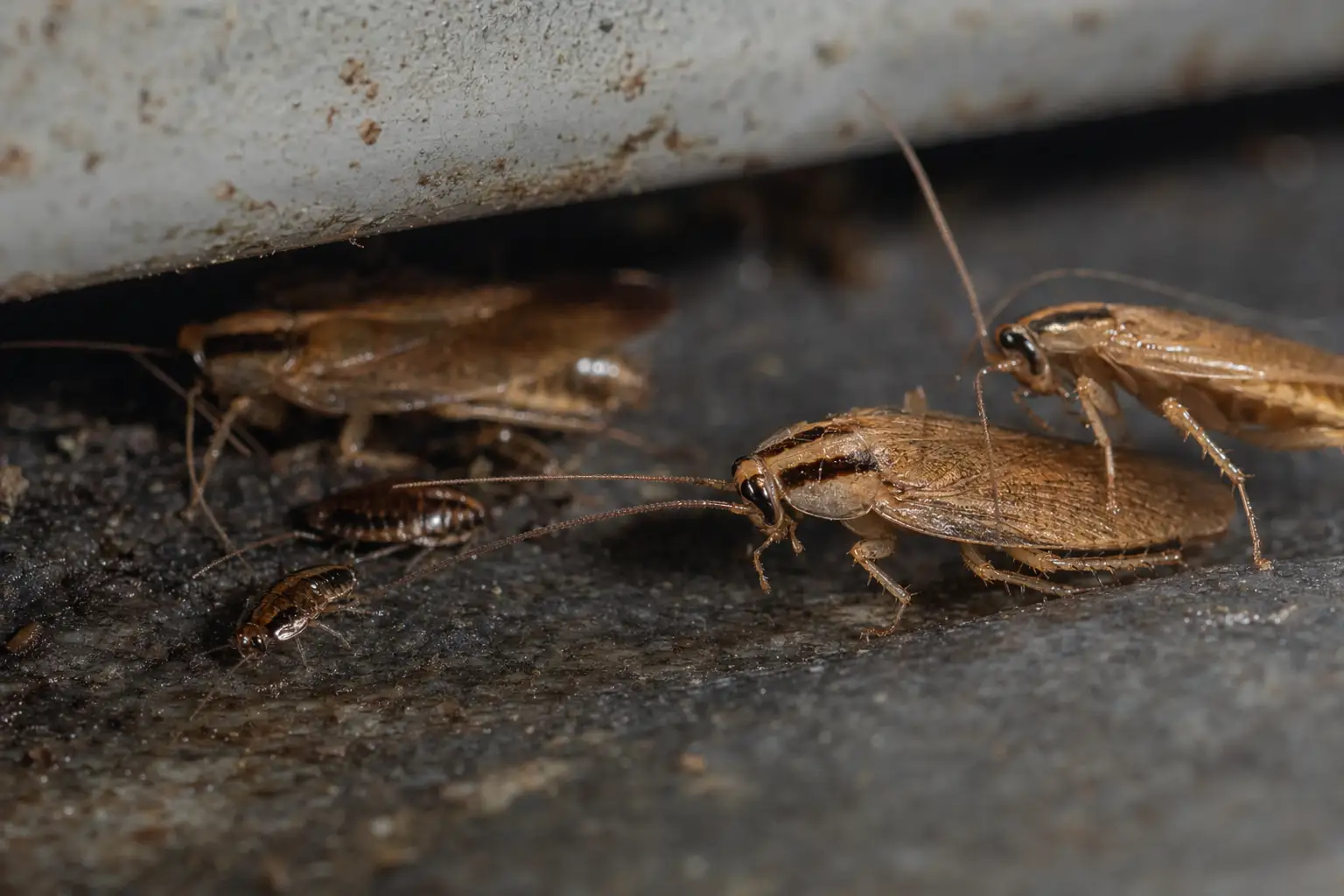
Seeing small striped roaches in your Collin County kitchen? Our office sits where McKinney, Plano, Frisco and Allen meet, 5 to 10 minutes from most homes in those four cities. Send us a photo or call, and we will tell you which roach it is.
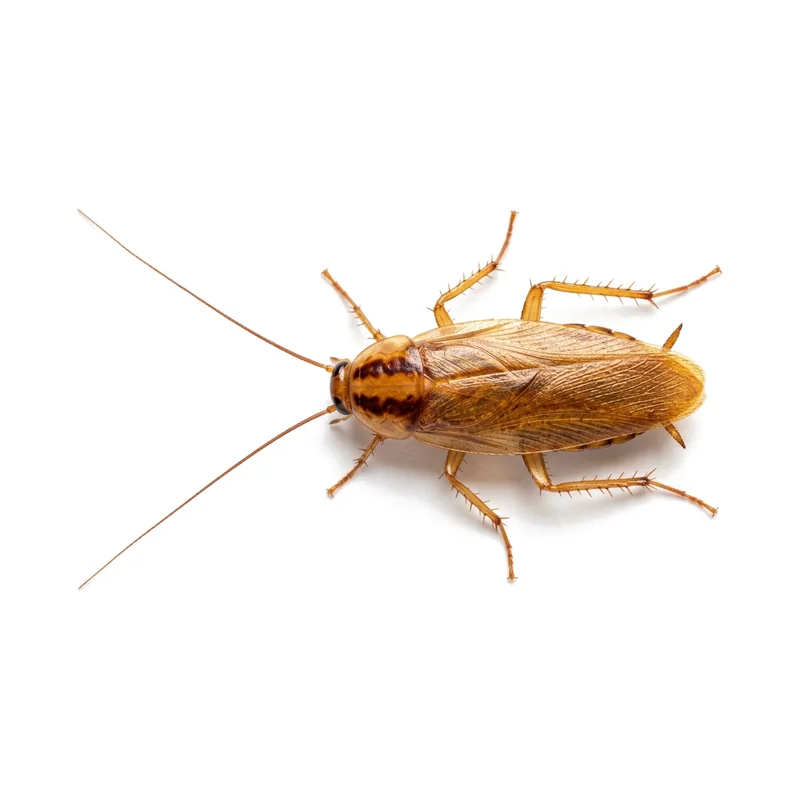
German Cockroach
The German cockroach is the most researched cockroach in pest control, a strictly indoor species that reached North America through shipping and now breeds inside heated buildings with no winter slowdown.
Risk Assessment
Choose a row for the full detail- Color
- Light brown to tan, with two dark stripes behind the head
- Threat level
- High
- Lifespan
- Up to 280 days for a female, 140 days for a male
- Active season
- Year-round inside heated and cooled homes
- Eggs
- 30 to 40 per egg case, 5 to 8 cases in a female’s life
- Generation time
- 50 to 60 days at 80°F
- Body length
- 13 to 16 mm (0.5 to 0.625 in)
What Does a German Cockroach Look Like?
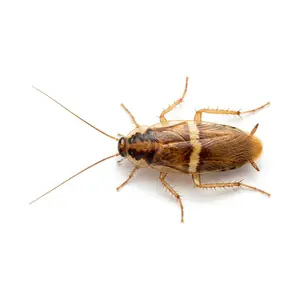
An adult German cockroach is 13 to 16 mm long, about half an inch, and light brown to tan. The surest mark is on the shield-shaped plate just behind the head, called the pronotum: two dark stripes that run lengthwise, side by side, toward the wings.
Close-up reference photos at several life stages from Oklahoma State University Extension help confirm it. Clemson Cooperative Extension says adult German cockroaches are 1/2 to 5/8 inch long, pale brown or tan with two dark stripes behind the head (Clemson Cooperative Extension).
Adults have full wings, but neither sex really flies. Males may glide a short way when they fall, and females do not fly at all. Young roaches are darker, often nearly black, with one pale stripe down the back. The female carries her egg case sticking out of the tip of her body for almost the whole time the eggs develop, which no other roach in our service area does.
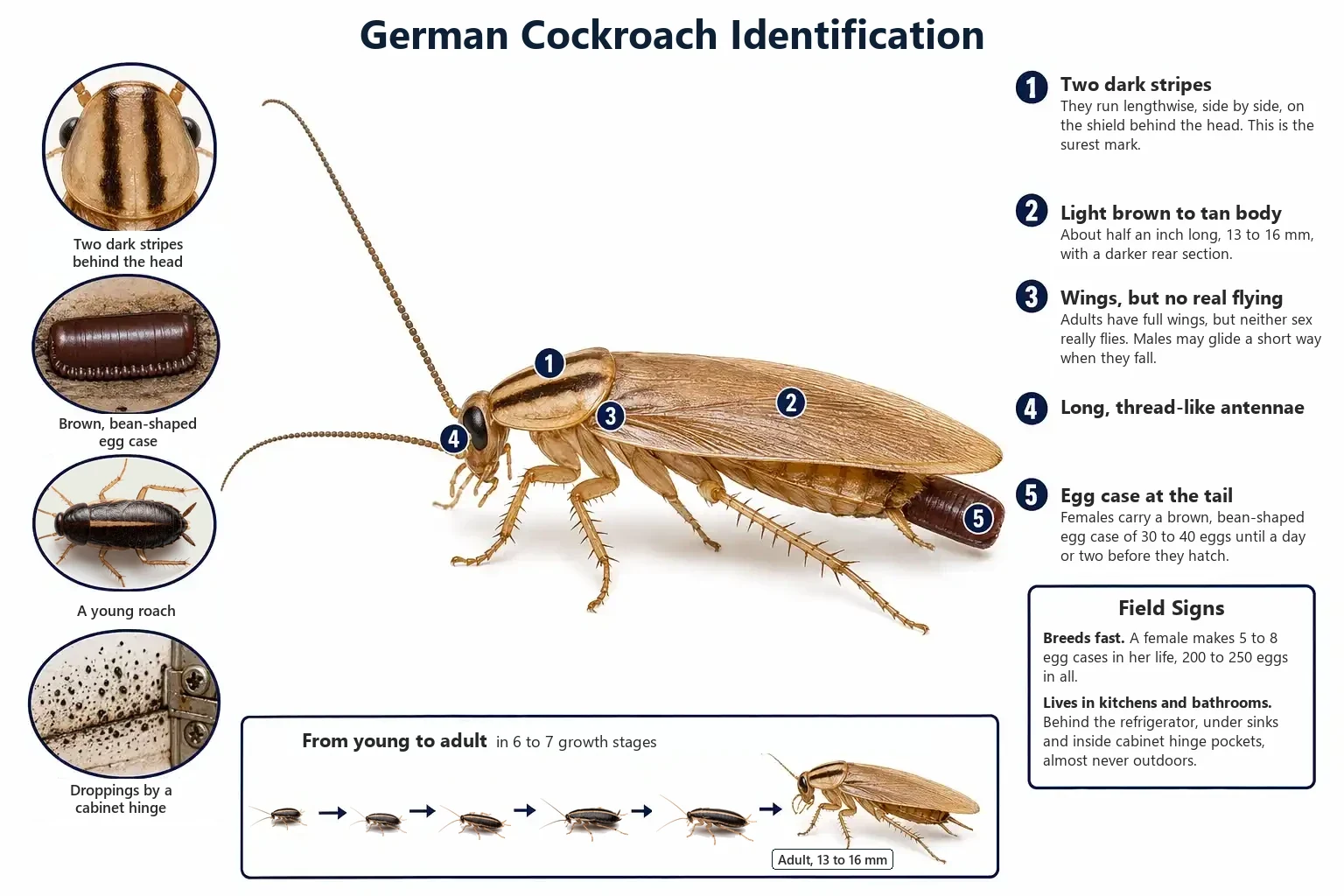
How to identify a German cockroach by the two stripes behind its head and the egg case the female carries
- Two dark lengthwise stripes on the shield behind the head
- Light brown to tan body, about half an inch long
- Young roaches nearly black, with one pale stripe down the back
- Females carry a brown, bean-shaped egg case at the tail end, which can look like a short tail
- Found in kitchens and bathrooms, scattering when the lights come on at night
- Seen in daylight only when the population has outgrown its hiding spots
Other Names for the German Cockroach
The German in German cockroach is a historical mistake. The species came from Southeast Asia and reached Europe on colonial-era ships, and Linnaeus named it Blattella germanica in 1767 from European specimens. Croton bug is the older American name. It comes from New York’s Croton Aqueduct, the brick water tunnels finished in 1842, where these roaches thrived in the damp brickwork and rode the supply pipes into Manhattan apartments. The name traveled south, and older Texas homeowners still use it. Every name in the table means the same small striped roach.
Where Are German Cockroaches Found in Texas?
German cockroaches are found indoors throughout Texas, and Collin County homes are no exception. Field observations of the German cockroach show it indoors year-round across the Dallas-Fort Worth area. It cannot live outdoors in our climate, so a German cockroach in your home came in with something or from the unit next door.
The Texas A&M urban entomology cockroach page covers its Texas populations.
| Name | What it means |
|---|---|
| Croton bug, or crotonbug | The old New York name from the Croton Aqueduct, still heard across Texas. |
| Kitchen roach | The modern nickname, because this is the roach that settles inside the kitchen rather than wandering in. |
| German roach | The everyday short form of German cockroach. |
| French or Prussian cockroach | What it was called in Germany and in Russia, each country naming a neighbor. |
| Small roach with two stripes | Not a name, but how most people describe it. Dark lengthwise stripes mean German, and pale bands across the wings mean brown-banded. |
How to Tell German Cockroaches from Other Cockroaches in Collin County
Three other cockroaches in Collin County get mistaken for the German cockroach. Size, color, which way the markings run and where you find it separate them without a microscope. A fourth, the Asian cockroach, looks nearly identical but flies readily toward porch lights at night. It is not the roach settling into Collin County kitchens, so a small striped roach on the counter at 11 pm that does not fly is a German cockroach.
| Species | Size and Color | Key Feature | Where Found |
|---|---|---|---|
|
German Cockroach
AKA: Croton Bug, Kitchen Roach
Blattella germanica
This species
|
13 to 16 mm, about half an inch. Light brown to tan with a darker rear section. Young roaches are nearly black with one pale stripe. | Two dark stripes running lengthwise on the shield behind the head. Females carry a brown, bean-shaped egg case at the tail until shortly before it hatches. | Kitchens and bathrooms, behind the refrigerator and dishwasher, under sinks, inside cabinet hinge pockets. Indoors all year, almost never outdoors in Collin County. |
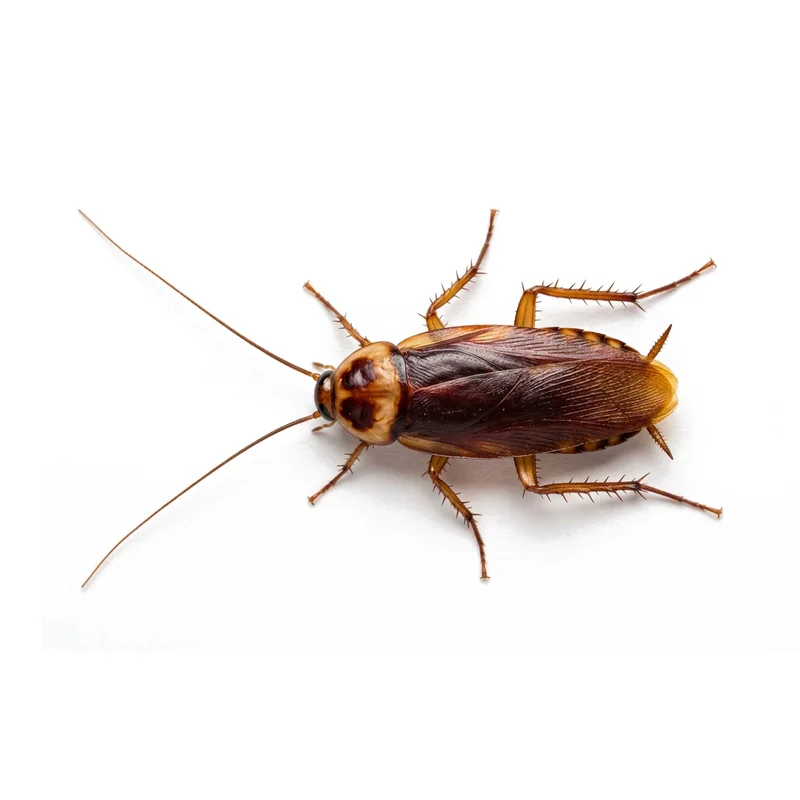
American Cockroach
AKA: Palmetto Bug, Water Bug, Sewer Roach
Periplaneta americana
|
35 to 50 mm (1.5 to 2 in), the largest cockroach in our service area. Reddish-brown, with a yellow outline around the shield behind the head. | Can glide short distances in warm, humid weather, unlike the German and Oriental cockroaches. Fast runner with antennae longer than its body. Often mistaken for a giant water bug. | Garages, utility rooms, sewer drains, plumbing voids and the slab edge. Outdoors in mulch through the warm months, coming in through floor drains, expansion joints and weep holes after heavy rain. |
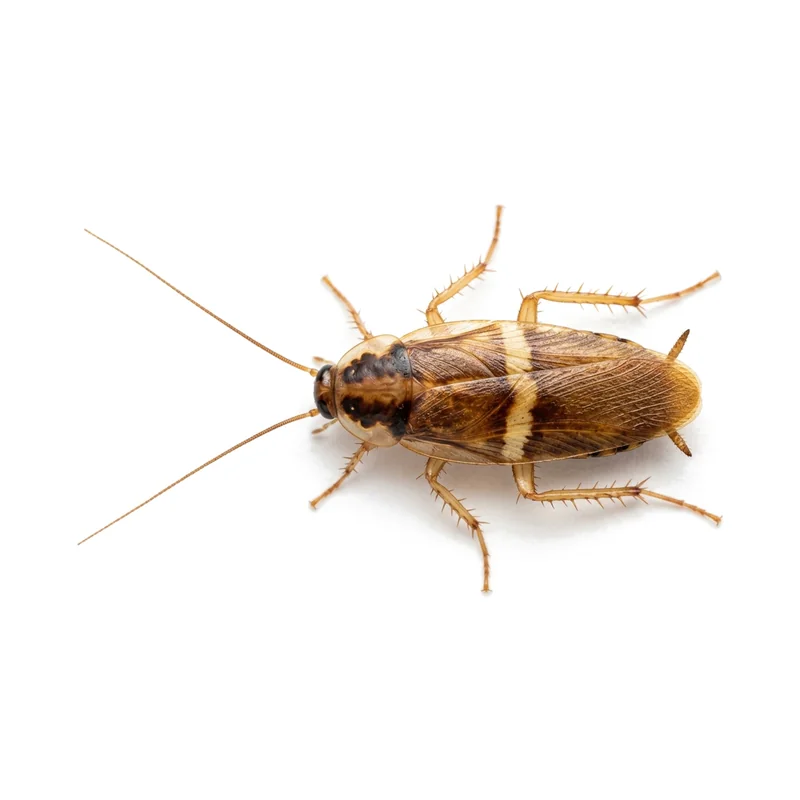
Brown-Banded Cockroach
AKA: Furniture Cockroach, Furniture Roach
Supella longipalpa
|
13 to 14.5 mm, about the size of a German cockroach. Light to medium brown, with two pale yellowish bands across the wings. | The bands run across the wings, not lengthwise behind the head. Females glue their egg cases to hidden surfaces instead of carrying them. Handles much drier conditions than the German cockroach. | Bedrooms, living rooms, inside electronics, upper cabinets, behind picture frames and under furniture. Prefers warm, dry rooms away from the kitchen. |
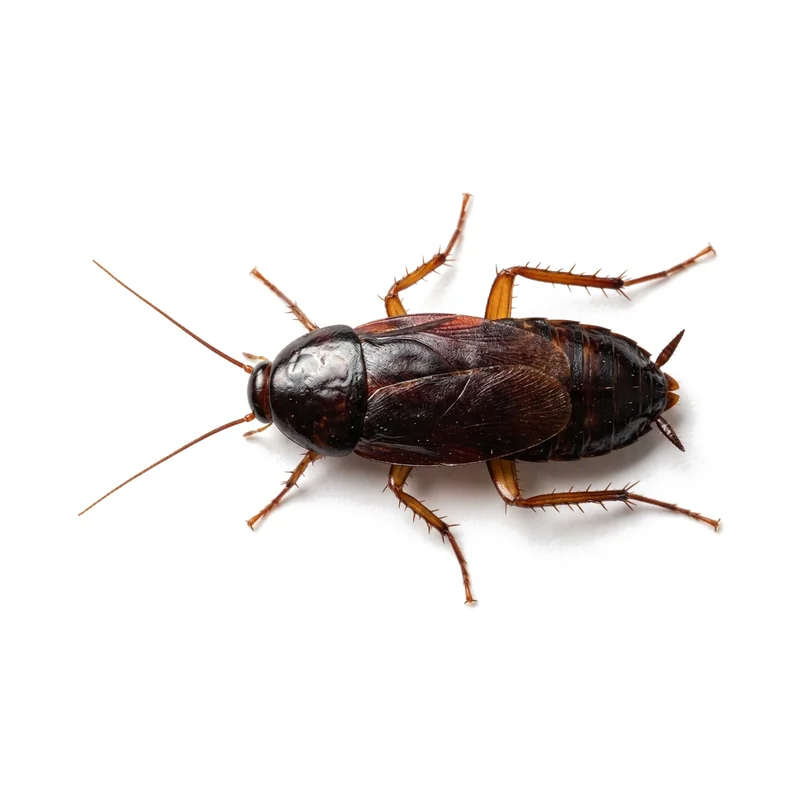
Oriental Cockroach
AKA: Black Beetle, Water Bug, Shiny Black Roach
Blatta orientalis
|
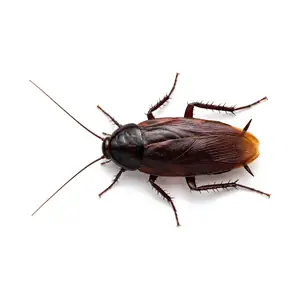
22 to 27 mm, about 1 inch. Shiny dark brown to jet black, the darkest cockroach in Collin County. Males have short wings and females are nearly wingless. | Neither sex can fly. Slow and heavy-bodied, and leaves a musty odor in infested garages. | Garages, utility rooms, the foundation edge, under mulch and stones and near floor drains. Mostly outdoors in cooler months, coming in through slab-edge gaps and floor drains. |
German Cockroach vs Brown-Banded Cockroach
The German Cockroach in Three Numbers
30 to 40
The University of Florida Extension puts a typical German cockroach egg case at 30 to 40 eggs, which the female carries until a day or two before they hatch.
University of Florida Extension
1/2 to 5/8 inch
Clemson Cooperative Extension says adult German cockroaches are 1/2 to 5/8 inch long, pale brown or tan with two dark stripes behind the head.
Clemson Cooperative Extension
78.5%
In the Inner-City Asthma Study, published in 2005, 78.5 percent of children aged 5 to 11 with moderate to severe asthma at the Dallas site tested sensitive to cockroach allergen, the allergen German cockroaches leave in house dust.
Inner-City Asthma Study, Journal of Allergy and Clinical Immunology, 2005
Are German Cockroaches Dangerous?
Yes, mainly to people with asthma or allergies. German cockroaches produce a family of allergen proteins found in their saliva, droppings and shed skins. That dust becomes airborne with normal household activity, settles into bedding, upholstery and HVAC filters, and stays there even after a population is fully eliminated.
They also carry bacteria. German cockroaches travel between drains and food preparation surfaces, and cockroaches collected from real infestations have tested positive for Salmonella typhimurium, Staphylococcus aureus, Pseudomonas aeruginosa and Escherichia coli. They carry these on their bodies and in their gut and leave them wherever they walk and feed.
German Cockroach Allergy, Asthma and IgE Testing
A landmark inner-city asthma study followed children with asthma across several major US cities. Children who were both allergic to cockroach and exposed to high levels of its allergen in their bedroom dust had 0.37 asthma hospital stays a year, against 0.11 for the other children, and more unscheduled medical visits. In the later Inner-City Asthma Study (Journal of Allergy and Clinical Immunology, 2005), 78.5 percent of the asthmatic children at the Dallas site were sensitive to cockroach on skin testing.
If a child in your home has asthma and the nighttime cough, wheezing, rescue inhaler use or school absences increase after an infestation is confirmed, ask your pediatrician about cockroach-specific IgE testing. Kids who test positive often improve once the home is treated and cleaned. Cleaning is half the work, because the allergens stay in bedding, upholstery and HVAC filters for months. Sudden severe wheezing, trouble breathing, lip or tongue swelling or hives are uncommon from cockroach allergen alone, but they need emergency care right away.
Do German Cockroaches Bite?
Almost never. German cockroaches are scavengers that eat food residue, grease and crumbs. Bites are recorded in the research literature only in extreme infestations where the population is very dense and food has run out. In an ordinary home infestation they do not seek out or bite people.
When German Cockroach Activity Needs Fast Action
Roaches Out in Daylight
German cockroaches hide by day. Seeing them in the open in daylight means the hiding spots are overcrowded and the population is well into the hundreds, not dozens.
A Child with Asthma in the Home
Any German cockroach activity in a home with an asthmatic child puts treatment on a medical timeline rather than a routine schedule.
Roaches in More Than One Room
Sightings in the kitchen, bathroom and laundry room mean the population has spread beyond where it started. The whole home needs inspecting, not one spot treated.
Store-Bought Spray Already Used
Spray near the hiding spots scatters roaches deeper into the walls and contaminates the cracks where bait needs to go. Tell us if you have sprayed. Treatment still works, but it takes longer.
Why You Found German Cockroaches in Your House
German cockroaches in a Collin County home almost always came in with something, not from outdoors. The usual carriers are cardboard moving boxes, grocery delivery bags and boxes from high-volume retailers, secondhand appliances, takeout containers and items from infested storage units. In apartments, townhomes and duplexes they also walk in from the next unit through shared plumbing chases, wall voids and gaps around electrical conduit.
It is not a sign of a dirty house. The cleanest kitchen can have German cockroaches within two weeks of unpacking one infested box. What a clean kitchen does change is how well treatment works, covered in the DIY steps below.
Where German Cockroaches Hide in Collin County Homes
Once inside, German cockroaches settle in tight, dark, warm, slightly damp spots near food and water. The kitchen comes first in nearly every home: behind the refrigerator compressor, inside the dishwasher void, under and behind the range, under the sink where the pipes come through, inside cabinet hinge pockets and inside the refrigerator door gasket itself. The bathroom comes second: under the vanity, behind the toilet tank and around the tub or shower valve access. Heavy infestations spread to the washing machine drain and into the wall voids behind kitchen electronics. Young cockroaches hide in cracks about a sixteenth of an inch wide, a preference measured by Koehler, Strong and Patterson in 1994, so almost no gap in a cabinet, appliance or wall keeps them out.
German Cockroach Pressure Across Collin County
German cockroach pressure in our service area follows three patterns. The first is multi-family housing: apartments, townhomes and duplexes in McKinney, Plano and Allen produce steady calls because shared wall voids let roaches move between units whatever any one unit does. The second is nearby restaurants and food service: homes along the US 75 corridor in Allen and the Dallas North Tollway commercial zones in Frisco see more pressure from populations in neighboring commercial kitchens. The third is older construction: homes built before 1990 with original plumbing and aging slab seals give roaches more routes between rooms.
New construction in Celina, Prosper, Anna and Melissa usually has low background pressure, with roaches arriving through moves, deliveries and secondhand items rather than the structure. The Colony and Carrollton sit closer to the Dallas commercial corridor and fall between the newer suburbs and the older McKinney and Plano housing.
German cockroaches breed year-round inside heated and cooled Collin County homes, so outdoor weather has little effect on them. Pest Me Off service records from 2023 to 2026 show German cockroach activity in Collin County homes in all 12 months of the year, peaking April through October. The small winter dip reflects only the few homes that let indoor temperatures drop overnight.
Pattern from Pest Me Off service records across Collin County, 2023 to 2026, checked against published German cockroach breeding biology at indoor temperatures.
Why German Cockroach Populations Grow So Fast
How Pest Me Off Treats German Cockroaches
German cockroach treatment is four steps over several visits, not one spray. Each step reaches the part of the population the step before could not, and skipping one lets the population rebuild at the next hatch, about three weeks later.
Inspect and Confirm
Confirm the species before any product goes down. Check the kitchen and bathroom for food and water the roaches can use instead of bait. Place 12 to 18 sticky traps at floor level to map where the population is concentrated.
Bait the Population
Place 20 to 30 pea-sized dots of gel bait per kitchen inside cabinet hinge pockets, behind appliances, under cabinet ledges, along plumbing chases and in the refrigerator and dishwasher voids. Bait goes in the cracks, not on open counters.
Stop the Next Generation
Apply a growth regulator, a product that stops young roaches from maturing rather than a poison, to the cracks where they live. Puff insecticide dust into wall voids through switch plates, outlet boxes and pipe openings.
Rotate and Follow Through
Reinspect at 30 days and switch bait products every 60 to 90 days. Apartments and food service kitchens get weekly or every-other-week visits until the roaches are gone, then monthly maintenance.
& Quick Fixes
How to Get Rid of German Cockroaches Yourself
DIY can shrink a German cockroach population but rarely ends one. Keep new roaches from coming in, take away their food and water, and put bait in the cracks where they hide.
Why Some DIY Responses Fail for German Cockroaches
German cockroaches beat DIY treatment more often than any other indoor pest in Collin County. The reasons are their biology, not homeowner skill, and two of the three mistakes below make the problem worse.
Bug Bombs (Total-Release Foggers)
The fog never reaches the cracks and voids where German cockroaches live. It drives them deeper into walls and appliance motors and can spread a kitchen problem into bedrooms and living rooms that had none. Independent university extension testing has found foggers ineffective against this species.
Store-Bought Roach Spray
Most spray cans use a chemical family called pyrethroids, and Dallas-Fort Worth German cockroaches have been building resistance to it since the 1980s, to the point of needing up to 100 times the dose that kills a non-resistant roach. Current German cockroach resistance research finds resistance by several routes now widespread in city populations. Spray also misses the hiding spots where about 80 percent of the population spends the day, and the survivors scatter deeper into the walls.
One Treatment Without Follow-Up
Any single treatment, DIY or professional, leaves egg cases behind, and 30 to 40 young hatch from each surviving case about three weeks later. Follow-up at that interval is what closes the gap.
Common German Cockroach Questions
What is the small light brown roach with two stripes in my kitchen?
What is the difference between a German cockroach, a croton bug, and a kitchen roach?
What is the small roach with yellow stripes?
Why does the roach in my kitchen look like it has a tail?
How do I know if I have German cockroaches or brown-banded cockroaches?
Are German cockroaches dangerous to my family, especially children?
What are German cockroach allergens and why do they affect children specifically?
Do German cockroaches bite humans?
Does having German cockroaches mean my house is dirty?
Can German cockroaches spread from an apartment unit into mine even if I keep my unit clean?
Why are German cockroaches so much harder to get rid of than other roaches?
Why do German cockroaches keep coming back after I thought I got them all?
Will store-bought sprays or bug bombs work for German cockroaches?
How long does professional German cockroach treatment take?
How do I get rid of German cockroaches?
The Roach That Came Home in a Cardboard Box. Bait, Growth Regulator, Follow-Through.
We confirm the species, map every hiding spot, rotate gel bait across chemical types, add a growth regulator and wall void dust, and return at the egg-cycle interval when our technician decides it is needed. Cockroach Crackdown across McKinney, Allen, Frisco, Plano, and all of Collin County.