
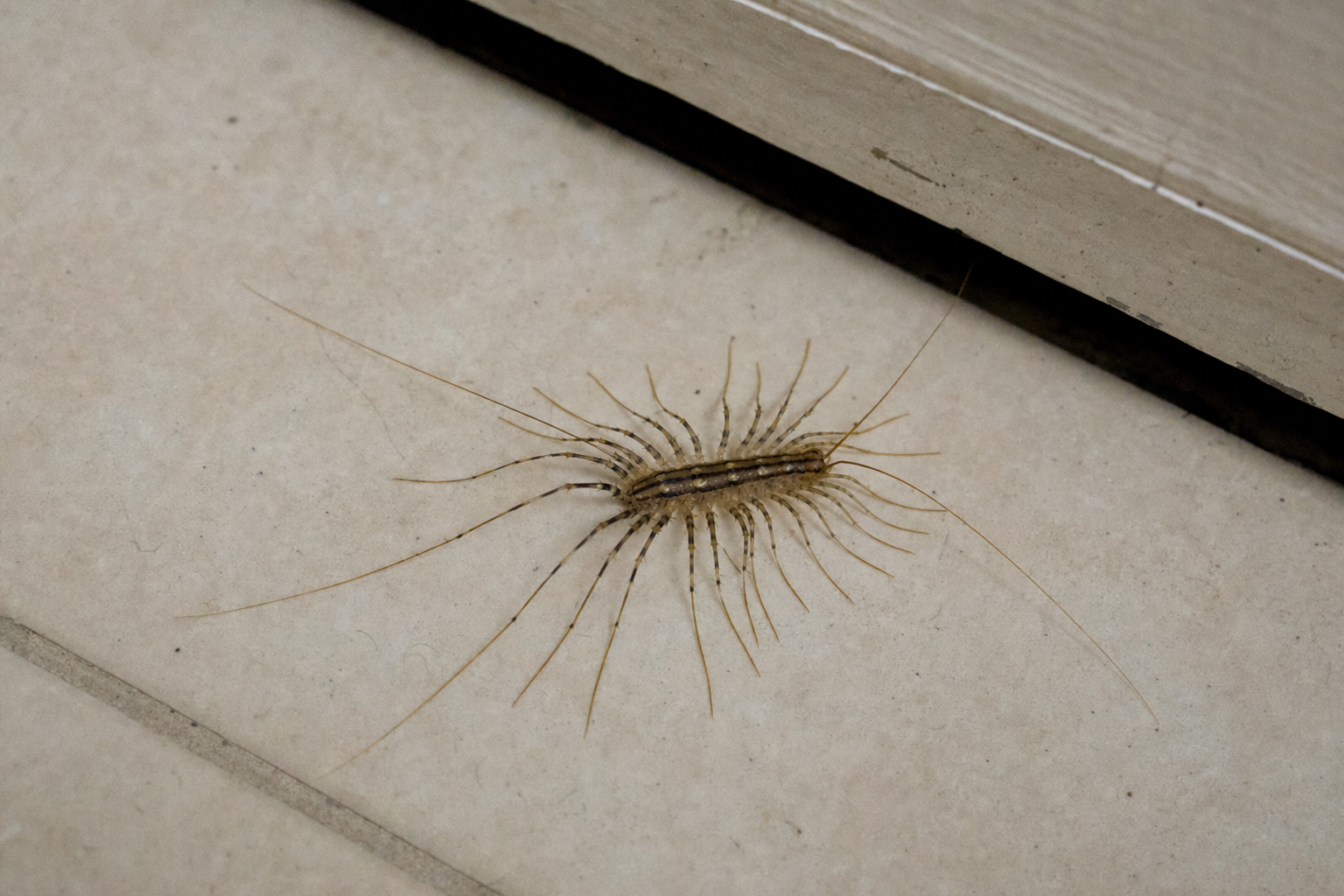
Signs of House Centipede Infestation in Your Home
A centipede infestation indoors is not really the problem. It is a signal. Centipedes are predators, and they follow their food indoors. Where centipedes are doing well, there is an insect population big enough to feed them. So the useful question is never how many centipedes you have. It is what they are eating.

- A centipede indoors is a hunter that followed its food in. Seeing them often points to another pest you have not found yet.
- They do not nest or group. Each one hunts alone, so repeat sightings in one room mean the food is there, not a colony.
- They want damp and dark. Floor drains, crawl spaces, slab edges and poorly ventilated bathrooms are the first places to check.
- The common indoor one is harmless. It can technically bite, but its mouthparts are weak and it has no interest in people.
- A big red-headed one is a different animal. It lives outdoors, usually arrives in firewood, and its bite genuinely hurts.





What Are Centipedes a Sign Of?
Of something else living in your house. House centipedes eat silverfish, firebrats, young carpet beetles, cockroaches, spiders and other small crawling pests. That list is more or less a list of common household pests, which is the whole point. A centipede is a predator, and a predator stays where the hunting is good.
Penn State Extension puts it directly, noting that frequent house centipede sightings mean something they hunt is plentiful in the house, and may point at a bigger problem than the centipedes themselves. That is the sentence worth reading twice. The centipede is not the infestation. It is the evidence of one.
 Source:
 If I Find One Centipede, Are There More?
Almost certainly, but not in the way people fear. House centipedes do not nest and they do not travel in groups. Each one hunts on its own. So finding one does not mean a nest is nearby and it does not mean dozens are behind the wall.
What it does mean is that conditions suited one centipede, and those same conditions suit others. Damp, dark and well stocked with small insects is a description of a place, not of one animal’s bad luck. If you found one and never see another, it wandered in. If you keep finding them in the same room, that room is feeding them.
How Do You Find a House Centipede?
They stay in dark, damp places and come out at night. Penn State Extension lists the usual spots as beneath concrete slabs, inside cement block walls, in floor drains without water traps, and in any cool damp area such as an unexcavated crawl space.
If the one you found looks like it has fewer legs than the last one, it is not a different animal. Penn State Extension records that newly hatched young start with four pairs and gain more at each molt, going through 5, 7, 9, 11 and 13 pairs before reaching the adult 15. So leg count is really an age, and seeing ones with different leg counts means they are breeding indoors rather than wandering in.
The same source notes that females have been known to survive several years and produce up to 150 young. That is the number behind the advice below: a centipede problem you ignore does not run out of steam on its own, because one female outlasts repeated rounds of whatever you were hoping would fix it.
A centipede on the carpet is the same animal, not a separate carpet centipede: they cross open floor at night hunting and there is nothing living in the pile. A sudden group of them is a centipede invasion in the loose sense people mean, but they do not swarm, so it means the conditions changed rather than that a nest hatched.
In a Collin County home that usually means the same short list. Check under and behind the washer and dryer, around floor drains, beneath sinks, in the garage along the slab edge, in bathrooms with weak ventilation, and behind stored boxes in a closet that never gets opened. Look at night with a flashlight if you want to see them, because during the day they are tucked into a crack.
The University of California guide to centipedes and millipedes gives the same picture. Indoors, it says, centipedes turn up in damp closets and bathrooms or anywhere in the home where insects occur. They hide in dark cracks by day and come out at night to hunt.
The Two Centipedes Collin County Homeowners Find
Which one you have changes how seriously to take it.
The house centipede (Scutigera coleoptrata) is the one that turns up indoors across McKinney and the rest of Collin County. The body runs 1 to 1.5 inches, carrying 15 pairs of very long legs that extend well past it, and on adult females the last pair is nearly twice the body length. It moves startlingly fast. It is also harmless. It can technically bite, but the mouthparts are weak and it has no reason to. It hunts roaches, silverfish, spiders, drain flies and other small insects inside the structure.
The Texas redheaded centipede (Scolopendra heros) is the large, boldly marked one, with a red or orange head, a black body, yellow legs, and a length of 6 to 8 inches. It is an outdoor predator that lives in landscaping, under rocks and in woodpiles. Finding one inside is uncommon and usually means something outdoor came in with it, and firewood is the most frequent culprit. Its bite delivers real venom and causes real pain. There is more on that in our post on centipede bites in Collin County.
Is a Red Centipede in the House Different?
Yes, it is the one case where the answer changes. A small one with a reddish head is usually a house centipede. A large one, 6 to 8 inches long, with a clearly red or orange head against a dark body, is the Texas redheaded centipede, which should not be handled.
A house centipede has banded legs and a dirty yellow body with dark stripes, and needs nothing beyond the usual. If it is the redheaded one, check where firewood, potted plants or landscape materials came into the house, because it did not walk in through the front door on purpose.
Signs That Centipede Activity Has Moved Beyond Occasional
One house centipede every few weeks in a garage or bathroom is normal and needs nothing. These four signs say it has become a real problem.
| What you notice | What it means |
|---|---|
| Several a week, same room | Enough prey is in that room to keep drawing new centipedes in. They hunt alone, so this is about the food, not a nest |
| Sightings in living areas | They have followed prey through the whole house rather than entering at one point |
| Shed skins behind appliances | Centipedes are completing their life cycle indoors rather than passing through |
| Clustered around damp | A slow leak or poor ventilation is supporting both the centipedes and whatever they are eating |
What the Centipedes Are Telling You
House centipedes are a useful diagnostic, because they concentrate where their food is. Appearing near a floor drain points to drain flies or roaches in the drain. Appearing in a closet points to silverfish or carpet beetles in stored items. Appearing in the garage usually means a roach or cricket population out there.
So the practical approach is short. Note where they show up most, because that is where to look for the real pest. Check floor drains, under appliances, behind stored boxes and anywhere that stays damp. Reduce the prey population through treatment of the underlying insects, which lowers centipede numbers far better than going after the centipedes. Then cut the moisture, which removes what supports both.
Treating centipedes on their own is a temporary fix. New ones follow the same food into the same rooms.
When to Call a Professional
If you are seeing them often and cannot work out what they are eating, an inspection will find it. Roach populations behind walls, silverfish in stored items and drain flies breeding in a slow pipe are all common sources, and none of them is obvious without a systematic look.
That is the part worth paying for. Anyone can kill the centipede in front of them. Get a free estimate or call us if they keep coming back, because that means the thing feeding them is still there.
How Do I Hire a Pest Control Company for Centipedes?
Hire a company with a current state license that inspects your home before it treats. The EPA also says to ask for proof of insurance, find out whether the company guarantees its work, and ask neighbors about it rather than rely on the salesperson. Pest Me Off is licensed by the Texas Department of Agriculture.
Centipedes turning up indoors? Same-day pest control in McKinney and the surrounding cities when you call before noon.
We find the source, treat the infestation, and help you keep them out long-term.