
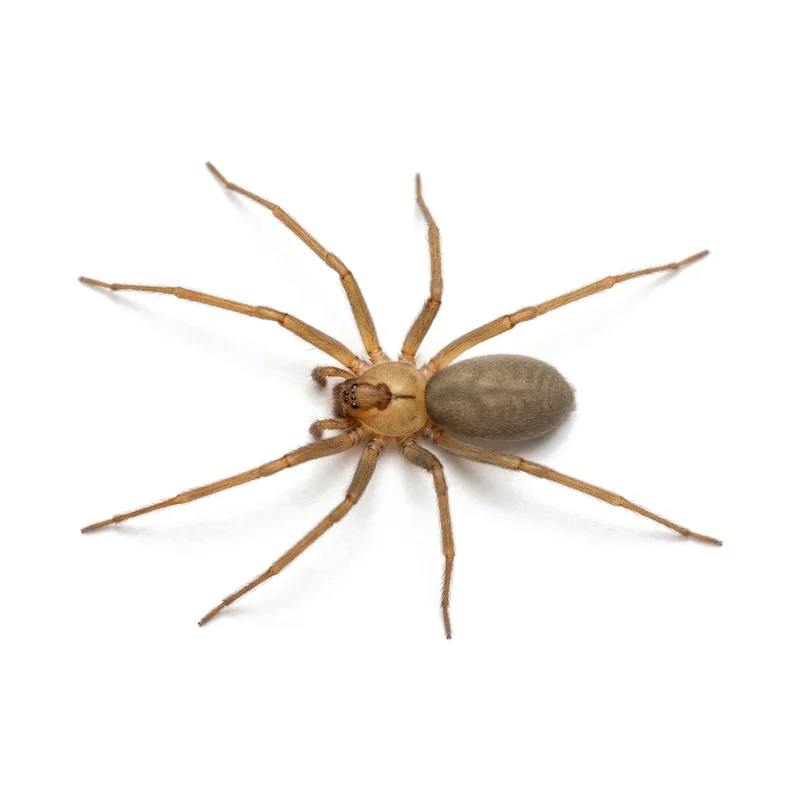
What a Brown Recluse Nest Looks Like and How They Get Inside
People go looking for a brown recluse nest and expect to find a web, so they check the ceiling corners, find nothing, and conclude the spider they saw was a stray. It almost never is. The retreat these spiders build is small, flat, off-white and hidden inside something, and it is not built to catch anything, because a brown recluse hunts on foot. Knowing what you are actually looking for, and what brought them into the house in the first place, is the difference between finding the problem and deciding you do not have one.

- The retreat is a loose, flat patch of off-white silk in a dark protected spot, never a shaped web out in the open.
- Cardboard is the favorite. Stored boxes, paper stacks and the flutes inside corrugated board all suit them.
- Six eyes in three pairs, not eight. It is the one identification feature that no common lookalike shares.
- They eat crickets, silverfish and cockroaches. A recluse problem usually sits on top of another pest problem.
- Adults are seen most in spring. Mating runs April to early July in Texas, which is when they move around most.
- One on a wall in daylight was disturbed. They hunt at night, so daytime sightings point at recent activity nearby.






What Does a Brown Recluse Nest Look Like?
Like almost nothing, which is exactly the problem. Texas A&M AgriLife Extension describes brown recluses as hunting spiders that do not spend much time on webs, and says that when webs are built they are inconspicuous and placed in protected sites. The structure serves as somewhere to lay eggs and somewhere to retreat to.
It is not a trap and it does not need to catch anything.
In practice that means a small, irregular, flattish patch of fine off-white silk, tucked into a dark corner, inside a box, under stored material or behind debris. It has no shape you would recognize as a web. It holds no dead insects, because the spider does its hunting elsewhere and brings nothing home. Next to it you may find round off-white egg sacs loosely wrapped in silk, and translucent tan shed skins from the spiders that grew up there over the 1 year a recluse needs to reach adult. Those two things are what turn a patch of silk into proof.
The thing people expect to see, a tidy web across a corner catching flies, belongs to a different spider entirely. If you are looking at a proper web, you are looking at a cellar spider, a cobweb spider or an orb weaver, and none of those is a recluse.
What Causes Brown Recluse Spiders in the House?
Brown recluse spiders move into a house for three reasons, and dirt is not one of them. They need storage nobody disturbs, insects to eat such as crickets, silverfish and cockroaches, and a way in, either carried inside in boxes and furniture or walking in under a door or through a gap.
Undisturbed storage. AgriLife puts recluses under old boards, in piles of discarded junk and in seldom-disturbed storage, and indoors puts them most often in cluttered closets, garages, crawl spaces and attics. The common factor is not dirt. It is stillness. A spotless garage full of boxes nobody has opened in 2 years suits them as well as a messy one, and better than a cluttered kitchen that gets used every day.
Something to eat. Brown recluses are predators, and AgriLife names their prey directly: crickets, silverfish and cockroaches. Large spider numbers in a building usually mean the insects they feed on are abundant too. That is why a heavy cricket season in McKinney or Plano tends to be followed by more spiders indoors, and why treating the spiders without touching what feeds them gives you the same result twice.
Being carried in, or walking in. Both happen and older advice usually names only one. Recluses ride in on things: boxes from a storage unit, furniture from a garage sale, firewood, and everything that comes out of an attic after a house move. They also walk in, most often where a garage meets the slab, under a door with a worn sweep, or through a gap around a utility penetration. The first route explains a population that appears in a specific room. The second explains one that concentrates near an exterior wall.
Where Do Brown Recluse Spiders Live in a House?
Inside things rather than on them, and always where nothing moves. Stored cardboard comes first, then closet back corners, the stored parts of garages and attics, crawl spaces, and under furniture that never moves. The list is short and the same in almost every house we inspect in Allen and Frisco.
| Where they settle | Why that spot suits them | What to do about it |
|---|---|---|
| Cardboard, above everything | Stored boxes, paper stacks and the corrugated flutes inside the board itself give a tight dark space that is never opened | Tape every stored box shut, which AgriLife recommends specifically to take them away as nesting sites |
| Closet back corners | Nothing moves there, and hanging clothes touching the floor make a covered run along the wall | Lift clothing clear of the floor and put a sticky card in the corner |
| Garages and attics | The stored parts, not the walked-through parts. Stillness is the requirement rather than dirt | Clear genuine junk out and treat the edges rather than the open floor |
| Crawl spaces and subfloors | Dark, undisturbed and directly connected to the outdoor population | Dust into the void, since a spray cannot reach where they sit |
| Under unmoved furniture | Same reason as the closets, plus the folds of any stored bedding | Move it twice a year and vacuum behind it |
| Outdoors against the house | Old boards, woodpiles and stacked landscape stone. This is where the ones that walk in are coming from | Move woodpiles and stone off the wall and treat the foundation line |
Every row has the same thing in common, and it is not dirt. It is that nothing there gets moved.
A brown recluse on a wall in daylight is worth a moment’s thought rather than panic. They hunt after dark, so one out in the open in the day has usually been pushed out by something: a box moved, a closet cleared, a room redecorated. It tells you roughly where the retreat is, which is the first place to show us when you call.
 Source:
 How Do You Know It Is Actually a Brown Recluse?
Count the eyes. Nearly every spider you will meet has eight, arranged across the front of the head. A brown recluse has six, set in three pairs in a semicircle, and AgriLife names that arrangement along with the dark violin-shaped mark as the two features that separate it from similar species.
The eye count is the reliable one, because the violin mark varies, fades on some individuals, and appears on other spiders that are not recluses.
The University of California guide to brown recluse and other recluse spiders agrees. It calls six equal-sized eyes in three pairs the most definitive feature, and says the violin marking is not a reliable way to identify one.
The rest of the picture is consistent. Light brown to grayish, legs spanning about the area of a quarter to a half-dollar, no stripes or bands on the legs, no spots or patterns on the abdomen, and a body that looks plain rather than marked. If the spider is hairy, boldly patterned, banded on the legs, or noticeably chunky, it is one of the harmless species people mistake for recluses. The southern house spider is the usual culprit here, and it is common enough in Collin County that telling the two apart is worth a minute.
How Do You Get Rid of Brown Recluse Spiders in a House?
By treating where they sit and removing what keeps them there, in that order, and by accepting that this species takes more than one visit. AgriLife recommends hiring a professional for a household infestation of recluses outright, and says that even for professionals an entrenched population is difficult to control.
- Clear and seal the cardboard. This is the homeowner’s part and it is the biggest single lever. Get rid of genuine junk, and tape shut every stored box that stays.
- Put sticky cards down. Against walls, in closet corners and under furniture, both to catch spiders and to count them. Without a count nobody can prove a treatment worked.
- Treat the edges rather than the middle. Residual product along closet edges, storage areas, room perimeters, the exterior foundation and the eaves, and dust into wall voids, attics and crawl spaces that a spray cannot reach.
- Deal with the food supply. If crickets, silverfish or roaches are established, the spiders have a reason to stay and a reason to come back, so call us about those insects too.
- Come back and read the cards. Numbers falling across two or three checks is what finished looks like. Two quiet weeks are not.
If you have found a retreat, egg sacs or more than one spider, professional spider control is the right call. Get a free estimate and we will inspect the storage areas, put monitoring down, and treat the places the spiders are actually sitting rather than the places they crossed.
Brown recluses in your storage? Same-day spider control in McKinney and the surrounding cities when you call before noon.
We find the retreats, treat where they sit, and set sticky cards so you can see whether the count is falling.

Ryan has spent more than 16 years in pest control and wildlife management across McKinney and Collin County, from inspecting homes and treating infestations to sealing the entry points pests use to get in. He built Pest Me Off on that field experience, and every technician on the team is trained against it.
More about the Pest Me Off team