
Cicada Killers in Collin County, TX | Identification and Control
The cicada killer (Sphecius speciosus), also called the giant ground wasp, is the largest wasp a Collin County homeowner will ever see, with a rusty red head. The Illinois Department of Natural Resources puts it at up to 2 inches long. It flies slow and low over lawns in summer and digs round holes in dry soil. It looks dangerous and is not. Females rarely sting, and the males that dive-bomb people cannot sting at all.
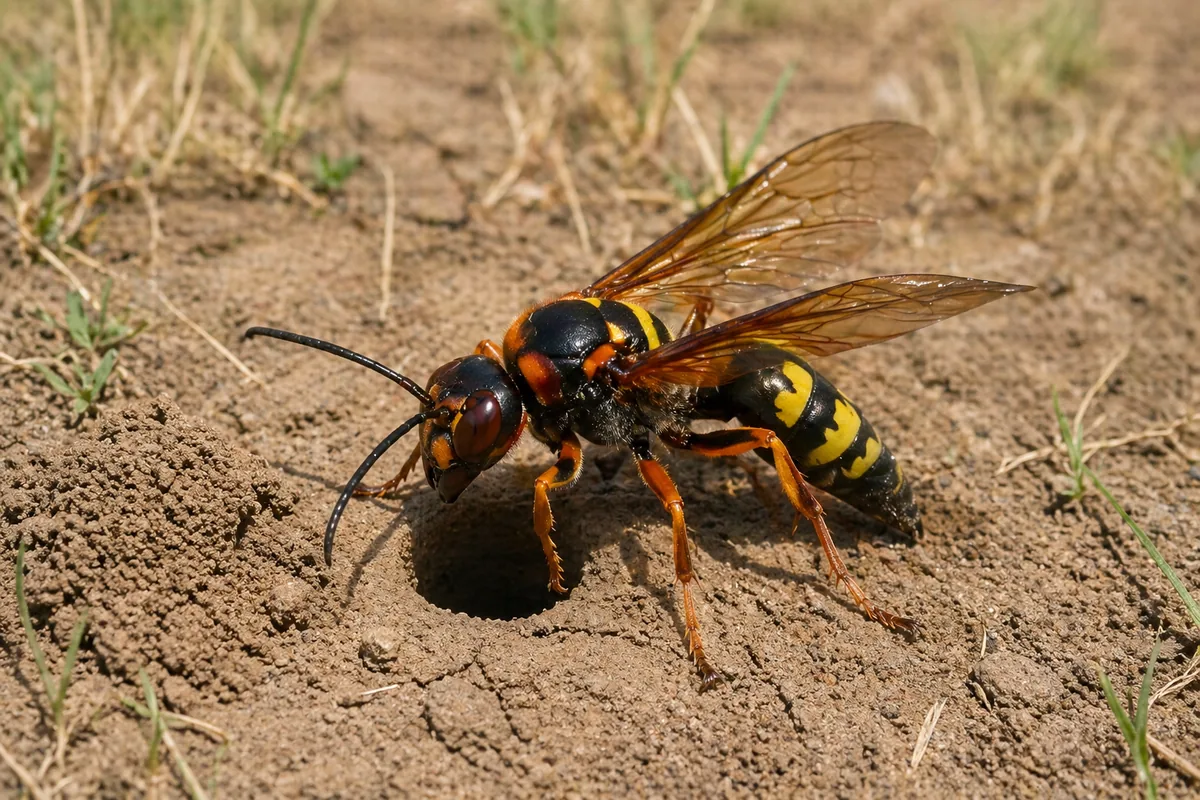
Found giant wasps and holes in your lawn in Collin County? Our office sits where McKinney, Plano, Frisco and Allen meet, 5 to 10 minutes from most homes in those four cities. Send us a photo or call, and we will tell you what the wasp is.
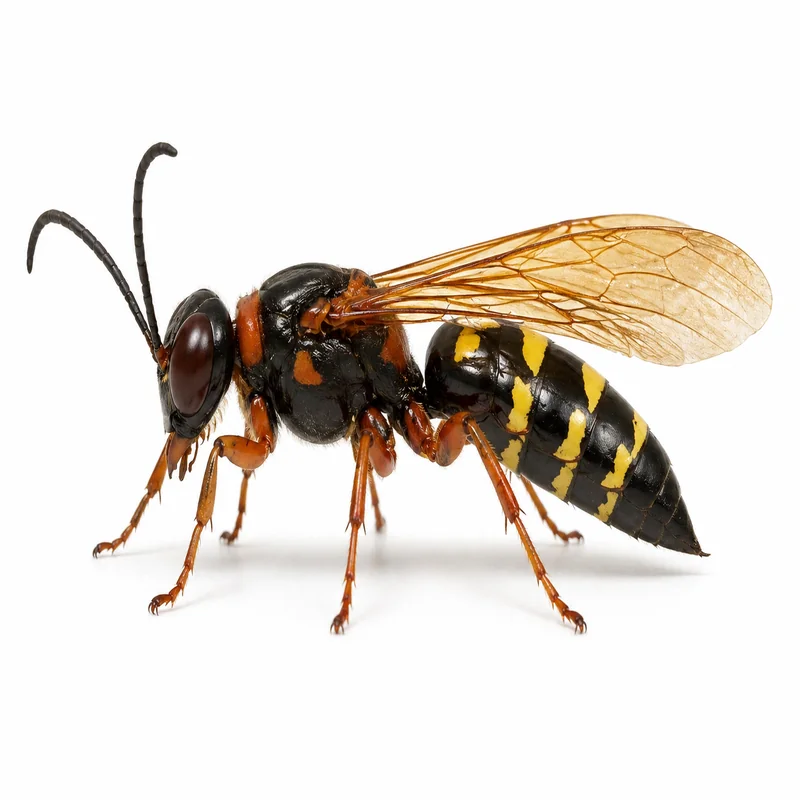
Cicada Killer
iNaturalist species records describe the cicada killer as a solitary wasp with no colony, no shared defense and no alarm signal, the most important biology point for homeowners.
Risk Assessment
Choose a row for the full detail- Color
- Rusty red to reddish-brown head and midsection, black abdomen with yellow bands, amber wings
- Prey
- Cicadas, paralyzed by the female’s sting and carried back to her burrow
- Can sting
- Females only, and rarely, when handled or stepped on
- Threat level
- Low
- Nest
- Solitary burrow in dry soil with a fan-shaped mound of dirt at the entrance, no colony
- Active season
- June through September in Collin County, peak in July and August
- Body length
- Up to 2 in, females larger than males
What Cicada Killers Look Like
Giant size, rusty head, slow low flight, and burrows with fan-shaped soil mounds at the entrance
The Illinois Department of Natural Resources puts cicada killers at up to 2 inches long. The head and the middle body section are rusty red to reddish-brown, the abdomen is black with broken yellow bands, and the large wings are tinted amber. From a distance the abdomen looks like a yellowjacket’s, but the size and the rusty head are unmistakable.
Behavior gives it away too. Cicada killers fly slowly and low over the lawn and go in and out of round holes in dry soil, each with a mound of dug-out dirt at the entrance. Several holes within 10 to 20 feet of each other are an aggregation, many separate females nesting side by side.
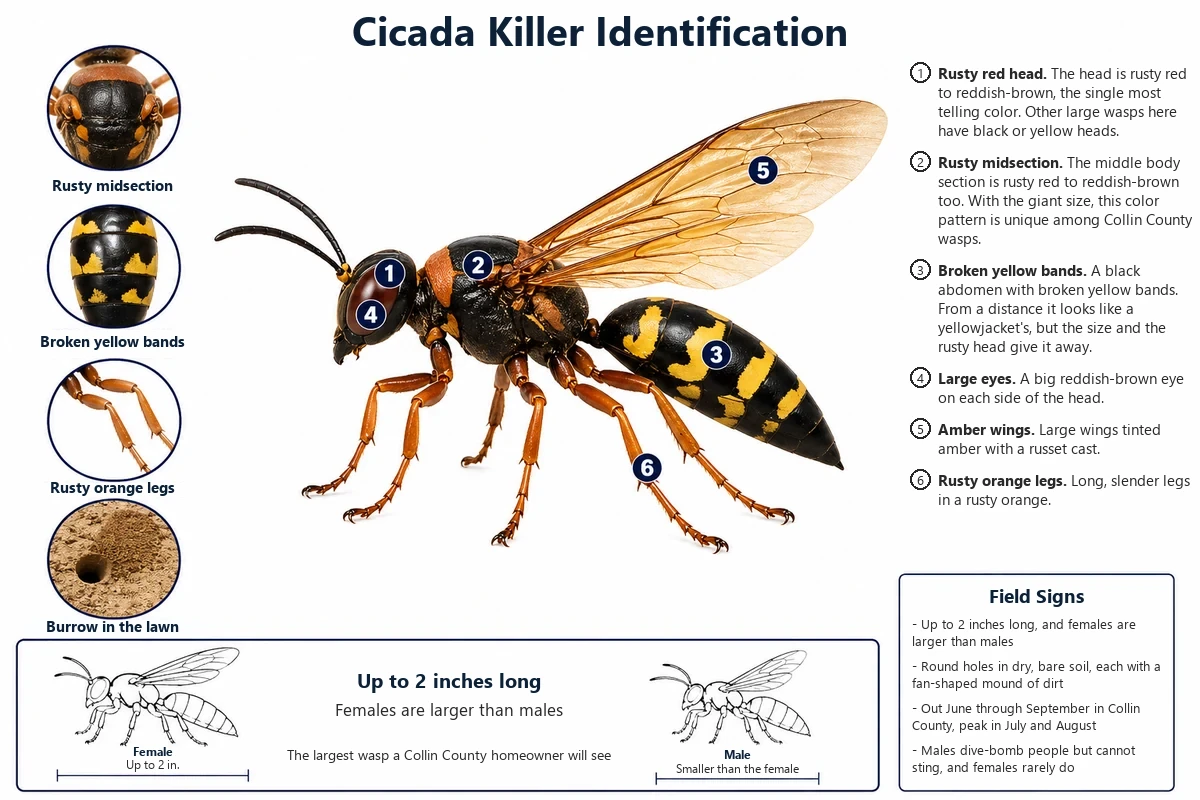
How to identify a cicada killer by its size, rusty head, amber wings and banded abdomen
- Enormous size, up to 2 inches long. Nothing else flying low over a Collin County lawn in summer comes close
- Rusty red to reddish-brown head and midsection, the single most telling color. Other large wasps here have black or yellow heads
- Black abdomen with broken yellow banding and large amber-tinted wings with a russet cast
- Slow, low, deliberate flight 2 to 4 feet above the lawn. Males hover over the same patch again and again, and females fly purposefully toward the ground or toward trees with cicadas
- Round holes in dry soil, each with a U-shaped or fan-shaped mound of dug-out dirt
- Males dive-bomb people, pets and moving objects, then veer off without contact
Other Names for the Cicada Killer
Giant ground wasp and ground hornet are the names most Collin County homeowners use when they call about cicada killers, because anything this large coming out of the ground gets called a hornet. It is a wasp, not a true hornet and not a bee. Every name in the table means the same insect, Sphecius speciosus, with the same biology and the same treatment, so if you searched for any of them, this is your wasp.
Where Are Cicada Killers Found in Texas?
Cicada killers are native to Texas and dig in Collin County lawns every summer. Texas A&M AgriLife lists the cicada killer as a solitary ground-nester native to Texas, with no colony, no queen and no shared defense. Around a home they turn up wherever the soil is dry, loose and thinly covered, most often the strip between a driveway or sidewalk and the lawn.
| Name | What it means |
|---|---|
| Giant ground wasp | The most accurate nickname. It is a large solitary wasp that nests entirely underground. |
| Ground hornet | What most callers say about a very large wasp coming out of a hole in the lawn. It is a wasp, not a true hornet. Yellowjackets get the same nickname, so check the size. |
| Eastern cicada killer | The full common name of Sphecius speciosus, the name field guides use. |
| Cicada killer wasp | The same insect, with the word wasp added. Cicada wasp and cicada hornet are shorter versions. |
| Killer wasp | A short form of cicada killer wasp. It is not the northern giant hornet, the so-called murder hornet. |
| Cicada hawk | Used in rural areas, for the way the female hunts cicadas in trees and carries them back to her burrow. |
| Sand hornet | For its liking for dry, sandy or loose soil at nest sites. |
| Locust killer | Many Texans call cicadas locusts, so the wasp that hunts them gets this name too. |
| Cicada killer bee | Not a bee. The cicada killer is a solitary wasp. |
Cicada Killer vs Similar Species
The size and the rusty head separate cicada killers from every other wasp in Collin County. A wasp 2 inches long with a reddish-brown head, flying low over lawn soil, is almost certainly a cicada killer. The table compares it with the three wasps behind most mistaken calls.
| Species | Size | Key Feature | Nesting Habit |
|---|---|---|---|
|
Cicada Killer
AKA: Giant Ground Wasp, Ground Hornet
Sphecius speciosus
This species
|
Up to 2 inches. The largest wasp a Collin County homeowner will encounter. Females are larger than males. | Rusty red to reddish-brown head and midsection, the most reliable field separator from every look-alike. With the giant size, this color pattern is unique among Collin County wasps. | Solitary ground burrow in dry, well-drained soil. Round entrance with a fan-shaped mound of dug-out soil. Each burrow belongs to one female. Many burrows in one area are an aggregation, not a colony. |
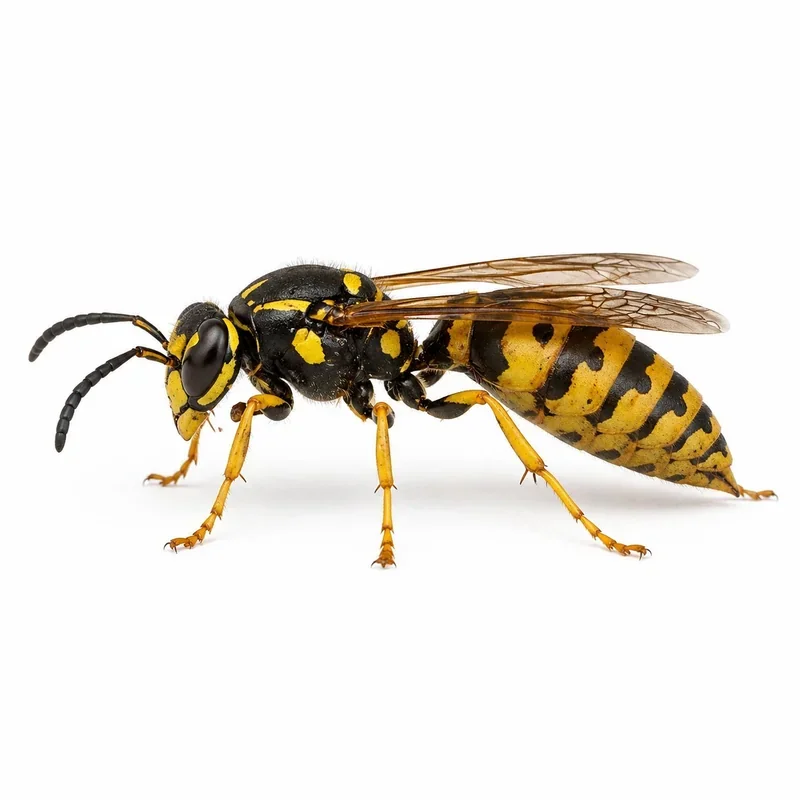
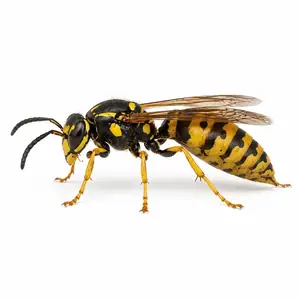
Yellowjacket
AKA: Ground Hornet, Ground Wasp
Vespula species
|
10 to 16 mm, roughly half an inch. Three to four times smaller than a cicada killer, a difference obvious at a glance. | Bright yellow and black bands, black head, hairless shiny body. Compact and stocky. Social, with a large colony that defends itself and an alarm scent that brings a mass attack. Cicada killers have none of these. | Hidden ground burrow or wall void with a small entry hole. One nest may hold 1,000 to 4,000 workers. Mowing over a yellowjacket ground nest brings a mass sting event. Disturbing a cicada killer burrow does not. |
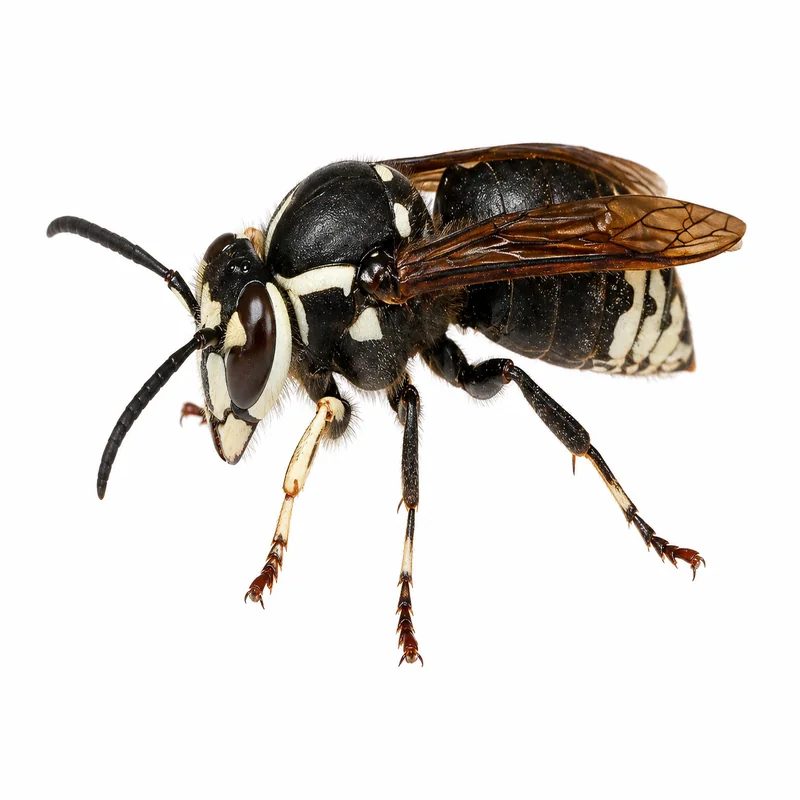
Bald-Faced Hornet
AKA: White-Faced Hornet
Dolichovespula maculata
|
15 to 20 mm. Much smaller than a cicada killer. Black and white, with no rusty tones. | White face markings on a black head, nothing like the cicada killer’s rusty head. Builds an enclosed gray paper nest above ground, not a soil burrow. | Gray paper nest wrapped in a paper envelope, in trees, shrubs or under eaves. Never digs ground burrows. Defends its colony and is highly aggressive near the nest. |
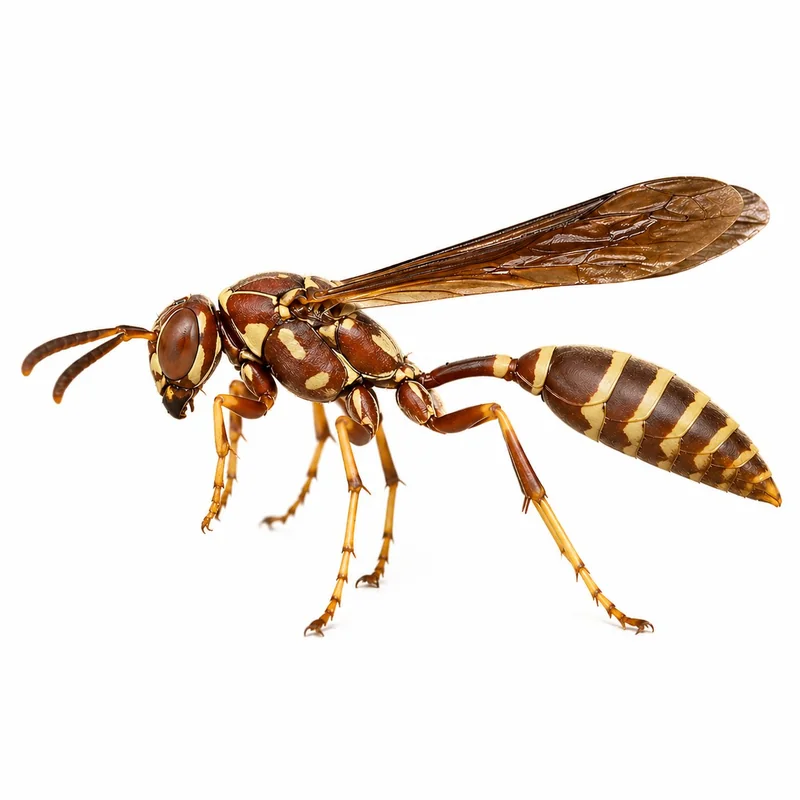
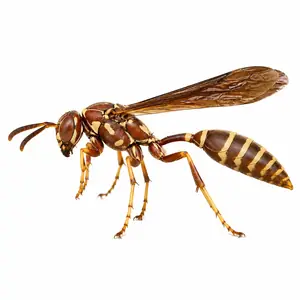
Paper Wasp
AKA: Red Wasp, Guinea Wasp
Polistes species
|
16 to 25 mm. Much smaller than a cicada killer, with a slender waist and dangling legs instead of a large, heavy body. | Narrow pinched waist and long hind legs that hang below the body in flight. Never digs ground burrows. | Open paper comb hanging from one stalk under an eave, porch ceiling or window frame. Entirely above ground and never in lawn soil. |
Cicada Killer vs Yellowjacket
The Cicada Killer in Three Numbers
Up to 2 inches
The Illinois Department of Natural Resources puts the cicada killer at up to 2 inches long, the largest wasp a Collin County homeowner will see.
Illinois Department of Natural Resources
10 to 20 inches
The Illinois Department of Natural Resources says a female cicada killer digs her burrow about 10 to 20 inches deep, where her young develop through the winter.
Illinois Department of Natural Resources
Up to 20
NC State Extension says one cicada killer burrow may hold as many as 20 cells, each stocked with a paralyzed cicada and one egg.
NC State Extension
Are Cicada Killer Wasps Dangerous?
No, not to most people. Females can sting, but they are not territorial, do not defend the burrow and give off no alarm scent that recruits other wasps. Purdue Extension rates the sting risk as low for most homeowners. Getting stung in a normal yard takes picking one up, stepping on one barefoot or trapping one against skin.
The males cause nearly all the fear. They hover inches from a face, charge lawnmowers, buzz children and grapple with each other in midair. None of it is dangerous, because males cannot sting. The stinger is a modified reproductive organ that only females have. Knowing that the wasp dive-bombing your face is physically unable to sting is the single most useful fact about cicada killers.
Cicada Killer Sting and What to Expect
A female cicada killer sting causes pain and swelling at the spot, much like other large wasp stings, and clears without treatment in people who are not allergic. Cicada killer venom is not documented in clinical literature as a major cause of allergic reactions. Anyone with a known wasp or bee venom allergy still faces the same anaphylaxis risk as with any wasp, should carry an epinephrine auto-injector and should treat any sting as a possible emergency.
Get emergency care for any whole-body reaction after a cicada killer sting, such as difficulty breathing, hives spreading beyond the sting, throat tightening, dizziness or a racing pulse. These are signs of anaphylaxis, a medical emergency whichever wasp caused it.
When Cicada Killer Activity Warrants Action
Aggregation Returning Each July
Twenty or more burrows in the same strip of dry soil kill turf at every entrance and come back each summer, with the disturbed area growing a little every season. That compounding footprint is the reason to treat.
A Small Aggregation in Its First Season
The damage from one season of a small aggregation is cosmetic, and the wasps pose little threat to the people walking past them.
Where Cicada Killers Nest Around Your Home
A female digs a burrow about 10 to 20 inches deep, according to the Illinois Department of Natural Resources, and moves a surprising amount of soil to the surface. NC State Extension says one burrow may hold as many as 20 cells, each stocked with a paralyzed cicada and one egg.NC State Extension describes the preferred site as dry, well-drained soil with minimal turf cover, which matches the soil along concrete driveway edges, foundation bed borders and the graded backfill around slab-on-grade homes. An aggregation of 20 to 50 females in one strip kills or weakens turf at every entrance and can undermine shallow-rooted groundcover over several seasons. The burrows do not threaten foundations, slabs, driveways or any other part of the structure.
Cicada Killer Presence Across Collin County
Aggregations follow dry, loose, thinly covered soil. The concern is greatest in new construction in Frisco and Prosper, where new lots often have compacted or disturbed soil and sparse turf along hardscape borders, exactly the habitat that attracts aggregations. A small site there that goes untreated tends to grow every season.
Established lawns in McKinney, Allen and Plano host them too, wherever a strip along a driveway or sidewalk has dried out and lost its grass.
Pest Me Off service records put adult cicada killers above ground for 4 months in Collin County, June through September, with the peak in July and August. The young spend fall and winter dormant underground and turn into adults in late spring. Males come out one to two weeks ahead of females in June. The peak of digging and stocking burrows lines up with the height of cicada season, and activity drops sharply in September as egg-laying winds down.
Pattern from Pest Me Off service records across Collin County.
Cicada Killer Lifecycle and Why Aggregation Sites Come Back
How Pest Me Off Treats Cicada Killers
We treat the burrow at depth, not the flying adults. Oklahoma State University Extension points to insecticidal dust applied directly into each burrow entrance. The rules are simple. Never seal the entrance, never rely on liquid spray at the surface, and treat every active burrow, because a missed burrow leaves its female and her cells untouched.
Aggregation Mapping
We walk the whole area between 7 and 9 AM, when females are most active at their burrows, and mark every active entrance before any product goes down. A site with 30 visible holes may have more hidden under groundcover, along fence lines or in nearby soil.
Direct Burrow Dust Application
We apply insecticidal dust into each marked entrance with a hand duster and a flexible wand that reaches down the tunnel, and we leave the entrance open.
48 to 72 Hour Re-Inspection
We come back after 48 to 72 hours and look for fresh soil at any entrance, the sign a female dug back out or was away when the dust went down. Those burrows are treated again, and busy sites often need at least one retreatment.
Habitat Assessment
Once the site is clear, we look at the soil that drew the wasps and tell you what to change, such as thicker turf on dry strips along concrete, organic matter in sandy bed soil and water for bare zones along the driveway.
& Other Companies
How to Get Rid of Cicada Killers Yourself
Most of what works for a homeowner is about the soil. Females need loose, dry, bare ground to dig, so thicker grass, mulch and steady moisture in the right spots make a yard far less attractive to them.
Why Cicada Killer DIY Leaves the Problem Intact Season After Season
With cicada killers, the most natural DIY moves fail most often. Every failure comes back to the wrong product, the wrong spot, the wrong timing or a missed burrow, and these are the mistakes we see on callbacks.
Spraying the Wasps or the Hole
Wasp spray at hovering adults kills a few wasps above ground and nothing else. Liquid poured into or around an opening soaks into the soil and never reaches cells 10 to 20 inches down. The females that were away hunting come back the next day to burrows that are still active.
Filling or Sealing the Holes
A female digs out loose soil or sand within 24 to 48 hours, because the burrow holds days of her work and cicadas she already caught. Foam, caulk or packed soil without insecticide may trap her, but the stocked cells keep developing and emerge next summer, and a partly sealed female can dig another way out. Seal only after the site is confirmed clear.
Treating One Burrow in a Large Aggregation
An aggregation of 20 to 40 burrows along a driveway is 20 to 40 separate females. Treating one or two entrances removes two wasps and leaves the other 18 to 38 untouched, because nothing passes between burrows. Every active entrance needs its own treatment.
Treating Too Late in the Season
By mid-August most females have finished laying eggs. A late treatment kills the remaining adults and feels like it worked as activity drops, but the cells already sealed underground produce next July’s wasps at the same site.
Cicada Killer Questions Collin County Homeowners Ask
What is the giant wasp with a rusty head going in and out of holes in my lawn?
What are cicada killers also called? Giant ground wasp, ground hornet, cicada hawk?
Can cicada killers sting me?
Why are giant wasps dive-bombing my lawn in July?
Are all those holes in my lawn one colony?
Why do cicada killers keep coming back to the same spot every year?
What is the loud buzzing coming from holes in my yard?
Can I fill the holes to get rid of cicada killers?
Is a cicada killer the same as a murder hornet?
When is the right time to treat cicada killers?
How do I get rid of cicada killers?
Cicada Killers Tearing Up Your Lawn. We Treat Every Burrow and Show You How to Keep Them From Coming Back.
Spraying the flying wasps or packing dirt in the holes does not work. We map the whole site, dust every active burrow at depth, re-check after 48 to 72 hours and tell you what to change before next July. Stinger Smackdown covers McKinney, Allen, Frisco, Plano and all of Collin County.