
Brown Recluse Spiders in Collin County, TX | Identification and Control
The Brown Recluse (Loxosceles reclusa), also called the violin spider or fiddleback, is the most medically significant spider in Collin County. US poison centers recorded 566 brown recluse bite cases in all of 2021, with 1 death, so a bite is rare and a death rarer still. Its bite starts as a small wound and can progress to tissue death over days to weeks. Most bites happen when people reach into stored shoes, clothing, or boxes without checking first.
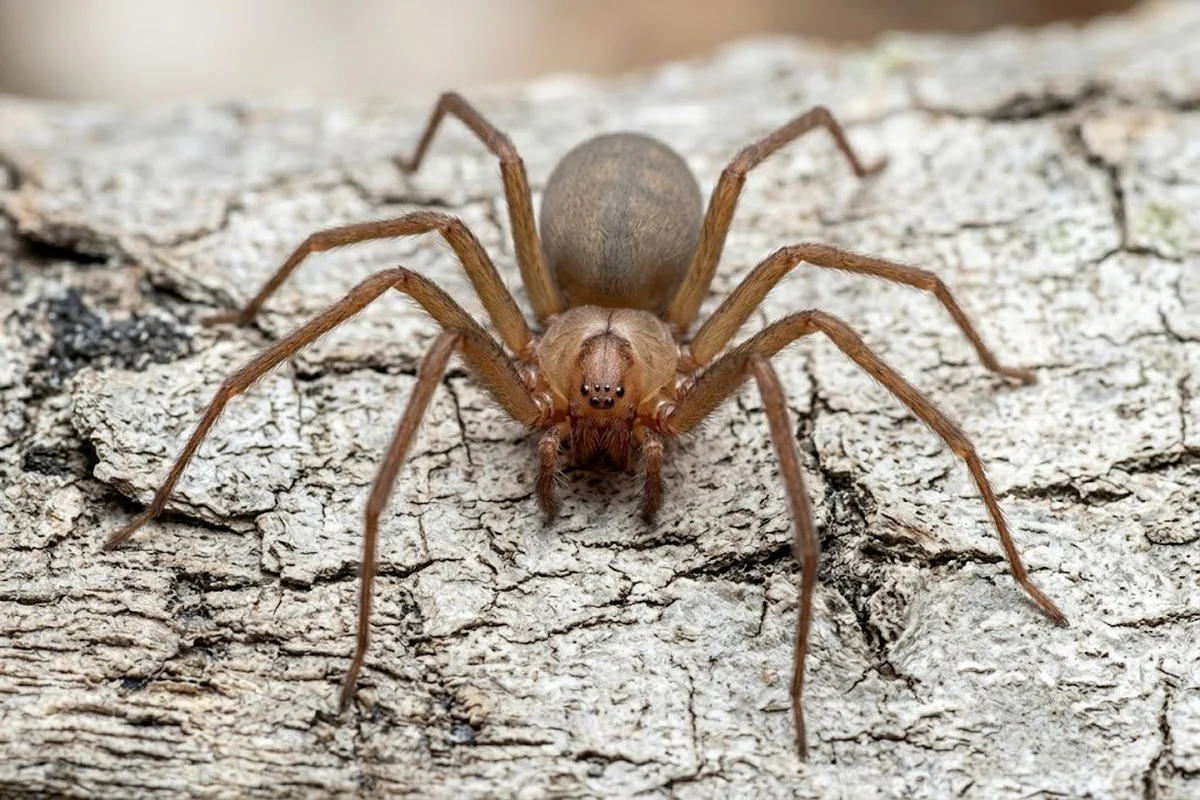
Found one in your garage or closet in Collin County? Our office sits where McKinney, Plano, Frisco and Allen meet, 5 to 10 minutes from most homes in those four cities. Send us a photo or call, and we will tell you whether it is a brown recluse.
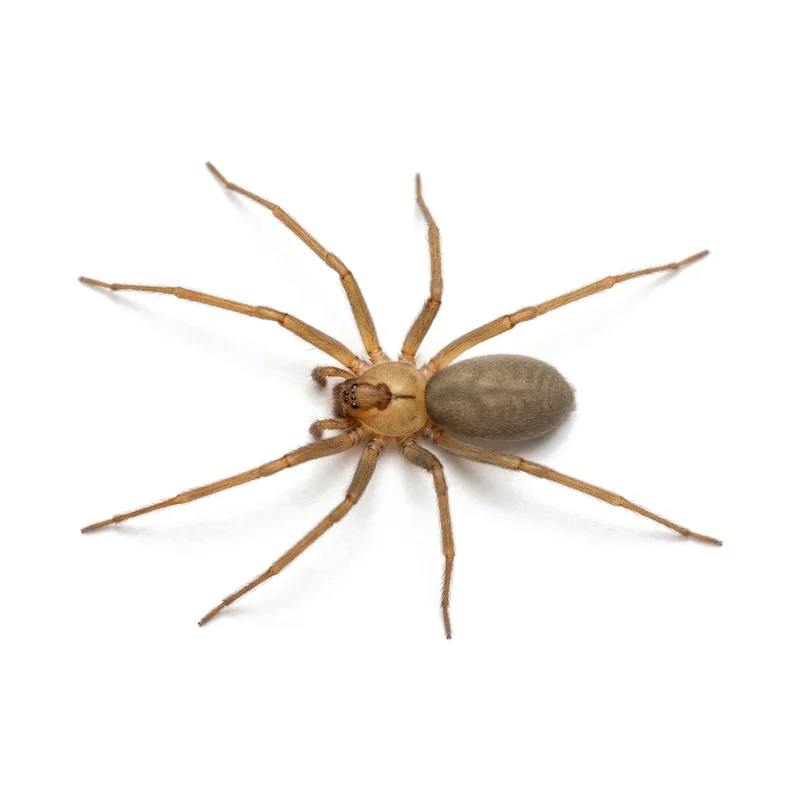
Brown Recluse Spider
A reclusive tan spider with a violin-shaped mark on its back and six eyes in three pairs. Most of its bites heal without a severe outcome when they are identified and managed early.
Risk Assessment
Choose a row for the full detail- Threat level
- Medically significant
- Eye arrangement
- 6 eyes in 3 pairs, which is diagnostic (most spiders have 8)
- Habitat
- Dark storage voids, garages, closets, cardboard stacks
- Adult lifespan
- Males about 543 days, females about 628 days, up to 4 to 5 years
- Active season
- May through October, year-round indoors
- Eggs per sac
- 31 to 300, with 1 to 2 sacs a year
- Size
- Body 0.25 to 0.5 in (6 to 13 mm), leg span 1 to 1.5 in (25 to 38 mm)
What a Brown Recluse Looks Like
Adult brown recluse range from 0.25 to 0.5 inches in body length, with a plain tan to dark brown color and fine hair. The body has no bold striping or contrasting markings other than the violin-shaped mark on the cephalothorax (the front half of the spider). That violin mark is the feature everyone has heard of, but it is one of the least reliable for field identification, because several other spider species have similar markings and the pattern fades with age. Penn State Extension puts a brown recluse body at about 9 mm long, roughly 3/8 inch, with legs that make it look bigger (Penn State Extension).
The diagnostic trait is the eye arrangement: 6 eyes in 3 pairs, arranged in a semicircle. Every other common Collin County house spider has 8 eyes. It is a phone-camera-zoom trait, not a naked-eye trait, but it separates a recluse from wolf spiders, cellar spiders and southern house spiders. Legs are uniformly colored without banding, and the body sits low and spread at rest, not upright and forward-leaning like a wolf spider.
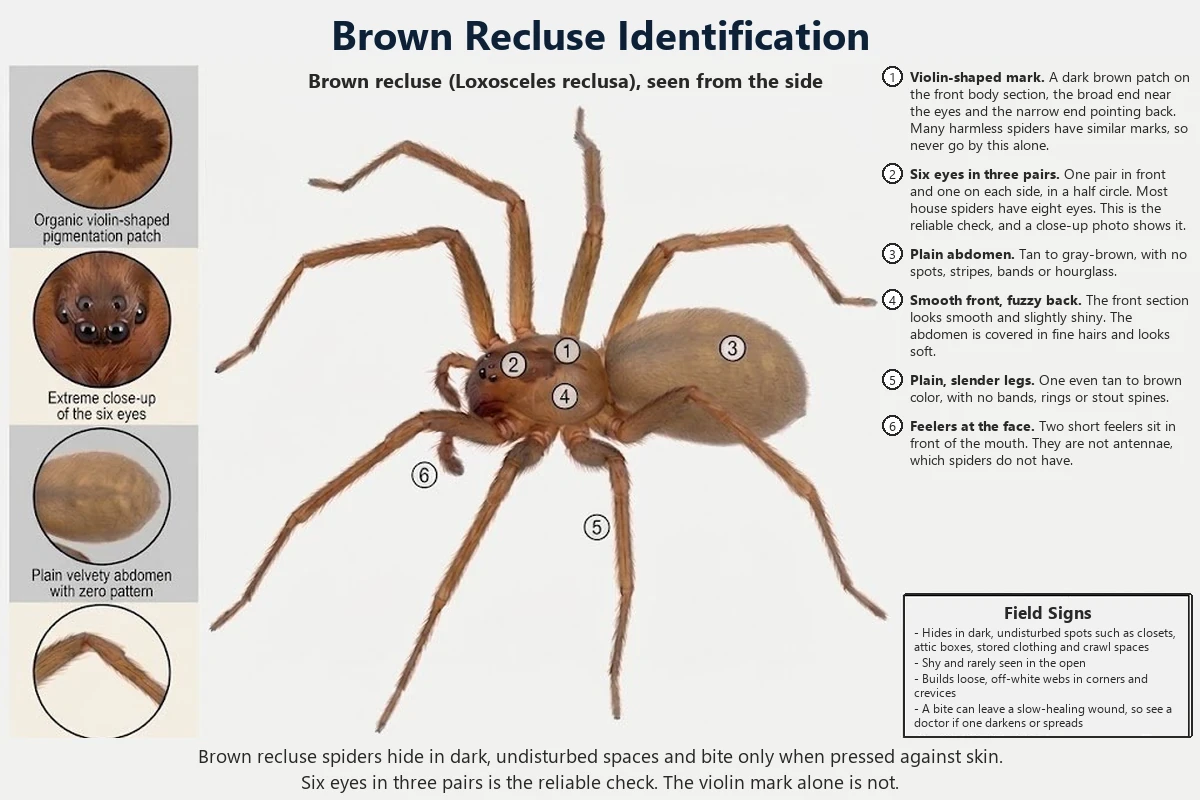
How to identify a brown recluse by its violin-shaped mark, six eyes in three pairs, plain abdomen and slender unbanded legs
- 6 eyes in 3 pairs arranged in a semicircle (all other common house spiders have 8)
- Plain tan-to-brown body with no bold striping and no banding on the legs
- Violin-shaped mark on the cephalothorax (suggestive but not definitive alone)
- Low, spread posture at rest, not upright or forward-leaning
- Found in dark, secluded clutter such as stored boxes, shoes, clothing and garage shelves
- Irregular, loosely woven gray or white retreat web used for shelter, not prey capture
- Off-white egg sacs in sheltered storage voids and closet corners
Other Names for the Brown Recluse Spider
Brown recluse is the standard common name used by pest professionals and medical literature. The “recluse” in the name describes how it actually lives. It avoids open spaces, retreats immediately when exposed, and lives in the lowest-traffic zones of a structure. A spider that is clearly visible and moving actively in an open area during daylight is not behaving like a recluse, and that behavior points to a wolf spider or cellar spider first.
Is a Fiddleback Spider a Brown Recluse?
Yes. Fiddleback spider, violin spider and brown recluse are three names for the same spider, Loxosceles reclusa. Fiddleback and violin both come from the violin-shaped mark on the cephalothorax, with the neck of the violin pointing toward the abdomen. A fiddleback is a brown recluse, so its size, eyes and bite are the same.
These names are common across the South and used interchangeably, and in Collin County service calls homeowners use all three.
Where Are Brown Recluse Spiders Found?
Brown recluse spiders are found throughout Texas, and Collin County sits well within their established range. The Texas Department of State Health Services confirms brown recluse and widow spiders are found throughout Texas. Adjacent confirmed counties include Dallas, Denton, Grayson, Cooke, Tarrant and Wise. Brown recluse range and confirmed Texas sightings show how common they are in Collin County structures.
| Name | What it means |
|---|---|
| Fiddleback spider | Named for the fiddle-shaped mark on the front half of the body. Also written fiddleback or brown fiddleback. |
| Violin spider | The same mark, named for the violin rather than the fiddle. |
| Brown fiddler | Another name built on the same violin-shaped mark. |
| Recluse spider | The short form most people use, after the way it hides. |
| Loxosceles reclusa | The scientific name, used in medical and university sources. |
| Brown spider in the house | Not a name, but how most people describe it before they know one. Many brown house spiders are not a recluse, so count the eyes. |
How to Tell Brown Recluse from Other Collin County Spiders
Brown recluse is the most over-identified spider in Collin County. Most spiders that homeowners call a recluse are wolf spiders, southern house spider males, or cellar spiders.
| Species | Size | Key Feature | Where Found |
|---|---|---|---|
|
Brown Recluse
AKA: Violin Spider, Fiddleback
Loxosceles reclusa
This species
|
0.25 to 0.5 in body. Plain tan-to-brown, no leg banding, no bold stripes. Legs uniformly colored and slender. | 6 eyes in 3 pairs (semicircle). Violin mark on front half. Low spread posture. Retreat web only, not a prey-capture web. Nocturnal. Found in clutter, not open surfaces. | Dark undisturbed storage: closet floors, cardboard boxes, stored clothing, shoes left untouched, garage shelves, attic bins. |
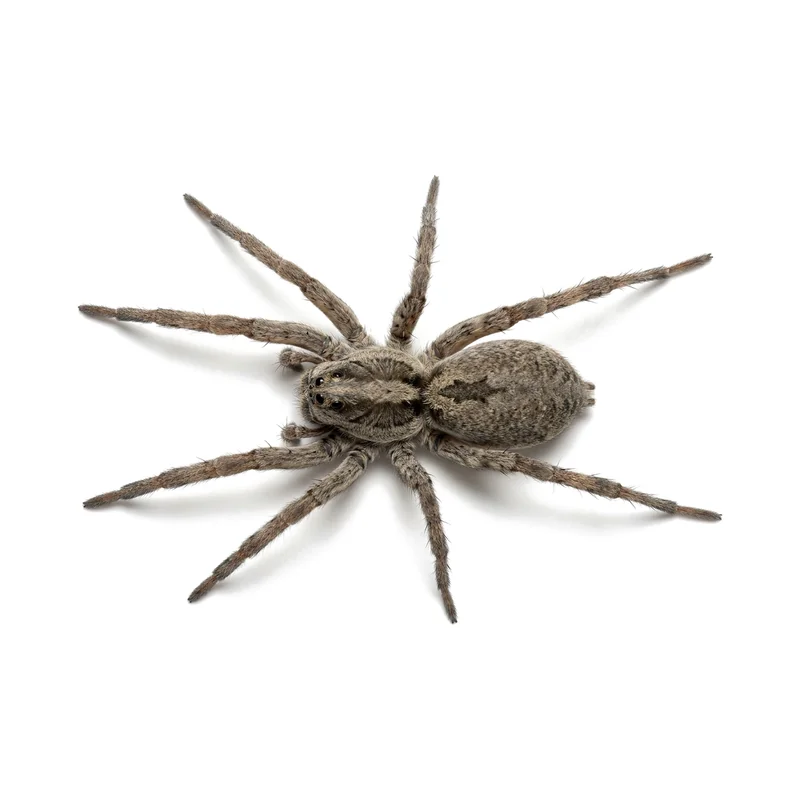
Wolf Spider
AKA: Hairy Spider, Ground Spider
Hogna carolinensis, Rabidosa spp.
|
0.5 to 1.5 in body. Significantly larger and bulkier. Heavy body hair. Distinct lengthwise stripes on the cephalothorax. | 8 eyes in 3 rows, with a large middle pair that shines under a flashlight at night. Stripes on the cephalothorax (not a violin). Fast, open runner, not a hider. No web. | Open garage floors, under doors, entering from outside during rain. Visible and fast-moving, not hidden in storage. |
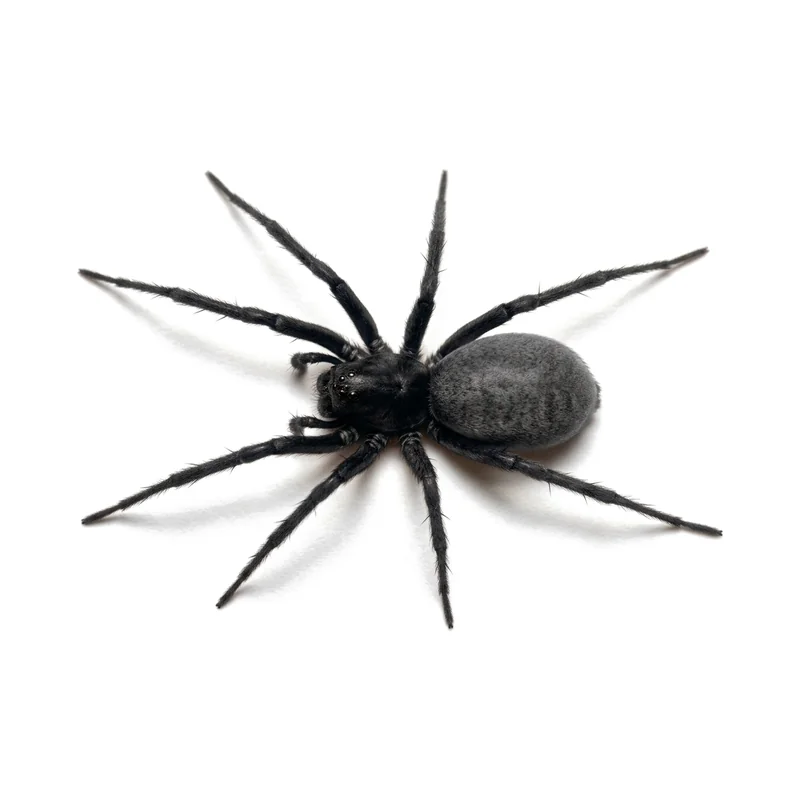
Southern House Spider
AKA: Crevice Weaver, Woolly Web Spider
Kukulcania hibernalis
|
Female 0.5 to 0.75 in, bulky, charcoal gray. Male 0.35 to 0.5 in, khaki-tan. Males are the number one recluse look-alike in Texas. | 8 eyes clustered tightly on a raised bump (not 6 in pairs). The male has very long pedipalps projecting forward like an extra set of legs. Woolly flat web radiates from a crevice. | Crevices in windowsills, door frames, garage walls, exterior brick weep holes. Flat woolly web with a retreat hole in a crack. |
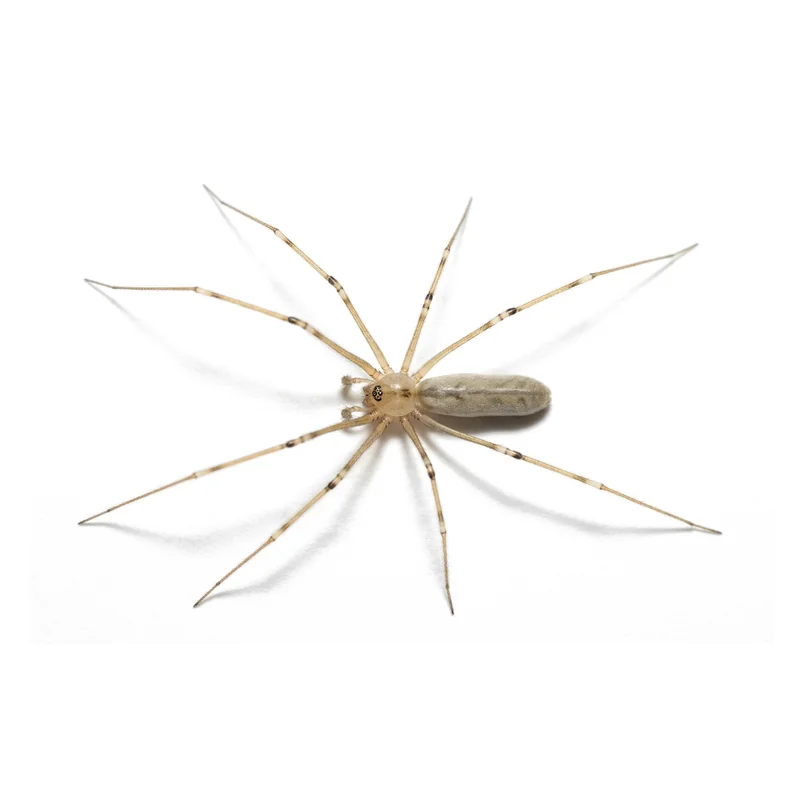
Cellar Spider
AKA: Daddy Long Legs, Vibrating Spider
Pholcus phalangioides
|
0.25 in body, leg span up to 2 in. Very thin, long legs and a tiny pale body, almost translucent. | 8 eyes. Hangs upside down in loose ceiling cobwebs and vibrates rapidly when disturbed. Body far too small and legs far too long to be confused with a recluse up close. | Upper corners of rooms, garage ceilings, bathrooms, under stairways. Hangs in ceiling cobwebs, not hiding in boxes. |
Brown Recluse vs Wolf Spider
The Brown Recluse in Three Numbers
566
US poison centers recorded 566 brown recluse bite cases in all of 2021, with 1 death, so a bite is rare and a death rarer still.
US poison center data, 2021
About 9 mm
Penn State Extension puts a brown recluse body at about 9 mm long, roughly 3/8 inch, with legs that make it look bigger.
Penn State Extension
628 days
The National Pest Management Association puts the average indoor lifespan of an adult female brown recluse at 628 days, and says 4 to 5 years is not uncommon.
National Pest Management Association
Is the Brown Recluse Venomous or Dangerous?
Yes. The brown recluse is venomous and the most medically significant spider in Collin County. The venom contains phospholipase D (also called sphingomyelinase D), an enzyme that destroys cell membranes and triggers both local tissue destruction and, in severe cases, red blood cell lysis.
The illness a bite causes is called loxoscelism, and it is either local (skin and tissue damage) or systemic (body-wide illness).
US poison center data recorded 566 brown recluse bite cases in 2021 with 1 death, in the 2021 annual report of America’s Poison Centers. A 2002 study in the Journal of Medical Entomology collected 2,055 brown recluse spiders from one occupied home in Lenexa, Kansas, over 6 months, and no one living there was bitten. Severe systemic illness (loxoscelism) is rare, and in a 2017 PLoS One study of 57 people with moderate to severe cases, 2 died, a rate of 3.5%, and the median age was 14. There is no antivenom approved by the US Food and Drug Administration as of 2026. Treatment is wound care, pain control, and management of any systemic complications. The University of Minnesota Extension publishes a general guide to spiders.
Brown Recluse Bites and When to Seek Medical Care
A brown recluse bite is often initially painless or mildly stinging, which is why many people do not realize they were bitten until symptoms develop hours later. Locally, the bite site develops redness and blistering within the first 24 hours. By 72 hours, some bites develop a characteristic red-white-blue zone (central pallor surrounded by redness). A necrotic core may develop around day 7, and the wound can continue to break down for weeks. A 2022 clinical review of North American envenomations covers current treatment standards and wound care.
Brown recluse do not chase or attack. Every documented bite involves accidental contact. The spider was inside a shoe, glove, clothing item, or bedding, and the person put it on or pressed against it. Shaking out shoes, gloves, sports gear and seasonal clothing before putting them on, especially items stored in the garage, prevents the overwhelming majority of indoor bites.
Most “recluse bites” are not recluse bites. Dermatology and emergency medicine literature documents consistent overdiagnosis of recluse bites, particularly in regions of the country where the species does not even occur. Common misdiagnoses include methicillin-resistant staph infection, diabetic wounds, vascular ulcers, and pyoderma gangrenosum. A recluse bite belongs on the list for a wound you cannot explain, but your provider needs to rule out resistant staph and other bacterial causes first, and an unconfirmed “spider bite” that fails to improve with standard wound care should be cultured for resistant staph.
Seek emergency care immediately if you see rapidly expanding redness or swelling, a blistering wound that grows over 24 hours, fever, chills, nausea, vomiting, joint pain, weakness, dark-colored urine, or widespread rash. These are signs of systemic loxoscelism. Any suspected bite involving a child, elderly individual, or person with kidney disease or immune compromise warrants medical evaluation even without systemic symptoms, because those populations face the highest risk of severe outcome.
For bites without systemic signs, clean with soap and water, apply ice (cold slows phospholipase D activity), elevate if on a limb, and monitor the wound closely for 72 hours. Do not apply heat. Do not cut or scrape the wound. Photograph the wound daily to track progression. If the wound enlarges, develops a dark center, or shows signs of infection after day 3, see a provider.
How Bad Is Your Brown Recluse Situation
Seeing one recluse is different from having an established indoor population. These are the signals that tell a technician whether your home has an isolated entry or an active shelter problem. Texas A&M AgriLife Extension’s Control of Brown Recluse Spiders sheet says indoors they are most common in cluttered closets, garages, crawl spaces and attics, and that a well-entrenched infestation usually takes insecticide and sanitation together.
Multiple Indoor Sightings Over Several Weeks
A single sighting can be a stray visitor. Multiple sightings across different rooms over several weeks indicate an established indoor population using a shelter source, typically a cluttered garage, storage area, or undisturbed attic space.
Confirmed Bite Event
A confirmed or strongly suspected bite, especially involving a child, makes the problem urgent. A bite is not just a medical event. It confirms an active population in occupied living spaces rather than only in storage areas.
Egg Sacs Found in Storage Areas
Off-white, round to slightly flattened egg sacs inside boxes, shoe corners, or behind stored items indicate an established breeding population. Finding egg sacs before they hatch is the most reliable early indicator.
Heavily Cluttered Garage or Storage Space
Undisturbed boxes, stacked cardboard, seasonal bins, and long-unused sports gear create ideal recluse shelter. A heavily cluttered garage in an older McKinney or Allen neighborhood with established trees is a high-risk environment even without confirmed sightings.
Shed Skins Found in Storage Zones
Molted skins look like translucent paper spiders with legs, and homeowners often mistake them for trash or dead insects. Shed skins in several storage areas confirm long-term indoor residence, not an occasional visitor.
Retreat Webbing in Multiple Shelter Zones
Irregular gray or white retreat webbing (not a patterned prey-capture web) in closet corners, behind boxes, or along garage baseboards indicates active shelter use. Web sites spread across the structure mean the population is distributed, not isolated.
Why You Found a Brown Recluse in Your House
A brown recluse in a bedroom or bathroom almost always came from storage in the same house, most often the garage. Brown recluse do not seek out living rooms or bedrooms. They follow the clutter, and bites in bedrooms and bathrooms typically happen when a spider that wandered from the garage gets carried in on clothing, shoes, or boxes. In our service records, closet and bedroom bites almost always trace back to garage shelter, not a population living in the bedroom.
Recluse most commonly enter a home on furniture, moving boxes, and stored goods brought from an infested location. Garage door sweeps, slab cracks, and utility penetrations are secondary entry routes. Sealing those gaps without clearing the shelter inside only delays the next round.
Where Brown Recluse Build Up in Collin County Homes
Brown recluse are indoor shelter spiders first. The profile of a problem home is almost always the same: a garage or storage space that has not been fully organized in years, with cardboard boxes stacked against walls, stored clothing, old furniture, sporting equipment, and seasonal bins in the corners. In Collin County slab homes, shelter pressure concentrates in the garage. Pier-and-beam homes add crawl spaces to that list. Attic storage is the secondary shelter zone, and closets with seasonal items complete the picture. The key pattern is low-traffic storage that has not been physically moved and inspected in months or years.
Brown Recluse Pressure Across Collin County
Brown recluse are confirmed across Collin County. Pressure is highest in older neighborhoods with mature landscaping and less-organized garage and attic storage. Historic downtown McKinney, El Dorado, and older Allen and Plano sections see higher call volumes than new construction neighborhoods in Prosper, Celina, and north Frisco.
New construction areas do see pressure in the first two years after move-in, when boxes pile up before they are sorted. Princeton and Anna show lower historical density but increasing calls as those cities fill in.
Encounter rates peak in late spring through early fall as adults wander to feed and mate. The highest encounter and bite rates fall in June through August. Winter reduces overall activity but does not end an established indoor population.
Texas A&M entomology records and Pest Me Off service call data across Collin County, 2023 to 2026, put the peak at the 5 months from May through September. Indoor sightings occur year-round in homes with significant clutter or undisturbed storage.
Why Brown Recluse Populations Are Hard to Eliminate
How Pest Me Off Treats Brown Recluse
Brown recluse control is a shelter problem, not a surface spray problem. A technician who sprays the visible surfaces and leaves has not addressed the source. Brown recluse control research consistently shows that shelter reduction combined with targeted product application outperforms blanket spraying alone. Texas AgriLife brown recluse management recommendations confirm this shelter-first approach for Texas homes.
Shelter Inspection
Walk the full interior with the homeowner. Identify every low-traffic storage zone: garage walls, closet floors, attic bins, stored clothing, piles of boxes, furniture pushed against walls. Count evidence zones (retreat webbing, shed skins, egg sacs) to judge how far the population has spread and how severe it is.
Shelter Reduction
Vacuum all visible spiders, webs, egg sacs, and shed skins from identified shelter zones, and pull stored items away from walls to expose the shelter behind them. Physical removal of egg sacs is critical, because the silk protects eggs from surface spray.
Targeted Crevice and Gap Treatment
Apply residual insecticide directly into confirmed shelter zones: along garage slab edges, behind stored items, into closet floor voids, and along baseboards in storage areas. Dust formulations work well in wall voids and attic edges where spiders move but liquid products cannot reach. Direct contact kills individuals, and residual product in retreat areas catches wandering spiders.
Exclusion and Entry Point Sealing
Seal garage door sweeps, slab cracks, utility penetrations, and any gap where stored goods are brought in from outside, closing the physical routes back in once the shelter is cleared.
& Other Companies
How to Get Rid of Brown Recluse Spiders Yourself
The most effective recluse prevention does not require a single drop of pesticide. It requires reducing the undisturbed clutter that recluse need to build a population.
Why DIY Fails for Brown Recluse
Most DIY attempts fail because they treat the spider you can see and leave the boxes, egg sacs and wall voids where the rest of the population lives.
Bug Bombs and Foggers
Foggers do not penetrate the clutter and wall voids where recluse live. The fog disperses into open air and settles on surfaces that recluse rarely contact. Homeowners fog and believe the problem is solved, while the population in the stored boxes is untouched.
Perimeter Sprays Without Shelter Reduction
Spraying visible surfaces while leaving cardboard stacks and stored items in place treats only the 10% of the space recluse occasionally cross. The 90% where they actually live remains untreated.
Moving Stored Items Without Inspection
Pulling long-unmoved boxes off a shelf without inspecting first is the most common way homeowners get bitten during a cleanout. Use a broom handle to push boxes before reaching in with your hands, and wear gloves during any serious storage cleanout.
Vacuuming or Spraying Only What You Can See
Vacuuming the spider you can see without pulling stored items away from the wall misses the retreat web, the egg sacs, and the rest of the population sharing the same shelter. Spraying a sac in place is less reliable than physically removing and disposing of it, and every sac left behind is the next generation of the problem.
Ultrasonic Repellents
There is no peer-reviewed evidence that ultrasonic devices affect spider behavior. Spiders do not detect ultrasound the way mice do, and recluse in a wall void are unaffected by a plug-in device in the outlet next to it.
Common Brown Recluse Questions
How do I identify a brown recluse spider?
Is the spider I found in my McKinney garage a brown recluse or a wolf spider?
Are brown recluse common in Collin County, Texas?
What does a brown recluse bite look like and how fast does it progress?
How dangerous is a brown recluse bite?
When should I go to the ER for a suspected recluse bite?
Where do brown recluse hide in Collin County homes?
What time of year are brown recluse most active in Collin County?
Do bug bombs kill brown recluse spiders?
How long do brown recluse spiders live?
Do brown recluse build webs in living areas like ceilings or corners?
Can organizing and decluttering my garage actually fix a brown recluse problem?
How do I get rid of brown recluse spiders?
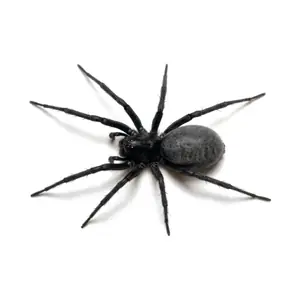
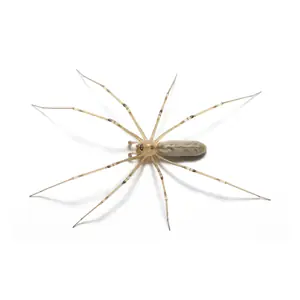
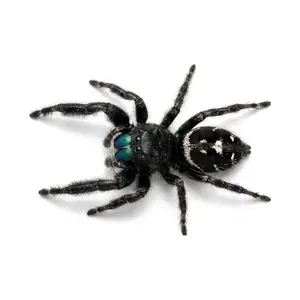
Brown Recluse in Your Garage. We Get Rid of Them.
We inspect every shelter zone, vacuum spiders and egg sacs directly, treat cracks and crevices where they actually live, and seal the entry points across McKinney, Allen, Frisco, Plano, and all of Collin County.