Black Widow Spiders in Collin County, TX | Identification and Control
The Southern Black Widow (Latrodectus mactans) is the most immediately recognizable dangerous spider in Collin County. Its neurotoxic bite causes severe muscle cramping, not local tissue death. Most bites happen in garages and water meter boxes when a hand enters a web without looking first. The spider hangs upside down in a messy tangle web and rarely leaves it.
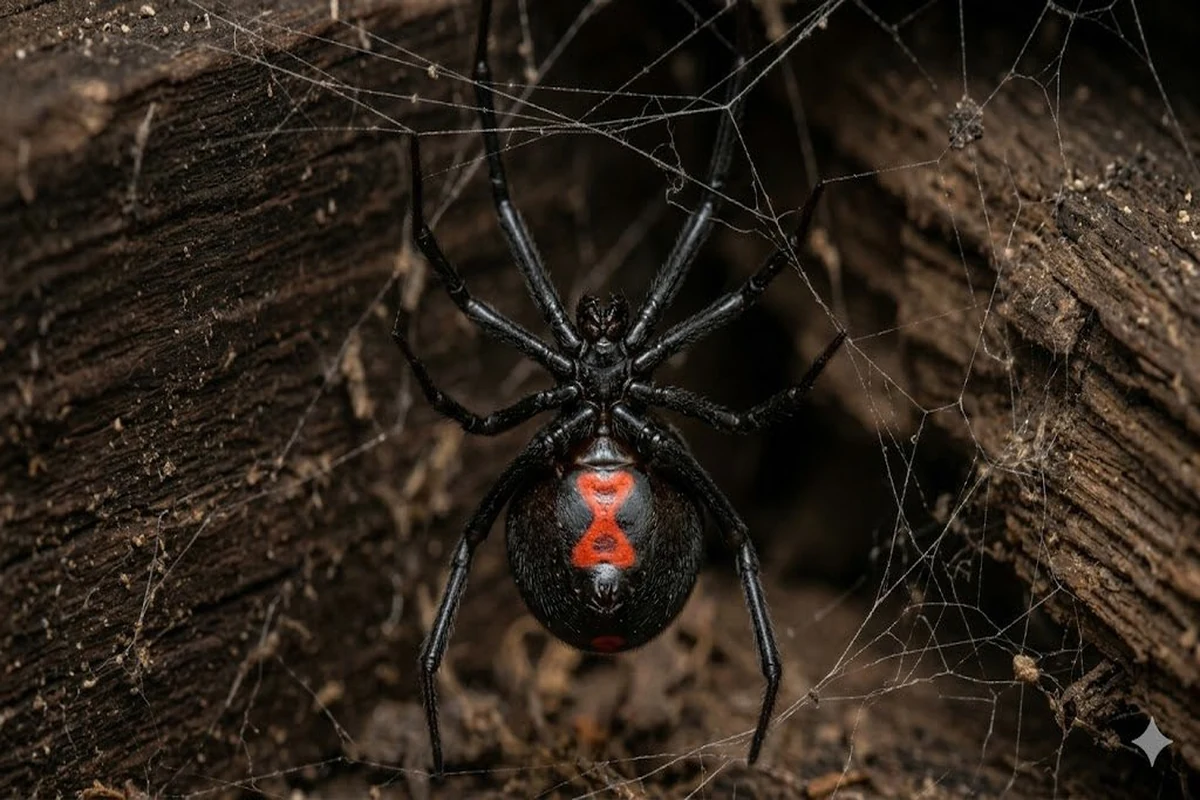
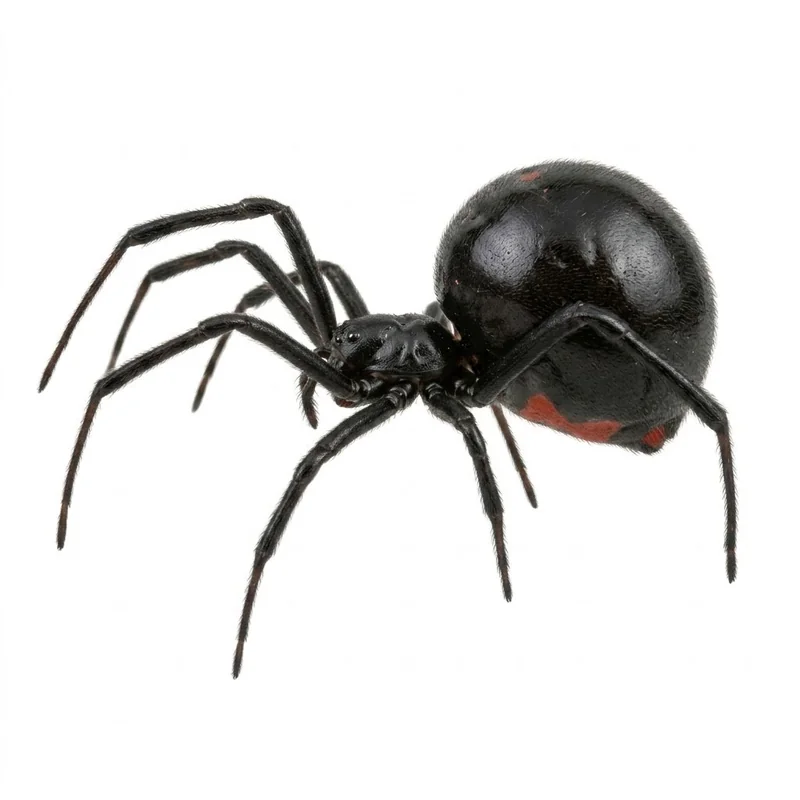
A jet-black spider with a red hourglass on her underside that most people recognize on sight. Her neurotoxic bite causes severe muscle cramping and rarely kills with medical care, but it is immediately serious in children, the elderly, and those with heart conditions.
Peak adult activity runs July through October in Collin County, driven by heat, prey availability, and the approach of fall. Web construction in garages and meter boxes begins in early spring when daytime temperatures hold above 60 F.
Pattern from Texas A&M entomology records and Pest Me Off service call data across Collin County, 2023 to 2026.
What a Black Widow Looks Like
The spider that hangs upside down in a crackly, disorganized web near the ground
The adult female black widow is jet black, shiny, and about 0.5 inches in body length with a leg span up to 2 inches. The definitive marking is the red or orange hourglass on the underside of the abdomen, visible when the spider hangs upside down in her web. The color of the mark ranges from bright red to orange or yellow depending on the individual. The silk itself is distinctive: black widow silk is exceptionally strong, gives a “crackling” sound when disrupted with a broom or stick, and builds at ground level and low anchor points rather than in high ceiling corners like cellar spiders.
Males are roughly one-quarter the female’s size, brown rather than black, and carry no medical risk to humans. Spiderlings are orange and brown when young and darken with each molt. Egg sacs are pear-shaped or spherical, 0.5 inch, tan or creamy white with a parchment-like texture, and hang suspended in the web where the female guards them actively.
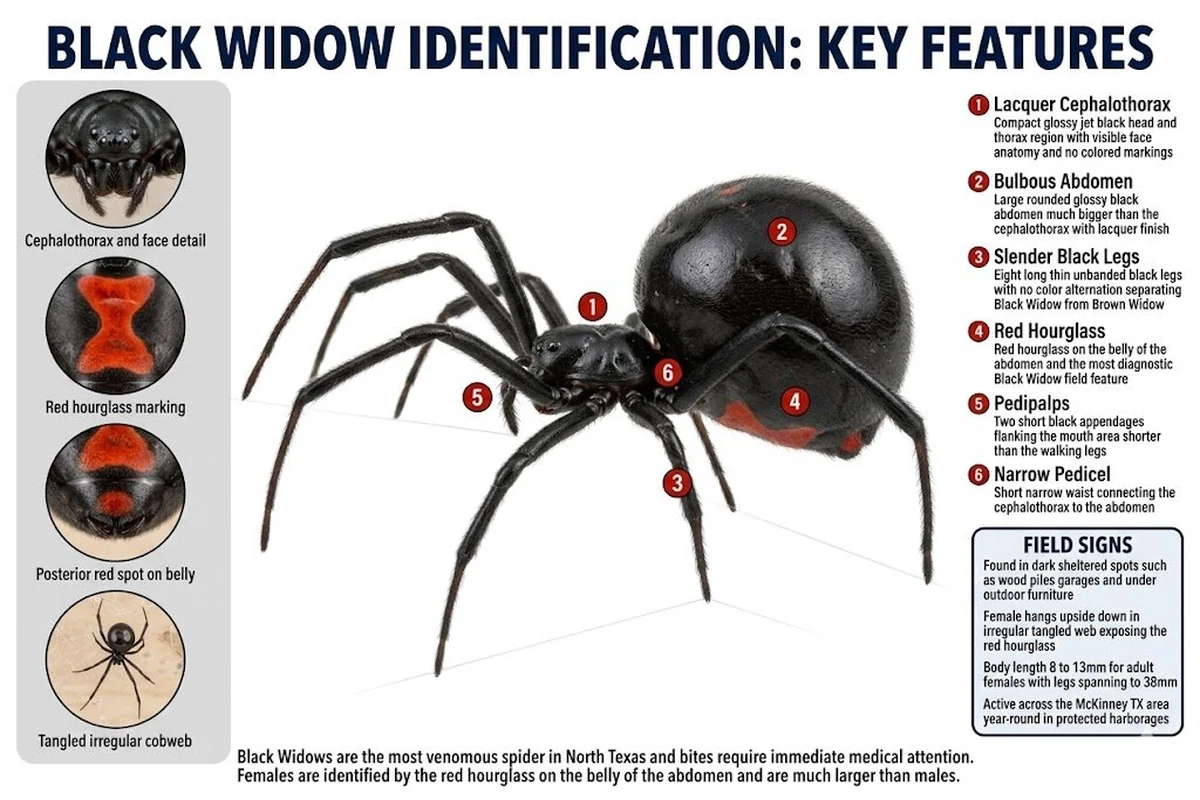
Black widow identification diagram with anatomical callouts
- Jet black, glossy body (females only; males are small and brown)
- Red or orange hourglass on underside of abdomen; visible when hanging upside down
- Hangs upside down in the web; does not sit on top
- Messy, disorganized tangle web near ground level or low corners
- Silk is very strong and makes a “crackling” sound when swept through
- Tan, pear-shaped egg sac suspended in the web, actively guarded
- Prey remains (beetle wings, cricket parts) bundled at web bottom
Southern Black Widow vs Black Widow
The species in Collin County is the Southern Black Widow (Latrodectus mactans). Other widow species exist in the United States, including the Western Black Widow (Latrodectus hesperus) and the Northern Black Widow (Latrodectus variolus), but those are not the species you encounter in Collin County. In everyday use, homeowners and pest professionals in Collin County refer to the Southern Black Widow simply as the black widow, and that shorthand is accurate here.
The “widow” name comes from the historically overstated claim that females eat males after mating. This occurs in captivity under artificial conditions but is not the typical outcome in the wild. The name stuck regardless of accuracy. The medically relevant fact is not the name but the venom: neurotoxic rather than cytotoxic, meaning it attacks the nervous system rather than destroying tissue.
How to Tell Black Widows from Other Collin County Spiders
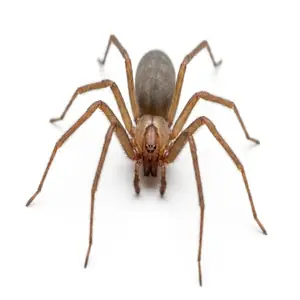
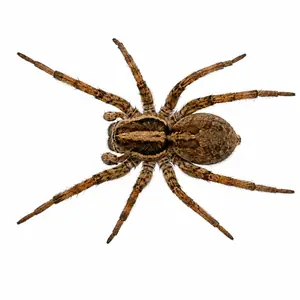
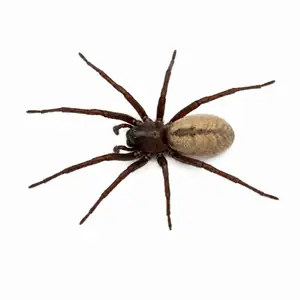
The adult female black widow is one of the most identifiable spiders in Collin County. The glossy black body and red hourglass are difficult to confuse. The common misidentification happens with false widows and dark jumping spiders, neither of which carry the same medical risk.
| Species | Size | Key Feature | Where Found |
|---|---|---|---|
|
Black Widow
AKA: Southern Black Widow, Hourglass Spider
Latrodectus mactans
This species
|
Female 0.5 in body, up to 2 in leg span. Jet black, glossy. Male 0.25 in, brown, no medical risk. | Red or orange hourglass on underside of abdomen. Hangs upside down. Very strong silk with crackling sound. Messy tangle web near ground level. Pear-shaped egg sac in web. | Garage corners, water meter boxes, woodpiles, under eave returns, outdoor storage benches, irrigation control boxes. Always near ground level. |
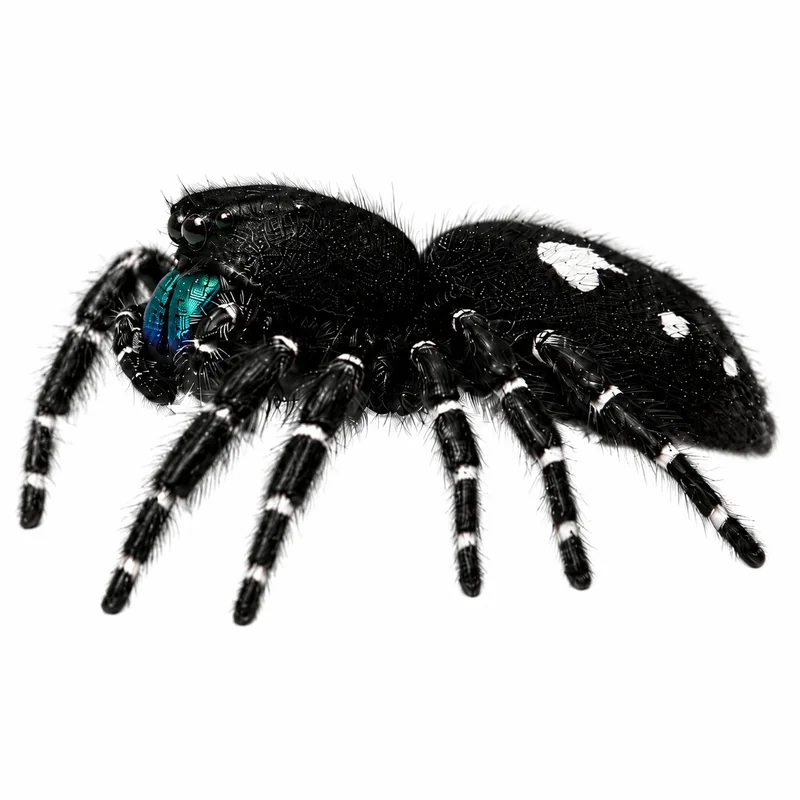
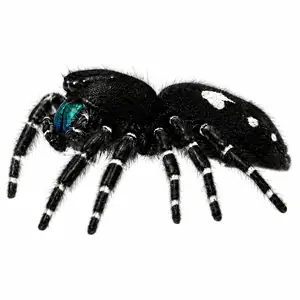
Jumping Spider
AKA: Bold Jumping Spider, Daring Jumper
Phidippus audax
|
0.3 to 0.6 in body. Stocky, compact, heavy-bodied. Black or dark with white or orange markings on abdomen. | No hourglass on underside. Two enormous front-facing eyes immediately visible. Iridescent green or blue chelicerae (mouthparts). Moves in quick, confident jumps. Does not build a web. | Fences, exterior walls, windowsills, garden vegetation. Active daytime hunter in open areas, not hiding in dark corners near the ground. |
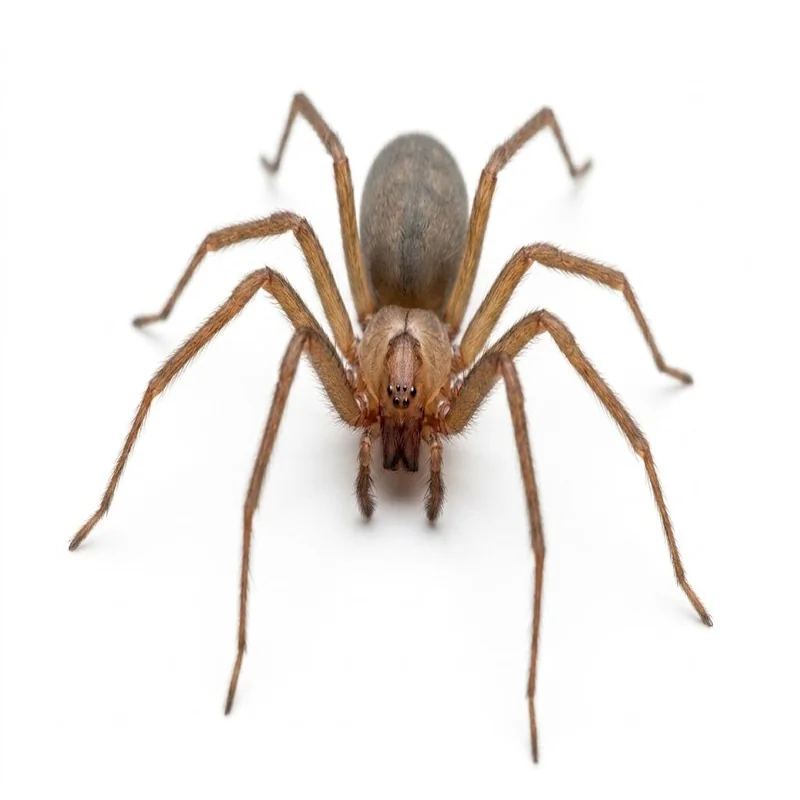
Brown Recluse
AKA: Violin Spider, Fiddleback
Loxosceles reclusa
|
0.25 to 0.5 in body. Matte tan-to-brown coloring. Slender, not glossy. Uniformly colored legs. | Matte brown body, no gloss, no hourglass. 6 eyes in 3 pairs (widow has 8 eyes). Found in undisturbed clutter and storage, not in an open web near the ground. | Dark undisturbed storage: cardboard boxes, stored shoes, garage shelves, closet floors. Hidden in retreat webbing, not hanging in an open web. |
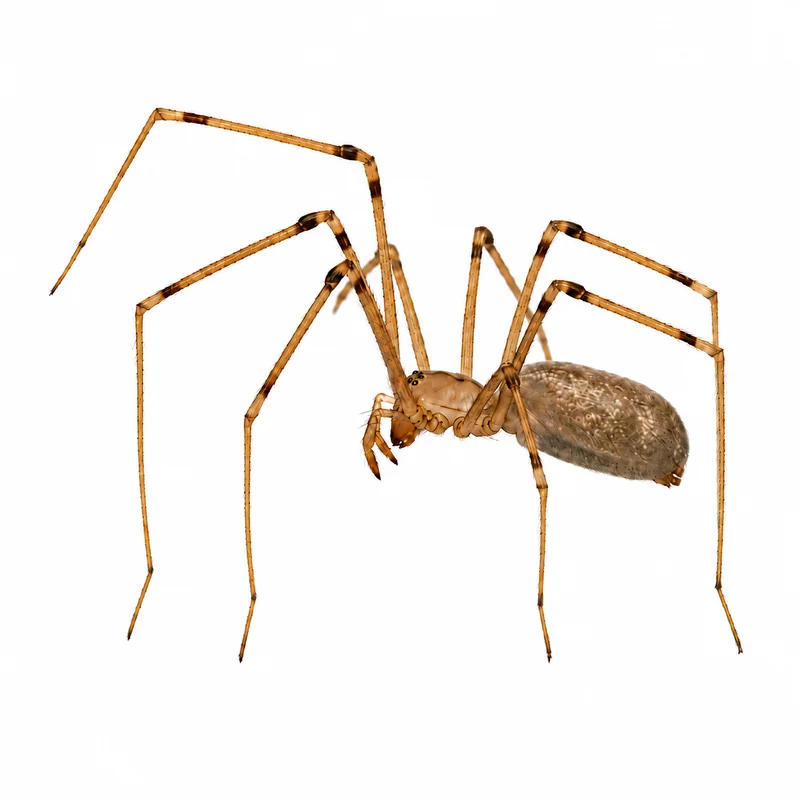
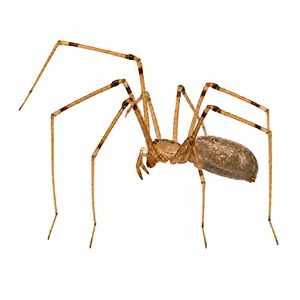
Cellar Spider
AKA: Daddy Long Legs, Vibrating Spider
Pholcus phalangioides
|
0.25 in body; leg span up to 2 in. Pale, almost translucent. Thin, long legs; tiny body. | Pale gray-tan, not black. Extremely thin legs (not the stocky black widow body). Hangs in loose cobwebs in upper ceiling corners, not near ground level. No hourglass, no gloss. | Ceiling corners of garages, bathrooms, and closets. Hangs near the top of rooms, not at floor level where widows build. |
Black Widow Bites and When to Seek Medical Care
A black widow bite is often described as a pinprick or burning sensation at the moment of contact, sometimes with two small puncture marks visible. Within one hour, pain spreads from the bite site to the chest or abdomen, accompanied by localized sweating and goosebumps. By 3 to 12 hours, symptoms peak: severe cramping in the abdomen and back muscles (sometimes mistaken for appendicitis or a gallbladder attack), profuse sweating, nausea, vomiting, elevated blood pressure, and rapid heartbeat. The syndrome is called latrodectism. Black widow envenomation clinical review covers current treatment standards.
US poison control data records approximately 2,500 black widow bites per year with no reported fatalities in over 11 years of published data, though severe cases requiring emergency intervention occur regularly. An antivenom exists (Merck Antivenin Latrodectus mactans) but is rarely administered because it carries its own anaphylaxis risk: a documented case of fatal anaphylactic shock occurred even when the antivenom was diluted and given as an infusion. Standard management is pain control (opioids for severe cramping), benzodiazepines for muscle spasms, cardiac monitoring, and IV access. Peer-reviewed black widow bite management guidance covers first aid steps and hospital evaluation criteria.
Seek emergency care immediately for: severe muscle cramping in the abdomen or back, chest pain or tightness, difficulty breathing, sweating beyond the bite site, elevated blood pressure, or any systemic symptoms. Any bite involving a child under 12, an elderly person, a pregnant woman, or anyone with a cardiac condition should be evaluated in the ER regardless of initial symptom severity, because these groups face the highest risk of severe outcome from neurotoxic effects.
For adults without immediate systemic symptoms: clean the wound, apply a cool compress, immobilize and elevate if bitten on an extremity, and monitor closely for 1 to 2 hours. If symptoms begin to spread beyond the bite site, go to the ER. Do not wait for severe cramping to develop before seeking evaluation.
How Serious Is Your Black Widow Situation
A single widow in a water meter box you rarely open is a different situation than a garage with multiple occupied webs in areas the family uses daily. These signals tell the difference. Texas A&M black widow biology in Texas covers local population patterns.
Occupied Webs in Actively Used Areas
Webs in garage corners at floor level, inside storage benches, or near play equipment in areas that children or pets regularly access require immediate treatment. A widow in a low corner that children walk past is a contact risk, not just a nuisance.
Multiple Webs Across Multiple Locations
Finding widows in more than one site around the property (garage, meter box, and woodpile simultaneously) indicates an established population using consistent shelter rather than a single isolated spider.
Egg Sacs Found in Occupied Webs
A pear-shaped tan sac in a web with a live female present means 200 to 400 eggs that will hatch within weeks. Treatment before hatch eliminates the next generation before it disperses across the garage and yard.
Woodpile or Construction Debris Near the Foundation
Firewood stacked against the house, leftover brick piles, and old lumber near the foundation create widow habitat within feet of entry points. Workers from these sites cross into the garage within a season if not treated.
Heavy Landscape Stone or Water Features
Properties with heavy decorative stone, rock borders, or water features have higher natural widow pressure. Stone retains heat, provides shelter, and attracts the cricket and roach prey widows depend on.
Newly Built Home With Adjacent Construction Debris
New developments in Prosper, Celina, and Melissa where brick, lumber, and soil disturbance remain on adjacent lots see elevated widow populations as spiders move from disturbed lots into landscaped homes with fresh shelter.
Where Black Widows Build in Collin County
Black widows in Collin County are primarily outdoor and transitional spiders. They build in the spaces between outdoor and occupied: the inside corners of garage door frames, inside water meter box lids, under siding lips, inside outdoor furniture, beneath eave returns at the roofline, and in irrigation control boxes. They are rarely found in living areas. The garage is the primary indoor location; beyond that, widows stay close to their exterior shelter sites.
The typical widow web is built near floor or ground level, within the first 18 inches of a vertical surface, and always anchored to something structural: a corner, a pipe, a lid interior. The spider hangs upside down in the center and rarely leaves the web voluntarily. This is one behavior that makes removal straightforward: a widow in her web is a widow you can see, target, and treat directly. Black widow spider identification and management guide from University of Minnesota Extension covers web placement and removal methods.
Black Widow Pressure Across Collin County
Black widows are confirmed and widespread across Texas. In Collin County, pressure correlates with property features more than with specific neighborhoods: heavy stone landscaping, woodpiles within 20 feet of the foundation, greenbelt-adjacent lots, and properties with dense cricket populations all see higher widow activity. The July-through-October peak in Collin County corresponds to peak cricket activity, which is the widow’s primary prey source.
Craig Ranch and Stonebridge Ranch generate consistent widow calls due to greenbelt adjacency and cricket pressure. Older properties in McKinney, Allen, and Plano with mature landscaping and stone elements also show steady activity. New construction in Prosper, Celina, and Melissa with leftover brick piles and disturbed soil adjacent to new sod creates opportunistic widow shelter. Water meter boxes in any Collin County neighborhood are a consistent hotspot regardless of property type.
Cost of Doing Nothing
A female black widow produces up to 3,000 eggs per lifetime. Left untreated through one summer, a single female produces 4 to 9 egg sacs with 200 to 400 eggs each. By the following spring, that translates to dozens to hundreds of new widows across the property. Emergency room treatment for a severe black widow bite runs $3,000 to $8,000 before insurance. Keeping firewood away from the house and treating the garage corners once a season costs a fraction of one ER visit.
Why Black Widow Populations Keep Coming Back
Things You Should Know About Black Widows
Facts that change how you interact with your garage and yard
How Pest Me Off Treats Black Widow Infestations
Black widow control starts with a complete site inventory, not a spray. A widow in a garage corner is easy to see and treat. The widows in the meter box, under the siding lip, in the irrigation controller, and behind the stacked firewood are the ones that get missed and produce next year’s population. Black widow management and control guidance confirms that complete shelter site identification is the critical step that separates effective treatment from repeat callbacks. Texas AgriLife black widow control recommendations for Texas residential properties reinforce the site-inventory approach.
Full Site Inventory
Inspect every potential shelter location around the property: garage corners at floor level, both sides of the garage door frame, the interior of the meter box lid, all eave return corners, outdoor storage benches, irrigation controllers, under siding lips, woodpiles, and stone landscaping within 20 feet of the foundation. Map every occupied web and every egg sac before treatment begins.
Direct Spider and Egg Sac Elimination
Apply direct contact pyrethroid (insecticide chemical family) or botanical spray to every occupied web site. Physical web removal follows treatment; all egg sacs are physically removed and disposed of, not left in place. A sprayed sac with an intact silk exterior may not deliver lethal dose to eggs inside. Physical removal eliminates this uncertainty.
Exterior Perimeter Treatment
Apply residual perimeter treatment along the foundation, under siding, at eave returns, and around any structural feature that serves as widow shelter. Garage door track voids receive dust formulation, which is highly effective in enclosed voids where liquid products cannot penetrate evenly. The perimeter treatment intercepts new widows establishing from adjacent lots and cricket populations before they reach the garage interior.
Habitat Modification Recommendations
Advise on woodpile relocation (20 feet minimum from the foundation), switching to yellow outdoor lighting to reduce cricket attraction, relocating decorative stone away from entry zones, and confirming meter boxes are closed fully. These modifications reduce the shelter and prey supply that sustain widow populations without requiring chemical reapplication.
& Other Companies
DIY Black Widow Prevention for Your Home
Black widow prevention is mostly habitat management. The spider is not going to be eliminated from the region; the goal is removing the conditions that make your property attractive to them.
Why DIY Fails for Black Widows
Treating the Garage, Missing the Meter Box
The most common DIY miss: a homeowner treats every visible web in the garage and feels done, while the meter box, the irrigation controller, and the base of the woodpile go uninspected. Those sites produce new widows into the garage within weeks.
Spraying Without Removing Egg Sacs
General bug sprays do not reliably penetrate the silk exterior of a widow egg sac. A sprayed sac may still hatch. Physical removal is the only reliable approach; do not assume a sprayed sac is neutralized.
General Bug Spray Without Knockdown Power
Many OTC “bug sprays” lack the knockdown speed or concentration required for reliable widow control. A widow that is hit but not killed retreats into a crack and rebuilds within days. Professional-grade pyrethroids (insecticide chemical family) applied at correct concentration deliver faster kill and longer residual.
Reaching Into Webs or Under Siding Without Checking
The fastest way to get bitten is to reach into a widow web without seeing the spider first. Use a flashlight before any hand contact in low garage corners, under siding, into storage benches, and especially into meter boxes. Sweep with a stick before your hand follows.
One-Time Treatment Without Repeat
Widows disperse to new locations each spring from neighboring properties. A single treatment in June without follow-up in late summer leaves the fall egg sac production window untreated. Two seasonal treatments (spring and late summer) are more effective than one annual visit.
Glue Traps as a Primary Control
Glue boards placed on open floor areas are ineffective against web-dwelling widows. A widow that never leaves her web will never contact a floor trap. Glue boards work for ground-level wandering pests, not for web builders hanging in low corners.
Common Black Widow Questions
Black Widows in Your Garage. We Get Rid of Them.
We inspect every shelter site from the meter box to the woodpile, treat every occupied web, and remove every egg sac across McKinney, Allen, Frisco, Plano, and all of Collin County.