
How to Make a Fruit Fly Trap That Actually Works
A fruit fly trap takes a jar, a few ounces of cider vinegar and a sheet of paper, and it works. What it does not do is stop the flies being made. This article covers how to build the trap the University of Kentucky and Cornell describe, how it works, why one stops catching flies, how long it takes, and what to use for gnats instead, for kitchens in McKinney and anywhere else.
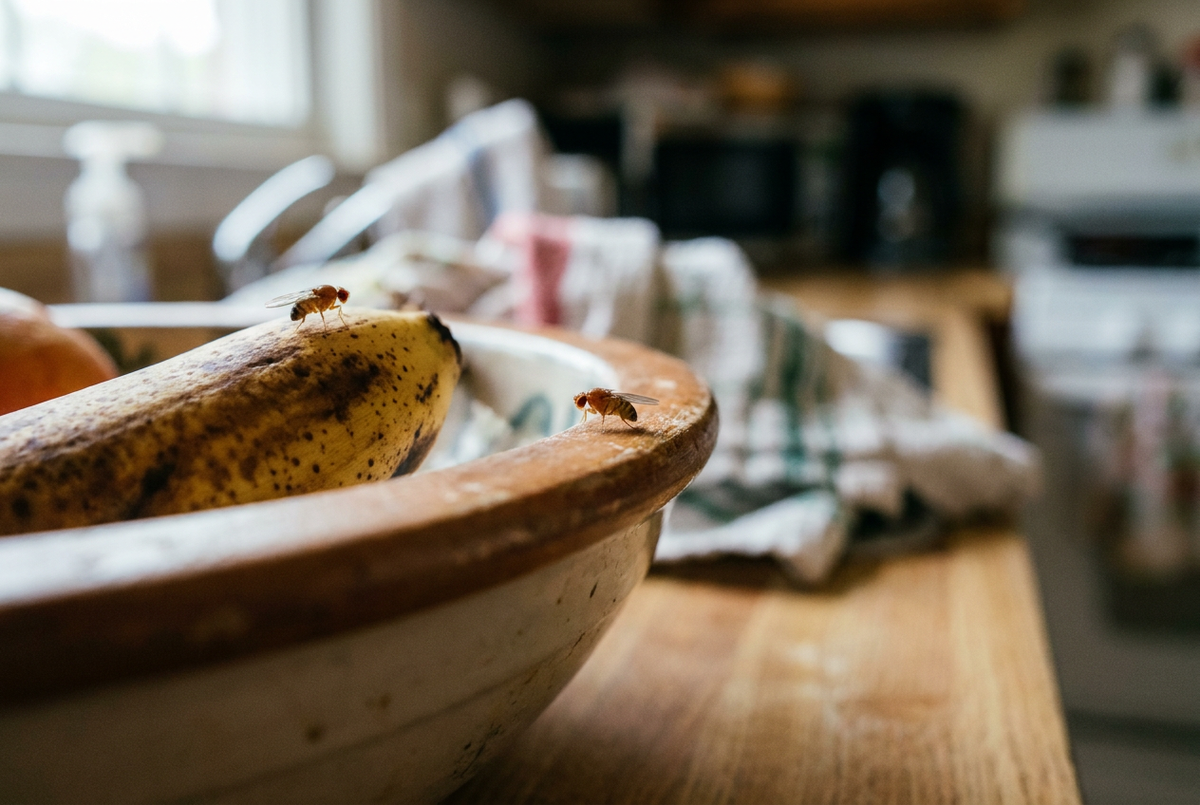

- The University of Kentucky’s trap is a jar, a few ounces of cider vinegar and a paper funnel.
- Cornell’s fruit fly fact sheet gives a funnel opening of less than a quarter inch.
- A drop of unscented dish soap breaks the vinegar’s surface tension, UMass Amherst’s fruit team says.
- A fruit fly can go from egg to adult in about a week, the University of Kentucky says.
- A trap catches adults. The breeding source still has to be found and cleaned.





How do you make a fruit fly trap?
A fruit fly trap is a jar holding a few ounces of cider vinegar with a paper funnel set in the top, the design the University of Kentucky gives. Cornell’s fruit fly fact sheet gives a funnel opening under a quarter inch, with the tip kept clear of the bait and the funnel taped to the jar.
Roll the funnel from a sheet of notebook paper, and put a trap wherever you keep seeing flies.
Vinegar is not the only bait. The University of Kentucky’s fruit fly fact sheet also suggests a slice of banana, and Cornell’s What’s Bugging You page on fruit flies lists a bit of ripe banana sprinkled with yeast, a banana peel, or part of a ripe peach or tomato. The fact sheet Cornell quotes says to check the trap daily, and the easy way to kill what it has caught is to put the trap in the freezer overnight, closed up in a bag so nothing escapes first.
How does a fruit fly trap work?
A fruit fly trap works by turning the flies’ pull toward fermenting food against them. Cornell says fruit fly young need the yeast that fermentation creates, so a jar of vinegar or ripe fruit draws the adults in. The narrow funnel lets them reach the bait through an opening under a quarter inch.
Some people use a jar of vinegar with no funnel and a drop of dish soap instead.
The soap is there for a reason. UMass Amherst’s fruit team, which traps a related fruit fly in fruit crops, adds a drop of unscented dish soap to cider vinegar to break the surface tension, so the vinegar works as a drowning solution. Cornell also notes that small vinegar traps with holes in the top can be bought ready-made or made at home.
Why is my fruit fly trap not working?
A fruit fly trap usually fails because the flies are breeding faster than it catches them, or because the bait has gone stale. The University of Kentucky puts the trap after the cleanup, catching the adults left once every breeding site is removed or cleaned, and Cornell’s fact sheet says to replace the bait every few days.
The fact sheet’s reason for fresh bait is that old fruit bait can start breeding new flies itself.
The breeding site is usually not on the counter. Kentucky lists drains, garbage disposals, empty bottles and cans, trash containers, mops and cleaning rags, and says a single rotting potato or onion forgotten in a closet, or juice spilled under a refrigerator, can breed thousands. For a drain or a disposal you cannot see into, Kentucky’s test is to tape a clear plastic food storage bag over the opening overnight. If flies are breeding there, the new adults come out into the bag.
Two smaller faults are worth checking too. A funnel opening much wider than a quarter inch, or a funnel tip sitting in the bait, goes against the design in Cornell’s fact sheet.
How long does a fruit fly trap take to work?
How long a fruit fly trap takes depends on whether the flies are still breeding. The University of Kentucky says a fruit fly goes from egg to adult in about a week, and Cornell says ten days at the best temperatures for the fly, so a trap still filling after about 10 days is catching new flies.
Once the source is gone, the catch should fall off, because nothing is replacing the flies.
The pace is why a trap alone loses. Kentucky says a female can lay about 500 eggs, and Cornell gives the same figure. A trap that catches the adults one at a time is no match for a bowl of fruit or a disposal that keeps producing them, which is why the source comes first and the trap second.

Does a fruit fly trap work for gnats?
A vinegar fruit fly trap is built for fruit flies. For fungus gnats, the small flies around houseplants, the University of California recommends yellow sticky traps for the adults and raw potato chunks in the pots to find the young, along with letting the soil surface dry between waterings.
The two flies look alike, so it is worth knowing which one you have before you trap.
The University of California’s fungus gnat guide says fungus gnats are weak fliers that usually stay near potted plants, wet soil and compost. Fruit flies breed in fermenting fruit, drains, disposals and trash, the University of Kentucky says. Our article on telling gnats, fruit flies and drain flies apart shows all three side by side.
Fruit fly trap baits, compared
Every bait below comes from the University of Kentucky, Cornell or UMass Amherst.
| Bait | Who gives it | Worth knowing |
|---|---|---|
| A few ounces of cider vinegar | University of Kentucky | Kentucky’s own trap, with a paper funnel in the jar |
| A slice of banana | University of Kentucky | The fruit choice for the same funnel trap |
| Ripe banana with yeast | Cornell | Replace it every few days so it does not breed flies itself |
| Banana peel, peach or tomato | Cornell | The same rule, fresh every few days |
| Cider vinegar and dish soap | UMass Amherst | One drop of unscented soap breaks the surface tension |
Any of these will catch adults. None of them reaches a drain or a disposal that is still breeding.
How to make the funnel trap, step by step
- Pour a few ounces of cider vinegar into a jar, or drop in a piece of ripe banana, as the University of Kentucky and Cornell suggest.
- Roll a sheet of paper into a wide cone and tape it, leaving an opening at the bottom of less than a quarter inch.
- Set the funnel in the jar so the tip does not touch the bait, and tape it to the rim of the jar.
- Put a trap wherever you see flies, and check it every day.
- Freeze the trap overnight in a bag to kill the catch, and replace fruit bait every few days, as Cornell’s fact sheet describes.
Then go looking for the source with Kentucky’s bag test on every drain and the disposal. Ripe produce goes in the refrigerator, Kentucky says, and window and door screens should be tight 16 mesh to keep adults coming in from outside. Our article on how and why fruit flies enter your home covers where they come from.
How Pest Me Off handles fruit flies
Pest Me Off treats a fruit fly problem the same way every time: name the fly, find every place it is breeding, clean out the source, then trap the adults that are left. A technician checks the sinks and floor drains, the disposal, the trash and recycling, the pantry and the space under the fridge, treats the drains with a foaming product that breaks down the film the young flies feed in, and shows you each breeding spot found.
Our pest control services include same-day service when you call before noon across Plano, Frisco, Allen and the rest of Collin County, with no-contract options. Get a free estimate if the flies have outlasted the trap.
Can a DIY Fruit Fly Trap Replace Pest Control?
A DIY trap works as the last step, not the first. The University of Kentucky says to clear every breeding site, then set the jar trap to catch the remaining adult flies. Cornell says to check the trap daily. A trap still filling after the cleanup means flies are breeding somewhere, so call a professional.
Fruit flies that outlast every trap? Same-day pest control in McKinney and the surrounding cities when you call before noon.
We find where they are breeding, clean and treat the source, and trap the adults that are left. No-contract options.
