
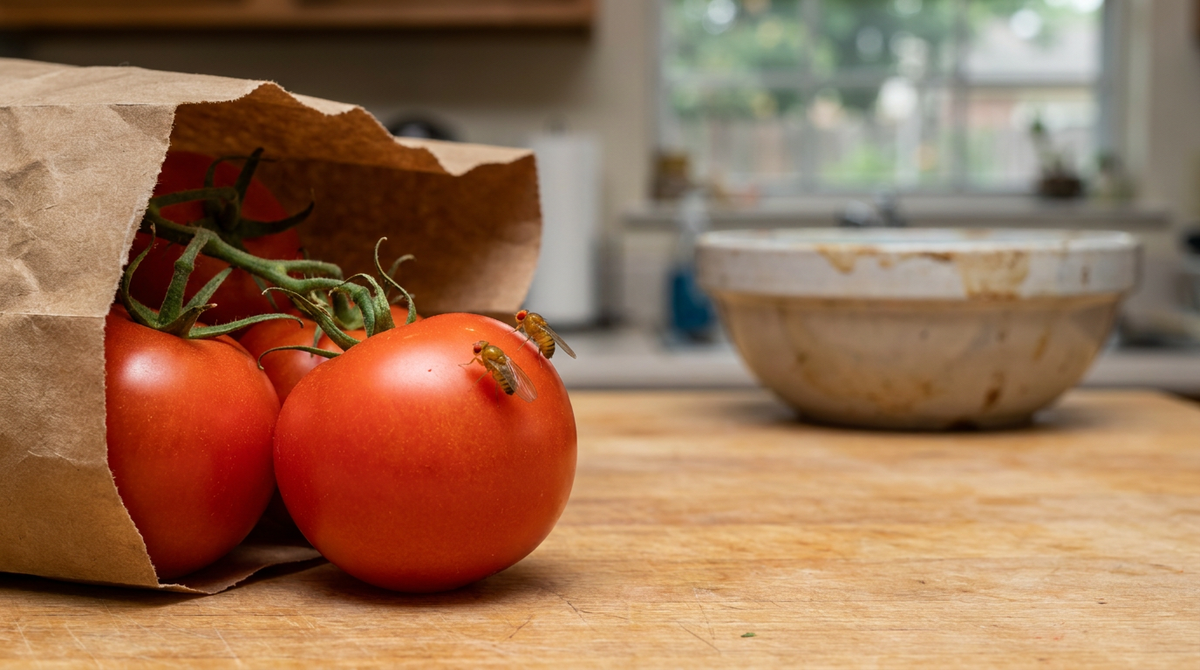
How and Why Fruit Flies Enter Your Home
A fruit fly infestation that seems to appear overnight almost never starts with flies coming in through a window or door. It starts inside the kitchen, on produce brought home from the store, in the drain film inside a sink, or in a recycling bin holding sticky residue. Knowing where fruit flies actually come from, and how they get into a home in the first place, changes how you get rid of them. The same sources apply in every kitchen across McKinney, Allen and the rest of Collin County.

- Eggs are laid directly on produce skin, especially thin-skinned fruit, and are invisible to the naked eye.
- Egg to flying adult runs about 8 to 10 days in a warm Texas kitchen, which is why an infestation looks sudden.
- Drain film inside a kitchen or bathroom drain breeds fruit flies on its own, even with the fruit bowl empty.
- Fruit flies do not bite. They contaminate exposed food, they do not break skin.
- Removing every breeding source at once works. Clearing only the fruit bowl while a drain stays active does not.





Where Do Fruit Flies Actually Come From?
What causes fruit flies in the house is almost never the house itself. It is something fermenting inside it. Fruit flies (Drosophila melanogaster and its close relatives) are small, about three millimeters, with red eyes and a tan or yellowish brown body.
They can pick up the smell of anything fermenting or overripe from a distance that surprises homeowners, and that sense of smell is the real reason an infestation seems to come from nowhere. Almost none of them fly in from outside. Instead, they start from a source already inside the house.
- Produce brought home from the store. Eggs are laid directly on the skin of thin-skinned fruit such as bananas, tomatoes and stone fruit, invisible to the naked eye. A banana left on the counter in a warm Collin County kitchen can go from eggs to flying adults in about 8 to 10 days, which is why the infestation looks sudden.
- Drain biofilm. The organic film coating the inside of a kitchen or bathroom drain is a breeding site on its own. This is why a house with an empty fruit bowl can still have fruit flies. Eggs are laid in the film and the young develop inside the drain itself.
- Recycling bins. Cans and bottles with even a little residue left unrinsed create a fermenting sugar source fruit flies find quickly. A bin kept indoors or in an attached garage can sustain a population on its own.
- Forgotten organic material. A potato going soft in a cabinet, a piece of fruit that rolled under the refrigerator, a damp mop head left standing in a bucket. Anything fermenting supports a generation of fruit flies.
The University of Kentucky Entomology fact sheet on fruit flies lists the same places. Besides ripe fruit, fruit flies breed in drains, garbage disposals, empty bottles and cans, trash containers, mops and cleaning rags. All they need is a moist film of fermenting material.
How Do Fruit Flies Get Into Your House?
Fruit flies mostly ride into a house rather than fly in. The single most common way is grocery produce that already carries eggs, especially fruit bought already ripe or with a soft spot. Farmers market produce and fruit bought in bulk carry the same risk, because it sits longer before anyone notices.
That is why sealing windows rarely solves the problem by itself.
A smaller number do fly in through an open door, a torn screen or a gap around a window, following the scent of anything fermenting on a counter or in a trash can. In Frisco and Plano kitchens with fruit left on the counter through the summer, that scent trail can pull flies in from a patio or garage within minutes of a door being propped open. Once even one or two fruit flies are inside and find a breeding source, the population builds fast enough that new arrivals from outside barely matter.
Fruit flies do not chew their way into sealed packages. What the University of Kentucky describes is a lid that is not well sealed: the flies lay eggs under it, and the tiny larvae crawl into the jar or bottle once they hatch. It says this about home canning, wine, cider and beer, so a jar that seems to have flies inside it usually had a loose lid or arrived with eggs already on the fruit.
Why Are Fruit Flies Attracted to You?
They are not, not personally. What draws them close to a person is whatever that person is carrying or wearing that smells fermented or sweet, a glass of wine, a piece of fruit, sugary residue on a hand or a cutting board.
Body heat and breath carry a faint trace of the same compounds, which is why a fruit fly sometimes hovers near a face or a drink instead of settling somewhere still. It reads as personal. It is really a sensitive sense of smell finding the strongest scent in the room, and that scent usually belongs to whatever is on the counter nearby, not to the person standing there.
Do Fruit Flies Bite?
No. Fruit flies have no biting mouthparts and cannot break skin. Anything that feels like a fruit fly bite is either a different insect entirely, most often a gnat or a mosquito, or it is irritation from a fruit fly landing somewhere sensitive.
What fruit flies do instead is contaminate exposed food by walking across it after landing in a drain, a trash can or the produce itself, which is the real reason to keep them off counters and away from open dishes.
Do Fruit Flies Turn Into House Flies?
No. A fruit fly is a different insect from a house fly, and a small fly never grows into a bigger one. Flies do all their growing as maggots, so each one comes out of its pupa at its full adult size.
The University of Kentucky puts an adult fruit fly at about 1/8 inch long, usually with red eyes. Virginia Tech puts an adult house fly at about 1/4 inch, and says its larvae grow and molt three times before they pupate. The University of California adds the easiest tell: four dark stripes down the back of a house fly. A swarm of tiny red-eyed flies around the fruit bowl is a fruit fly problem, and it stays one.
Do Fruit Flies Mean Your House Is Dirty?
No. A spotless kitchen can get fruit flies, because most of them arrive on the produce itself. Cornell says they often come into the kitchen as eggs or larvae on store-bought and homegrown produce, and the University of Kentucky says an infestation can start from fruit or vegetables that were already infested when they came home.
Where a house does play a part is in keeping them going. The University of Kentucky notes that a single rotting potato or onion forgotten at the back of a closet, or juice spilled under a refrigerator, can breed thousands of them. So having fruit flies is not a sign of a dirty house. Flies that keep coming back point to a hidden source like that one.
How Long Do Fruit Flies Live?
An adult fruit fly typically lives about 8 to 10 days, and the full run from egg to flying adult covers roughly the same span in a warm Texas kitchen. That speed is the whole reason an infestation seems to explode overnight.
Eggs laid on a Monday can be a visible cluster of adults within 8 to 10 days, and each new adult is capable of laying more eggs almost immediately. Slowing that cycle down means removing the breeding source, not swatting the flies already in the air.
Are Fruit Flies the Same as Drain Flies?
No, though the two get confused constantly because both show up around drains. Fruit flies are the small tan insects with red eyes described above, drawn to anything fermenting. Drain flies, sometimes called moth flies, are fuzzy, moth shaped and grey, and they breed in the same organic film inside a drain but do not need ripening fruit at all.
Telling them apart matters less than it seems, because the fix is nearly the same either way: clear the drain film. A fruit fly problem that persists after a drain is clean usually means a produce or recycling source somewhere else in the kitchen.
How to Get Rid of Fruit Flies
You do not kill your way out of a fruit fly problem. The fix is removing every active breeding source at once, not just the one that is easiest to see, because killing the adults in front of you leaves whatever is producing them untouched. Clearing the fruit bowl while a drain stays active just means the population keeps going from a source nobody is looking at.
| The source | What to do with it | Why it has to be the same day |
|---|---|---|
| Overripe or exposed produce | Everything on the counter goes into the refrigerator or a sealed trash bag | Produce that looks perfectly fine can still be carrying eggs, so judging by appearance leaves a source in place |
| Every drain in the house | Boiling water down kitchen and bathroom drains, or a drain gel made to break down the film | One untreated drain keeps the whole population going, so treating three of four achieves nothing |
| The recycling bin | Rinse every can and bottle before it goes in, wash the bin, and keep it outside or in a detached garage until it clears | The residue in an unrinsed can is a breeding site sitting inside the kitchen |
| The garbage disposal | Clean it with ice and salt, or a cleaner made for the job | Residue collects around the splash guard and blades where nothing you pour down reaches it |
All four at once, or none of it works. A source left running refills the kitchen inside a week.
Apple cider vinegar traps catch adult fruit flies and cut down what you see flying around, which can feel like progress. They do not stop breeding. If a drain or a piece of produce is still active, new adults keep emerging faster than a trap catches them. Traps are a good way to confirm a source is actually gone, not a fix on their own.
 Source:
Should I Hire Pest Control for Fruit Flies or DIY?
Most fruit fly problems are a DIY job, as long as every place they breed is found and cleaned. The University of Kentucky says the problem will continue no matter how often insecticides are applied unless the breeding sites are removed or cleaned. Flies still coming after a full cleanout point to a hidden source worth a professional look.
When Fruit Flies Persist After Cleaning
If every visible source has been removed and every drain treated, and fruit flies are still around after two weeks, there is a breeding site that has not been found yet. In Allen and McKinney homes the most commonly missed sources are:
- A slow or partly clogged bathroom drain, where the film is thick enough to survive one treatment
- A floor drain in a utility room or garage that rarely sees water
- Compost kept indoors, or a worm bin
- The overflow hole near the top of a bathroom sink basin, which collects the same film and gets overlooked constantly
- A mop bucket or cleaning equipment left standing in a utility closet
A fruit fly problem that will not resolve after a real source elimination effort can point to a plumbing issue instead, a slow drain or a dried out trap under a fixture giving sewer gas and the insects that travel with it a path indoors. At that point a professional look at the plumbing is worth more than another round of traps. Contact us if fruit flies are still active after a thorough cleanout.
Fruit flies that will not go away? Same-day service in McKinney and the surrounding cities when you call before noon.
We identify the actual breeding source and treat it directly, not just the flies you can see. Call before noon for a same-day visit.

Ryan has spent more than 16 years in pest control and wildlife management across McKinney and Collin County, from inspecting homes and treating infestations to sealing the entry points pests use to get in. He built Pest Me Off on that field experience, and every technician on the team is trained against it.
More about the Pest Me Off team