
What Signs of Cellar Spider Infestation Actually Mean
Cellar spiders are the thin, long-legged spiders that build loose, tangled webs in garage corners, utility closets and water heater rooms in Texas homes, from McKinney to Allen and Frisco. The usual answer is to wipe the webs down every few weeks and move on. A population that keeps growing and keeps rebuilding is worth a second look, because what a cellar spider eats says something about what else is sharing the house with it.

- A body about a quarter inch long carries legs stretching 2 to 3 inches in every direction. No other common house spider is built this way.
- Disturb one and it vibrates rapidly in its web until it blurs. That defensive shake is the fastest way to confirm what you are looking at.
- The claim that cellar spiders are the most venomous spider alive is a myth. They are not known to bite people and are not a medically important species.
- Damp, undisturbed corners hold them: water heater closets, laundry rooms and garages. Cut the moisture and the population usually follows it down.
- Clear a web and a new one is often back inside 7 days. That is the same spider still living in that exact spot, not a different one passing through.





What Does a Long-Bodied Cellar Spider Look Like?
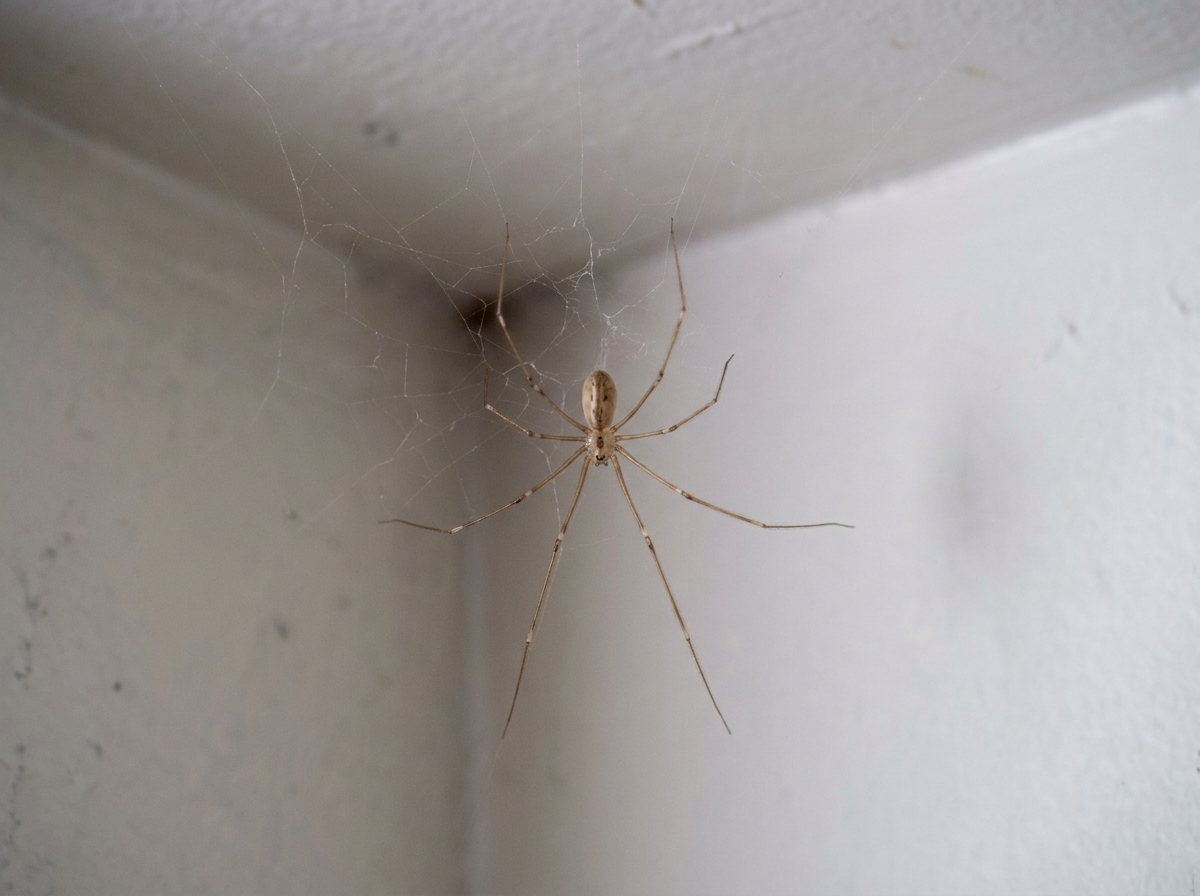
The long-bodied cellar spider, Pholcus phalangioides, carries a small tan or gray body only about a quarter inch long, attached to legs that stretch 2 to 3 inches in every direction. Their bodies stay that small however leggy they look, so a large cellar spider is a spider with a longer leg span rather than a bigger or different species.
That leg-to-body ratio is the fastest way to identify one on sight: no other spider commonly found inside a Plano or Frisco home is built quite this way. Cellar spiders do make webs, and their webs are the other tell. Unlike the tidy spiral of an orb weaver, a cellar spider web is an irregular, three-dimensional tangle strung across a corner or a wall-ceiling joint, and it collects dust fast enough to look older than it is.
People often call any long-legged spider a daddy long legs, but that name properly belongs to harvestmen, a different order of arachnid entirely. A harvestman has one fused body section instead of two, no silk glands, and no venom glands at all, so it cannot build a web and cannot bite. Cellar spiders build webs and harvestmen do not, which is the simplest way to tell the two apart in a garage corner.
What Are the Warning Signs of a Cellar Spider Infestation?
A single web in a garage corner is ordinary in a Collin County home and is not, by itself, an infestation. The warning signs are webs in more than one room, webs rebuilt within days of being cleared, females carrying egg sacs, and more spiders than last season. Repetition across the house is what marks an established population.
| What you see | What it means | Why it is not just one spider |
|---|---|---|
| Webs in more than one room | Garage, laundry room and utility closet all holding webs at once | Spread through the structure, rather than one spider that wandered in and stayed put |
| Webs rebuilt within days | A corner you cleared is spun again inside 7 days | Cellar spiders rebuild fast, so that corner still has its own spider in it and did not attract a new one |
| Females carrying egg sacs | A visible female holding a small round mass in her mouthparts rather than leaving it in the web | She is actively reproducing on site, which is a population rather than a visitor |
| More than last season | A count that is clearly higher year over year in the same rooms | The population is growing, and a growing spider population needs a growing food supply to sit on top of |
One web in a garage corner is ordinary here. Repetition across the house is what makes it an infestation.
People sometimes describe a thick cluster of overlapping webs as a cellar spider nest. Cellar spiders do not build a nest the way ants or wasps do. What is actually there is usually one spider reusing the same web for months, or more than one spider sharing a corner because that corner keeps producing food.
How Do Cellar Spiders Get Into a House?
Cellar spiders come in the same way other small pests do: through gaps that were never sealed rather than through any deliberate effort to get inside. Foundation vents, gaps around utility lines, garage door weather stripping that has gone thin, and weep holes in brick veneer are the usual points of entry in an Allen or McKinney home.
Once inside, a cellar spider does not need much to settle. A dark, undisturbed corner with a wall-ceiling joint to anchor a web from three planes is enough.
Few homes in this part of Texas have a cellar, which is why the name cellar spider is a little misleading here. The spiders that earned the name in colder climates with actual cellars settle for the closest local equivalent: water heater closets, garages, attics, crawl space access panels and any other dim, low-traffic room. That is why so many of the long-legged attic spiders people describe turn out to be cellar spiders. They are not seeking a specific room type, they are seeking stillness and food, and those rooms happen to offer both.
Why Are There So Many Cellar Spiders in My House?
A cellar spider population grows in direct proportion to what it can eat. Cellar spiders prey on small flies, moths, roaches, silverfish and other spiders, including species that are actually harmful, such as brown recluses caught wandering into their webs.
A garage or utility room with a rising cellar spider count is very often a garage or utility room with a rising population of the insects that feed them, whether or not those insects are ever seen directly.
Humidity is the other driver. Cellar spiders and the insects they eat both do better in damp air than dry air, so a leaking hose bib, a condensation line that drips instead of draining, or a laundry room that never quite dries out will support more spiders than a dry one, season after season. Reducing that moisture tends to bring the spider count down without a single web being touched.
Are Cellar Spiders Venomous?
Yes. Cellar spiders are true spiders with venom glands, which they use on the insects they catch. That does not make them a danger to people. Penn State Extension says they are not known to bite people, and the University of California says their fangs are usually too short to pierce skin.
Is a Cellar Spider Bite Dangerous?
No. Nothing about cellar spiders is poisonous, and the word people usually mean is venomous, which is a different thing: poison is swallowed, venom is injected. The claim that cellar spiders are the most venomous spider of all but their fangs are too short to bite through human skin shows up constantly online.
Only the second half holds up. There is no study measuring cellar spider venom as unusually potent. Cellar spiders are true spiders with venom glands, but Penn State Extension says they are not known to bite people and are not a medically important species.
The University of California spider guide gives the reason. It says cellar spiders are only marginally able to bite people, because their fangs are usually too short to pierce skin. The real trouble they cause is messy cobwebs.
 Source:
 The myth likely persists because cellar spiders look fragile and are so often confused with harvestmen, the actual daddy long legs, which have no venom glands and genuinely cannot bite anyone. Once the two are told apart, the whole claim falls apart with them. A cellar spider bite is not a medical event. A heavy cellar spider population is still worth addressing, but the reason is the mess and the insects behind it, not the bite.
How Do You Get Rid of Cellar Spiders?
Regular web removal keeps a light cellar spider presence manageable on its own. A vacuum with an extension wand run through garage and utility room corners every few weeks clears webs, egg sacs and the spiders along with them faster than any spray.
Sealing the gaps that let them in, the same foundation vents and weep holes covered above, closes off new entry over time rather than just resetting the clock on the current population.
Reducing humidity does more than either of those on its own, because it removes the reason cellar spiders and their prey are drawn to that room in the first place. A dehumidifier in a persistently damp laundry room or a fixed leak under a Plano home’s water heater often does more for the spider count than any amount of web clearing.
When to Call for Spider Control
If web removal every few weeks has turned into a standing chore, or cellar spiders keep showing up in living areas rather than staying in the garage and utility spaces, the population feeding them is worth addressing directly. Professional spider control targets the entry points and the prey insects sustaining the webs, which brings the population down more lastingly than clearing webs alone ever will. Call us and we will find what the webs are feeding on.
Spider webs taking over your garage? Same-day spider control in McKinney and the surrounding cities when you call before noon.
We find what the spiders are feeding on, treat the full pest population, and reduce activity at the source.

Ryan has spent more than 16 years in pest control and wildlife management across McKinney and Collin County, from inspecting homes and treating infestations to sealing the entry points pests use to get in. He built Pest Me Off on that field experience, and every technician on the team is trained against it.
More about the Pest Me Off team