
Weevils in Flour and Rice, Where They Come From and What to Throw Out
You open the flour for a batch of cookies and something small and brown is crawling in it. This article covers what the bugs in flour are, where weevils come from, how they get into rice, what to throw out, and how to clear the pantry so they stay gone.
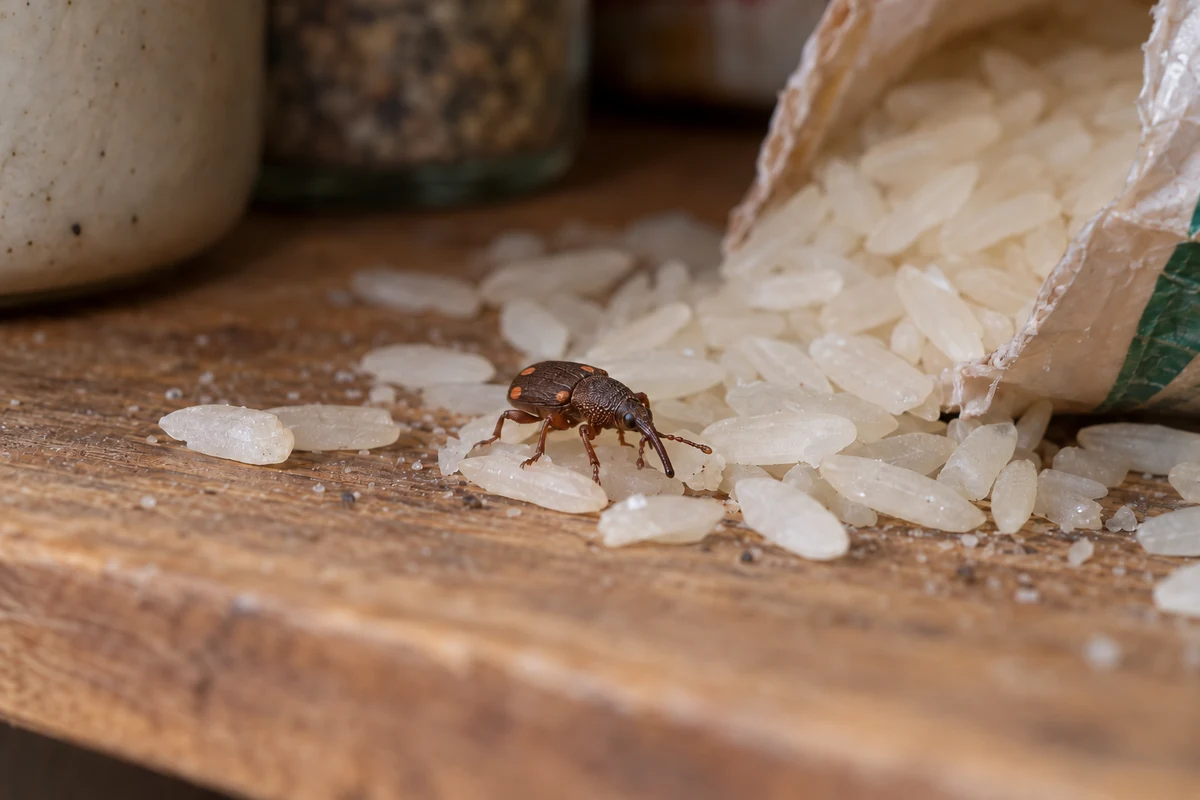

- The small brown bugs in flour are more often grain beetles than true weevils.
- A rice weevil is a snout beetle 1/8 to 1/4 inch long.
- Weevils grow up inside whole kernels of rice, wheat and corn.
- They usually come home inside a package from the store.
- Throwing out the source is the fix. Spraying near food is not recommended.





What are the bugs in my flour called?
The small reddish-brown beetles in flour are more often grain beetles, such as the flour beetles, than true weevils. The University of Kentucky says the red and confused flour beetles feed on processed grains such as flour and meal but cannot attack whole, undamaged grains. True weevils, such as the rice weevil, grow up inside whole kernels.
The University of Kentucky’s guide to pantry pests puts the flour beetles, the sawtoothed grain beetle, the cigarette beetle and the drugstore beetle all at roughly 1/8 inch long and red brown, so they are hard to tell apart by eye. It says the rice weevil is 1/8 to 1/4 inch long, a reddish brown to black snout beetle.
The two flour beetles behave differently. The University of Kentucky says confused flour beetles fly and are drawn to lights, red flour beetles crawl toward light but apparently do not fly, and the flour beetle life cycle takes about 7 weeks. Adult females can live from several months to more than a year.
Flour beetles are not the only thing in a bag of flour. The University of California’s pantry pest notes say the Indian meal moth is the most common moth on food in the home, and its caterpillars leave silk webbing behind wherever they crawl. Webbing in the flour points to the moth, which our article on where pantry moths come from covers.
Where do weevils come from?
They usually come home from the store. The University of California says pantry pests usually enter in an infested package of food. The University of Kentucky says the first source is often a half-used box or bag forgotten at the back of a shelf, and that bird seed and decorative items are the next places to look.
The young stages are so small that an infested package is easy to overlook, the University of California says, and the first sign is often an adult beetle or moth in or near the food. By the time you spot one, it has usually spread to other packages. The University of Kentucky adds a rough rule: the more insects you see, the older the infestation.
They travel, too. The same guide says adult rice weevils may be found some distance from the food they came from, and that pantry beetles often hide beneath cans and other items on the shelf.
How do weevils get in rice?
Rice weevils grow up hidden inside whole kernels, so a bag can look clean when you buy it. The University of Kentucky says the young are legless grubs that develop inside kernels of grain, and that egg to adult takes as little as a month. The University of Maine says one female can lay 300 to 400 eggs.
The University of Maine’s rice weevil fact sheet lists what it eats: wheat, rice, corn and other whole grains, millet, rye, beans and bird seed. The adults are reddish brown to nearly black and usually carry four pale reddish or yellowish spots on their backs.
That is why one forgotten bag can turn into a shelf full. Our rice weevil page in the pest library has the full identification guide.
Is it safe to eat flour with weevils in it?
The University of California says to throw infested food out rather than use it. It says infested food is contaminated with insect hairs, droppings, webbing and secretions, that warehouse beetle hairs can irritate the mouth, throat and digestive tract, and that pantry pests can bring in microbes that rot food.
The risk from microbes is highest when food is stored warm and humid, the University of California says, which is one more reason to keep flour and grains dry and sealed.
What should you throw out if you find weevils?
Throw out anything with live bugs, webbing or tiny holes, then check every other open package. The University of California says to destroy any package with the slightest sign of infestation, because by the time you see pantry pests they have usually spread. Packages still in their original seal are less likely to be infested.
The University of California says to seal up an infested package and take it out of the house right away.
Check the places people forget. The University of Kentucky says cigarette beetles turn up most often in dry dog food and paprika, and drugstore beetles in bread, flour, breakfast foods and spices such as red pepper. Bird seed, pet food and decorative dried corn belong on the list too.
Telling the pantry bugs apart
These come from the University of Kentucky, the University of California and the University of Maine.
| Pantry bug | Size and look | Where you find it |
|---|---|---|
| Rice weevil | 1/8 to 1/4 inch, reddish brown to black, long snout, four pale spots | Inside whole rice, wheat, corn, beans and bird seed |
| Flour beetles | About 1/7 inch, shiny, flat and reddish brown | Flour, meal, dried fruit and dry dog food |
| Sawtoothed grain beetle | About 1/10 inch, slender, flat and brown, six tiny teeth on each side | Cereals, grain products, pet food and bird seed |
| Cigarette beetle | About 1/8 inch, light brown and rounded | Dry dog food and spices such as paprika |
| Indian meal moth | Moth 1/3 to 2/5 inch with coppery wing tips, caterpillars that spin webbing | Cereal, flour, dried fruit, nuts and chocolate |
A long snout means a weevil, and weevils mean whole grain. A beetle with no snout in the flour is a flour, grain, cigarette or drugstore beetle, and the table tells them apart.
How to get rid of weevils in the pantry
- Find the source and get it out. Seal up every infested package and take it out of the house right away, as the University of California advises.
- Check everything else. Look in every open box and bag, under cans, and in the bird seed and pet food. The University of Kentucky says a thorough search the first time beats repeating a hasty one.
- Clean the shelves. Vacuum the upper and lower surfaces of the shelves with a crevice attachment, then wash them with soap and water, the University of Kentucky and the University of California say.
- Freeze or heat what you want to keep. For things like bird feed and decorative corn, the University of Kentucky gives a freezer at 0°F for 4 days, in one that does not defrost itself, or an oven at 155°F for about 20 minutes with the door propped open.
- Store it sealed. The University of California says to use containers with tight-fitting lids, because plastic bags are not enough, to keep little-used flours and grains in the freezer, and never to mix an old batch into a new one.
Skip the spray can. The University of California says insecticides are not recommended for pantry pests, and spraying on or near food may cause more harm than the bugs. It also says some pantry pests can live for many weeks without food, so keep the dry goods sealed or in the freezer for a few months afterward. It suggests sticky traps with a lure, checked weekly, to catch what is left, and says most stay effective for about three months.
How Pest Me Off handles weevils and pantry beetles
On every pantry pest control visit, Pest Me Off confirms the pest first, because a moth, a weevil and a grain beetle hide in different foods. We open and inspect the whole pantry, including sealed bags that look fine from outside, and pull every infested item before any treatment goes down, checking the garage pet food and birdseed too. For rice weevils, we remove the infested rice and grain, then keep everything in airtight containers.
We treat the shelf cracks, corners and crevices, never across food surfaces, and install the Scorched Earth Barrier at the exterior entry points. Pets and kids are back in the kitchen in 1 to 2 hours, once the treatment dries. The inspection and estimate are free, with same-day service when you call before noon, in McKinney, Plano, Frisco, Allen and across Collin County.
Bugs in the flour again? Pantry pest control across Collin County.
We confirm the pest, find every infested package and treat the shelf cracks, never your food. Free inspection and estimate.
