
Skunk Under the House? The Smell, the Season and Getting It Out
A musky smell rising through the floor, a fresh hole by the porch and a dog that comes in reeking usually mean a striped skunk has moved in under the house or deck. This article covers how dangerous skunks are, why the house smells like skunk, how to get the smell off a dog, and how to get a skunk out without it coming back.
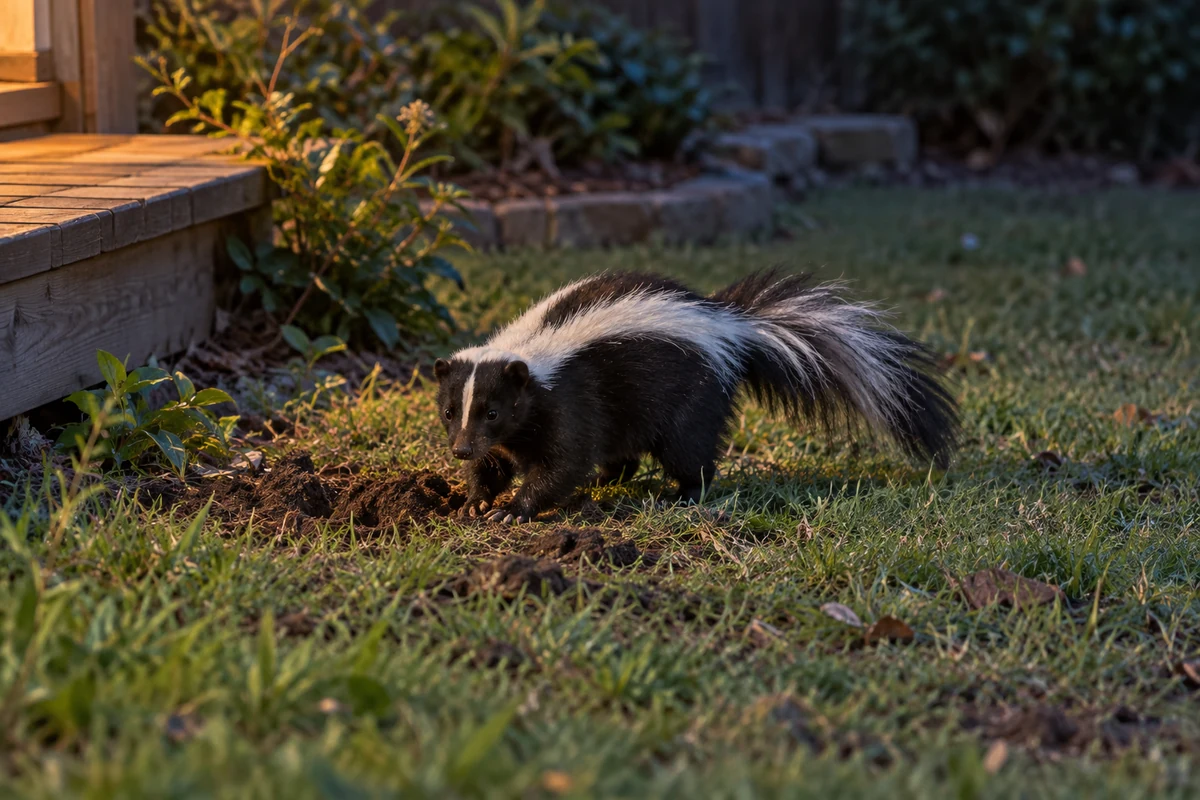

- Skunks were 136 of the 412 rabid animals found in Texas in 2024.
- A skunk can spray several times, with aim to about 10 feet.
- It warns first by stamping its front feet and arching its tail.
- Most Texas skunks are born in early May, about five to a litter.
- Skunks come out late in the day and are back in the den by morning.





Are skunks dangerous?
Yes, skunks can be dangerous, mainly because of rabies and their spray, though they prefer to be left alone. The Texas Department of State Health Services confirmed rabies in 136 skunks in 2024, a third of all rabid animals found in the state. A skunk defends itself only when cornered or harmed, the Internet Center for Wildlife Damage Management says.
The state’s 2024 report on rabies in animals says skunks had the second highest number of cases after bats, and that 31% of the skunks tested were positive. Texas law lists skunks among the high-risk animals for rabies, with bats, foxes, raccoons and coyotes. The report says rabies spreads mainly through a bite, less often a scratch, and is nearly always fatal unless treatment after exposure is given urgently. If a skunk bites or scratches anyone, get medical advice the same day.

The spray is the other risk. Texas A&M AgriLife Extension’s guide to skunk damage says a skunk can spray several times, with accuracy to about 10 feet. The wildlife damage center’s skunk damage page says it usually warns first by stamping its front feet and arching its tail over its back, and that anyone who sees that should back away quietly and slowly. The spray is not known to carry rabies, the page says, but some people get asthma-like symptoms from the smell and should leave the area.
The center’s skunk page lists four skunks in North America. The striped skunk is the most common and lives across the US, the hog-nosed skunk lives in the southern half of Texas and the hooded skunk only in west Texas, so the skunk under a Collin County deck is most likely a striped skunk.
Why does my house smell like skunk?
A skunk smell in the house often means a skunk is denning underneath it or has sprayed close by, though the smell alone does not prove it. The Internet Center for Wildlife Damage Management says the musk soaks into carpets, cloth furniture and clothing and can reach rooms several floors away.
Skunks look for a dry, hidden spot. The wildlife damage center’s skunk biology page says they prefer to den under decks, porches and other secluded areas with good drainage. Texas Tech’s Mammals of Texas calls them notorious for denning under houses, barns and abandoned buildings, and says they move into old armadillo burrows.
The smell is not always a skunk under the floor. The center’s skunk page says the musk can be smelled up to a mile away, that opossums give off a skunk-like smell of their own, and that a dog or cat sprayed outside can make owners think a skunk is in the house. Look for a fresh hole at the edge of the slab, porch or deck before deciding. A smell that lasts for days and grows stronger usually means a skunk has died and its musk gland has broken open, the same page says, so the source has to be found.
How do you get rid of a skunk under the house?
To get rid of a skunk under the house, find out when it leaves, then close the opening behind it. Texas A&M AgriLife Extension says to sprinkle flour at the entrance and check for tracks after dark. In spring and early summer, assume young are still inside, and seal the openings only once the whole family has gone.
Timing matters most in spring. Texas Tech says most Texas skunks are born in early May, three to nine in a litter, about five on average. The young open their eyes and can make musk at about 30 days, are weaned at 8 to 10 weeks and then follow their mother out to feed. Close the hole while young are inside and they are trapped under the house. Once every skunk is out, AgriLife says to close all the entrances with sheet metal or hardware cloth so they cannot get back in.
The wildlife damage center’s control page describes a one-way door at least 4 by 4 inches over the entrance, so a skunk can leave and not get back. It also says no frightening devices work on skunks and no repellents are registered for them, so store-bought repellents and scare devices are not the answer.
Moving a trapped skunk is regulated in Texas. Texas Parks and Wildlife’s rules on nuisance fur-bearing animals allow one to be relocated only with the department’s authorization and the permission of the owner of the land where it is let go, and the person has to send the department a monthly report.
How do you get skunk smell off a dog?
To get skunk smell off a dog, wash it with a mix of hydrogen peroxide, baking soda and dish soap. Penn State Extension gives 1 quart of fresh 3% hydrogen peroxide, 1/4 cup of baking soda and 1 to 2 teaspoons of liquid dish soap. Mix it in an open container and use it at once.
The Penn State Extension answer says to wash the dog, leave the mix on for 5 minutes before rinsing, and that it may take more than one wash. The wildlife damage center adds a few cautions. Do not touch a sprayed pet with bare hands, keep it outdoors and wash it before anyone handles it. Have the skunk tested for rabies if you can, ask your vet about the dog, and ask the local health department whether anyone in the family needs rabies shots. The state health department’s rabies report notes that Texas law requires dogs and cats to be vaccinated against rabies.
How do you get rid of skunk smell in the house?
To get rid of skunk smell in the house, first find and remove the skunk, then treat what holds the smell. Texas A&M AgriLife Extension says a commercial deodorizer can neutralize skunk odor under buildings, that vinegar, tomato juice or a weak household ammonia solution can help on clothing, and that lime deodorizes the soil.
The smell will keep coming back while a skunk is still living or sprayed under the floor, so the den comes first. The wildlife damage center says the musk soaks into cloth furniture, clothing and carpets, so those are what to wash or air out. For a dog that brought the smell in, the Penn State mix in the section above is the one to use.
Are skunks nocturnal?
Yes, skunks are mostly nocturnal. Texas Tech’s Mammals of Texas says striped skunks head out late in the day and return to their dens early in the morning, usually staying within 1 to 2 miles of the den. The Internet Center for Wildlife Damage Management warns that a skunk out in daylight, or acting abnormally, may be rabid.
Skunks do not truly hibernate. Texas Tech says they store fat and may stay in the den for short spells in cold weather, and reports winter groups of as many as 7 to 10 skunks in a good den. A quiet week in January does not mean the space under the deck is empty.
A skunk walking straight at people or pets without fear should be kept away from everyone. The wildlife damage center says to report a skunk behaving abnormally to local animal control.
The skunk’s year in Texas
These come from Texas Tech University’s Mammals of Texas and the Internet Center for Wildlife Damage Management.
| When | What skunks are doing | What it means at home |
|---|---|---|
| Late February to March | Females come into heat and mating begins | Males roam up to 4 to 5 miles a night, and spraying is more common |
| Early May | Most young are born, about five to a litter | A den under the deck may hold a family |
| June and July | Young are weaned at 8 to 10 weeks | The family follows the mother out to feed at night |
| Late summer and fall | Families split up | Young skunks look for dens of their own |
| Winter | Short spells in the den, sometimes shared | A quiet den is not always an empty one |
From spring into summer a den may hold young, so check before closing anything.
How to keep skunks out from under the house
- Take away the food. AgriLife says to bring pet food and water bowls in at night and keep lids on trash cans. The wildlife damage center adds that skunks follow rodents into crawl spaces, sheds and garages, so dealing with mice helps.
- Clear the cover. The center says to remove garbage, debris and lumber piles, because skunks like cover and cluttered spots to hunt in.
- Make sure the den is empty. Sprinkle flour at the hole and check for tracks after dark, as AgriLife suggests. From spring into summer, assume young may be inside.
- Seal the low openings. The center says to cover foundation openings with wire mesh, sheet metal or concrete, and where skunks can dig, to bury 1/2 inch mesh 2 inches deep and run it at least 12 inches out from the deck or shed.
- Cover window wells. The center says any pit deeper than 3 inches should be covered so young skunks cannot fall in and get trapped.
How Pest Me Off handles skunks
For skunks, Pest Me Off’s wildlife removal means a careful trap and remove with the right approach, then the den entrance gets sealed. Every job starts with an inspection to find the animal, the entry points and any nest or young. Removal is the humane way, with live traps or one-way doors sized to the species, checked every day and handled within Texas wildlife rules. When there are young, we make sure the whole family comes out. We never use poisons on wildlife.
We clear nesting and droppings from the access area, then seal the den and the other low openings through our rodent proofing and exclusion service, so the next skunk cannot move into the same spot. Homes backing the greenbelts and creeks see more skunks working the yard and deck line. The wildlife inspection is free, and the job is quoted after it. Same-day service when you call before noon, in McKinney and the surrounding cities.
A skunk under the deck or the house? Wildlife removal across Collin County.
We find the den and check for young, get the skunks out the humane way, clear the access area, and seal the low openings so the next one cannot move in. Free wildlife inspection.
