
Where Do Pantry Moths Come From? How to Clear Them From a Collin County Kitchen
Small moths fluttering around the kitchen at night, or pale caterpillars crawling across the ceiling, mean pantry moths. They usually ride in on a package of food, and spraying the cabinets will not stop them. This article covers where pantry moths come from, whether they are harmful, what draws them, and how to clear them from a Collin County kitchen for good.
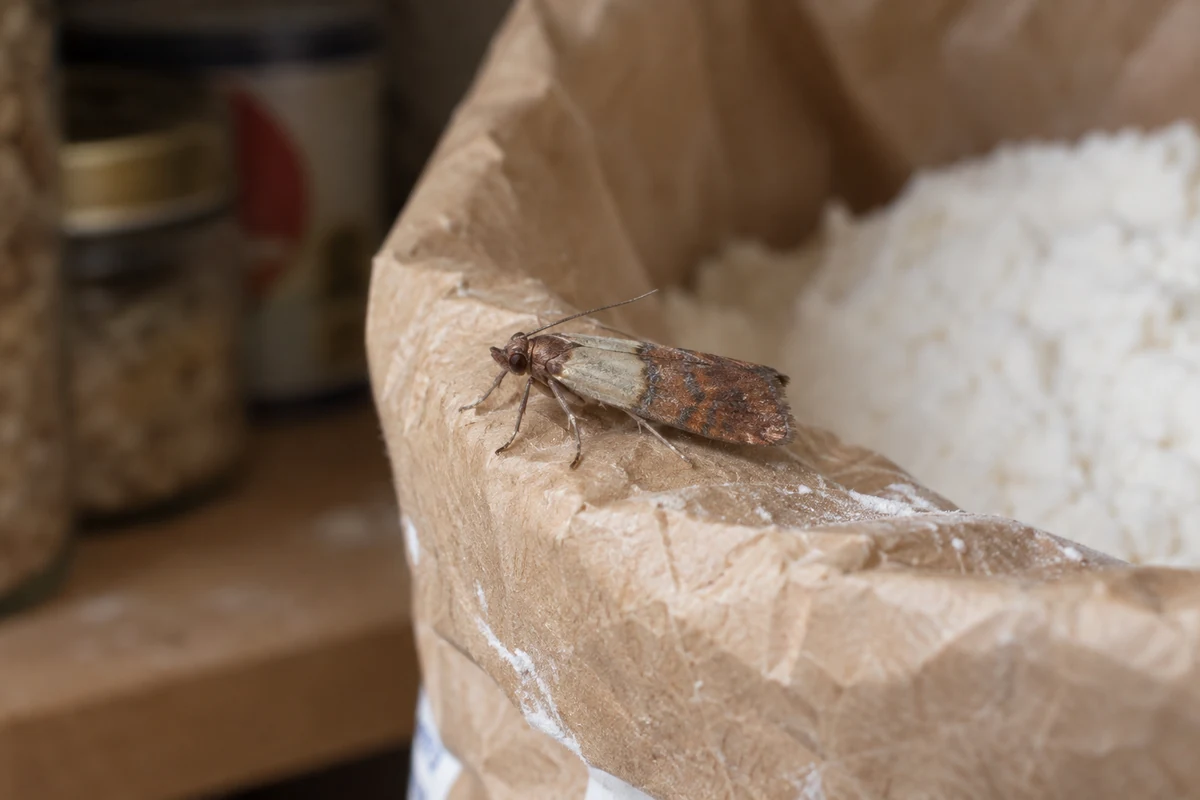

- Pantry moths usually come home inside a package of food that was already infested.
- Only the caterpillars eat stored food. The adult moths do not.
- The caterpillars are not poisonous and do no harm if eaten by accident.
- Full-grown caterpillars leave the food and turn up on walls and ceilings.
- Spraying does not fix it. The infested food has to be found and thrown out.





Where do pantry moths come from?
Pantry moths usually come into the house inside a package of food that was already infested, the University of California says. The University of Kentucky adds that an infestation often starts in a partly used box or bag forgotten at the back of a pantry, then spreads as the moths look for new food.
The Texas A&M AgriLife Extension sheet on stored food pests says they are often carried home from a store or warehouse, and others start in the house when food sits on a shelf for a long time. The usual culprit is the Indian meal moth. The University of California calls it the most common moth found on food in the home, and Texas A&M says it is one of the most common indoor pests brought to county Extension offices.
It is a small moth whose wings are two-toned, pale near the body and copper toward the tips. Our Indian meal moth page in the pest library has close-up photos of the moth and the caterpillar.
Are pantry moths harmful?
Pantry moths and their caterpillars are not dangerous to people, but the food they get into is spoiled and has to go. Virginia Tech says the caterpillars are not poisonous and will not cause harm if eaten by accident. Infested food can carry insect hairs, droppings and webbing, the University of California says.
California adds that infested food can also hold their secretions, and that pantry pests can bring in microbes that rot food.
All of the damage is done by the caterpillars, the University of California page on pantry pests explains, because the adult moths do not eat stored food. Kentucky’s sheet puts it plainly: the adult moths are the sign of an infestation, and merely killing them is not the solution.
Birds are not at risk either. Virginia Tech’s sheet on the Indian meal moth even says infested birdseed can still go out to the birds, since they eat the caterpillars along with the seed.
What attracts pantry moths?
Pantry moths are drawn to dry stored food, especially food that sits a long time without being opened or checked. Clemson University says household infestations are often traced to birdseed and dry pet food, because both are usually kept in large amounts in unattended spots.
The University of Kentucky says Indian meal moths prefer coarse flours and cornmeal, and also feed in dried fruit, powdered milk, chocolate and bird seed.
The list of foods is long. Texas A&M adds nuts and grain products, and the University of California names cereal, rice and candy. A bag of dog food in the garage or a sack of birdseed on a shelf can feed the caterpillars for a long time before anyone opens it. The Clemson University fact sheet on the Indian meal moth says a single female lays 200 to 300 eggs, and that the caterpillars can chew through packaging and even plastic film.
Clemson’s advice is to buy only sealed packages with no sign of damage, and only as much as you will use in 2 to 4 months.
Why are there pantry moth larvae on the ceiling?
Pantry moth larvae on the ceiling are full-grown caterpillars looking for a place to spin a cocoon and turn into moths. Texas A&M AgriLife Extension says that when they are fully grown they often wander off and turn up on ceilings, walls and countertops.
Virginia Tech says it is not uncommon to find full-grown caterpillars on ceilings, and the cocoons they spin there, after they travel up the walls.
They are about half an inch long and white with a greenish or pinkish tinge, according to the University of California, which adds that in a heavy infestation they can turn up far from the food because they travel quite a distance. The University of Kentucky says caterpillars crawling up walls or across the ceiling are usually the first sign anyone notices.
That is why the search for the source covers the whole kitchen and the garage, not only the cabinet under the spot on the ceiling.
Pantry moth or clothes moth, told apart
Both are small moths that live indoors, and they need different fixes. These details come from Texas A&M AgriLife Extension, the University of California and the University of Kentucky.
| Feature | Pantry moth | Clothes moth |
|---|---|---|
| Size | About 1/3 to 2/5 inch long, wings spread about 3/5 inch | Smaller, wings spread about 1/2 inch |
| Color | Pale gray near the body, coppery brown toward the wing tips | Shiny golden scales and a tuft of reddish-golden hair on the head |
| Where you see them | The kitchen and food storage, mostly at night but sometimes by day | Closets and rooms with wool, fur or leather, and rarely seen, since they avoid light |
| What the caterpillars eat | Grain products, dried fruit, nuts, chocolate, powdered milk, birdseed and dog food | Wool, carpet, fur, pet hair, piano felts and natural hair brushes |
Moths flying around the kitchen point to food. Small golden moths you almost never see, and holes in a wool sweater, point to the closet.

Clothes moths have their own page in our pest library. If the moths are in the closet and not the kitchen, that is the page to read.
How to get rid of pantry moths
- Find the source. Texas A&M says pantry moths are controlled by first finding and getting rid of the infested food. Check every opened package, the University of California says, plus birdseed and decorative items such as dried flowers or Indian corn, which the University of Kentucky names as places to look, and the pet food Clemson says infestations are often traced to. Webbing inside a package or tiny holes in it are signs, the University of California says.
- Throw out what is infested. The University of California says to throw away any food that shows signs of them, and the University of Kentucky calls disposal the best way to end the problem. For birdseed or decorative items you want to keep, Kentucky suggests a non-self-defrosting freezer at 0°F for 4 days, or an oven at 155°F for about 20 minutes with the door propped open.
- Vacuum the shelves, both top and bottom, and use the crevice tool on cracks, as Kentucky’s entomologists advise. They say one thorough job beats repeating a hasty one.
- Store food sealed. California’s advice is to keep dry food and pet food in containers with tight-fitting lids, not plastic bags, to keep rarely used flour, spices and grains in the freezer, and never to mix old food with new.
- Do not spray the food or the shelves it sits on, and watch with traps. The University of California does not recommend insecticides for pantry pests, since spraying on or near food may do more harm than the moths, and says to keep traps labeled for pantry pests out after the source is gone, because pantry pests can live for weeks without food. Call a professional when moths keep appearing after the cleanup.
How Pest Me Off handles pantry moths
Pest Me Off’s pantry moth control starts with a package-by-package inspection of the pantry, and of the garage when pet food or birdseed is kept there, to find the bag the moths came from. The technician removes what is infested, treats the shelf cracks of the emptied pantry, never the food or the surfaces food sits on, and leaves traps so you can see the moths are gone.
Same-day service is available for McKinney and the surrounding cities when you call before noon, with no-contract options. Beetles in the flour instead of moths are covered on our pantry pest control page.
Moths in the pantry or caterpillars on the ceiling? Same-day pest control in McKinney and the surrounding cities when you call before noon.
We find the package the moths came from, remove what is infested, treat the emptied shelves without spraying your food, and leave traps so you can see they are gone. No-contract options.
