
Why DIY Rodent Control Methods Don’t Work
DIY rodent control usually fails for one reason. Traps, store-bought bait and repellers go after the mice or rats you can reach, but the gaps they came in through stay open, and new ones keep arriving. In Pest Me Off’s rodent work across McKinney, Plano, Frisco and Allen, trapping is only half the job, and closing those gaps is the other half. Here is where each common method falls short, with the sources.
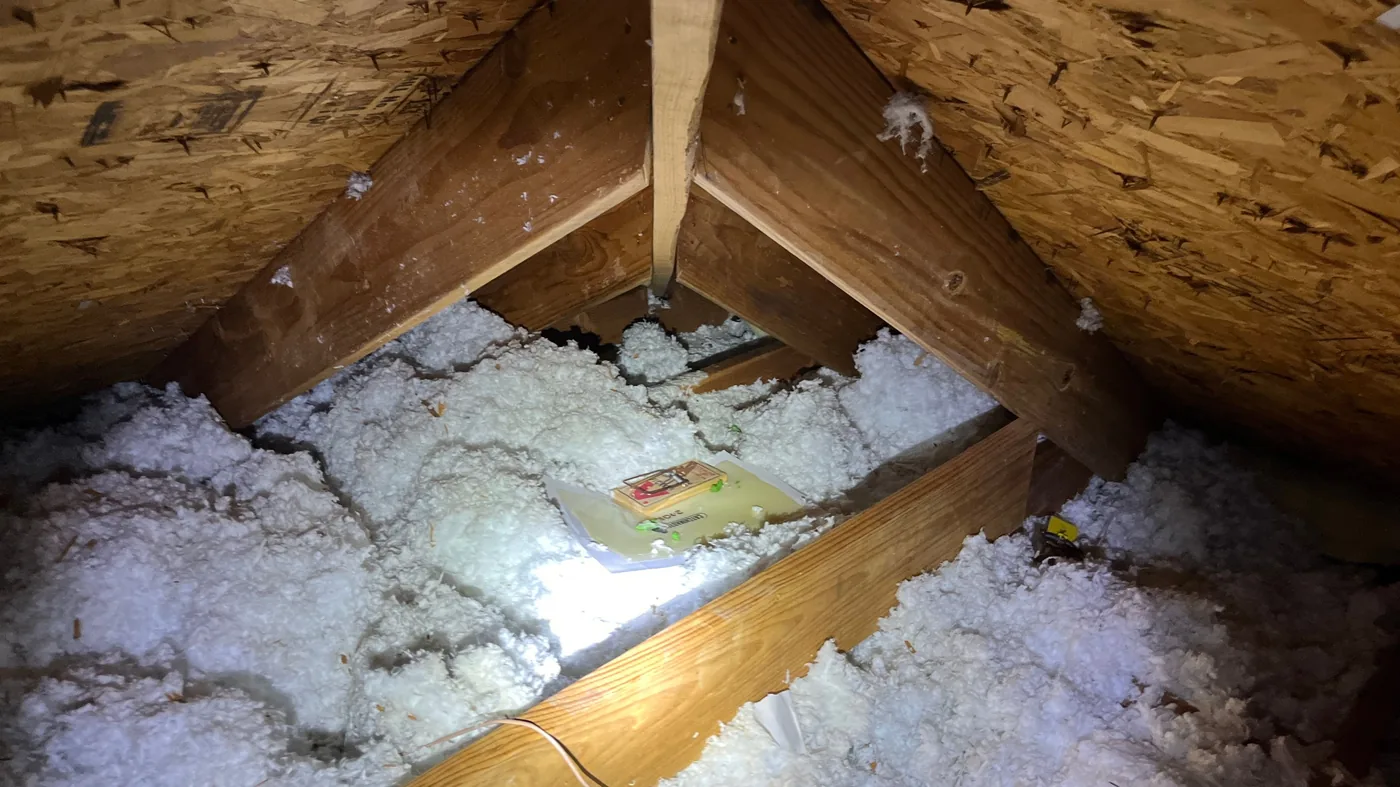

- A female house mouse can have 5 to 10 litters a year of about 5 or 6 pups each, the University of California says.
- Norway rats tend to avoid new objects, and they often leave new traps and bait stations alone for days.
- Rodent poison sold in stores now comes only as ready-to-use bait stations, and the strongest baits are sold to professionals only, the EPA says.
- Ultrasonic sound does not reach behind objects, and rodents quickly get used to repeated sounds.
- A house mouse can get through an opening as small as 1/4 inch, and young rats can squeeze under a door with a 1/2-inch gap.





Do snap traps work on a mouse or rat infestation?
Snap traps do catch mice and rats, and the University of California calls them a great first step when enough traps sit near rodent activity. The problem is scale. One trap takes one rodent, while a female house mouse can have 5 to 10 litters a year, so a short row of traps rarely keeps up.
The University of California guide to the house mouse says to use enough traps to make the trapping short and decisive. A house mouse seldom goes more than 30 feet from its nest and food, so it advises spacing traps no more than about 10 feet apart where mice are active. Rats breed fast too. A female Norway rat has 3 to 6 litters a year of 6 to 12 young each, the Internet Center for Wildlife Damage Management says.
Placement decides most of the result. The University of Kentucky guide to controlling mice says to set traps up against walls, behind objects and where droppings and gnawing show up, with the trigger end against the wall. It also says traps are generally preferred over rodent poison when only a small number of mice are present, and that traps and glue boards should be checked daily.

Why do mice and rats avoid traps?
Norway rats tend to avoid new objects, the Internet Center for Wildlife Damage Management says. They often leave traps and bait stations alone for days, and roof rats have a strong tendency to do the same. A trap out in the open gets ignored, and one that snaps and misses can leave a rat trap-shy.
The University of California says it can take days to weeks before rats enter and feed at a new bait station, and that roof rats may skip bait stations even when they sit on an established runway. Its advice is to leave traps baited but unset until the bait has been taken several times, so the rats lose their fear of the trap before it can go off.
Trap design matters as well. In research the wildlife center cites, snap traps with an expanded trigger caught almost twice as many rats as the narrow trigger kind. For mice, the University of California says the best bait is often the food they are already eating, and that too much bait lets a mouse take it without setting the trap off.
Is rat poison dangerous to pets and kids?
Yes, it can be. The University of California says all rodenticides are toxic to pets, people and other animals, and that most pet deaths involve dogs eating the bait itself. A pet can also be poisoned by eating a poisoned rodent. The EPA says to place traps and baits only where children and pets cannot reach them.
The EPA’s rules for rodenticide products changed what a store can sell. Rodent poison for homeowners now comes only as ready-to-use bait stations holding block or paste bait. The second-generation anticoagulants, such as brodifacoum and bromadiolone, are no longer registered for consumer products, because they put animals that eat the bait, or eat a poisoned rodent, at greater risk.
A poisoned rodent does not always leave the house first. The University of California guide to rats says to close entry points before baiting outside, so poisoned rats do not come inside to die, and its house mouse guide notes that trapping avoids the odor of mice dying inside the walls. The EPA’s advice on rodent bait products says to remove and dispose of dead rodents promptly so pets and wildlife do not eat them.
Do peppermint oil or ultrasonic repellers keep rodents away?
Not for long. The University of California says rats have an initial aversion to some odors, but no repellent has been found to solve a rat problem for more than a very short time. It also says rodents quickly get used to repeated sounds, and ultrasonic sound does not reach behind the objects where they hide.
The Internet Center for Wildlife Damage Management’s guide to Norway rat control says tests of ultrasonic devices found rodents may leave the immediate area for days, and that the devices are not recommended as a solution to an infestation. It calls chemical repellents seldom practical for rats.
Mothballs are a different problem. The National Pesticide Information Center says mothballs are insecticides, not wildlife repellents, and that used out in the open they can be harmful to people, pets or wildlife that touch them, eat them or breathe the vapors.
Every common DIY rodent method, side by side
Each method below does something. None of them closes the gaps a rodent used to get in, which is why the same problem keeps coming back.
| DIY method | What it does | Where it falls short |
|---|---|---|
| Snap traps | Catches 1 rodent per set, placed along walls | Falls behind a breeding population, and rats may avoid a new trap for days |
| Store-bought bait stations | Ready-to-use stations with block or paste bait | A poisoned rodent can die in a wall, and a pet can be poisoned by eating one |
| Glue boards | Holds a mouse that crosses it | A caught rodent may not die quickly and still has to be dealt with |
| Peppermint oil | Puts a strong scent near the problem | No repellent has solved a rat problem for more than a very short time |
| Ultrasonic repellers | Plays a sound above human hearing | Does not reach behind objects, and rodents get used to repeated sound |
| Mothballs | Gives off an insecticide vapor | Not a wildlife repellent, and harmful to people and pets out in the open |
None of these methods closes the gaps rodents use to get in.
Why does trapping fail if you do not seal entry points?
Because the way in stays open. The EPA notes that rodents released outside may find their way back unless the entry points are sealed. The Internet Center for Wildlife Damage Management lists a control area small enough for rats to move in from next door as one reason control fails, and says exclusion lasts where traps and bait do not.
Rats and mice move in from wherever the pressure comes from: a greenbelt, an alley, a neighbor’s yard. The EPA’s page on options for rodent infestations makes the same point about live traps. Sealing up comes in 3 steps:
- Walk the whole outside of the house: the foundation, the roofline, vents, garage door seals and every spot where pipes and wires go through a wall. A roof rat climbs, so its way in is often up at the roofline, and our article on how roof rats enter your home covers the usual spots.
- Seal every opening with something rodents cannot gnaw through. The wildlife center names concrete mortar, 24-gauge galvanized sheet metal and 18-gauge hardware cloth, and the University of California adds steel wool and wire screen.
- Take away the food. Store pet food and bulk food in rodent-proof containers, and outdoors, feed pets only what they eat at one meal or bring the bowl in at night, as the University of California advises.
How small a gap can a mouse or rat get through?
A house mouse can get through an opening as small as 1/4 inch, the University of California says, and young rats can squeeze under a door with only a 1/2-inch gap. The University of Kentucky puts it as narrower than a dime. So the University of California advises sealing every hole larger than 1/4 inch.
The University of Kentucky says foundation cracks 1/4 inch and larger should be sealed, along with gaps under doors and where utility pipes enter the house. For roof rats, the wildlife center’s roof rat guide says to check the roof and roofline closely and seal openings over 1/2 inch with concrete mortar, steel wool or metal flashing. The University of California also says to screen the tops of rooftop plumbing vent pipes more than 2 inches across.
How Pest Me Off handles a rodent problem
If you are weighing a DIY kit against a pest control company for rodents, the question to ask is who finds and closes the gaps. On our rodent control service, a licensed Pest Me Off technician, never a subcontractor, confirms the species first, because the plan changes with it. In Collin County homes, roof rats work the attic, Norway rats burrow at ground level and house mice settle in behind the kitchen wall.
The inspection maps the runways and every entry point, and traps go on the routes the rodents already travel, never out in open floor space. Locked, tamper-resistant bait stations go outside at the foundation corners and along travel routes, placed where pets and kids cannot reach them. You get a written map of every gap we find, and when our technician decides a follow-up is needed, they come back to collect traps and check the activity. Call us to book a free inspection.
Done with DIY rodent control? Same-day pest control in McKinney and the surrounding cities when you call before noon.
A licensed Pest Me Off technician confirms which rodent you have, traps the routes it runs and maps every gap it used to get in. Free estimate. No-contract options.