
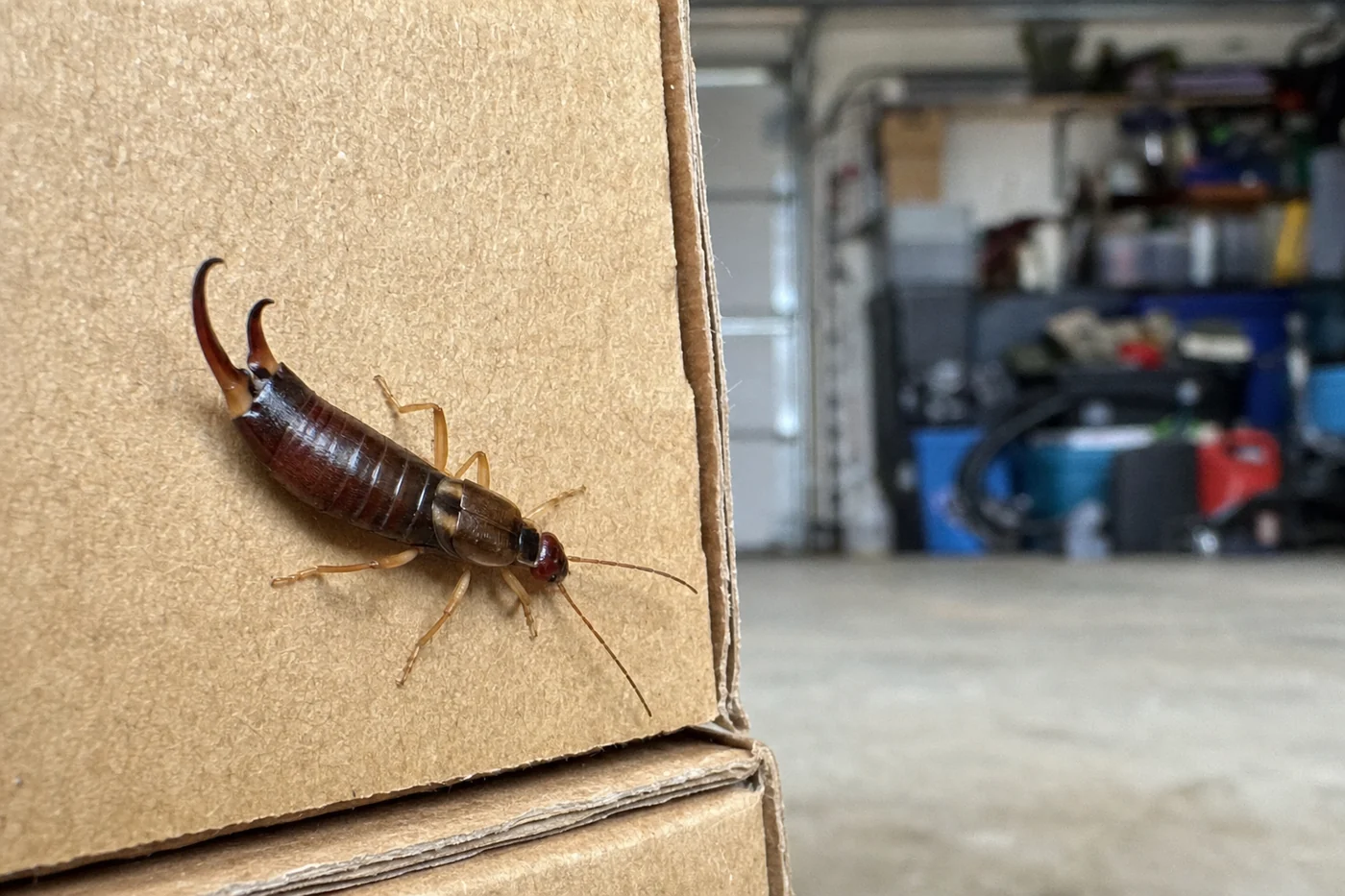
Pincher Bugs and Earwig Myths McKinney Homeowners Get Wrong
Pincher bugs, which are properly called earwigs, have no interest in your ear, cannot sting you, and are not a sign that your house is dirty. Those three ideas send McKinney homeowners one of two ways: panic at the sight of one, or ignore the damp problem that brought it inside. The pincers are real. Almost everything else people believe about them is not.

- The name is a leftover from an old European superstition, not a description of what they do.
- The rear pincers can nip, but they carry no venom and rarely break skin.
- They are not colony insects at all, so earwigs indoors are never the start of a nest.
- They feed at night and spend daylight packed under mulch, stones, boards and leaf litter.
- Indoor sightings spike in drought, when they follow moisture in, and after heavy rain floods them out.





Earwig identification and habits
An earwig is a flattened brown to black insect with a pair of curved pincers at the tail end. Those pincers, called cerci, are what earn it the local nickname pincher bug. Texas A&M AgriLife Extension counts about 10 species in Texas, only a few of them common, and adults can reach an inch long. A common one here is the ring-legged earwig, which LSU AgCenter names for the two dark bands on each of its light brown legs.
 Source:
- What the pincers are for. Defense, gripping prey and courtship. On the winged species they also fold the hind wings away, though the ring-legged earwig has no wings at all. None of it is for attacking people.
- What they eat. Decaying leaves and plant matter, plus soft-bodied insects such as aphids. That makes them useful against aphids, but they also chew seedlings, flower petals and soft fruit, so they are not purely a friend of the garden. The University of California guide to earwigs says the same, calling them both a seedling pest and a predator of aphids.
- Where they sit all day. Anywhere dark and damp: under mulch, flower pots, stones, firewood, and the boards along a fence line.
One habit sets them apart from almost every other insect in your yard. The female stays with her eggs, cleans them, and guards the young after they hatch. Maternal care of that kind is rare enough that entomologists single earwigs out for it.
Do earwigs crawl into your ears while you sleep?
No. This is the myth the insect is named after, and there is nothing behind it. The name traces back to a medieval European belief, not to observed behavior, and it survived because it is memorable rather than because it is true. Earwigs want damp, tight, dark spaces at ground level.
A bed is dry, warm and nowhere near the mulch line, so it is one of the least likely places in your house to find one.
Are earwigs dangerous, and do they bite?
No, and strictly speaking they do not bite. An earwig has no stinger and no venom, and its mouth is not what you need to worry about. What it can do is nip with the rear pincers if you pick it up or trap it against your skin.
You will feel that, but it very rarely breaks the skin, and washing the spot is the whole of the treatment. They are not a danger to children or pets, they do not damage the building, and they do not get into stored food. Are earwigs aggressive? No. They run from light and only use the pincers when they are handled or pinned.
Do earwigs infest homes?
Not in the way roaches or ants do. An earwig indoors is an accident, not a colony. They need damp air, and air-conditioned rooms are too dry for them, so the ones that reach your living room rarely last long. Damp rooms are the exception: a bathroom, a laundry room or an uncooled garage will hold them far longer.
Finding more than one at once does not mean they are breeding in your walls. It means they came in from the same spot outside, usually a mulch bed or a damp slab edge near the door they used.
Are earwigs a sign of a dirty home?
No, and this is the myth that causes the most unnecessary embarrassment. Earwigs are drawn to moisture, not to mess. The tidiest house in Allen will still get them. All it takes is irrigation running against the foundation, mulch piled deep and damp along the wall, or gutters dumping water beside the slab.
What they are really telling you is that there is a moisture problem outside the wall, and that is worth fixing whether or not the earwigs came back.
What to do about the earwig you just found
Pick it up with a paper towel rather than crushing it, because a crushed earwig leaves a foul smell on the surface. Then deal with how it got in. A slab-on-grade house in McKinney only gives them a short list of ways through.
- The door sweep. A worn or missing sweep under an exterior or garage door is the most common route by a wide margin.
- Weep holes. The small gaps along the bottom course of brick. They are meant to be open, so screen them rather than seal them shut.
- Plumbing penetrations. The gap where pipes rise through the slab under a bathroom vanity or kitchen sink.
- The tub access panel. Often an unsealed opening straight into the wall cavity behind the bath.
One more thing worth knowing: outdoor lights draw earwigs, and the University of California advises swapping white outdoor bulbs for yellow ones, which attract fewer of them. A porch light beside the front door collects them right at the threshold. Switching that fixture off, moving it, or changing to a yellow bulb takes away the reason they were gathered at the door to begin with.
Is DIY Earwig Control Enough, or Should You Hire Help?
DIY works for a few earwigs if you dry out their hiding spots and trap them every day. The University of California advises trapping daily until they are gone and says indoor pesticides are not recommended. When they keep coming back, our licensed applicators treat the mulch and perimeter and seal the weep holes and door thresholds they use.
How Pest Me Off treats earwigs in McKinney
Spraying the ones you find inside solves nothing, because the population lives outside and the indoor ones were already dying. Pest Me Off’s earwig control treats where they actually live instead: the mulch beds, the ground cover, the damp strip along the slab, and the fence lines where they spend daylight. A residual perimeter barrier then stops the nightly march toward the house.
The lasting fix is drying the edge of the building out. Pulling mulch back a few inches from the foundation, fixing sprinkler heads that soak the wall, and clearing gutters removes the conditions rather than the insects. Call us and our technicians point out the specific spots on your property during the visit.
Earwigs share that damp-loving habit with silverfish and springtails, so the same work usually reduces them at the same time. Quarterly general pest control keeps that perimeter in check year round, with no-contract options. For same-day service when you call before noon, see pest control in McKinney.

Earwigs turning up in your bathroom or garage? Same-day pest control in McKinney and the surrounding cities when you call before noon.
We treat the damp ground cover outside where earwigs actually live, then set a perimeter barrier so they stop reaching the house. Call for a free estimate. No-contract options.