
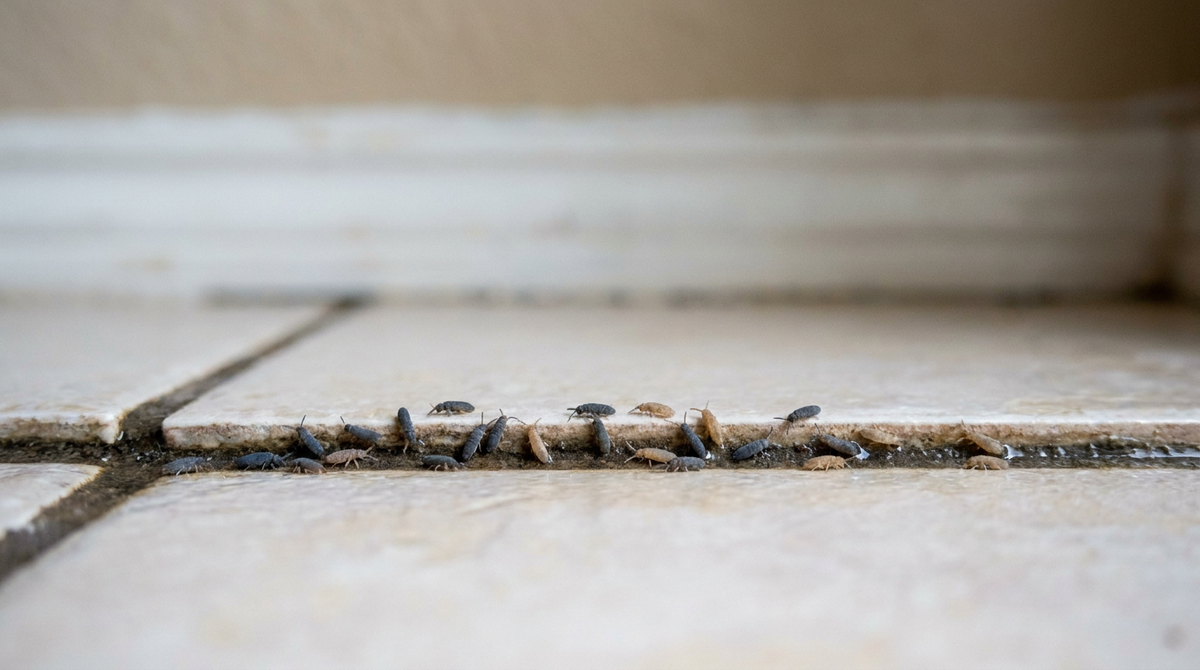
Springtails in Texas Homes and Why They Jump
Springtails in Texas homes are tiny gray, tan or brown insects that jump when disturbed, and they turn up by the hundreds in bathrooms and kitchens with no warning. That combination leads to two mistaken assumptions: that they are fleas, and that spraying alone will clear them out. Neither holds up, and believing either one wastes time. The same insects show up in McKinney, Allen and the rest of Collin County, and the fix is the same everywhere.

- Springtails need constant moisture. Damp mulch, a slow leak or a steamy bathroom draws them in, not food left out.
- They cannot bite, sting or spread disease. What looks alarming in a bathtub is harmless to people and pets.
- Adults run about 1 to 2 millimeters, close to the size of a printed period, which is why clusters are what people notice.
- Spraying kills what is present but does nothing about the moisture drawing in the next batch, so the same spot fills back up.
- Fixing the moisture source, not the insecticide, is what actually keeps a Texas home from restocking.





Are Springtails the Same as Fleas?
No, and the two are easy to tell apart once you know what to look for. Springtails measure 1 to 2 millimeters, close to the size of a period at the end of this sentence, and they run gray, tan or brown to nearly black depending on the species.
Fleas are reddish brown, slightly larger, and flattened from side to side, while a springtail’s body stays elongated or rounded when you look closely.
The jump itself is the giveaway. A springtail carries a forked structure called a furcula folded under its abdomen, held in place by a small clasp and released like a spring the moment the insect is disturbed. That single motion can throw it roughly 100 times its own body length, in whatever direction it happens to be facing. A flea jumps with its hind legs, aimed at a host, and lands with intent. A springtail’s jump looks more like a hop than a controlled leap, and it scatters rather than aims.
The difference that matters most is what happens after they land. Fleas feed on blood and live on animals. Springtails have no interest in mammals at all. They do not land on pets, they do not bite ankles, and they cannot survive on skin. Scratching pets or bites on your own legs point to fleas. Hundreds of tiny brown or gray insects hopping in a tub, that disappear once the surface dries, point to springtails.
Are Springtails Harmful to Humans or Pets?
No. Springtails cannot bite people or animals. Their mouthparts are built for scraping mold, fungi and decaying plant matter, not for piercing skin, and they carry no venom and no sting. They also do not damage a house the way other insects do.
Unlike silverfish they will not eat paper or fabric, and unlike carpenter ants or termites they will not affect the wood. The only real damage springtails cause is the reaction from finding hundreds of them in a bathtub at once, which is unpleasant even once you know they cannot hurt you or your pets.
The University of California guide to springtails puts it the same way. Springtails do not bite people or pets, do not spread disease and do not damage household furnishings. It also notes that springtails that keep turning up indoors are a sign of moisture.
Why Do Springtails Jump So Much?
The furcula is doing all the work. It snaps down against the surface underneath the springtail and launches the insect into the air, and Penn State Extension records the motion carrying a springtail roughly 100 times its own body length in a single jump. That is not aimed movement toward a person or a pet.
It is an escape reflex, most likely to throw off a predator that just found it.
Springtails as a rule jump this way. Groups with a reduced or missing furcula move by crawling instead, but either way the jump is not a sign of aggression and it does not mean the insect is heading toward you. A springtail hopping across bathroom tile is trying to get away, not get closer.
 Source:
 Where Do Springtails Come From Indoors?
Springtails come indoors from mulch beds, compost, potted plant soil and leaf litter, anywhere that stays damp with something decaying to feed on. When mulch dries out in summer heat, or a wet spring soaks the ground, they move toward the house and follow moisture in through gaps around doors, siding and window screens.
Across Frisco and the rest of Collin County they are present in landscaping year round.
Once inside, they concentrate wherever damp holds on longest: bathtub drains, the cabinet under a sink, grout lines in a shower, and any other spot that never fully dries. A handful near a drain in spring is normal. A population that keeps coming back after the surface dries out is following moisture that has not been addressed yet.
Does Spraying Get Rid of Springtails?
On its own, no. Insecticide kills the springtails it touches, but it does nothing about the moisture that drew them in to begin with. More arrive from the same outdoor source through the same gaps, and the cycle starts again.
Homeowners who spray, watch the problem vanish for a week, and then see it return often assume the treatment failed. It worked, for the insects that were there. The draw stayed.
What actually reduces the numbers is closing the gap between moisture and structure. Pull mulch back from the foundation and keep depth under 2 inches within 18 inches of the house, since that band is the most common source feeding an indoor population. Fix any slow drip under a sink. Even a small amount of sustained moisture is enough to support springtails living in the cabinet. Run the bathroom exhaust fan after every shower so tile and grout actually dry. A perimeter treatment applied to the foundation and mulch zone slows the migration in the first place, and it holds up better than treating indoors after springtails have already arrived.
When Springtails Are Worth a Professional Look
Springtails near one drain in spring are not worth acting on. Hundreds across more than one room, or a population that keeps returning after the obvious fixes, points to something bigger: a slow leak inside a wall or slab, a drainage problem at the foundation, or moisture building up in a crawl space. Springtails do not show up without a reason. A persistent, high volume population that will not respond to drying things out is worth a professional inspection, not just to deal with the insects but to find what is keeping that spot wet.
Get a free estimate if you are seeing springtails in more than one room, or in numbers that go past ordinary seasonal migration, in Plano or anywhere else in Collin County.
Springtails keep coming back? Same-day service in McKinney and the surrounding cities when you call before noon.
We find the moisture drawing them in and treat the entry zone, not just the insects you can see.