Three Myths About Black Crickets (Hoppers) in Collin County
Black crickets show up every August in Collin County in numbers that surprise even longtime residents. They pile against garage doors, gather at exterior lights, and push inside through gaps nobody notices the rest of the year. Three beliefs about them lead homeowners to do the wrong thing at the wrong time, and cricket pressure here is heavy enough that the timing matters.

- They have no stinger and no venom. A big one can pinch if you hold it, but it rarely breaks skin and needs no treatment.
- They are not poisonous and they do not spread disease to people or pets. Harmless to touch is not the same as harmless to have.
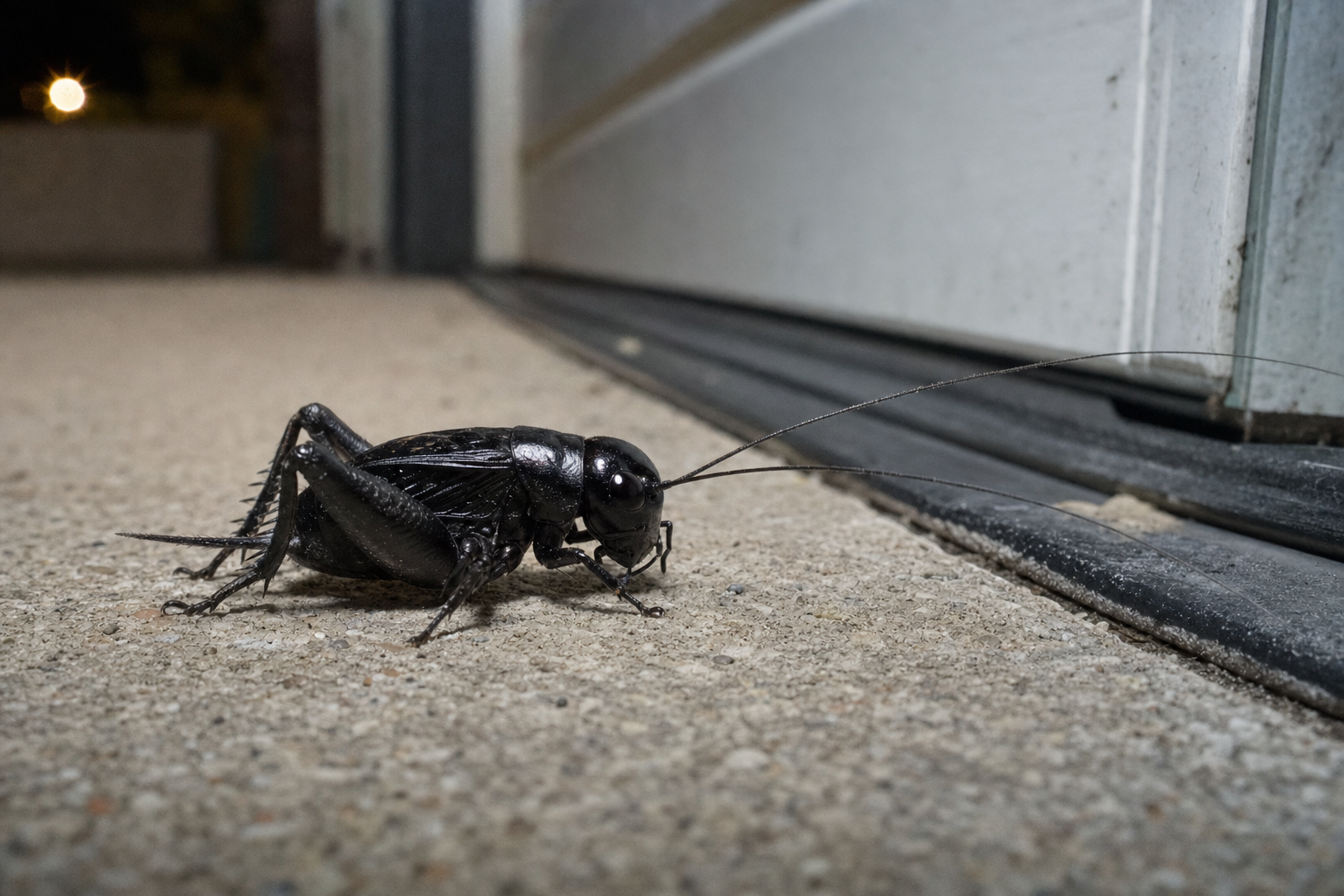
- The black ones here are field crickets, dark brown to black and from about half an inch to over an inch long.
- Two or three indoors during August usually means hundreds are staged outside against the foundation.
- The season is predictable. It peaks in August and September, so treating before it starts beats reacting after.





Are Black Crickets Harmful?
Not to you directly. Black crickets are not venomous, they carry no disease that transfers to people or pets, and they have no stinger. If one lands on you, nothing happens. That much of the reassurance is true, and it is why people often decide a cricket problem is not really a problem.
What is not true is that they are therefore harmless to have in numbers. Texas A&M AgriLife Extension notes that crickets may damage clothing, drapes and wall coverings, both by feeding and by staining them with droppings, and that soiled or perspiration-stained clothing is the most likely to be chewed. They do not normally attack clean fabric, which is a narrower claim than the one usually made about them, and it still means a stored load of worn clothes in a garage or spare room is at risk during a heavy season.
The noise is the other cost, and it is not trivial. A large indoor population chirps through the night and reliably wrecks sleep. Crickets also draw predators. Brown recluse spiders and wolf spiders hunt them, so steady indoor cricket pressure usually comes with rising spider activity.
Do Black Crickets Bite or Sting?
They do not sting. Crickets have no stinger of any kind, so the thing people are usually worried about cannot happen. Biting is a narrower yes: a large field cricket held in a closed hand can pinch hard enough to feel, but it rarely breaks the skin, it carries no venom, and washing the spot is all it needs.
Biting is a narrower yes than the usual warnings suggest. A cricket has chewing mouthparts, and a large field cricket held in a closed hand can pinch hard enough to feel. It rarely breaks the skin, it carries no venom, and it needs nothing more than washing the spot. In practice it takes handling one to get bitten. Crickets do not seek people out, they do not bite while you sleep, and they have no interest in you at all.
Are Black Crickets Poisonous or Dangerous?
No on both. There is no venom, no toxin, and nothing dangerous about a black cricket to a person, a dog or a cat. A pet that eats one is almost always fine, though a dog or cat that eats insects regularly can pick up stomach worms, so it is worth mentioning to your vet rather than treating as nothing.
The danger, such as it is, is indirect and it is worth knowing. Heavy cricket numbers pull spiders toward the house, and some of those spiders do matter. Crickets that die indoors also feed scavenging beetles. So the honest answer is that the cricket itself is harmless and the situation it creates is not.
Why Are Some Crickets Black?
Because the ones causing trouble here are field crickets, and that is simply their color. Texas A&M AgriLife Extension describes field crickets as dark brown to black, running from about nine sixteenths of an inch to over an inch long.
Most of the ones behind local outbreaks belong to the Gryllus assimilis complex, a group of closely related black field crickets rather than one species. That is why the ones at your door vary a little in size and shade.
The University of California page on crickets gives the same picture. Adult crickets are shiny black or brown, about 0.6 to 1 inch long, with long antennae. They are active at night and need shelter during the day.
A small black cricket is usually a young one of the same species rather than a different insect. Young crickets look like the adults but smaller and without full wings. Pale or green jumping insects with very long antennae are a different animal, usually tree crickets or katydids, and they are not the ones that gather on buildings.
Are a Few Black Crickets Inside a Problem?
During peak season in McKinney, Allen and Frisco, two or three crickets indoors almost always means hundreds are staged outside. They gather against the foundation, under mulch beds and along fences and landscape borders before they push in. A handful indoors is an early signal rather than an isolated event.
The ones you found inside located a gap. The rest are finding the same gap. Cricket pressure in Collin County gets heavy after a dry spring and summer, and AgriLife puts the peak in August and September, when a summer drought is broken by rainfall and cooler weather. Black crickets in Texas are overwhelmingly field crickets, so that is the pattern statewide, not just here.
 Source:
 When you do find them inside, check four things. Look at exterior lighting near entry points, the gap under the garage door, the weatherstripping on exterior doors, and any expansion gap or crack in the slab. Crickets follow light and moisture, and they concentrate first where those two overlap near the foundation.
Can Anything Be Done About Cricket Season?
Yes. Cricket numbers in Collin County follow the calendar, not luck. Eggs sit in the soil through winter and hatch in spring, and Texas A&M AgriLife Extension puts development at about 3 months from hatching to adult, so the pressure lands in August every year and treating in July beats reacting in September.
Believing nothing can be done is the belief that costs the most, because it leads people to wait until the pressure is already overwhelming.
Five things genuinely work.
- Perimeter treatment applied before the August window cuts how many reach your foundation.
- Yellow or sodium vapor exterior bulbs draw fewer insects and reduce the initial pull.
- Trimming vegetation back from the foundation removes the cover they stage under.
- Sealing gaps at garage doors, utility penetrations and door weatherstripping reduces entry.
- Where pressure is already high, professional perimeter treatment collapses the group staging near the house fastest.
Outdoor lighting is worth singling out. AgriLife calls it the most important single cause of severe cricket infestations around homes and commercial buildings, which makes a porch light the cheapest thing on that list to change.
Is Pest Control Worth It for Black Crickets?
It is, if it comes with fewer outdoor lights. Texas A&M AgriLife Extension says cricket outbreaks are one of the most predictable pest events of the year in most of Texas, but warns that insecticide is only a partial solution, and that crickets drawn to lighted buildings keep causing problems regardless of how much insecticide is used.
When Cricket Pressure Becomes an Infestation
Crickets in the garage during August are a normal seasonal event. Crickets in more than one room, chirping through the night, or damage to stored clothing and paper is a different thing. At that point the population is established indoors and will not resolve on its own, and that is the point to call us.
Heavy pressure brings secondary problems too. Spiders follow the crickets indoors. Crickets that die inside feed scavenging beetles. What starts as an annoyance turns into a more complicated situation through the fall.
If you are seeing steady cricket activity inside rather than one or two near a door, professional cricket treatment finds the entry points, treats the perimeter and stops the cycle before the secondary pests arrive. Get a free estimate or schedule a visit if the numbers are climbing.
Cricket swarms at your home? Same-day perimeter treatment in McKinney and the surrounding cities when you call before noon.
We treat the entry zone and perimeter to stop the migration before it gets inside.

Ryan has spent more than 16 years in pest control and wildlife management across McKinney and Collin County, from inspecting homes and treating infestations to sealing the entry points pests use to get in. He built Pest Me Off on that field experience, and every technician on the team is trained against it.
More about the Pest Me Off team