Wolf Spider Infestation, What It Actually Looks Like
A wolf spider infestation is a rarer thing than the phrase suggests, and knowing why takes the worry out of it. These are solitary hunters. They build no catching web, they do not gather in groups, and they do not breed indoors in any numbers. So finding three in a week in McKinney almost never means a population has moved in. It usually means three separate spiders came in from the same place, and that place is worth finding.

- They build no catching web. UC says they make only a small thick web to rest in, so there is nothing to find.
- Their eyes reflect green under a flashlight at night. That is the free way to count what is really in your yard.
- 8 eyes in 3 rows. A brown recluse has six in three pairs, which is how you tell them apart for certain.
- They hunt insects on the ground. More wolf spiders means more of something else at ground level.
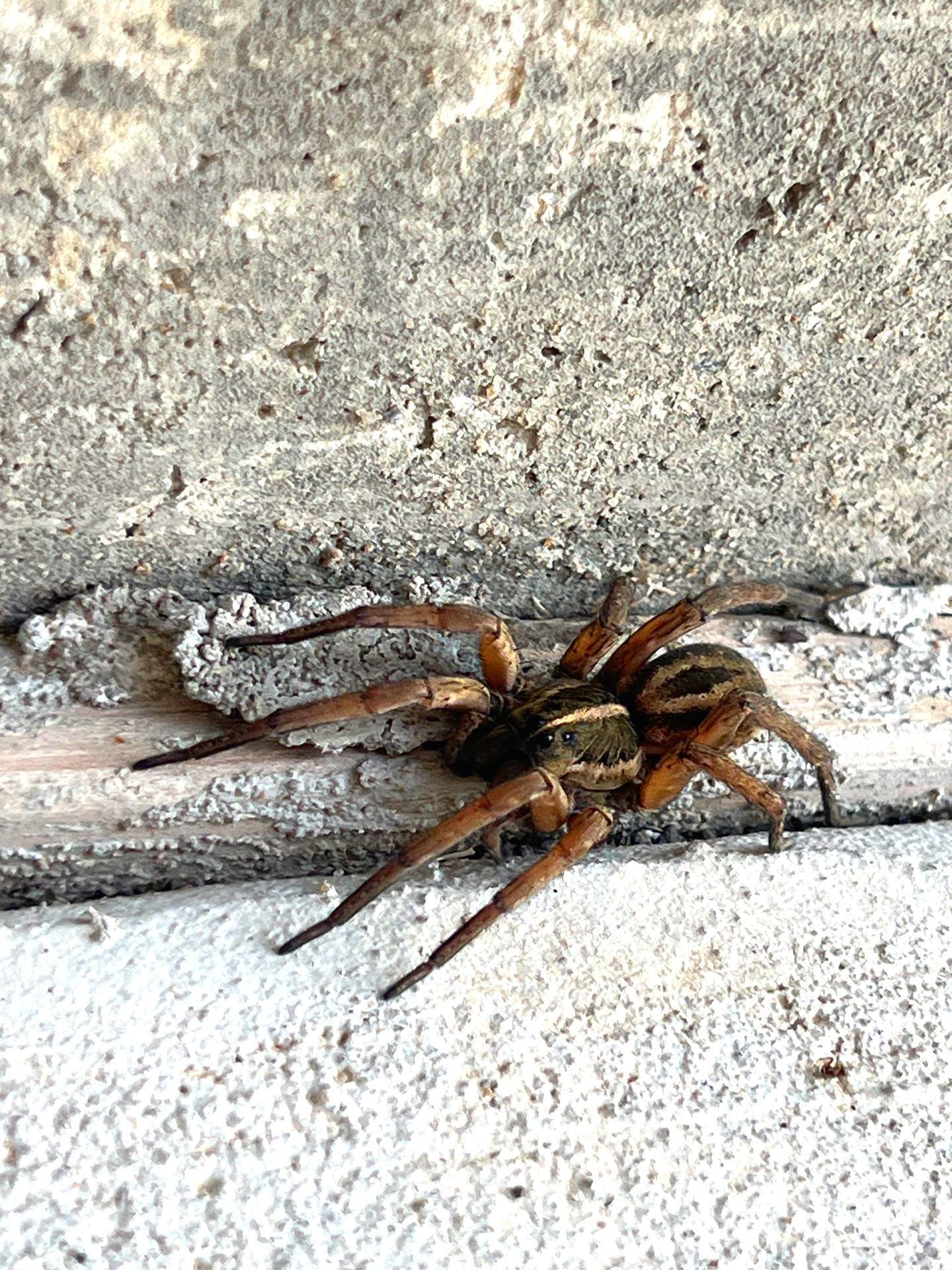
- Brown to tan with long hairy legs, and hard to see unless they move. Size is why people say tarantula.
- Not dangerous. A bite is possible if one is trapped against skin and it is comparable to a bee sting.






Is a Wolf Spider Infestation Even Possible?
Not in the way the word usually means. Wolf spiders are solitary hunters that live on the ground, and UC Agriculture and Natural Resources describes them hunting actively in the open by day and night, in litter and low vegetation, sometimes in burrows or under debris on soil. None of that describes an animal that colonises a building.
So what people call an infestation is nearly always repeated entry rather than a resident population. Spiders coming in one at a time over weeks, from a yard that is full of them, through the same few gaps. That distinction matters because it changes the fix entirely: there is no nest indoors to find, and the work belongs outside and at the threshold.
Why Are There So Many Wolf Spiders in My House?
A house that keeps finding wolf spiders has two things going on: the yard is producing them, because they hunt ground insects and crickets above all, and the ground-level gaps are open. They walk in under doors, through garage gaps and through foundation cracks, which is why they turn up downstairs and almost never upstairs.
The first is that the yard is producing them. Wolf spiders prey on insects walking or resting on the ground, so the number outside tracks the number of ground insects, which in Collin County means crickets above all. A heavy cricket year gives a heavy wolf spider year, reliably, and August and September are when both peak. So the meaning of a wolf spider in the house is usually a busy yard and an open gap, not a nest indoors.
The second is that your ground-level gaps are open. These are not climbers looking for a high entry. They walk in under a door, through a garage gap, or through a foundation crack, which is exactly why they turn up in garages, laundry rooms and ground-floor rooms and almost never upstairs.
 Source:
Where Do Wolf Spiders Come From?
The ground immediately outside, and usually a specific part of it. UC puts them in litter and low vegetation, in burrows, and under debris sitting on soil. In a Collin County yard that means mulch beds against the house, leaf litter along a fence line, stacked stone or timber, a woodpile, and the strip where lawn meets the foundation.
They are not coming from far away and they are not coming from inside the walls. If you want to know how many you have, take a flashlight into the yard after dark and look along the mulch line. Their eyes reflect green, which is the single most useful field trick here and it costs nothing. The count can be startling, and it is normal.
How Do You Tell a Wolf Spider From a Brown Recluse?
Count the eyes, the reliable difference: a wolf spider has eight in three rows, a brown recluse six in three pairs. A wolf spider is heavy, hairy and out in the open, a recluse slim and hidden. The mix-up is worth getting right, because only the recluse matters medically.
| What to look at | Wolf spider | Brown recluse |
|---|---|---|
| Eyes | Eight, in three rows: four small in front, two large in the middle, two set wide on top | Six, in three pairs in a semicircle. This is the reliable difference |
| Build | Heavy and hairy, with thick legs. Often called a tarantula by people who find one | Slim and smooth, with long thin legs and a small body |
| Markings | Brown to tan, often with dark patterning down the body | Plain, with no pattern on the abdomen at all |
| Where you see it | Out in the open, moving fast across a floor or a driveway | Hidden, in boxes and stored clothing. Out in daylight only if disturbed |
| Web | None to speak of. Only a small thick resting web | A small irregular off-white retreat tucked in a corner or a box |
| Why it matters | A bite is like a bee sting and needs nothing much | A bite can leave a slow-healing wound and is worth a doctor |
If it ran across an open floor and it looked big and hairy, it was a wolf spider. Recluses do neither of those things.
Are Wolf Spiders Dangerous?
No. They have venom, as almost all spiders do, and it is not medically significant to people. A bite happens when one is pressed against skin, usually inside a shoe or a glove, and it compares to a bee sting: it hurts, it swells, it passes.
University of Kentucky Entomology, Wolf Spiders of Kentucky puts it the same way. Their bites are extremely rare and no more dangerous or painful than bee stings, and they only bite if they are mishandled.
They also do not chase people. A wolf spider running toward you is running away from something else, and their speed is what makes them frightening rather than anything they intend. Set against that, they spend every night eating the ground insects you actually do not want.
How Do You Get Rid of Wolf Spiders?
Outside first, because that is where they live, and then the threshold. Clear mulch, leaf litter and firewood off the wall, cut the crickets they follow, and close the low gaps at door sweeps and foundation cracks. Treating indoors on its own achieves very little against an animal that keeps walking back in.
- Clear the ground cover against the house. Mulch, leaf litter, stacked stone, timber and firewood pulled back off the wall. This is where they are before they are indoors.
- Deal with the ground insects. Crickets above all in late summer, since the spiders are following them.
- Change the outdoor lighting. Yellow bulbs or a repositioned fitting cut the insects at the door, which cuts the spiders that follow them.
- Close the low gaps. Door sweeps, garage weather stripping and foundation cracks. Everything about this spider is at floor level, including the way in.
- Treat the perimeter, not the rooms. A treated band around the foundation catches them at the boundary they cross.
If they are coming in steadily in Allen, Frisco or Plano, professional spider control treats the perimeter and the ground cover and deals with the insects underneath it. Call us or get a free estimate and we will tell you whether the yard is the problem or the doorway is.
Big spiders crossing the floor at night? Same-day spider control in McKinney and the surrounding cities when you call before noon.
Call and we treat the perimeter and the ground cover, and deal with the insects the spiders are hunting.

Ryan has spent more than 16 years in pest control and wildlife management across McKinney and Collin County, from inspecting homes and treating infestations to sealing the entry points pests use to get in. He built Pest Me Off on that field experience, and every technician on the team is trained against it.
More about the Pest Me Off team