
How Roof Rats Get Into Your Attic and Why They Stay
Roof rats get into an attic from above, which is why people looking for a hole at ground level find nothing and conclude they must be hearing something else. These are climbing animals. They run fence tops and utility lines, go up a downspout or a tree limb, and arrive at the roofline where the gaps are, and the gap they need is a great deal smaller than anybody expects. If something is moving over the ceiling in a McKinney house at night, this is usually what it is.

- Anything wider than a quarter of an inch is a door. They chew through plastic, foam, wood and caulk to widen it.
- They come from above. Fence tops, utility lines, downspouts and tree limbs, then in at the roofline.
- By day they are still in the attic, the wall void or a false ceiling. You hear them at dusk because that is when they move.
- 3 to 5 litters a year, up to 8 young each. Two in the attic in spring is not two by autumn.
- They travel 300 feet or more to feed, so they can live in your attic and eat off a neighbor’s fruit tree.
- They are not aggressive and they avoid people. The damage is done to wiring and insulation, not to you.






What Are Roof Rats?
A climbing rat, and the distinction from the other common rat matters because it changes where you look. UC Agriculture and Natural Resources separates them plainly: the Norway rat is stocky, burrows along foundations and woodpiles, and indoors stays on the ground floor.
The roof rat is a strong climber with a tail longer than its head and body together, nests above ground in shrubs, trees and dense vegetation, and indoors favors attic spaces, wall voids, false ceilings and cabinets.
That is the whole reason a homeowner searching for a hole near the foundation comes up empty. There is nothing wrong with the inspection. It is being done at the wrong height.
How Do Rats Get in the Attic?
By climbing to the roofline and finding an opening that is already there. They rarely make a new hole in sound material when a gap exists. The usual ways in are roof and turbine vents, the gap where the roofline meets the gutter, soffit and eave returns, and pipe penetrations, reached over tree limbs, fence tops and utility lines.
| The way in | Why it works for them | What closes it |
|---|---|---|
| Roof and turbine vents | Factory screening is thin, often plastic, and it perishes in the Texas sun. A rat chews a perished screen in minutes | Metal vent guards over every roof and turbine vent, not plastic replacements |
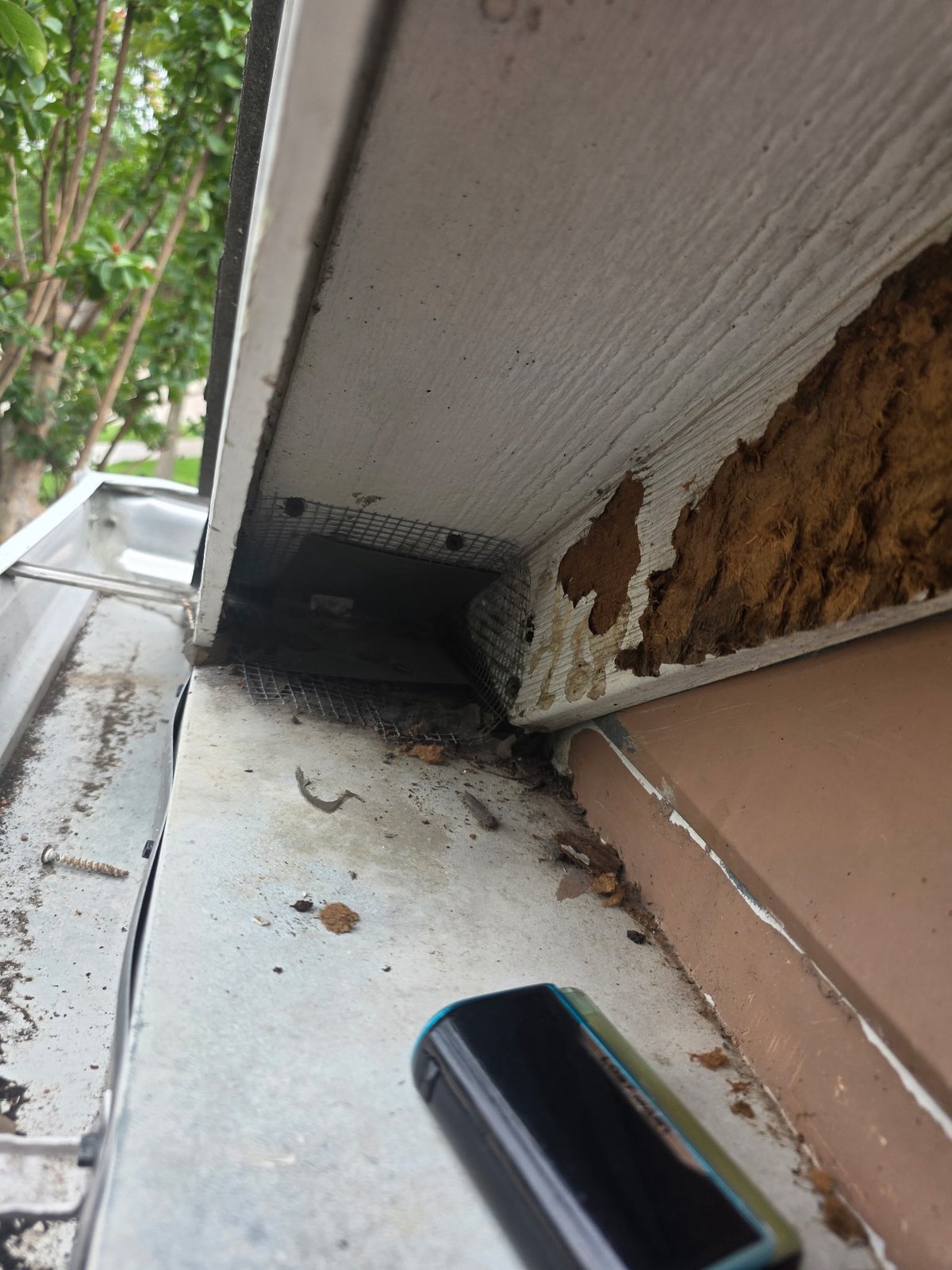
| The gap where roofline meets gutter | Fascia and drip edge do not always meet, and a rat pulls the gap open from a gutter it can already stand in | Sealing the fascia line and repairing chewed board, which is what the photo at the top of this article shows |
| Soffit and eave returns | Where a roof plane meets a wall there is often a small open corner that nobody sees from the ground | Closing the return with metal, then checking every corner on the house rather than the one that was found |
| Utility and pipe penetrations | The hole cut for a cable or a vent stack is always bigger than the pipe, and the collar around it fails first | New collars and sealing to a quarter inch, using material they cannot chew |
| Overhanging tree limbs | A limb within about 6 feet of the roof is a bridge. They do not need to touch the house to reach it | Cutting limbs back so nothing overhangs within about 6 feet of the roof |
| Fence tops and utility lines | Both are highways, and both usually end at the house. They travel them at dusk, which is when people spot them | Nothing, and that is fine. This is the approach route rather than the entry, so the work belongs at the roof |
Every row is above head height. That one fact is why homeowners inspect for an hour and find nothing.
 Source:
 Where Do Roof Rats Go During the Day?
Roof rats spend the day inside the building, asleep in the attic insulation, inside a wall void, above a false ceiling or behind boxes in a cluttered part of the garage. They are active at night and quiet in daylight.
That is why a house can hold a settled population for months while everybody assumes the noise is the air conditioning.
Outdoors the same animals nest above ground rather than in burrows: in dense ivy, in palms, in a woodpile, or up in a tree. A yard with heavy ground cover against the house gives them somewhere to live before they ever get inside, and it is usually the first thing worth changing.
What Are the Signs of Roof Rats?
Sound is the first one for nearly everybody: scratching or running across the ceiling after dark, most often between dusk and midnight, moving rather than staying in one place. After that come droppings near stored food or pet food, gnaw marks, and rats travelling along utility lines or fence tops at dusk.
After that, look for droppings near stored food, in the pantry or around a pet food container, and for gnaw marks. UC’s own list is worth knowing because two of its items are outdoors: gnaw marks on fruit or nuts in the yard, and rats travelling along utility lines or fence tops at dusk. If you see one running a fence line at sunset, that is not a passing animal, that is a resident on its commute.
Inside, the damage that costs money is electrical. They gnaw wiring insulation, and they shred attic insulation to build with, which shows up as flattened trails and hollowed pockets between the joists.
What Does a Roof Rat Nest Look Like?
A shredded pile rather than a built structure. They tear up whatever is nearby, attic insulation, paper, cardboard and fabric, and pack it into a sheltered pocket between joists, in a wall void, behind stored boxes, or up in dense vegetation outdoors. There is no neat entrance and nothing woven about it.
Finding one matters more than finding droppings, because a nest with young in it means the population is breeding in the structure rather than passing through it. At 3 to 5 litters a year and up to 8 young in each, that difference decides how big the problem gets.
Are Roof Rats Aggressive?
No. Roof rats avoid people, they move at night partly for that reason, and one cornered in an attic is trying to get past you rather than at you. Bites happen when an animal is handled or trapped against something.
That is a reason not to reach into a nest by hand rather than a reason to be afraid of the animal.
The real risks are indirect and they are worth taking seriously anyway. Chewed wiring in an attic is a fire risk, and Texas A&M AgriLife, Rodents in attics warns that rats in an attic may chew on wiring with the potential to start a fire. Droppings and nesting material in insulation are a contamination problem in a space connected to your air handling. Neither of those needs the rat to be aggressive.
How Do You Get Rid of Roof Rats?
Trapping clears the animals that are already inside, and sealing is what stops the next ones. Trap along the runs until the activity stops, then seal every opening to a quarter of an inch with steel wool, wire screen or sheet metal. Sealing first traps rats in your attic, so the order is not optional.
- Inspect at roof height first. Vents, the fascia and gutter line, soffit returns, and every pipe or cable penetration. The entry is up there even when the noise sounds like it is in a wall.
- Trap before sealing. Snap traps set along the runs, checked and cleared. Nothing gets closed until the activity stops.
- Seal to a quarter of an inch, in material they cannot chew. Steel wool, wire screen or sheet metal. Foam and caulk on their own are a delay, not a repair.
- Cut the approach routes. Limbs back off the roof, ivy off the walls, and firewood away from the house.
- Come back and check. Two quiet weeks are not proof. Fresh droppings and new gnawing are, and both need looking for rather than waiting for.
Attic and roofline work is height work, and that is why people hand it over. If something is running over your ceiling at night in Allen, Frisco or Plano, professional rodent control finds the entries, clears what is inside and closes the roofline properly. Get a free estimate or call us, and we will tell you where they are getting in before anything is sealed.
Something running across the ceiling at night? Same-day rodent service in McKinney and the surrounding cities when you call before noon.
We inspect at roof height, trap what is already inside, then seal the roofline so it stays closed.

Ryan has spent more than 16 years in pest control and wildlife management across McKinney and Collin County, from inspecting homes and treating infestations to sealing the entry points pests use to get in. He built Pest Me Off on that field experience, and every technician on the team is trained against it.
More about the Pest Me Off team