
How and Why German Roaches Get Into Your Home
German roaches do not come through floor drains or crawl in from outside the way American cockroaches do. They hitchhike in, on grocery bags, cardboard boxes, secondhand appliances, and restaurant equipment. Understanding this one distinction is the key to understanding why German cockroach infestations are so much harder to prevent and eliminate than other species.

- Eggs hatch in about 28 days, and a female produces a new egg case roughly every 6 weeks.
- Each egg case carries 30 to 48 eggs at a time.
- A small starting population can reach hundreds within months under normal kitchen conditions.
- They come in through transported objects such as grocery bags, boxes, and appliances, not through gaps in the home.
- Professional treatment typically requires more than one visit to confirm the colony is fully gone.





What Makes German Cockroaches Different
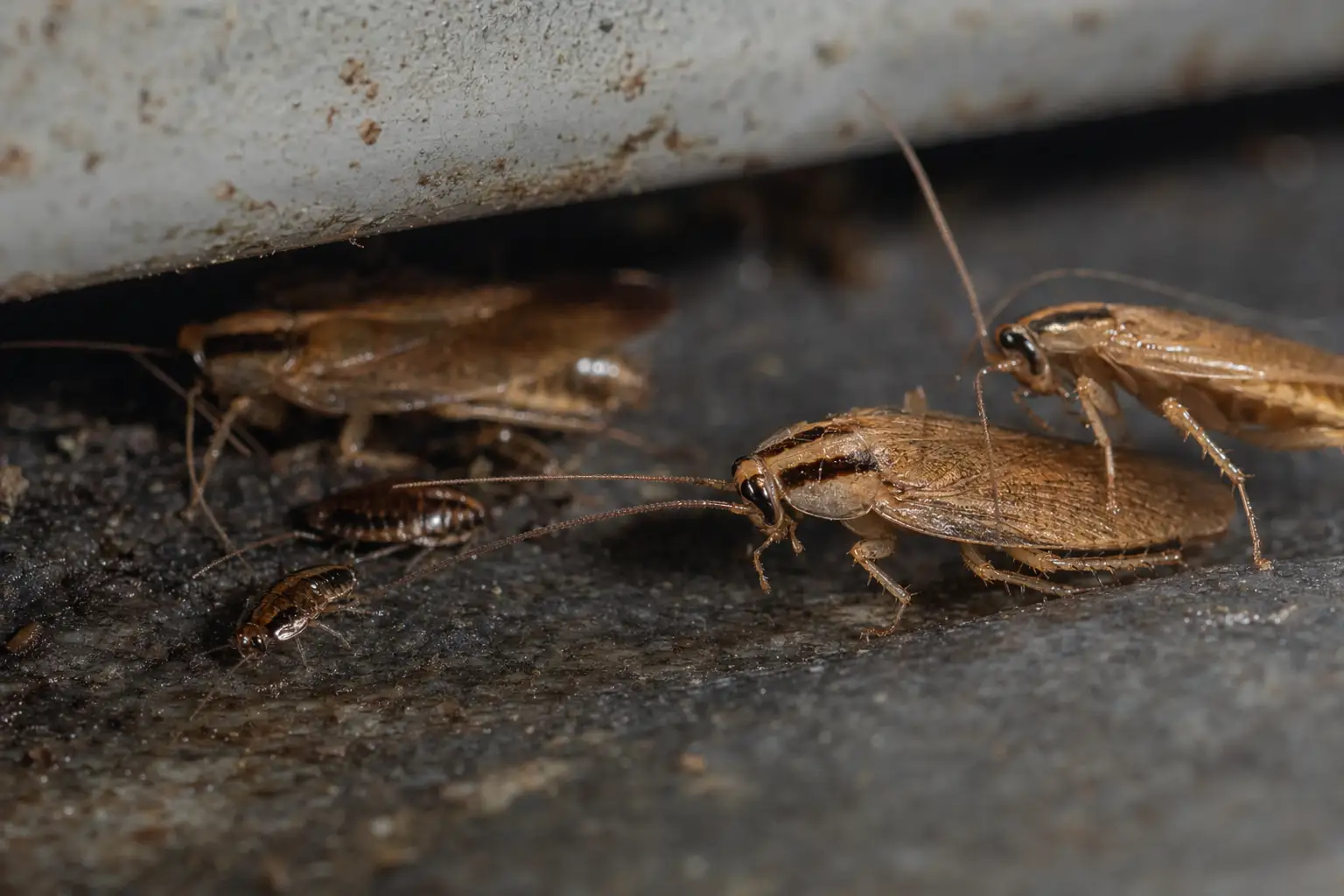
The German cockroach (Blattella germanica) is the small, fast roach found in kitchens and bathrooms across Collin County. Adults are about half an inch long, tan to light brown, with two dark parallel stripes running behind the head. They are the most common cockroach species inside structures in McKinney, Allen, and Frisco, and by far the hardest to eliminate once established.
Three characteristics separate German cockroaches from American and Oriental roaches:
| Trait | What it means |
|---|---|
| Indoor-only | No outdoor population: they live, breed, and die inside structures, so an infestation never resolves on its own. |
| Fast breeding | An egg case carries 30 to 48 eggs about every 6 weeks and hatches in 28 days, so a small population reaches hundreds within months. |
| Pesticide-resistant | Surface sprays repel roaches away from treated areas, including gel bait placed nearby, which is why DIY treatment often backfires. |
How German Cockroaches Actually Enter Your Home
German cockroaches enter through transported objects, not through structural gaps. The most common entry routes:
| Entry route | How it happens |
|---|---|
| Grocery bags | Roaches and egg cases from stockrooms transfer onto bags at checkout, then reach the kitchen once the bags are set down. |
| Cardboard boxes | Corrugated cardboard is a favored hiding and egg-laying surface, so boxes from an infested warehouse or vehicle carry them in. |
| Secondhand appliances | A used refrigerator, microwave, or dishwasher can carry a full colony, including egg cases inside the motor housing and door panel. |
| Restaurant deliveries | Food service deliveries from an infested facility introduce roaches to a commercial kitchen, which can spread to nearby businesses and homes. |
| Shared walls | In apartments and townhomes, roaches move through shared wall voids, so a neighboring infestation can introduce them regardless of your own upkeep. |
Where Do German Cockroaches Come From?
Not from your yard, and this is the fact that separates them from every other roach in Collin County. The American and Oriental cockroaches you find here live outdoors in drains, mulch and sewer lines and come inside when the weather pushes them. The German cockroach does not do that.
It has no outdoor population to come from. It lives with people, in heated buildings, and it has done for so long that it no longer survives outside one.
So what causes German cockroaches in the house is another building. A grocery stockroom, a warehouse, a restaurant, a previous tenant’s apartment, a moving truck, or a relative’s kitchen. It arrived in something that was carried through your door, which is the whole of the table above, and it is why the question people usually ask next is the wrong one.
What Attracts German Cockroaches to Your House?
Nothing does, because they were never in the yard. Something brought them in, and what decides whether they stay has three answers: warmth around appliances and hot water lines, moisture from a dripping trap or sweating pipe, and food residue in a tight space, such as grease behind a range. It is not a dirty house.
- Warmth. They want it hot and they want it constant, which is why they settle around a dishwasher motor, a refrigerator housing or a hot water line rather than in a cool pantry.
- Moisture. Water matters more to them than food. A dripping trap, a sweating supply line or a condensation pan will hold a population that a spotless dry kitchen would not.
- Food residue in a tight space. Not a dirty house. A film of grease behind a range, crumbs in a cabinet seam, or a bin liner that leaks is plenty, and all three are places nobody looks.
The University of California cockroach guide says the same thing in fewer words. German cockroaches favor warm, humid spots of 70 to 75 degrees that sit close to food, water and dark places to hide. It names kitchens, bathrooms and food preparation areas as the places they prefer.
That is why asking what attracts them leads people to clean the wrong surfaces. Wiping counters is not what removes them, because the counter was never the attraction. Fixing the leak under the sink is.
Why Is There a German Cockroach in My House?
A German cockroach in the house either rode in recently or comes from an established population, and the two need different responses. One roach seen once, with no droppings or shed skins, likely came in on a grocery delivery or a box. Seeing them regularly, seeing small ones or seeing any in daylight means they are breeding on site.
If you have seen exactly one and nothing else, it very likely rode in on something recent: a grocery delivery, a cardboard box, a bag from a trip. A single roach with no droppings, no shed skins and no others is worth taking seriously precisely because German cockroaches almost never travel alone for long. Put a couple of sticky monitors down near the dishwasher and the sink and give it two weeks.
If you are seeing them regularly, or seeing small ones, or seeing any of them in daylight, that is an established population rather than an arrival. Small pale roaches mean breeding on site, and daytime activity usually means the numbers have outgrown the hiding places.
Can German Roaches Travel From House to House?
In attached housing, yes, routinely, and it is the reason a spotless apartment can have a problem that will not end. They move through shared wall voids, along the plumbing chases that run between units, and through the gaps around pipes under sinks. A neighbor’s infestation is functionally your infestation with a delay.
In a detached house in McKinney it is far less common, because there is no shared void to travel through. There they arrive the way the table above describes, carried in.
The practical consequence in an apartment or townhome is that treating one unit is treating half the problem. If the units either side are not dealt with, the population comes back through the wall, and no amount of work inside your own kitchen changes that.
Can a clean home still get German cockroaches?
Yes. German cockroaches arrive through transport, not through hygiene failures, so a spotless kitchen is not protection on its own. A clean kitchen with no available food does slow their reproduction, but it does not eliminate a colony already established in an appliance motor or wall void.
Finding them in a spotless kitchen does not mean you did anything wrong. It means something came in that carried them.
 Source:
Why German Cockroaches Are So Hard to Get Rid Of
Three factors combine to make German cockroach infestations resistant to DIY treatment:
| Factor | Why it matters |
|---|---|
| Hidden nesting | They nest inside appliance motors, wall voids, cabinet hinges, and dishwasher door panels, where consumer surface sprays never reach the colony. |
| Sprays repel bait | Gel bait is the most effective treatment, but consumer spray products repel roaches away from the treated area, including any bait placed nearby. |
| Egg cases survive | The egg case protects eggs from many pesticides, so a treatment that kills every visible roach can still leave eggs that hatch 28 days later. |
How Pest Me Off treats a German cockroach infestation
Effective treatment requires gel bait placed directly where roaches hide (inside cabinet hinges, behind the refrigerator motor, inside the dishwasher door panel), combined with insect growth regulators (IGRs) that interrupt the reproductive cycle. Because egg cases can hatch after the first treatment, professional cockroach control for German roaches often takes more than one visit, and we return when it is part of the same infestation or when our technicians decide it is needed.

Ryan has spent more than 16 years in pest control and wildlife management across McKinney and Collin County, from inspecting homes and treating infestations to sealing the entry points pests use to get in. He built Pest Me Off on that field experience, and every technician on the team is trained against it.
More about the Pest Me Off teamGerman roaches in your kitchen? Same-day pest control in McKinney and the surrounding cities when you call before noon.
We place bait at the source, treat where they hide, and follow up to confirm the colony is gone.