
Ticks in the House and How They Got There
Finding ticks in the house is unsettling in a way that finding an ant or a roach is not, because the obvious question has an obvious wrong answer. People assume the tick came in the way an ant does, through a gap. It did not. A tick has no way to get indoors on its own, so every one you find rode in on something warm, and working out what that was is how you solve the problem. There is one exception, it is a single species, and it is the difference between a tick somebody carried in and a tick population living in the building.

- The CDC says it plainly. Ticks cannot fly and cannot jump. Anything that got indoors was carried.
- The carriers are a dog, a cat, or your own clothing after time in grass, brush or leaf litter.
- Lone star, American dog and blacklegged ticks cannot breed indoors and die out. The brown dog tick can, and does, which is the whole exception.
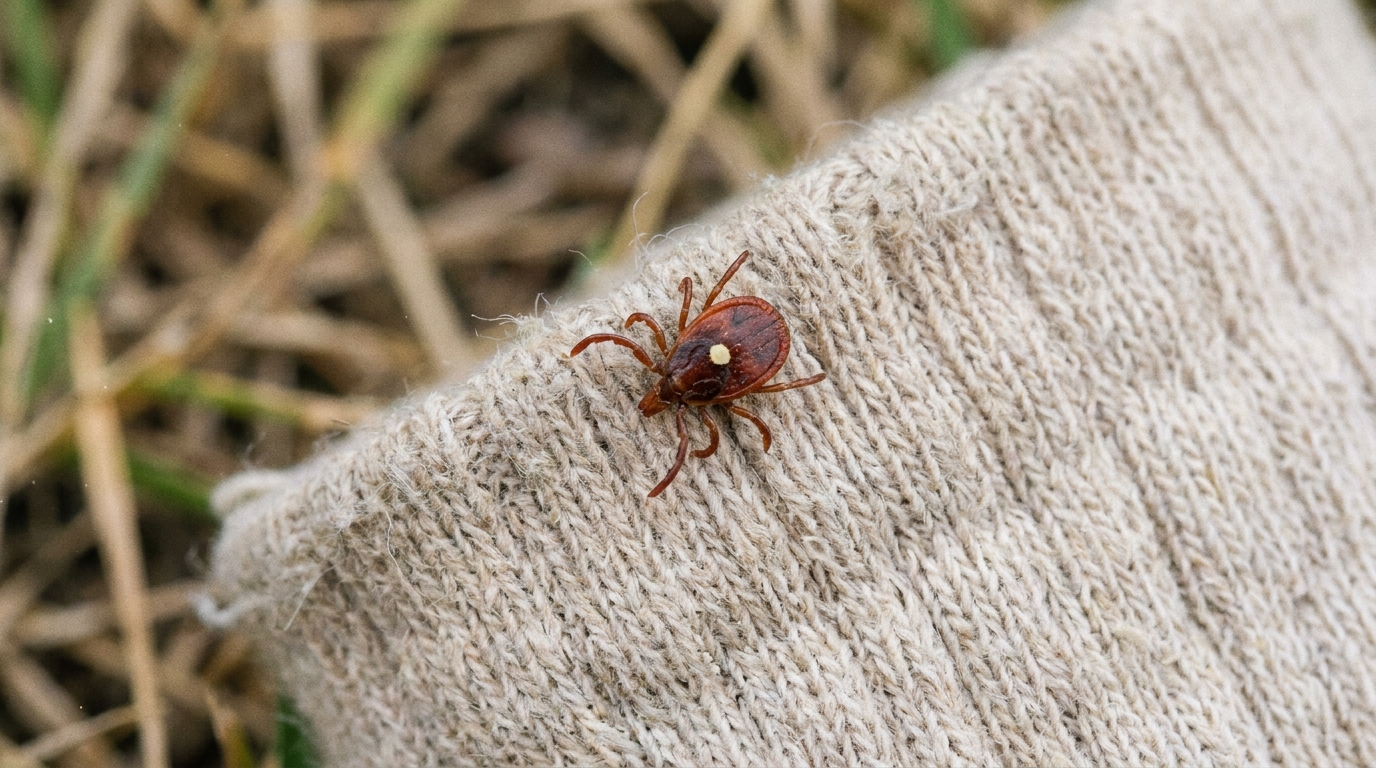
- The lone star tick is the one you are most likely to meet here, with a single cream spot on the female’s back.
- A clothes dryer on high heat for 10 minutes kills ticks that came through the wash alive.
- A lone star tick bite can leave a lasting allergy to red meat. That risk is local and it is growing.






How Do Ticks Get in the House?
Ticks get in the house on a host, every time: a person or a pet carries them in. The CDC says a tick waits on the tip of a grass blade or a shrub along a well-used path, holding on with its back legs and reaching out with its front pair, and climbs aboard when something brushes past.
It finds a host by detecting breath and body odor and sensing body heat, moisture and vibration, and some species can even register a shadow passing.
Nothing in that describes travel. A tick waits, then rides. So the routes into a house in McKinney or anywhere else in Collin County come down to three carriers.
| How it gets in | Why that route works | What stops it |
|---|---|---|
| On the dog or the cat | The biggest route by far. The tick attaches during the walk through grass, brush or wooded edges, and is not noticed until the animal is lying on a rug. American dog ticks and lone star ticks both take dogs readily | A tick check every time the pet comes in, ears and between the toes included, plus whatever your vet prescribes |
| On your own clothes | A tick that climbs on and does not reach skin straight away holds on to fabric instead. Pants legs, socks and jacket cuffs after yard work or a trail walk | 10 minutes in a dryer on high heat. The dryer kills them and the wash often does not, so the dryer is the step that matters |
| Wildlife crossing the yard | Deer, raccoons and possums move through and ticks drop off them near the fence line and foundation, then climb the nearest grass or post and wait | Treating the yard edges and keeping tall grass, brush and leaf litter off the boundary and away from the house |
There is no fourth route. A tick that got indoors was carried by one of these three.
Apartments follow the same rule with one addition. A shared stairwell, a shared lawn and a neighbor’s dog put ticks closer to your door than a detached house would, but the tick still needs a ride to get through it.
Can Ticks Fly or Jump Into Your House?
No. The CDC states it flatly: ticks cannot fly or jump, and there is no species anywhere that does either. A tick that appears on an ankle was already waiting at that height on a grass stem or fence rail, and it crossed over when you or the dog touched the spot.
The confusion is understandable, because a tick appears on an ankle or a forearm without anybody feeling it arrive. What actually happened is that it was already at that height, waiting on a grass stem or a fence rail, and it transferred across when you or the dog touched the spot. That is why ticks turn up on the lower half of the body outdoors and on the upper half indoors, after they have had time to walk. The CDC puts the time a tick spends preparing to feed after it climbs on at 10 minutes to 2 hours, which is the window you have to find it before it is attached.
The same answer covers ceilings and light fixtures. A tick found high on a wall walked there. It did not drop from anywhere, because nothing carried it up.
Can Ticks Infest a House?
Almost never, and then one species that absolutely can. Lone star, American dog and blacklegged ticks dry out indoors, so one carried in will not become a population. The brown dog tick tolerates dry indoor air and can run its whole life cycle inside a house, so the two cases need completely different responses.
Lone star ticks, American dog ticks and blacklegged ticks all need outdoor conditions to complete their life cycle. Indoors they dry out. One that comes in on a pet may live for a while, may bite somebody, and will not turn into a population. Finding one of those every few weeks through spring and summer means a yard problem showing up indoors, not an indoor problem.
The brown dog tick is the exception, and it is a real one. It tolerates the dry air inside a building, it feeds on dogs at every stage of its life, and it can run its entire life cycle indoors without ever going outside. A single infested dog can seed a house. Once it is established, the signs are unmistakable once you know to look for them, and they are the reason people search for ticks on door frames.
- Ticks in the cracks around window and door frames, which is the classic sign and the one most often reported.
- Ticks behind baseboards and in gaps in the wall.
- Ticks concentrated where the dog sleeps, in and under the bed, crate or blanket.
- Ticks climbing walls upward, often toward the ceiling line, which is normal behavior for this species and is not normal for the others.
Treating the dog alone will not end that. The dog is the food supply, but the population lives in the structure, so the structure has to be treated alongside whatever the veterinarian prescribes.
The University of Kentucky guide to ticks and disease says the same about this species. Unlike other ticks, the brown dog tick can survive its entire life indoors, and it usually gets into a home by riding in on the family dog.
Why Do You Keep Finding Ticks in the House?
Repeated finds mean one of two things. Single ticks days apart, after somebody or a pet has been outside, mean the population is in the yard. Ticks with no outdoor trip to explain them, around door frames or the dog’s bed, point at the brown dog tick living inside. Work out which before spending money.
If the ticks appear after somebody or some animal has been outside, and they are single ticks days apart, the population is in the yard. The yard is where the treatment belongs, aimed at the fence line, the tall grass borders, the brush and leaf litter, and the strip where the lawn meets the house. That is where ticks wait, and cutting that pressure cuts what comes indoors.
If the ticks appear with no outdoor trip to explain them, if they are turning up around door frames or the dog’s bed, or if new ones turn up every week, that pattern points at the brown dog tick and at a population already living inside. That one needs an inspection rather than a guess, so call us before treating anything yourself.
 Source:
 Which Ticks Live in Collin County?
Three species account for nearly everything found on people and pets in Allen, Frisco and Plano, plus the brown dog tick covered above. The lone star tick is the common one, the American dog tick strongly prefers dogs, and the blacklegged tick, the Lyme disease carrier, is far less common here than in the northeast.
- Lone star tick. The common one here, named for the single cream spot on the back of the female. It bites people readily at every stage of its life rather than only as an adult, which is part of why it is the common biter here. It is the main carrier of ehrlichiosis in Texas and the tick behind the red meat allergy described below. On a dog it is often found around the head, ears and between the toes.
- American dog tick. Bigger than the lone star tick, brown with pale mottled markings on the back. It strongly prefers dogs, and it can carry Rocky Mountain spotted fever. Its season peaks in spring and early summer here.
- Blacklegged tick. The Lyme disease carrier, sometimes called the deer tick. Present in Texas but far less common here than in the northeast, so the risk is real and much lower. Prompt removal matters either way, because Lyme transmission generally needs the tick attached for 36 to 48 hours.
What Does a Lone Star Tick Look Like?
A lone star tick is reddish brown, and the adult female has one white dot on her back. The University of Kentucky says the male has smaller white marks along the rear edge of his back instead, and that the mouthparts are long. The young ticks are reddish brown and round.
The University of Kentucky’s tick page says the adults and the older young are active from March through September, with the smallest young out later in summer and fall, and that lone star ticks are active questers, which means they will chase a host rather than wait on a grass blade.
Is a Lone Star Tick Bite Dangerous?
A lone star tick bite can be. The University of Kentucky lists ehrlichiosis, Rocky Mountain spotted fever, tularemia, southern tick-associated rash illness and the red meat allergy among what this tick can pass on. It cannot carry Lyme disease, and most tick-borne diseases can be stopped by early treatment with an antibiotic.
So a tick bite is worth a note on the calendar. Kentucky says anyone worried about a bite and possible disease should ask a doctor, and that the red meat allergy can occur in people who have had strong reactions to tick bites, with redness and itching at the bite lasting for weeks, or many bites at once. It adds that the antibody behind it has been found in up to 20% of people tested where the lone star tick is common.
What Is Alpha-Gal Syndrome?
Alpha-gal syndrome is an allergy to red meat that a tick bite can give you, and the lone star tick is the one that gives it. The allergy is to a sugar molecule found in beef, pork, lamb and venison, which a bite introduces into the bloodstream.
The immune system learns to react to it, and afterward the same molecule arriving in food sets off the reaction.
What makes it hard to spot is the delay. The reaction usually arrives 3 to 6 hours after the meal rather than during it, so people connect it to almost anything except dinner. Symptoms run from hives and stomach upset to severe reactions needing emergency care. There is no cure and management means avoiding the trigger foods, sometimes for years. The CDC lists alpha-gal syndrome among the conditions ticks transmit in the United States, and cases in Texas have climbed alongside lone star tick numbers.
The only prevention is not being bitten. Repellent on skin, permethrin-treated clothing for time in brush, a tick check every time you come in, and keeping the yard from turning into the kind of edge habitat ticks wait in.
What Should You Do If You Find a Tick Inside?
One tick on a person or a pet is not an infestation, and the first job is removal rather than treatment. Use fine-tipped tweezers, grip as close to the skin as you can, and pull straight up with steady pressure. Do not twist it, do not burn it, and do not cover it in petroleum jelly.
Clean the spot with rubbing alcohol afterward and note the date. If fever, a rash or joint pain turn up in the following weeks, tell a doctor there was a tick and when.
Then work out where it came from. Check the dog properly, including the ears and between the toes. Put the clothes from that outing through 10 minutes in a hot dryer. Have a look at the door frames and the dog’s bed for the pattern described above.
If ticks keep appearing, the source is either the yard or the structure, and professional flea and tick control is how you find out which without guessing. Get a free estimate and we will inspect both, treat the places ticks actually wait, and tell you plainly which of the two problems you have.
How Long Do Pets Stay Off After Tick Treatment?
Pets stay off treated areas for as long as the product label says. The EPA warns that pesticides could hurt a pet if not used and stored correctly. Our flea and tick treatment uses EPA-registered products, and we tell you when the treated areas are dry.
Ticks in your home or on your pets? Same-day treatment in McKinney and the surrounding cities when you call before noon.
We inspect the yard and the structure, then treat where the ticks are actually waiting.

Ryan has spent more than 16 years in pest control and wildlife management across McKinney and Collin County, from inspecting homes and treating infestations to sealing the entry points pests use to get in. He built Pest Me Off on that field experience, and every technician on the team is trained against it.
More about the Pest Me Off team