
How and Why Black Widow Spiders Enter Your Home
Black widows are outdoor spiders that end up inside occasionally, using the same routes as everything else that gets in: prey insects, ground level gaps, and objects carried in from outside. They are the most medically significant spider found in McKinney, Allen, Frisco and the rest of Collin County, and a bite from a female is always worth medical attention. Knowing where they establish outdoors and how they end up inside cuts the risk substantially.

- Ground level, not up high. Black widows nest in gaps, boxes and stacked material close to the floor, never in ceiling corners.
- Most active at night. Daytime is spent motionless in the web’s retreat, which is why they go unnoticed until dusk.
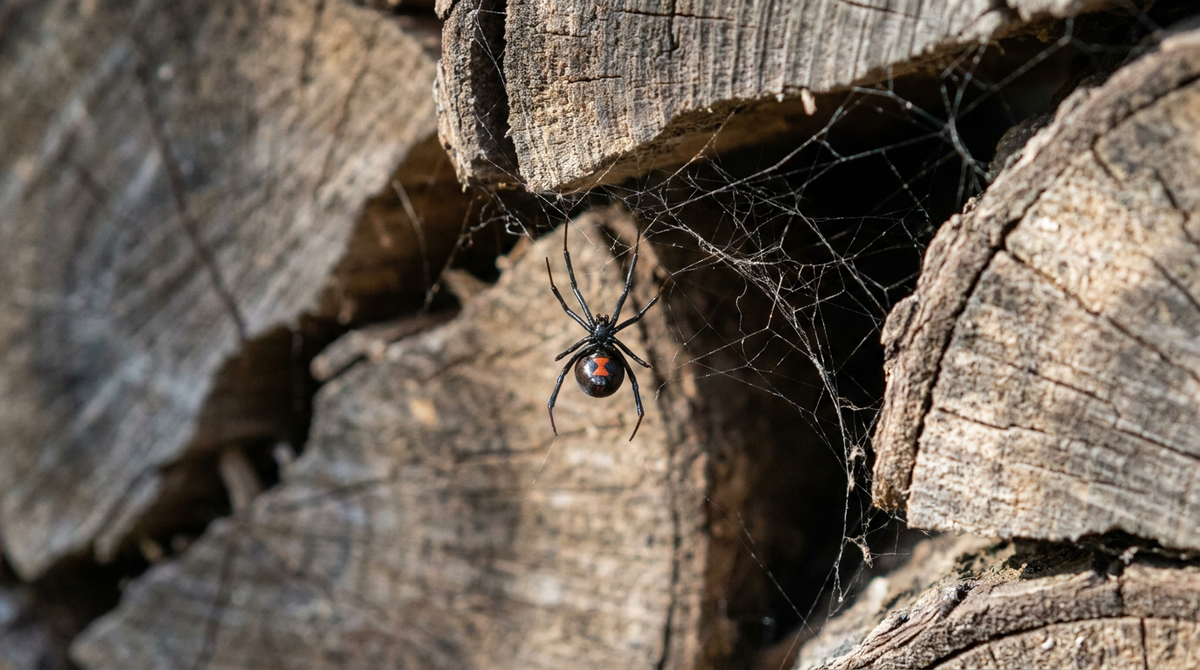
- The red hourglass on the underside of the abdomen is the tell. Males are brown, much smaller, and almost never seen.
- Bites happen from being pressed against skin, in a shoe, a glove or a stored cushion, not from a spider chasing anyone.
- Clearing one web rarely finishes the job. A new female usually claims the same spot within weeks unless the habitat and food source are addressed.





Do Black Widows Live in Texas Homes?
Yes, but rarely as residents. Black widows do come inside, and finding a black widow in the house once is not unusual. One actually living there is. There are black widows in Texas in effectively every county, and black widows, most often the southern black widow (Latrodectus mactans), are common in Collin County yards.
So they are common in Texas yards and uncommon in houses, which is the distinction that matters. What surprises people is how seldom a black widow lives inside a house at all. A black widow is a ground level, outdoor spider by habit, so a black widow home is a woodpile, a meter box or a stack of storage bins in a shed, not a bedroom or a kitchen shelf.
University researchers say the same. The University of California page on spiders describes the black widow as a spider that generally remains outdoors and out of sight, in sheltered, dry, undisturbed areas such as wood piles and garages.
Finding one inside does happen, usually because a spider riding on an object was carried through a door rather than because it chose to move in. A black widow taking up residence indoors on its own is the exception, not the rule. If you are seeing one in the house more than once, treat it as a sign that the outdoor population near the structure has grown large enough to be spilling over, not as bad luck.
Where Do Black Widows Live Around the House?
Black widows live low and close to the ground around a house, in spots nothing disturbs. The usual ones are under decks and outdoor steps, inside stored outdoor furniture, in rocks and yard debris against the foundation, and in garage corners near the floor. They build low, tangled webs in each of these places.
Females are the ones people recognize, with the shiny black body and the red hourglass marking on the underside of the abdomen. Males are smaller, brown, and rarely encountered. The same handful of places account for where black widows like to hide around an Allen or a Frisco property:
- Under decks and outdoor steps. The space beneath deck boards holds webs undisturbed for months, tucked into the gaps between boards and the framing lumber.
- Inside stored outdoor furniture. Cushions, hollow furniture legs, and anything left in a garage or outside through winter are common places for one to settle.
- In landscape debris and under rocks. A pile of rocks, landscaping timbers or yard debris against the foundation gives cover close to the structure.
- Garage corners near the floor. A garage sits between the yard and the living space, and floor level corners, stored boxes and the gap around the door frame all hold them.
A yard holding more than one of these spots at once is usually why one house seems to have more black widows than the one next door. Each undisturbed corner is more real estate, and the spider follows whatever insects already live there. Clear one spot and the population often just shifts to the next one, which is why the number climbs instead of dropping on its own.
That answers three questions people ask about them. Do black widows make webs up high? Almost never, since they build low and close to the floor, not in ceiling corners or eaves. What attracts black widows to your house is that same pair, undisturbed cover near the ground and the insects living in it. And do black widows come out during the day? Mostly not. They stay tucked in the web’s retreat by day and move out onto the web after dark, which is why most people first see one with a flashlight.
Do Black Widows Form a Colony?
Not in the way the word suggests. A black widow does not share a web or cooperate with others nearby. Each female builds and defends her own web, and once she has one anchored somewhere with good insect traffic she stays in one place rather than roaming.
What people call a black widow colony is really separate webs built close together because the same spot offers the same cover and food to more than one spider.
That is also why clearing every web in a garage corner does not remove the reason they were there in the first place. A new female usually claims the space within weeks unless whatever drew the first one, the darkness, the stillness, the insects, gets addressed as well.
That also answers why there are so many black widows around some houses and almost none around the one next door. It is never that they arrived together. It is that one property offers more of what a female needs, undisturbed ground level cover and steady insect traffic, so more than one female claims her own patch of it independently, and each of her egg sacs may hold 200 to 300 eggs (Kansas State Research and Extension, MF3346). And why would a black widow be in your house at all? Almost always because something it was already living in came through the door.
How Do Black Widows Get In Your House?
Black widows rarely enter through a high gap. They are ground level spiders and use ground level paths. Three routes account for nearly every one found inside a Plano or McKinney home: riding in on a potted plant or stored box, coming through the garage and under the door gap, and following prey insects through gaps at the foundation.
| How it gets in | Why that route works | What closes it |
|---|---|---|
| Hitchhiking on an object | A spider established in a potted plant, patio furniture, a firewood stack or a stored box rides inside the moment that object is carried through the door. This is the most common way people find one somewhere unexpected | Look before you lift, especially at anything that has sat outside or in the garage untouched for a season |
| Through the garage | A garage with an established population is a staging point for the rest of the house, and the gap under the door into the living space is all a spider needs | Weather stripping on the internal door, and treating the garage rather than only the rooms where one turned up |
| Following prey | Roaches, crickets and other ground level insects come in through gaps at the foundation and door thresholds, and black widows use the same openings looking for food | Sealing those gaps, and dealing with what the spiders are eating rather than only the spiders |
All three are at ground level, which is why checking high corners for black widows finds nothing.
What Does a Black Widow Web Look Like?
Even before you spot the spider, the web usually gives it away. A black widow web sits low to the ground rather than up in a corner, and its structure is tangled and three dimensional rather than the neat spiral of an orb weaver, with a funnel or retreat visible at one end where the spider waits.
The silk itself is unusually strong, noticeably more resistant than typical spider silk when a stick or a gloved finger is run through it.
Finding this kind of web near floor level in a garage or under a deck anywhere in Collin County is worth treating as a black widow sign on its own, even before the spider itself turns up.
What Does a Black Widow Bite Actually Do?
Female black widows can bite, and the venom is a neurotoxin called alpha-latrotoxin. Bites almost always happen when the spider gets compressed by accident: someone reaches into a glove, pulls on a shoe stored in a garage, moves a box, or picks up a piece of outdoor furniture.
The spider is not aggressive. It bites because it has been trapped against skin with nowhere to go.
Symptoms typically develop over the next 30 to 60 minutes and can include sharp pain at the bite site, sometimes with two small fang marks visible, muscle cramps and spasms spreading from the site (often centered in the abdomen, which leads some people to mistake it for appendicitis), sweating, nausea, headache, and a faster heart rate with higher blood pressure.
 Source:
Healthy adults rarely face a life-threatening outcome from a black widow bite, but the symptoms are severe enough to need medical evaluation every time. Bites on children, older adults, or anyone with a heart condition are more serious. Treat any confirmed black widow bite as a reason to seek care, without waiting out the 30 to 60 minutes symptoms take to build.
Are Black Widows Good to Have Around?
Outdoors and away from foot traffic, such as the back corner of a shed, yes, because a black widow eats other pests. Near a door, a garage shelf or a play area, no, because a bite serious enough to need medical care outweighs that benefit. The goal is keeping them out of the spots where a person could be surprised.
The calculation changes anywhere hands and feet reach without looking: a garage shelf, a stored shoe, a child’s play area, or anywhere close to a door. A bite serious enough to need medical care outweighs the small benefit of one spider’s pest control, so the goal is not eliminating every black widow on the property. It is keeping them out of the spots where a person is going to get surprised by one.
When to Call for Spider Control
One black widow spotted outdoors on a deck is different from more than one turning up in the garage or one found inside living space. Finding them in more than one location, or finding them in the garage on a regular basis, usually means the outdoor population near the structure has established and will keep producing indoor encounters until it is addressed. That is the point to call us.
Professional spider control finds where black widows are establishing on the property, treats those locations directly, and addresses the insect population that is feeding them. Treating only the spider you can see leaves the habitat and the food source exactly as they were, which is why the same corner tends to fill back in. Schedule a free estimate and we start with the garage and the ground level spots above.
Black widows on the property? Same-day spider control in McKinney and the surrounding cities when you call before noon.
We treat the nesting sites and the insects drawing them in, not just the spider you saw.

Ryan has spent more than 16 years in pest control and wildlife management across McKinney and Collin County, from inspecting homes and treating infestations to sealing the entry points pests use to get in. He built Pest Me Off on that field experience, and every technician on the team is trained against it.
More about the Pest Me Off team