
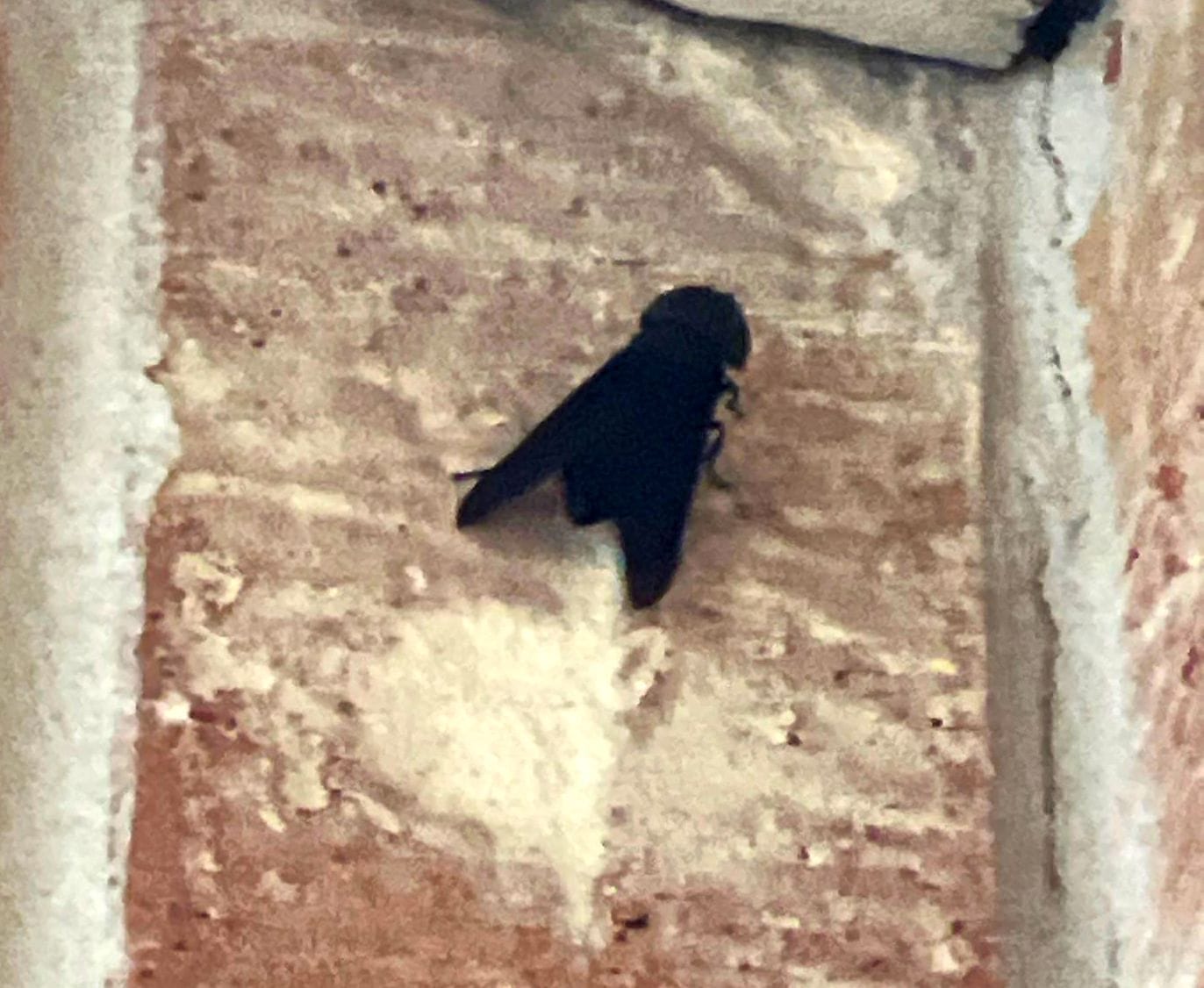
Signs of Carpenter Bees and the Damage They Do to Your Home
The signs of carpenter bees are easier to read than almost any other pest, because they leave a hole you could have drilled yourself. A round opening about half an inch across, in unpainted wood, with a pale streak running down the siding underneath it. Add a big black bee hovering near the eave that will not leave you alone, and you have the whole picture. What trips up homeowners in McKinney is not spotting the signs. It is assuming the bee that keeps buzzing them is the dangerous half of the pair.

- The entrance hole is almost perfectly round and about half an inch across. Nothing else in a Texas yard leaves that mark.
- The bee that dives at you cannot sting. Males have no stinger at all, and they are the ones that hover and chase.
- A shiny hairless black back is the identification. A bumble bee’s is furry and yellow, and it does not drill anything.
- They go for bare, unpainted wood over 2 inches thick. Fascia boards, deck rails, eaves, doors and window sills.
- One year’s hole is minor. The damage that matters comes from later years branching the same tunnel again and again.
- Plug the holes in fall, not in spring. Sealing a live tunnel traps bees that then chew their way out somewhere else.






What Are the Signs of Carpenter Bees?
Four, and you can check all of them from the ground with nothing but your eyes. Look for a round half-inch hole drilled across the grain, coarse pale sawdust below it, a yellow-brown stain running down the wood under the opening, and a large bee hovering and darting in one spot near an eave or deck rail.
| What you see | What it tells you | Where it shows up |
|---|---|---|
| A round half-inch hole | A nest entrance. It goes in about an inch, then turns at a right angle and runs along with the grain, which is why you can see nothing when you look inside. It looks manufactured, so people assume somebody drilled it | Bare unpainted wood over about 2 inches thick, drilled across the grain |
| Coarse pale sawdust below | The hole is being worked right now rather than left over from a previous year. Much coarser than dust, often still there after rain, and called frass in the trade | On the deck, the sill or the ground directly under the opening |
| A yellow-brown stain | The bees are leaving waste on the wall under the entrance. Usually noticed before the hole above it, so it is the sign that sends people looking | Running down the siding or trim below the hole, sometimes several inches |
| A bee that hovers and darts | A male on patrol, which means a nest is right there. He has no stinger and cannot hurt you, and he will keep it up all afternoon | In one spot near an eave, a deck rail or a door frame |
One hole is normal. Six along the same board, or holes at different weathering stages, means more than one season of use.
Finding one hole is normal. Finding six along the same fascia board, or holes at different weathering stages on the same run of trim, means the site has been in use for more than one season and the tunnel behind the boards is bigger than the openings suggest.
Is a Carpenter Bee a Black Bumble Bee?
They look almost identical in flight, and the difference is on the back. Penn State Extension puts it simply: most of the top of a carpenter bee’s abdomen is bare and shiny black, while a bumble bee’s is completely covered in hair, much of it yellow.
If the rear half of the bee gleams like polished plastic, it is a carpenter bee. If it looks furry all over, it is a bumble bee and it is not drilling anything.
The behavior separates them too. Bumble bees nest in the ground or in existing cavities, usually in a colony, and they are not interested in your siding. Carpenter bees are not social insects at all. Each female works on her own tunnel, which is why you can have six holes on one board with no nest, no swarm and no shared hive anywhere.
Do Carpenter Bees Sting?
The male cannot, and the male is the one you meet. He has no stinger, only territory, so he hovers near the nest and inspects anything that moves quickly nearby. The female can sting and almost never does, because she has to be seriously provoked first, which in practice means being handled.
Males have no stinger. What they have is territory, so a male hovers near the nest, chases off other flying insects, and comes over to look at anything large that moves quickly nearby, including you waving your arm at him. Penn State Extension describes exactly that behavior and calls the panic it causes unnecessary. He cannot hurt you, and he will keep doing it all afternoon.
The female can sting and almost never does. She has to be seriously provoked first, which in practice means being handled. She is also the one doing the drilling, so she is busy and rarely out patrolling. If somebody in the house is allergic to stings it is still worth keeping distance, but a bee dive-bombing the porch is not the one to worry about.
 Source:
 Can Carpenter Bees Damage Your Home?
Yes, and slowly, which is what makes them easy to ignore for too long. Carpenter bees do not eat wood. They excavate it, hollowing out a tunnel for shelter and to raise their young, so the wood removed in one season by one bee is genuinely a small amount.
The problem is that the tunnel does not get abandoned. The bees that emerge in August overwinter in it, mate in spring, and then clean out and enlarge the tunnel they already have rather than starting fresh. Penn State Extension notes that these later years branch the tunnel and can add up to considerable structural damage. A female typically builds six to eight chambers along a tunnel, and after years of reuse a fascia board that looks fine from the driveway can be honeycombed behind the surface.
Two things make it worse than the tunneling alone. Water follows the hole in, so the board rots from the inside where nobody can see it. And woodpeckers hear the young inside the wood and tear the board open to get at them, which routinely does more visible damage in one morning than the bees did in 3 years.
Are Carpenter Bees as Damaging to a House as Termites?
Usually not, though they still do real damage over time. The University of Kentucky says carpenter bees are seldom as destructive as termites but can cause cosmetic and structural damage, that significant damage occurs when the same wood is infested year after year, and that the holes let in moisture, rot and decay.
Why Are Carpenter Bees Hovering Around My House?
Because there is a nest site on the house, or one they are considering. A male hovers in the same spot for hours near a tunnel entrance, and he picks that spot because a female is working there or overwintered there. Bees hovering around the eaves or the deck are not passing through.
They are the clearest possible sign of where to look.
The wood they choose is predictable, and it is nearly always the bare stuff. Unpainted fascia and soffit boards, deck rails and stair stringers, arbors and pergolas, window sills, door frames, shed siding, and outdoor furniture. They prefer boards thicker than about 2 inches, and they will pass over painted wood in favor of bare wood nearby. University of Kentucky Entomology, Carpenter Bees says they prefer unpainted, weathered wood, especially softer kinds such as redwood, cedar, cypress and pine, and that painted or pressure-treated wood is much less likely to be attacked. Cedar and redwood decks in Allen and Frisco take the worst of it here, because that is what they are made of and because so much of it never gets painted.
Why Are There Carpenter Bees in the House?
Carpenter bees turn up in the house almost always because one emerged on the wrong side of a board. A tunnel drilled into an exposed beam end, a rafter tail or a garage frame runs deeper than expected, and a newly grown bee chews out through the inside face into an attic, a garage or a room.
The bees do not nest inside living space.
So a carpenter bee indoors is a bigger sign than a carpenter bee outdoors. It means a tunnel has reached all the way through a structural piece of wood. Let it out, then go and look at the outside of that same wall for the entrance hole, because it is there.
How Do You Get Rid of Carpenter Bees?
The order matters more than the product, and the single most common mistake is doing the last step first. Treat the tunnels with insecticide dust and leave the holes open, repeat in spring, mid summer and early fall, and only seal the holes and paint or varnish the wood once the tunnels are inactive.
- Treat the tunnels, not the air. Spraying a hovering bee accomplishes nothing, because the population is inside the wood. Insecticide dust puffed into each opening coats the tunnel, and the bees pick it up on the way in and out.
- Leave the holes open at first. This is the step people get backwards. The entrance has to stay usable so bees travelling through contact the treatment, and so any bee still developing inside walks into it when it emerges. Sealing a live tunnel traps bees that chew a fresh exit somewhere else in the board.
- Time it across the season. Treat in spring when bees first appear, again in mid summer for any that emerged since, and once more in early fall for the ones settling in to overwinter.
- Then seal, in the fall. Once the tunnels are inactive, fill them with wood putty or a wooden dowel and paint or varnish the whole surface. Painting is the part that actually prevents next year, and it has to be paint or varnish rather than stain, because stained wood is not usually protected.
The reason people hand this one over is height and position. The holes that matter are usually in the fascia, the soffit or the second-story trim, and treating them means working overhead off a ladder with a dust that goes airborne. Penn State Extension says outright that many homeowners hire a licensed company for exactly that reason.
If you are seeing round holes, sawdust piles or stained siding, professional carpenter bee control handles the treatment and the timing. Get a free estimate or call us and we will find every entrance on the structure, treat the tunnels, and tell you which boards need sealing before winter.
Round holes in your trim? Same-day carpenter bee treatment in McKinney and the surrounding cities when you call before noon.
We treat the tunnels rather than the bees in the air, then tell you what to seal and when.

Ryan has spent more than 16 years in pest control and wildlife management across McKinney and Collin County, from inspecting homes and treating infestations to sealing the entry points that keep pests out. He built Pest Me Off on that field experience, and every technician on the team is trained against it.
More about the Pest Me Off team