Are Crickets and Grasshoppers the Same?
No. Crickets and grasshoppers are close relatives and easy to mix up, but they are not the same insect. Both jump, both have long back legs, and both turn up across Collin County. But they live in different places, are active at different times of day, and only one shows up at your garage door in August.
If you are trying to work out what is piling up outside your house, the difference is the whole answer.

- They are related but not the same. Both sit in the order Orthoptera, the way dogs and foxes both sit in one family without being one animal.
- Check the antennae first. A cricket’s are as long as its body or longer. A grasshopper’s are short and stubby and stop near the head.
- Crickets work at night and chirp. Grasshoppers work in daylight and are mostly silent. Night noise means crickets.
- Only crickets are a home pest here. A grasshopper indoors is a stray that wandered in. Crickets arrive in numbers and push inside.
- August and September are the months it matters. That is when cricket numbers peak and exterior lights start pulling them to the foundation.





Cricket vs Grasshopper, the Short Answer
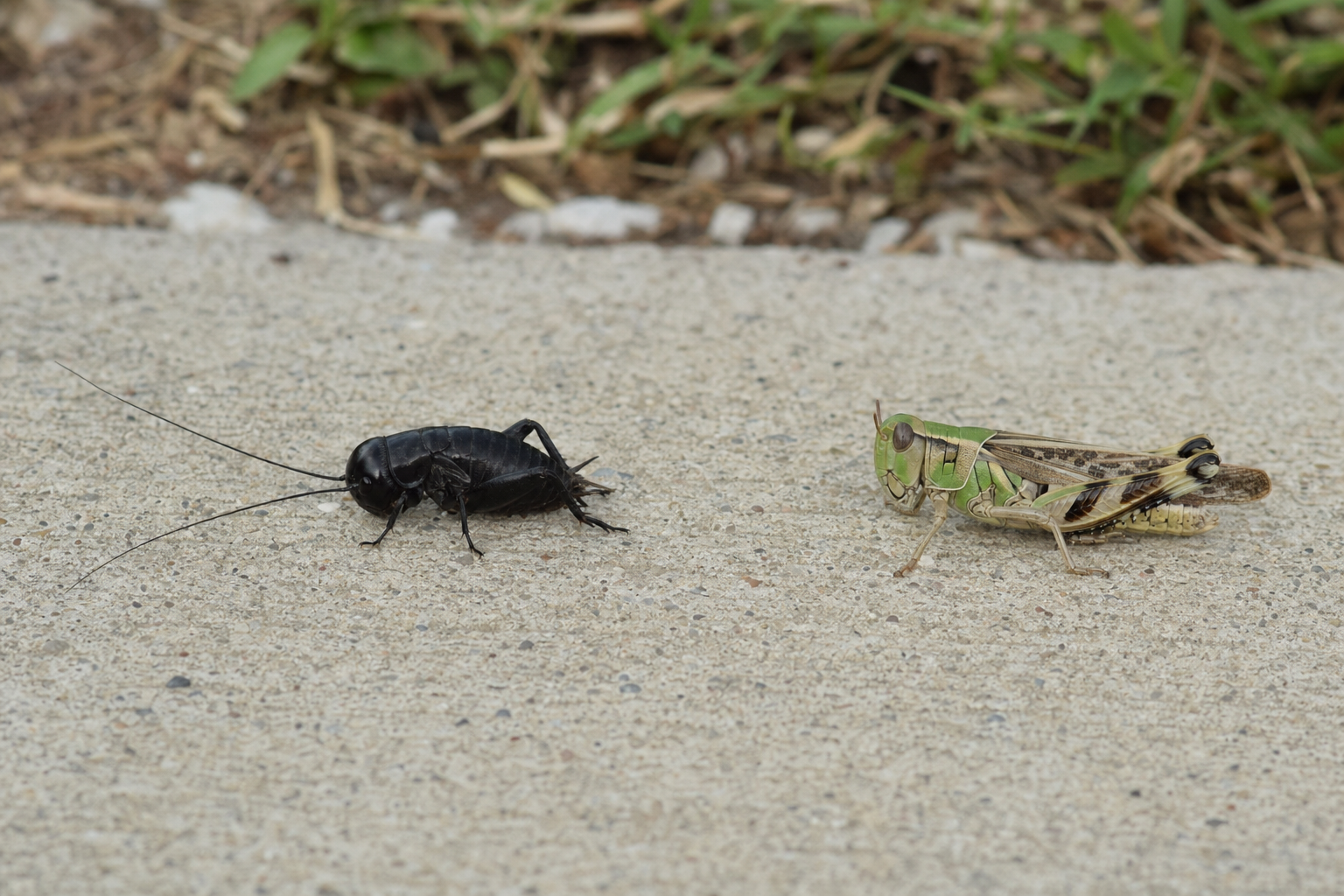
A cricket is not a grasshopper. Crickets vs grasshoppers, or grasshoppers vs crickets, comes down to the same two checks whichever way round you ask it. In a cricket vs grasshopper comparison the fastest reliable tell is the antennae, because it does not depend on catching the insect or seeing it in good light. Long thin antennae trailing behind the body mean a cricket. Short thick antennae that barely clear the head mean a grasshopper.
Whichever way round the question comes, cricket versus grasshopper or grasshopper versus cricket, and whether you call it a cricket bug or a hopper, color does the remaining work after that. The crickets people find around homes in Collin County are dark, usually near black. Grasshoppers are green, tan or dusty brown, because they spend their lives sitting on grass and need to disappear into it.
Are Crickets and Grasshoppers Related?
Yes, and that is exactly why the question keeps coming up. Both belong to the insect order Orthoptera, which covers crickets, grasshoppers, katydids and locusts. They share the big folded back legs, the jumping, and the habit of making noise. So people who guess they are the same thing are not being careless. They are noticing a real family resemblance.
Where they split is the suborder. Grasshoppers sit with the short-horned insects, named for those stubby antennae. Crickets and katydids sit with the long-horned ones. That single split is the reason the antennae test works so well, and it is why a cricket and a grasshopper behave nothing alike despite looking related at a glance.
How to Tell a Cricket From a Grasshopper
Five things separate them, and you rarely need more than the first two.
| What to check | Cricket | Grasshopper |
|---|---|---|
| Antennae | As long as the body, often nearly twice it, thin and trailing | Short and thick, rarely reaching past the head |
| Color | Dark brown to black. Field crickets here are almost fully black | Green, tan or brown, matched to grass and open ground |
| Body shape | Shorter, rounder, slightly flattened seen from above | Longer and more slender, built for sitting on stems |
| Sound | Males chirp by rubbing their wings together, loudly and all night | Much quieter and far less consistent, mostly by day |
| When you see it | After dark, often at lights and doorways | In daylight, out in the yard, away from the house |
Field crickets run from about half an inch to an inch and a quarter long, per the University of Maryland Extension, and most of the ones behind a local cricket problem belong to what entomologists call the Gryllus assimilis complex, per Texas A&M AgriLife Extension. That is a group of closely related black field crickets rather than one single species. It is why the ones at your door vary a little in size and are still the same problem.
The University of California page on crickets backs up the two main checks. It describes adult crickets as shiny black or brown with long antennae, and says crickets are active at night and need shelter during the day.
Is a Green Cricket a Grasshopper?
Usually it is neither, and this is the one case where the color rule sends people wrong. A green jumping insect with very long antennae is most often a katydid, a third member of the same order that gets called a green cricket in everyday speech.
It has the cricket’s long antennae and the grasshopper’s green camouflage, which is precisely why it causes the confusion.
Fall back on the antennae and the time of day. Long antennae and active at night puts it with the crickets and katydids. Short antennae and active at midday makes it a grasshopper. Either way, a green one in your garden is not the insect that swarms a garage door in August. That is the black field cricket, and it looks nothing like a grasshopper once you have seen the two side by side.
Why the Difference Matters for Pest Control
Grasshoppers are outdoor insects. They live in fields, meadows and open grass, and they rarely enter buildings. One in the house is an isolated stray that came in through an open door. They do not nest around homes and they do not gather at exterior lights. Across McKinney, Allen and Frisco they are not a home pest problem in any practical sense.
Crickets are a different situation entirely. Field crickets and house crickets in Collin County gather at exterior lights in large numbers through August and September. They pile against garage doors and exterior walls, then push inside through gaps under doors and around utility lines. Indoors they chirp through the night and disrupt sleep. In numbers they also damage clothing, drapes and wall coverings, though they do not normally feed on clean fabric: it is soiled or perspiration-stained clothing that gets chewed, plus staining from droppings. They also bring spiders, which follow the cricket population toward the house.
 Source:
How Does Pest Control Work on Crickets?
Pest control works on crickets from the outside in, at the lights and the gaps they use. Texas A&M AgriLife Extension calls cutting outdoor lighting the first and most important step, says indoor sprays are not very effective for field crickets, and calls insecticide only a partial solution that should be paired with less outdoor lighting.
What Hoppers Means Around Here
Locals sometimes call both insects hoppers, because both jump. In late summer, when people describe hopper swarms at a garage door or a pile of them under a porch light, they are almost always talking about field crickets. True grasshoppers do not gather on buildings. Large numbers of jumping insects at your house in August or September are crickets, whatever they are being called.
What Drives Cricket Season in Collin County
Two things happen at once. Populations that started in spring have been building all summer, so by August the numbers are at their highest. At the same time, exterior lighting becomes the main draw as nights cool slightly from the peak of the heat. Texas A&M AgriLife Extension puts it plainly, calling outdoor lighting the most important single cause of severe cricket infestations around homes and commercial buildings. A porch light, a garage light or an illuminated doorbell camera left on through August nights pulls crickets in from a long way off.
Moisture and temperature swings feed it too. Hot dry summers followed by a humid turn in late summer push crickets toward buildings. Homes in McKinney and Plano that back onto open fields or undeveloped lots usually take the heaviest pressure, because the ground next door supports a big population all summer.
Three things cut how many reach your foundation. Reduce exterior lighting during peak season, switch to yellow or sodium vapor bulbs that draw fewer insects, and treat the perimeter before August. Once they are inside, the chirping and the damage to stored clothing need active treatment.
Which One Are You Dealing With?
If jumping insects are concentrated at your garage door, gathering under porch lights and working their way inside in late summer, they are crickets. If the jumping insects are large, green or tan, out in the yard by day, and never near the house, they are grasshoppers. Nothing needs doing.
For cricket pressure around your home or already inside it, professional cricket and perimeter treatment works better than DIY once the season is underway. It targets the group staging near the foundation before they find a way in. Get a free estimate if the numbers at your door are climbing.
Cricket swarm at your home? Same-day perimeter treatment in McKinney and the surrounding cities when you call before noon.
We treat the entry zone and perimeter to stop the migration before it gets inside.

Ryan has spent more than 16 years in pest control and wildlife management across McKinney and Collin County, from inspecting homes and treating infestations to sealing the entry points pests use to get in. He built Pest Me Off on that field experience, and every technician on the team is trained against it.
More about the Pest Me Off team