
Where Do Spiders Hide in Your Home?
Where do spiders hide? Never at random. They pick places that give them three things: cover from being disturbed, something to eat nearby, and stillness. Once you know what makes a spot attractive, you can find them anywhere, which is more useful than memorizing a room-by-room list.
The same logic holds in every house in McKinney, Allen and the rest of Collin County.

- Cover, food and stillness. Any spot with all three will hold spiders, in any house.
- Most hide by day and move at night. Seeing none in daylight says nothing about how many are there.
- Cardboard is the one that surprises people. Its texture reads like tree bark, and brown recluses favor it.
- Almost every recluse bite happens by pressing on one, in a shoe, a sleeve or bedding. Shake things out.
- Spiders indoors are following prey. Killing spiders without dealing with the insects just makes room for the next ones.





Where Do Spiders Hide During the Day?
Tucked into something tight, dark and undisturbed, waiting for dark. Most house spiders are nocturnal, so daytime is when they are wedged into a crack, folded into a box seam, or sitting motionless at the back of a cupboard. This is why a house can look completely spider-free and not be.
You are awake during the hours they are hiding. If you want to know what is actually in a room, look after dark with a flashlight along the skirting boards and ceiling corners, and check the places listed below during the day.
Where Do Spiders Hide in Bedrooms?
Bedrooms are quieter than the rest of the house through the day, which is exactly what a spider wants. The spots are consistent: under the bed where storage boxes sit, inside and behind the headboard, the ceiling corners, behind wall art and mirrors, the closet floor, and behind furniture against an exterior wall.
Under the bed, especially where storage boxes sit and nothing gets moved. Inside and behind the headboard, particularly upholstered or slatted ones. Along the ceiling corners and the join between wall and ceiling, where web builders anchor from three planes at once. Behind wall art and mirrors. Inside the closet, on the floor among shoes and bags. And behind furniture that sits flat against an exterior wall, where it is 1 or 2 degrees cooler and nothing disturbs them.
Do Spiders Hide in Clothes?
Yes, and it is the habit worth changing today. Folded clothes on a closet floor, laundry left in a basket for days, clothing in storage boxes, and anything hanging undisturbed at the back of a wardrobe all make good cover. A spider is not seeking you out. It is seeking a dark fold that nothing moves.
The reason it matters is not the hiding, it is the getting dressed. A spider pressed between fabric and skin bites defensively, and that is how recluse bites usually happen. Shake out clothing and footwear that has been sitting, especially anything stored in a garage or an attic.
Are There Spiders in Your Couch?
Sometimes, and for the same three reasons as everywhere else. A couch offers deep dark cover in the frame and under the cushions, it is still for long stretches, and it collects crumbs which bring the small insects that spiders eat.
Look underneath the couch rather than in it. The underside of the frame, the corners where the fabric is stapled, and the gap where the base meets the floor are where they sit. Pulling furniture out from the wall and vacuuming underneath regularly removes both the spiders and the food that keeps drawing them.
Do Spiders Usually Stay in One Spot?
It depends which kind. Web builders are largely stationary. Once a web is anchored somewhere with good insect traffic, that spider stays with it, which is why the same ceiling corner grows a web again a week after you clear it.
Hunting spiders are the opposite. Wolf spiders and recluses do not sit on a web waiting, they move at night looking for prey, then return to a retreat by morning. So a wolf spider crossing your floor is not necessarily living in that room, while a web in the corner very much is.
Indoor Hiding Spots and What Makes Them Ideal
| Where | Why spiders choose it |
|---|---|
| Stacked cardboard boxes | The texture reads like tree bark and the seams give deep cover. Boxes that sit for months in a garage, closet or attic become established recluse habitat, and reaching in without looking is how bites happen there |
| Closet floors | Shoes, bags and folded clothes give dark folds nothing disturbs. A spider compressed inside a shoe bites defensively |
| Behind and under big appliances | Warmth, darkness and no traffic, plus the roaches and silverfish that gather there. Food and cover in one place |
| Under sinks and kick plates | Damp, dark and untouched behind the cabinet, with drain flies and small roaches around the plumbing to eat |
| Ceiling corners and wall junctions | Web builders want right angles, because strands anchor on three planes from one position. Rarely used rooms stay still long enough for webs and egg sacs to develop |
The Brown Recluse and Why It Matters Most Here
The brown recluse is the most medically significant spider across Collin County. Unlike black widows, which build untidy webs low down and outdoors, recluses live inside the structure and give you nothing visible to find. They hide inside objects rather than out on surfaces, and they move at night.
The numbers are what explain the build-up. Texas A&M AgriLife Extension records that a female produces up to five egg sacs of about 50 eggs each, that development to adult takes slightly less than a year, and that recluses have been observed living up to two and a half years. So an undisturbed storage room is not hosting a passing spider. It is hosting something that will still be there in two years, breeding the whole time, which is why clearing boxes matters more than killing the one you saw. For scale, an adult’s legs span an area about the size of a quarter to a half-dollar, so the body itself is much smaller than people expect.
 Source:
 AgriLife lists the places they turn up indoors as cluttered closets, garages, crawl spaces and attics, and inside boxes or under debris. That is the same list as the table above, arrived at from the other direction. More on identification and risk is on our brown recluse page.
Bites almost never come from a spider walking across the floor in front of you. They come from the spider being pressed between skin and an object, a shoe, a glove, a sleeve, a blanket taken out of storage. Shaking out stored clothing and footwear before putting it on is the single most effective habit there is.
Outdoor Spots That Feed Indoor Spider Populations
Spiders that settle around the outside of the house eventually come in. Four places are worth checking regularly.
- Firewood stacked against the house. Dark, undisturbed, and full of the insects spiders eat. Every armful carried indoors carries passengers. Store it away from the foundation.
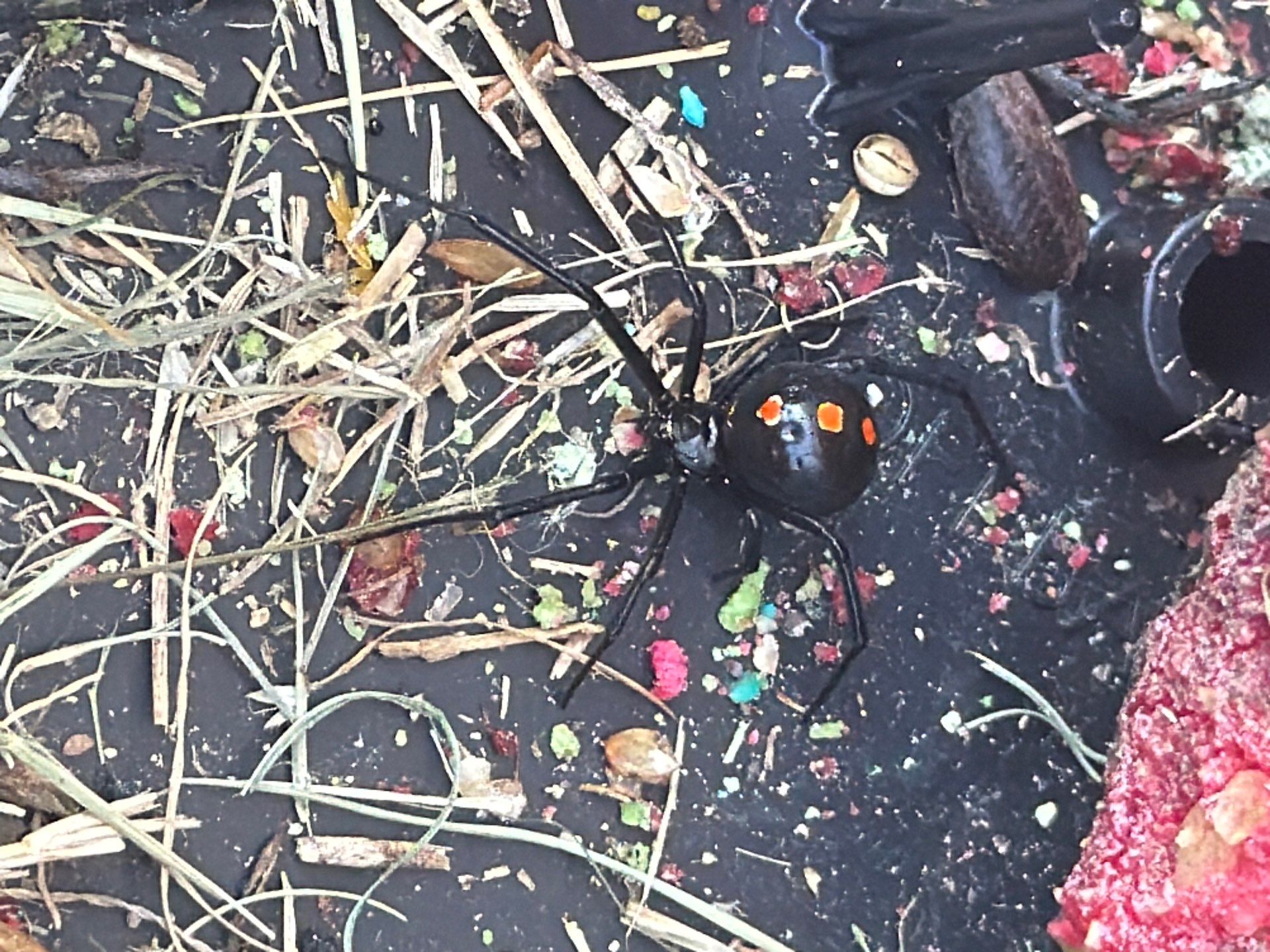
- Under deck boards and steps. Black widow spiders favor the gaps between boards and the insides of hollow metal furniture legs, and that is where people tend to meet them.
- Garage door tracks and ceiling corners. A garage has everything they want, and populations that establish there move into attached living space through door gaps and utility openings.
- Shrubs and ground cover touching the foundation. Vegetation pressed against the wall is a bridge from the yard to the house. A gap between planting and foundation removes it.
The University of California spider guide points at the same places. It says spiders that might hurt people, black widows for example, spend most of their time hidden outside the home in woodpiles or in clutter in the garage.
When to Call for Spider Control
Occasional spiders are normal anywhere and always will be. What is worth acting on is a recluse or black widow identified indoors, webs and egg sacs rebuilding in the same places after you clear them, or spiders appearing in numbers, which usually means the insects they eat are there in numbers too. Any of those three is the point to call us.
That last one is the reason treating spiders alone tends not to hold. They came for the food. Get a free estimate or call us if you are finding them faster than you can clear them, or if you have identified one you would rather not have in the house.
Spiders you would rather not have? Same-day treatment in McKinney and the surrounding cities when you call before noon.
We treat the hiding places and the insects drawing them in, not just the spiders you can see.

Ryan has spent more than 16 years in pest control and wildlife management across McKinney and Collin County, from inspecting homes and treating infestations to sealing the entry points pests use to get in. He built Pest Me Off on that field experience, and every technician on the team is trained against it.
More about the Pest Me Off team