
What Is Termiticide Treatment, and How Long Does It Last?
A termiticide is any pesticide made for termites, and the most common termiticide treatment is a liquid put into the soil around and under a house, so termites coming up from the ground hit it before they reach the wood. Here is how it goes in, how long it lasts, and how it compares with bait stations.

- An unprotected wooden house in Texas has over a 70 percent chance of termites within 10 to 20 years.
- The trench along the foundation runs 6 to 8 inches wide and 10 inches deep.
- Holes drilled through a slab go no more than 12 inches apart.
- Liquid termiticides are labeled to work for at least 5 years.
- Bait stations can take a few months to more than a year to bring a colony down.





What is termiticide treatment?
Most often it means a liquid termiticide applied to the soil under and around a building. The EPA says this soil-applied barrier is the most common way termite problems are treated, and that the product has to be labeled for that use. Baits and treated wood are termiticides too. Texas A&M AgriLife calls the soil barrier a treatment zone.
Subterranean termites, the kind that do the damage in Collin County, live in the soil and travel up into a house to feed. The Texas A&M AgriLife guide to choosing a termite service says a soil treatment is meant to protect the building, not to kill every colony in the ground. It is meant to stop termites crossing from the soil into the structure.
The EPA’s page on termites adds that in most cases the application can only be done properly by a trained pest management professional, and that firms offering termite work must be licensed by the state. The University of Kentucky’s termite guide says a typical treatment may use hundreds of gallons of diluted termiticide, which is why it is not a job for a garden sprayer.
How is liquid termite treatment applied?
It goes into the soil three ways: a trench dug along the foundation, a rod pushed into the soil, and holes drilled through the slab. Texas A&M AgriLife says the trench is 6 to 8 inches wide and 10 inches deep, rod points go about every 12 inches, and slab holes go no more than 12 inches apart.
| Method | Where it goes | The measurement |
|---|---|---|
| Foundation trench | A strip of soil dug along the outside foundation wall, treated and put back | 6 to 8 inches wide, 10 inches deep |
| Rodding | A long rod with a special tip pushed into the soil around the foundation | A point about every 12 inches |
| Sub-slab drilling | Holes drilled through the slab where pipes come through, and along cracks | No more than 12 inches apart |
| Foam | Wall voids, chimney bases and other hard-to-reach spots, after the liquid | A supplement, never a substitute |
From Texas A&M AgriLife Extension, How to Select a Termite Control Service (E-369).
The same guide says rodding alone is not recommended because it can leave gaps, and that a trench combined with rodding is preferred. Inside a slab home, the drilling is mainly in bathrooms and kitchens, where pipes come up through the concrete and termites find a way in. On a porch, patio or driveway that is a separate slab, the holes are drilled there too.
How long does termiticide treatment last?
Usually at least 5 years. The University of Kentucky says every liquid termiticide is supposed to control termites for at least five years when applied by its label. Mississippi State University Extension says the better soil-applied products last 8 to 12 years or longer, and Texas A&M AgriLife says several years in Texas soil.

How long it really lasts depends on the soil staying put. The Texas A&M AgriLife guide says the soil returned to the trench should be treated and then left undisturbed. A new flower bed dug against the foundation, a patio poured over the treated strip, or a French drain put in after the treatment can open a gap. The Mississippi State termite control page says buildings need to be treated again from time to time to stay protected.
Do termiticides kill termites or keep them away?
Both kinds are sold. The University of Kentucky says most of the older liquid termiticides repelled termites, while the newer non-repellent products kill termites tunneling into the treated soil. Texas A&M AgriLife says either kind protects the building when the treatment is thorough, with no gaps in the treated zone.
The difference matters at the gaps. A repellent product turns termites away, and a termite that finds an untreated gap simply goes through it. A non-repellent product gives no warning, so termites keep moving through the treated soil and pick it up as they go. Neither kind makes up for a treatment with holes in it, which is why the spacing in the table above is so tight.
Is liquid termite treatment better than bait stations?
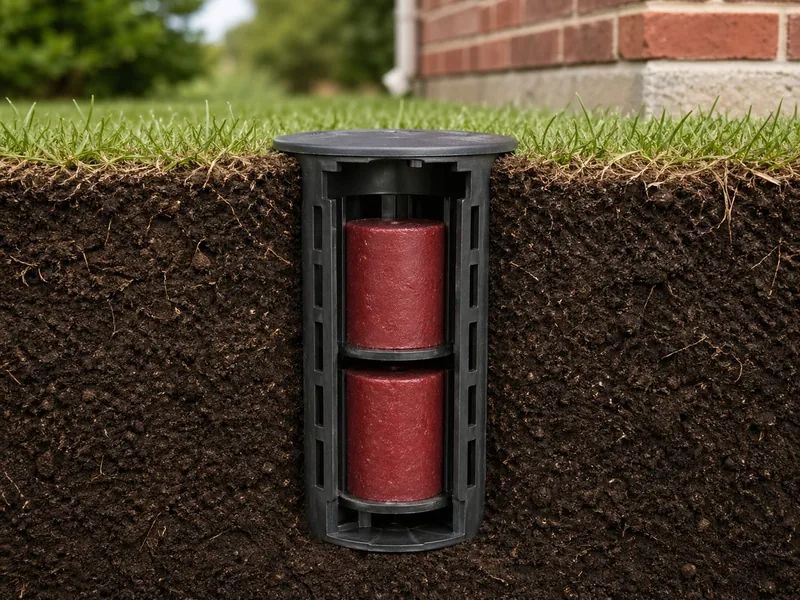
They do different jobs, and both can work. Texas A&M AgriLife says bait stations may take a few months to more than a year to control a colony, with frequent visits. The University of Kentucky says liquids are usually more reliable on the first attempt, while baits bring numbers down gradually as termites share the bait.
Mississippi State University Extension says bait stations are usually not used on their own against termites already inside a building: the active feeding is treated with liquid, and the baits are then used for long-term prevention. The EPA describes the baits as cellulose, the plant fiber termites eat, with a slow-acting insecticide in it, and the Kentucky guide says the termites that feed on it share it with their nest mates. The Kentucky guide says it can take weeks or months for termites to find the stations in the ground, and months more for the bait to work.
Can you stay home during termite treatment?
Ask before the work starts, because the answer is on the product label. The EPA says to make sure the applicator has told you when you may go back into the building, and that the time before a home can be lived in again varies by product and is printed on its label. You can ask for a copy.
Fumigation under a tent is a different treatment. Texas A&M AgriLife says fumigants are used for drywood termites and for Formosan termite nests above the ground, which do not need contact with the soil. The same guide says the house is aired out after fumigation before anyone goes back in, and that fumigation leaves nothing behind to stop the next infestation. Our article on signs of subterranean termites covers how to tell what you have.
How Pest Me Off treats termites
A termite job in McKinney, Plano, Frisco or Allen starts with an inspection of the crawl space, attic, garage and every outside foundation surface, with in-wall detection that finds termite activity behind finished walls without cutting into them. That decides where the termites are feeding before anything is put down.
We install Trelona in-ground bait stations every 10 feet around the full foundation, and check them on a schedule. Where termites are feeding now, we add targeted liquid treatment along the affected sections of the foundation, rather than treating the whole perimeter by default, and foam goes into wall cavities where in-wall detection confirms activity above the floor. Every treatment location is photographed. Our termite treatment page explains the service, and the eastern subterranean termite and Formosan termite library pages cover the two subterranean termites in our pest library. Buying a house? Read termite inspections before you buy.
Wondering what treatment your house needs for termites? Same-day pest control in McKinney and the surrounding cities when you call before noon.
We inspect first, find where the termites are feeding, and match the treatment to it: bait stations around the foundation, with liquid and foam where termites are active now.