
Common House Spiders in Texas, and the Two That Are Dangerous
The common house spiders in Texas are the southern house spider, the common house spider, the cellar spider, the wolf spider and the jumping spider, and none of them is dangerous to people. Only two kinds of spider in Texas are considered medically significant, the brown recluse and the widow spiders. Pest Me Off’s technicians sort one from the other on every spider call across Collin County, because a harmless brown spider and a brown recluse need very different treatment.
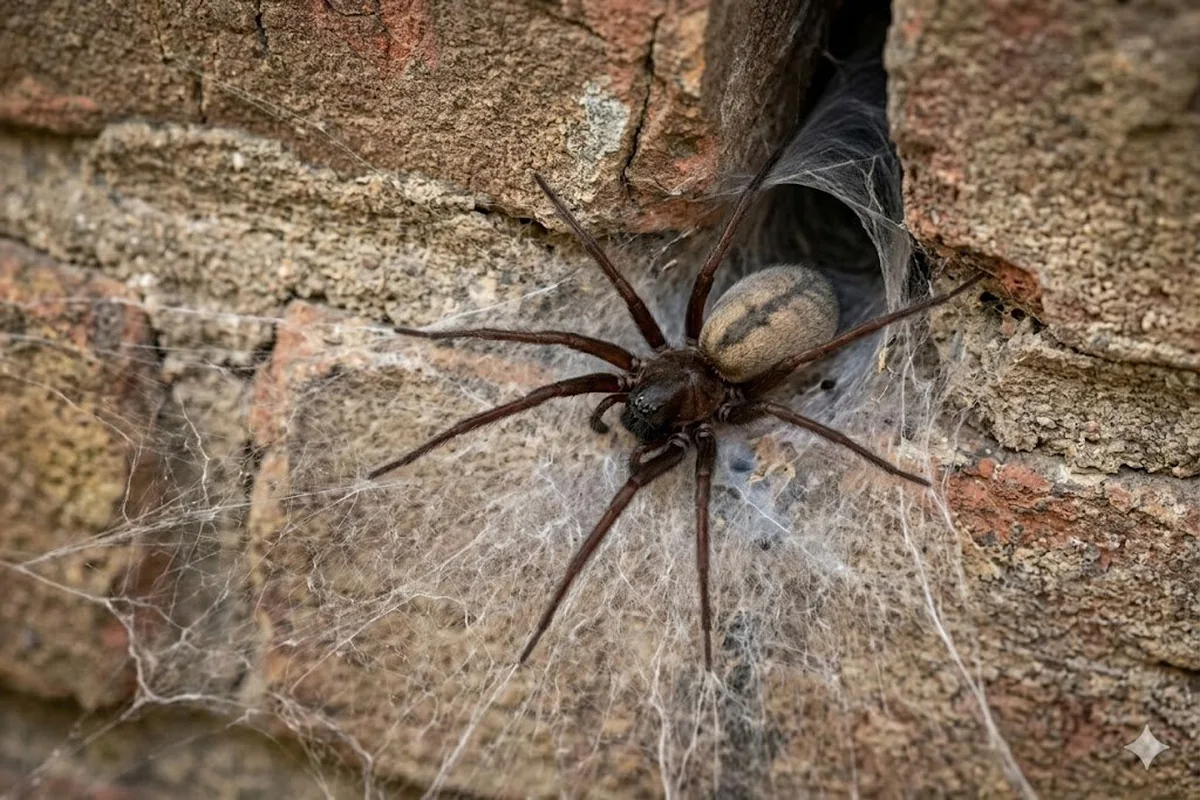

- Only 2 types of spider in Texas are considered medically significant, the brown recluse and the widow spiders.
- A brown recluse has 6 eyes in 3 pairs, where most other spiders have 8.
- The southern house spider is not known to have a dangerous bite, though its males are often mistaken for a brown recluse.
- The brown recluse is seen most in the spring months, and hunting spiders such as wolf spiders wander into homes accidentally, particularly in the fall.
- Hundreds to thousands of wolf spiders may live in an average backyard lawn.





The common house spiders in Collin County homes
Seven spiders account for nearly every spider Pest Me Off finds inside a Collin County home. Five are harmless, and the two that are not look nothing alike, so the quickest sort is where the spider sits and what its web looks like.
| Spider | Where you see it | What it looks like | Dangerous? |
|---|---|---|---|
| Southern house spider | A flat, woolly web around a crack in brick, a window sill or an overhang, males wandering the floor | Female charcoal gray, 1/2 to 3/4 inch, male khaki to amber with very long legs | No, it is not known to have a dangerous bite |
| Common house spider | Tangled cobwebs in room corners, windows, garages and crawl spaces | Grayish to brownish, round abdomen with chevron marks | No, its fangs rarely pierce skin |
| Cellar spider | Loose webs in ceiling corners, garages and crawl spaces | Pale, small body on very long thin legs | No, it is harmless |
| Wolf spider | Running across the floor at night, often under a door, no web | Hairy, mottled brown and gray, two dark stripes on the front body | No, not generally dangerous to people or pets |
| Jumping spider | On walls, windows and sunlit surfaces by day, no web | Stocky, some black with white bands, one big pair of front eyes | No, it rarely bites unless handled |
| Brown recluse | Hidden in closets, attics, stored boxes and wall voids, out at night | Tan to dark brown, violin mark, 6 eyes, plain legs | Yes, a bite can become a slow-healing sore |
| Black widow | Wood piles, garages, crawl spaces and gas and electric meters | Shiny black female with a red hourglass underneath | Yes, the venom affects the nervous system |
Five of these seven are harmless, and only the brown recluse and the black widow are dangerous.
The big webs strung across porches and garden beds belong to outdoor spiders, the orb weavers. The best known is the black and yellow garden spider, which the Texas A&M AgriLife Extension guide to spiders calls common in Texas, and orb weavers are harmless to people.
The cellar spider is the one many people call a daddy long legs. Minnesota’s extension entomologists say its 1/4 to 1/3 inch body sits on long, delicate legs that resemble a daddy longlegs. Texas A&M points out that the true daddy longlegs, the harvestman, is not a spider at all and has no venom.
Are house spiders poisonous?
House spiders carry venom, as almost all spiders do, but the common house spiders in Texas are not dangerous to people. Texas A&M AgriLife Extension says almost all spiders use venom on their prey, yet only two types in Texas are considered medically significant, the brown recluse and the widow spiders.
The southern house spider, the common house spider, the cellar spider, the wolf spider and the jumping spider are not on that list.

House spiders usually cannot even get a bite in. The University of California guide to spiders says spider jaws are usually too small to bite a person, and that the common house spider and the cellar spider are only marginally able to, because their fangs are usually too short to pierce skin. The southern house spider is not known to have a dangerous bite, according to the University of Florida page on the southern house spider, and the two bites it records caused pain and swelling for up to two days.
Which spiders in Texas are dangerous?
Only two kinds of spider in Texas are considered medically significant, the brown recluse and the widow spiders, such as the southern black widow. That is Texas A&M AgriLife Extension’s wording, and it adds that sac spiders can also give a noticeable bite.
A brown recluse bite can turn into a slow-healing sore, and a black widow bite affects the nervous system and needs a doctor.
A brown recluse bite is often painless at first and, Texas A&M says, can turn mildly to severely painful 2 to 8 hours later. A blister usually forms about 24 hours after the bite and a slow-healing lesion within 1 week, and the University of Kentucky fact sheet on the brown recluse adds that bites usually stay small and heal within 3 weeks without serious trouble. Brown recluses bite when they are pressed against the skin, in a bed, a shoe or a piece of clothing.
Black widows, usually the southern black widow on Pest Me Off’s calls, turn up in Collin County yards. Texas A&M finds them in wood piles, garages, crawl spaces, rain spouts and gas and electric meters. Within 1 to 3 hours of a bite, pain can spread through the body and last 2 to 3 days, and Texas A&M advises anyone bitten to go to a hospital emergency room for the right antivenom.
How do you tell a house spider from a brown recluse?
Look at the eyes and the legs. A brown recluse has 6 eyes set in 3 pairs, where most other spiders have 8, and its legs are one even color with no bands, stripes or spines. The dark violin mark on its back helps, but the University of California warns the mark is not always clear enough to rely on.
The male southern house spider is a harmless brown spider often mistaken for one.
The University of Florida spells out the difference: the male southern house spider has 8 eyes grouped together on a small raised bump, much longer legs than a brown recluse, and a narrow brown stripe behind its eyes rather than the recluse’s wider violin. A wolf spider is the other common mix-up, and Texas A&M points to its dark stripes, its missing violin mark and the large pair of eyes on top of its head. The web is a clue too. Kentucky’s entomologists note that a brown recluse does not hang a web along walls and ceilings, so a spider sitting in a corner web is almost always something else.
Six eyes alone do not make a recluse. The woodlouse spider has 6 eyes too. Minnesota Extension describes it with a purplish-brown front body, a grayish-white abdomen and orange legs, hunting pillbugs at night. Texas A&M adds the harmless spitting spider, which shares the eye pattern but has banded legs and a spotted, domed front body. The brown recluse also goes by violin spider and fiddleback spider, the University of Kentucky notes, after the mark on its back. Our guide to the signs of a brown recluse infestation covers what a real one leaves behind.
Why are there so many spiders in my house all of a sudden?
A sudden rush of spiders indoors is usually males on the move, plus insects drawing them in. University of California entomologists say the large hunting spiders found in homes are often adult males searching for females, and University of Minnesota Extension says hunting spiders wander into homes particularly in the fall.
Rain can set them moving too. The University of California says burrowing spiders sometimes wander for a time in the rainy season after wet burrows force them out.
New building nearby makes it worse. The University of California notes that houses in new developments can be invaded by wolf spiders that have lost their outdoor homes, which is what neighborhoods on the growing edges of McKinney, Prosper and Celina see when the field next door is cleared. The University of Minnesota Extension page on spiders adds the good news: hunting spiders do not survive well indoors and usually do not breed there. Web spiders are different, because a single egg sac can hold hundreds of young spiders.
When is spider season in Texas?
Spiders are around all year in Texas, but sightings come in waves. Texas A&M AgriLife says the brown recluse is seen most often in the spring months and stays active outdoors from spring through fall, and year-round in climate-controlled homes, attics and garages. Fall brings wandering males and a yearly drift of baby spiders on silk.
| Season | What you see | Who says so |
|---|---|---|
| Spring | The brown recluse seen most often, active outdoors from spring on | Texas A&M AgriLife |
| Summer | Female wolf spiders carrying egg sacs and then young on their backs, garden spiders in big round webs by late summer | Texas A&M AgriLife, University of Minnesota |
| Fall | Hunting spiders wandering indoors, wolf spiders mating, baby spiders ballooning on silk | University of Minnesota, Penn State, Texas A&M |
| Winter | The brown recluse still active in heated homes, attics and garages, mated female wolf spiders sheltering in buildings | Texas A&M AgriLife, Penn State |
Spiders are present all year, and what changes by season is which ones you see and where.
The fall wave can even be seen in the sky. In late September 2013, Dallas television and radio stations reported white silk drifting down out of the sky, and Texas A&M’s Insects in the City blog explained it was spider silk from a mass dispersal that happens every year, especially in the fall. Baby spiders climb a grass stem or a fence post, let out silk and ride the wind, a habit called ballooning. By Texas A&M’s estimate, hundreds of spiders go into a single visible clump of silk.
Do spiders come inside when it gets cold?
Some do, but most of them wander in by accident. University of Minnesota Extension says hunting spiders wander into homes accidentally, particularly in the fall. Penn State Extension says wolf spiders mate in autumn, the males die before winter, and mated females spend the winter in sheltered places, buildings included.
What you find indoors in winter is mostly what already lived there. Texas A&M says the brown recluse can stay active year-round in climate-controlled spaces. Kentucky’s entomologists add that it can withstand winters in unheated spaces and the summer heat of attics, going many months without food or water. Penn State adds that the wolf spiders that spend the winter sheltered produce egg cocoons the following May or June.
What attracts spiders to your house?
Insects and hiding places. Outdoor lights draw night-flying insects, and the spiders follow them, Texas A&M and the University of California both say. Clutter, stored boxes and firewood by the foundation give spiders cover, and Texas A&M adds that piles of clothes and wet towels draw wandering spiders such as the brown recluse.
The color of the bulb matters. In a Texas A&M Insects in the City post on spider problems, the author explains that night-flying insects are drawn most strongly to UV light. Yellow bug bulbs or low pressure sodium security lights therefore cut the spider food drawn to a house. The same post calls lakeside houses spider heaven, because lakes produce midges, mosquitoes and other flying insects. California’s extension entomologists sum it up: the more insects a building holds, the more likely it is to have spiders living there.
Brown recluses also follow clutter indoors. The Texas A&M post from October 2025 on widow and recluse spiders finds them in garages, firewood piles, bathrooms, bedrooms, closets and anywhere that gives a snug fit, and advises shaking out shoes, clothes, towels and linens that have sat undisturbed for a long time.
How to cut down the spiders in a house
- Vacuum the spiders, the webs and the egg sacs, and empty the vacuum outside. Each egg sac can hold hundreds of young spiders.
- Switch the lights by the doors to yellow bug bulbs, which draw fewer of the night-flying insects spiders come to eat.
- Add door sweeps, fix torn window screens and seal the gaps around doors and windows, where wolf spiders walk in.
- Move firewood and stacked pots away from the foundation and trim back shrubs that touch the house.
- Tape stored cardboard boxes shut or switch to lidded plastic bins, so a brown recluse has nowhere to hide.
How Pest Me Off handles house spiders
Pest Me Off’s spider control starts by naming the spider, so a harmless southern house spider is never treated like a brown recluse and a brown recluse is never waved off as a house spider. A technician clears the webs and egg sacs, treats the foundation, the door thresholds and the gaps spiders walk through, and treats for the insects they feed on, because fewer insects means fewer spiders. Where a brown recluse or a black widow turns up, the inspection widens to the attic, the garage, closets and stored boxes.
Quarterly visits renew that barrier as new spiders press in from the yard, and the spring and fall waves are when it matters most. Same-day service is available for McKinney and the surrounding cities when you call before noon, with no-contract options. Our guide to where spiders hide in your home shows the spots to check first.
Spiders turning up all over the house? Same-day pest control in McKinney and the surrounding cities when you call before noon.
We confirm which spider you have, clear the webs and egg sacs, and treat the foundation, the gaps spiders walk through and the insects they feed on. No-contract options.