House Fly Myths McKinney Homeowners Get Wrong
A house fly is not harmless, does not live for a single day, and cannot bite you. Those three house fly myths get McKinney homeowners to shrug off what is really a food-safety problem. Flies pick up bacteria on garbage and pet waste, then track it onto counters and food. The flies you see are the symptom. A breeding source nearby is the cause.

- Adults live about two to four weeks, not the single day of legend.
- A female can lay up to 500 eggs, and eggs reach adult flies in 7 to 10 days in warm weather.
- They cannot bite. The biting look-alike outdoors is the stable fly.
- They can carry more than 100 disease-causing germs from filth onto your food (CDC).
- Killing adults does nothing about the breeding source, which is what has to be removed.





House fly identification and biology
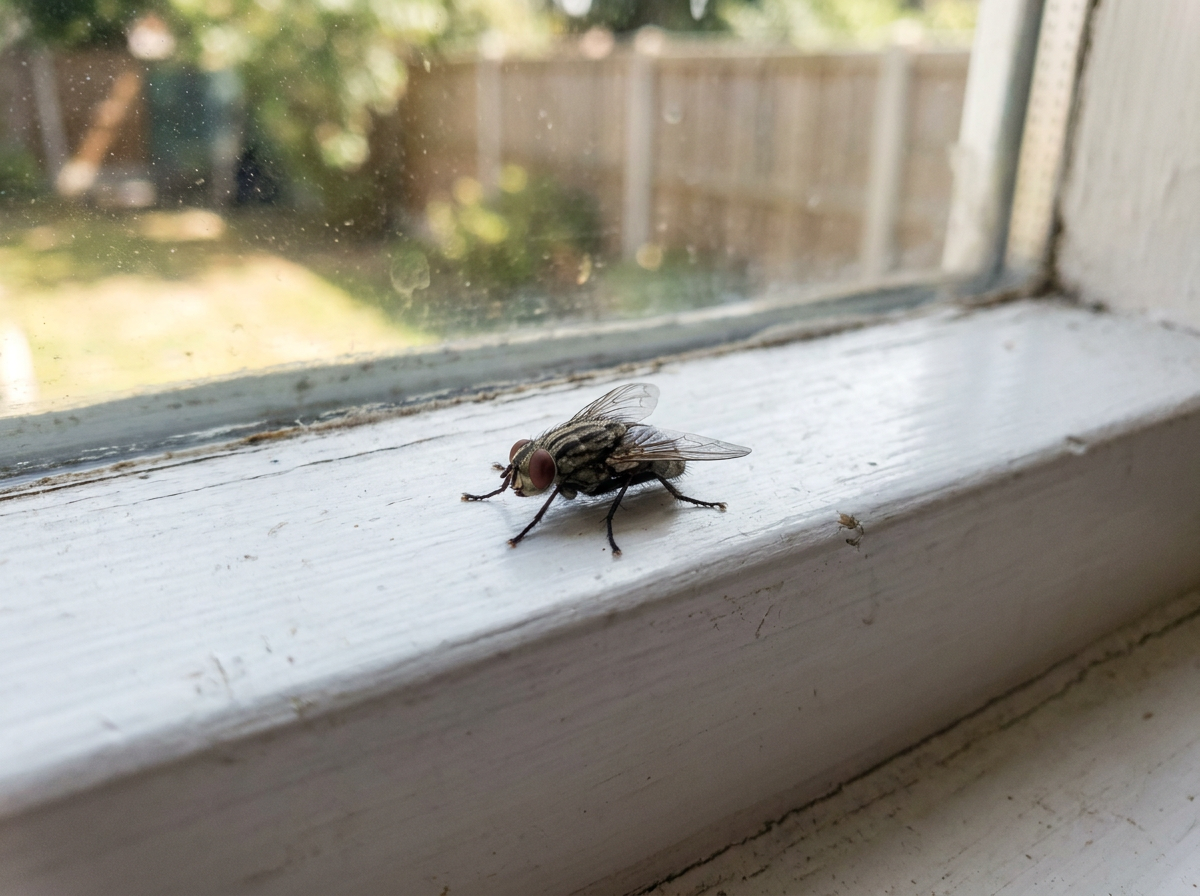
The common house fly (Musca domestica) is about a quarter inch long, dull gray, with four dark stripes down its back and large reddish eyes. It has sponging mouthparts rather than biting ones, so it feeds by dribbling saliva onto food to dissolve it, then sponging the liquid back up. According to Texas A&M AgriLife Extension, a house fly develops from egg to adult in as little as 7 to 10 days in warm weather, which is why a small summer fly problem in McKinney turns into a large one within two weeks.
- Where they breed. Moist, decaying organic matter: garbage, pet waste, compost, grass clippings, and spilled food in and around trash cans.
- How many. A single female can lay up to 500 eggs across her short life, in batches on decaying material.
- Why they matter. House flies walk on filth, then on your food, carrying bacteria from one to the other.
How long do house flies actually live?
The one-day insect is a mayfly, not a house fly. Adult house flies live about two to four weeks, and a female spends that time laying hundreds of eggs. That lifespan is exactly why ignoring the first flies for a week turns into a kitchen full of them a couple of weeks later.
Are house flies actually dangerous?
They are a food-safety problem, not just a nuisance. A house fly can carry Salmonella, E. coli and Shigella, picked up from garbage and waste, and because it liquefies food by regurgitating onto it before feeding, every landing is a chance to leave germs on the surface.
 Source: U.S. Centers for Disease Control and Prevention
The CDC reports that house flies pick up these pathogens from garbage and waste and leave them behind when they land on food or a counter. That is the real reason to control them, not just the buzzing.
Do house flies bite?
No. House flies have sponging mouthparts and physically cannot pierce skin. The biting culprit outdoors is almost always the stable fly, a near-perfect look-alike that feeds on blood and hangs around McKinney yards with livestock, stables, or wet straw and grass clippings.
House fly, fruit fly and stable fly, told apart
Three very different flies get called the same thing in McKinney kitchens and patios. Telling them apart tells you what to fix.
| Fly | Size and look | Where you see it | Bites? |
|---|---|---|---|
| House fly | About a quarter inch, gray, four back stripes | Kitchens, trash cans, counters | No |
| Fruit fly | About an eighth inch, tan, red eyes | Fruit bowls, recycling, drains | No |
| Stable fly | Looks like a house fly, sharp beak | Yards, patios, near livestock | Yes |
The rule is simple. If it is biting, it is not a house fly. If it hovers over the fruit bowl, it is a fruit fly. Our guide on how and why fruit flies enter your home covers that kitchen version in detail.
Why do I suddenly have so many flies in my McKinney kitchen?
A sudden indoor swarm almost always means a breeding source is close and active. Summer heat in McKinney speeds fly development to about a week from egg to adult, so an overflowing trash can, pet waste in the yard, a dirty recycling bin, or a dead animal in a wall can produce hundreds of flies fast.
Finding and removing that source matters more than any spray.
How Pest Me Off treats a house fly problem in McKinney
Zappers and sprays knock down some adults and do nothing about the eggs and maggots in the breeding source outside, so new flies keep hatching. Because flies are produced by a source, Pest Me Off treats the cause: our technicians track down the decaying matter, pet waste, wet drain, or dead animal the flies come from, then treat where flies rest and breed. For steady outdoor pressure, exterior fly bait stations and a residual perimeter treatment keep new arrivals down.
Every fly visit includes a search of the yard and the house for the breeding source, treatment where the flies rest and breed, and exterior bait stations where outdoor pressure is steady. The price is set after a free look at the property, so it fits the home rather than an average.
Fly pressure in McKinney peaks from roughly June through September, when summer heat drops fly development to about a week. Quarterly general pest control keeps the sanitation and exclusion gaps that draw flies in check across that window, with no-contract options. Flies share this habit with cockroaches, which also multiply out of a hidden source. See where cockroaches breed. For same-day service when you call before noon, see pest control in McKinney.
Can I DIY a House Fly Problem or Should I Hire Pest Control?
You can handle most house fly problems yourself by removing where they breed and keeping screens tight. The University of California says sanitation along with screens should be sufficient, and that sprays are no substitute for getting rid of breeding sites. Outdoors, it says a professional pest control company can treat the walls and overhangs where flies rest.

Ryan has spent more than 16 years in pest control and wildlife management across McKinney and Collin County, from inspecting homes and treating infestations to sealing the entry points pests use to get in. He built Pest Me Off on that field experience, and every technician on the team is trained against it.
More about the Pest Me Off teamFlies taking over your kitchen or patio in McKinney? Same-day pest control in McKinney and the surrounding cities when you call before noon.
We track down the breeding source the flies are coming from, treat it, and keep new ones out with exterior bait and a perimeter barrier. Free estimate. No-contract options.