
How to Tell If You Have Bed Bugs, and What the Bites Look Like
The surest way to tell if you have bed bugs is to find the bugs or what they leave behind: rusty smears on the sheets, black dots along the mattress seams, and pale shed skins in the folds. Bites alone cannot prove it, because bed bug bites look like mosquito or chigger bites and some people never react at all. In Pest Me Off’s bed bug inspections across McKinney and Collin County, the first live bugs nearly always turn up close to the pillow, in the mattress piping or the headboard joints.
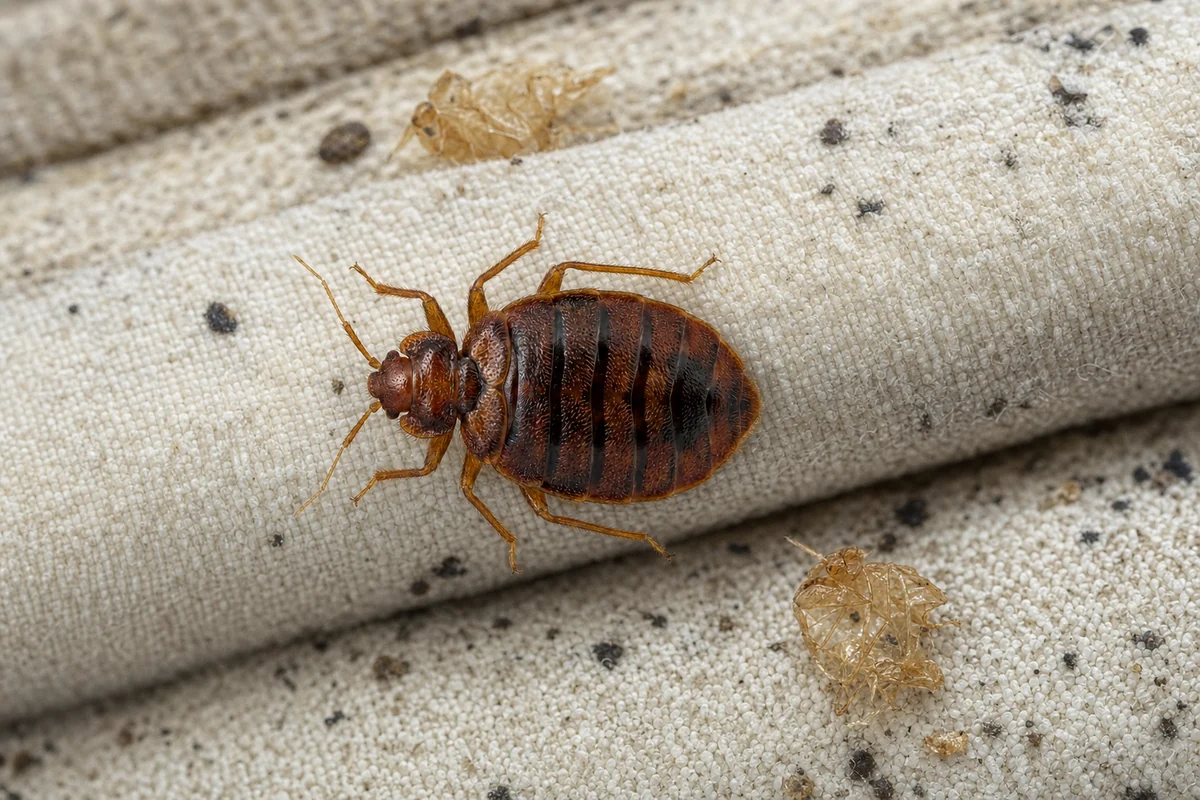

- An adult bed bug is about the size of an apple seed, 5 to 7 millimeters long, flat and reddish brown.
- About 30 percent of people show no reaction to bed bug bites, even when bitten again and again.
- One female lays 1 to 3 eggs a day and 200 to 500 over her life.
- Bed bugs cannot fly or jump. They crawl 5 to 20 feet from a hiding spot to feed.
- Bed bugs die when their bodies reach 113 degrees, which is why bedding goes through a hot dryer.




What do bed bug bites look like?
Bed bug bites are small, red, itchy welts, often grouped together, on skin left uncovered in bed such as the arms, shoulders, neck and face. About 30 percent of people never react at all, according to the University of Kentucky’s entomology department, which is why bites alone never confirm bed bugs.
The welts can show within a day, but the reaction can take days or even weeks to show.

The bites themselves are not known to spread disease. The University of Kentucky notes that bed bugs can carry germs, but passing them to people has never been proven and is considered unlikely. The real harm is the itching, the scratching and the lost sleep, which is reason enough to find the source fast.
Bed bug, flea, chigger and mosquito bites, told apart
Where the bites are, and when they appeared, says more than how they look. Texas A&M AgriLife’s guide to mystery bites sorts the common biters this way.
| Biter | Where the bites land | The other clue |
|---|---|---|
| Bed bugs | Any skin left uncovered in bed: arms, shoulders, neck, face | Bites appear after sleeping, with stains or dark spots on the mattress |
| Fleas | Mostly the lower legs and ankles | A dog or cat in the house, where cat fleas breed |
| Chiggers | Under socks and around the waistband, where clothing is tight | Time outdoors in grass or weeds, with itching hours later |
| Mosquitoes | Whatever skin was bare outdoors, scattered rather than grouped | Time spent outdoors rather than in bed |
Bites on the ankles point to fleas, and bites around the waistband point to chiggers.
What are the signs of bed bugs on a mattress?
The signs of bed bugs on a mattress are rusty stains, dark spots that bleed into the fabric like a marker, tiny pale eggs and shed skins, and the live bugs themselves. The stains come from crushed bugs, the dark spots are about the size of a pen tip, and the eggs and skins are about one millimeter long.
The US Environmental Protection Agency calls these physical signs a more accurate test than bites.
| What you see | What it means |
|---|---|
| Rusty smears on sheets | A bed bug was crushed after feeding, usually by someone rolling over in the night |
| Black dots on seams | Bed bug droppings, digested blood that soaks into fabric the way ink does |
| Pale, empty skins | Young bed bugs shed their skin five times as they grow, so skins mean a breeding population |
| Tiny white eggs | Pinhead sized and sticky, tucked into seams and joints, and the hardest sign to spot |
| A musty sweet odor | Glands on the bugs give off the smell, noticeable only when a room is heavily infested |
Check with a flashlight along the mattress piping, under the tag, at the corners of the box spring and in the screw holes of the bed frame. The EPA’s guide to finding bed bugs adds that females lay 1 to 3 eggs a day and 200 to 500 over a lifetime, so bugs found early are a far smaller job than the same bed a month later.
Where do bed bugs hide?
Bed bugs hide in the piping, seams and tags of the mattress and box spring and in the cracks of the bed frame and headboard, close to where people sleep. As a home fills up, they spread to couch seams, curtain folds, drawer joints, electrical outlets and the line where the wall meets the ceiling.
The EPA’s rule of thumb is that a crack that will hold a credit card can hide a bed bug.
They stay close because they do not need to go far. According to the EPA, a bed bug will travel 5 to 20 feet from its hiding place to feed and takes 3 to 12 minutes to fill up, then walks straight back. Bed bugs cannot fly or jump like fleas, as the University of Kentucky points out, so where you find one is close to where it fed.
How do you get bed bugs in your house?
You get bed bugs by carrying them in, almost always in luggage, clothing, a used mattress or secondhand furniture. They are hitchhikers, not a sign of a dirty home, and the University of Kentucky lists hotels and apartments as the classic sources because people pass through them constantly.
Bed bugs feed only on blood, so a spotless home is no protection.
After a trip, unpack straight into the washing machine rather than onto the bed, and check the seams of a suitcase before it goes back in the closet. Used furniture deserves a flashlight inspection before it comes through the door, and a used mattress is rarely worth the risk.
What to do tonight if you think you have bed bugs
- Catch one if you can. Press clear tape over the bug or drop it into a sealed bag, so it can be identified rather than guessed at.
- Strip the bed and run sheets, pillowcases and blankets through the dryer on high heat. The EPA notes bed bugs die once their bodies reach 113 degrees.
- Stay in your own bed. Moving to the couch or a guest room invites the bugs to follow you and spreads them to a second room.
- Leave furniture where it is. Carrying a mattress or nightstand through the house drops bugs along the way.
- Skip the bug bomb. A fogger does not reach into mattress seams and wall cracks, and it pushes the bugs it does touch deeper into the walls.
- Book an inspection, so the rooms affected and the work needed are known before anything is treated.
Why store sprays and bug bombs rarely end a bed bug problem
Bed bug eggs sit inside a protective coating, so a spray that kills the adults leaves the eggs to hatch about a week later and start the cycle again. Store sprays only work where they touch, and bed bugs spend nearly all their time in seams and cracks the spray never reaches. That is the reason Pest Me Off never fogs a bedroom: a fog cannot reach where the bugs are, and it scatters the ones it does reach.
How Pest Me Off treats bed bugs
Pest Me Off’s bed bug treatment starts with a free inspection that maps which rooms have bed bugs, so the quote and the number of visits are known before any product is applied. On the treatment visit, a licensed technician treats every place the bed bugs hide, from mattress seams and box spring folds to headboard joints and the baseboards beside the bed, and treats the routes they travel to reach you. Nothing is fogged into the air.
Every bed bug job includes a return visit 10 to 14 days later, timed for after the next round of eggs hatches and before those young bugs can lay eggs of their own. The technician re-inspects every treated room and treats anything still active. Severe cases get a third visit, agreed at the first inspection. Same-day service is available for McKinney and the surrounding cities when you call before noon, with no-contract options.
Found bed bugs, or bites you cannot explain? Same-day pest control in McKinney and the surrounding cities when you call before noon.
We start with a free inspection that maps which rooms have bed bugs, treat every seam, joint and crack they hide in, and come back 10 to 14 days later to catch the next hatch. Nothing is fogged. No-contract options.
