
Camel Crickets, the Spider Crickets in Garages and Laundry Rooms
The silent, humpbacked cricket that leaps at you from a dark garage corner goes by three names, camel cricket, spider cricket and cave cricket. This article covers whether it is a real cricket, why it comes inside in the fall, whether it is blind or harmful, what it eats and where it lives in Texas.
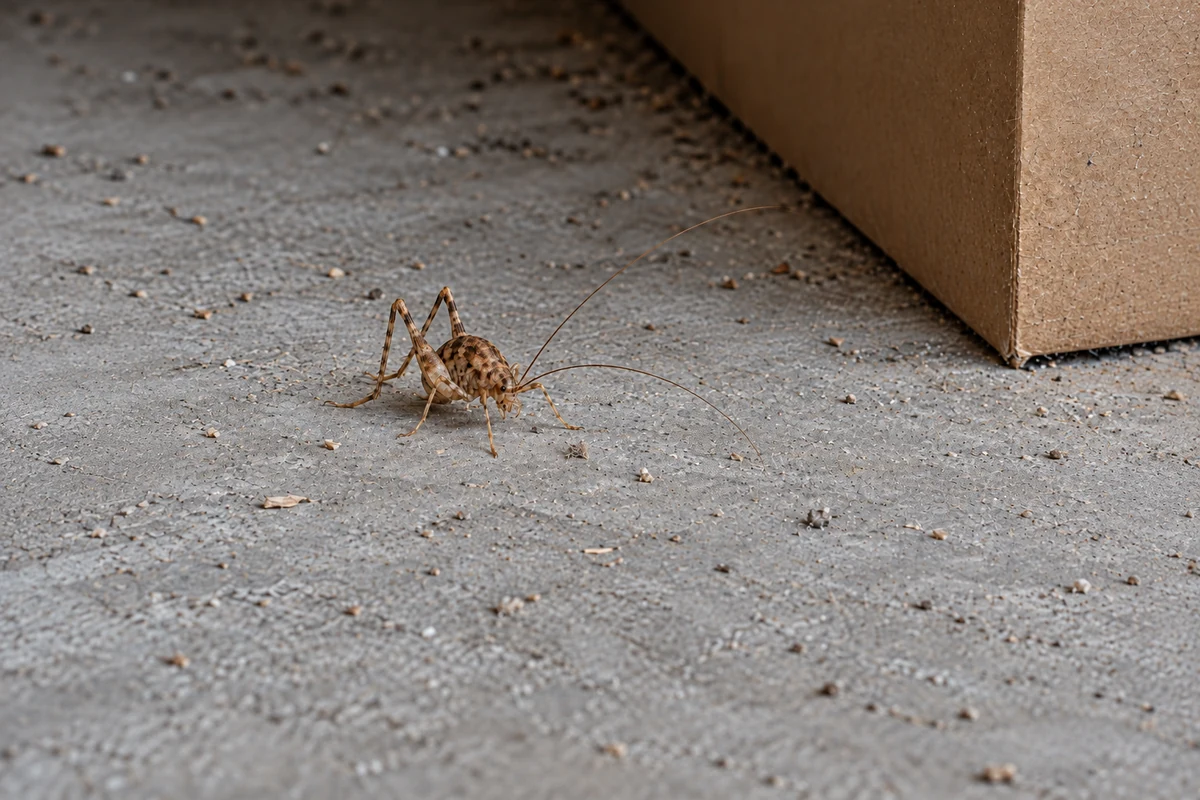

- Camel cricket, spider cricket and cave cricket are three names for the same wingless, humpbacked insect.
- They move into garages and crawl spaces in the fall, looking for a place to spend the winter.
- They come out at night and are not drawn to porch lights.
- They cannot bite, sting or chirp, and carry no venom.
- Left alone in a damp garage, they can chew cardboard, paper and stored linens.





Are camel crickets real crickets?
They are cricket relatives with a family of their own. A University of Michigan site, BioKIDS, files them under Orthoptera, the order of crickets and grasshoppers, in the family Rhaphidophoridae. The University of Missouri says they have jumping hind legs and long antennae like other crickets, but no wings, so they cannot chirp.
Camel crickets and spider crickets are the same insect. The University of Missouri Extension says the camel name comes from the humped back you see from the side, and the cave cricket name from how often they live in caves. NC State Extension says their long legs give them a spider-like look, which is where spider cricket comes from. Count the legs: a camel cricket has 6 and a pair of long antennae, a spider has 8 and none.
Missouri says most species belong to the genus Ceuthophilus and grow 0.5 to 1.5 inches long, light tan to brown with dark bands. A 2014 NC State University study found an Asian species, the greenhouse camel cricket, in eastern United States houses far more often than the native kinds. The black, chirping crickets that pile up at a garage door in the fall are field crickets, a different insect our articles on black crickets and crickets and grasshoppers cover.
Why do camel crickets come into the house in the fall?
They are looking for a place to spend the winter. The University of Missouri says camel crickets, like other crickets, invade buildings in the fall seeking suitable places to pass the winter. NC State Extension adds that long spells of heavy rain or of hot, dry weather push them toward cool, damp spots in and around homes.
NC State lists where they end up: storage buildings, crawl spaces, garages and the damp rooms of a house, such as bathrooms and laundry rooms. Collin County homes sit on concrete slabs, so here that means the garage, the laundry room, the gap under a worn door sweep and the crawl space on homes that have one. NC State says they pass the winter as young or adults, so the crickets in a damp garage in October can still be there in spring.
Spider crickets in a crawl space are the hardest to reach. NC State says to seal the crawl space access door, and that baits placed in the corners or along the sill plate work best there. It warns that spraying in a confined crawl space needs caution and the proper safety equipment, and that the granular baits suited to it are not readily available to the public.
Are camel crickets blind?
No, but they barely use their eyes. Michigan’s BioKIDS site says a native camel cricket has well-developed eyes but weak eyesight, does not rely on them and is sensitive to light. It finds food and mates with its antennae and mouthparts, by touch and smell, and it senses air currents.
Those antennae are the giveaway. BioKIDS measures them at 44 to 52 mm on a cricket whose body is only 14.5 to 16 mm long.

Are camel crickets nocturnal? Yes. BioKIDS says they are rarely active during the day, stay under stones and logs to avoid light and dive for cover when a light hits them, and Clemson Extension says they are active at night. The University of Minnesota Extension says camel crickets are not attracted to light, so changing the porch bulb does nothing for them.
Are spider crickets harmful?
Not to people. PestWorld, the National Pest Management Association’s guide, says camel crickets are neither poisonous nor venomous and are not known to carry diseases. The harm is to stored things. NC State Extension says they can damage garments and linens packed in boxes in a garage when they cannot find other food.
PestWorld says they have no fangs and no way to bite, and our camel cricket library page explains why the leap at you is a startle, not an attack. Clemson says they can also damage fine fabrics and houseplants indoors.
The damage is usually small. The University of Maryland Extension says cricket chewing on fabric usually goes unnoticed unless dozens are in the home, and Missouri says camel crickets that winter indoors seldom damage items. NC State says dark smears on surfaces such as floor joists are the telltale sign of a heavy infestation.
What do camel crickets eat?
Almost anything decaying. BioKIDS, from the University of Michigan, calls camel crickets scavengers of decaying matter such as mushrooms, dead insects, fruits and flowers, and PestWorld adds wood, carpet, fungi, cardboard and even other camel crickets. In a garage, that means cardboard boxes, damp debris and the dead insects in the corners.
Minnesota says that outdoors they feed on plant debris and indoors they sometimes eat paper products but rarely fabrics. Clemson says their chewing mouthparts handle animal products, plants, fabrics and other insects. BioKIDS notes that females eat their mates, and that camel crickets eat young camel crickets, even when other food is around.
PestWorld gives camel crickets a lifespan of about 1 to 2 years and says they can live without enough food, which is why a garage corner can hold them for months. Moving stored clothes and linens out of cardboard and into sealed plastic bins takes away both the food and the hiding place.
Are there cave crickets in Texas?
Yes. Michigan’s BioKIDS site says the native black-sided camel cricket ranges from the eastern United States as far west as Texas or Nebraska. Texas A&M AgriLife in El Paso County logged one Ceuthophilus camel cricket in an old Franklin Mountains mine in 2015. Closer to home, our service notes show camel crickets in McKinney, Melissa and Blue Ridge.
That mine record, on the Texas A&M AgriLife El Paso County page, found on 11-07-2015, is a single far west Texas record of a species apparently not recorded that far west before, so it says little about Collin County homes. In Collin County, a damp garage or crawl space stands in for the cave.
Our own service notes from 2025 and 2026 find them mostly from early summer into early fall, in laundry rooms, behind kitchen appliances and on walls near crawl spaces. On a Melissa job in July 2025, the homeowner expected field crickets and we found tan, humpbacked camel crickets clustered on a wall instead.
Camel crickets, field crickets and house crickets side by side
Sizes, colors, songs and where each settles indoors come from the University of Maryland Extension, the garages from NC State Extension, and the pull of lights from the University of Minnesota Extension.
| What to check | Camel cricket | Field cricket | House cricket |
|---|---|---|---|
| Size | 1/2 to 1 1/4 inches | 1/2 to 1 1/4 inches | 3/4 to 7/8 inch |
| Color and shape | Tan to dark brown, humped back | Stout and black | Light yellowish brown, 3 dark bands on the head |
| Wings and chirping | No wings, silent | Wings, males sing | Wings, males sing |
| Drawn to porch lights | No | Yes, strongly | Yes, strongly |
| Where it settles indoors | Damp crawl spaces and garages | Lower floors | Anywhere warm |
A chirp in the wall is never a camel cricket. Maryland says only house and field crickets sing.
Five fall jobs that keep camel crickets out of the garage
- Fit weather-stripping to the bottom of the garage and house doors so it seals tight against the threshold, and caulk gaps around window frames, doors, the foundation, dryer vents and where pipes and AC lines pass through the foundation, as NC State advises.
- Lift boxes off the floor and away from the walls. NC State says it improves airflow and makes it easier to spot crickets, and sealed plastic bins keep stored linens safe.
- Dry out the damp spots. Fix leaks, run a dehumidifier and keep the crawl space well ventilated, as PestWorld advises, since Maryland says solving high moisture greatly reduces or eliminates camel crickets.
- Pull mulch and ground cover at least 12 inches back from the foundation, and keep firewood off the house walls, as NC State advises.
- Set sticky traps in corners and behind the washer and dryer. Missouri says sticky traps work especially well on camel crickets, and a vacuum takes care of the rest.
How Pest Me Off gets rid of camel crickets
On a cricket control visit, the free inspection covers the garage, laundry room, crawl space and foundation, and we confirm it is a camel cricket and not a field cricket, because the two need different plans. A licensed applicator treats the damp, low-light zones where camel crickets rest: the garage corners, behind shelving and around the laundry and utility areas.
Outside, we treat along the foundation and the edges of the mulch beds, with bait granules worked into the beds where a liquid cannot reach. Then we seal and treat the gaps they use on a slab home, the garage door sweep gap, the brick weep holes, the slab expansion joints and the door thresholds. Pets and kids are back inside in 1 to 2 hours, with same-day service when you call before noon, in McKinney, Plano, Frisco, Allen and across Collin County. Our camel cricket page in the pest library shows how to tell one from a field cricket or a wolf spider.
Camel crickets jumping in the garage? Same-day pest control in McKinney and the surrounding cities when you call before noon.
We confirm it is a camel cricket, treat the damp corners where they gather and the foundation outside, and seal the gaps they walk through. Free inspection and estimate.
