
Are Daddy Long Legs Spiders? The Answer Depends on Which One You Mean
Some daddy long legs are spiders and some are not, because three different animals share the name: the cellar spider, which is a true spider, the harvestman, which is a relative of spiders with no silk and no venom, and the crane fly, which is an insect. The one living inside a house is nearly always the cellar spider, the long-legged web spider Pest Me Off’s technicians clear from garages, closets and ceiling corners across Collin County. None of the three is dangerous to people.
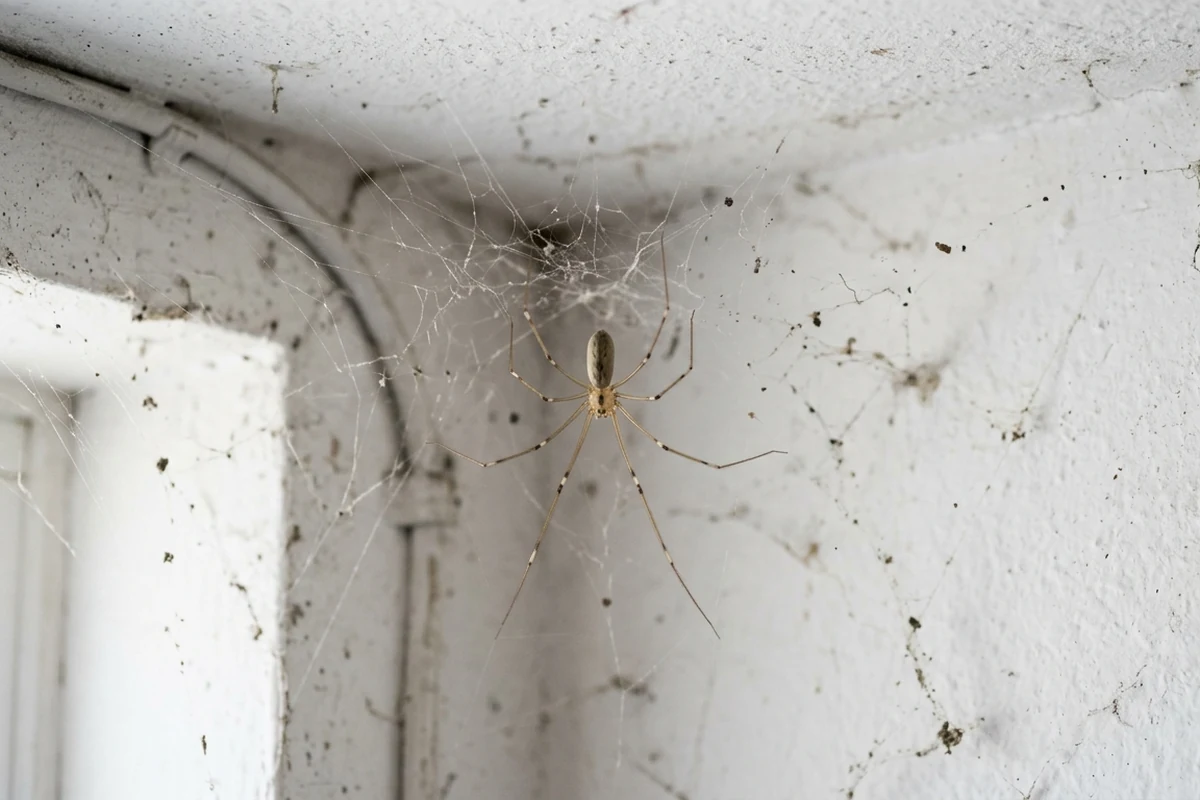

- Three animals are called daddy long legs: the cellar spider, the harvestman and the crane fly.
- A harvestman has one round body section and at most 2 eyes, where a cellar spider has two body parts and 8 eyes.
- Harvestmen have no venom glands and no fangs, so they cannot poison anyone.
- UC Riverside’s spider researchers know of no record of a cellar spider bite harming a person.
- Crane flies do not bite and do not eat mosquitoes, whatever the name mosquito hawk suggests.



Are daddy long legs spiders?
Only one kind of daddy long legs is a spider. The cellar spider is a true spider that spins webs, while the harvestman belongs to its own group of arachnids, called Opiliones, and makes no silk at all. The crane fly is not an arachnid of any kind.
The crane fly, the third animal people call daddy long legs, is a fly with six legs and wings.
The confusion is old enough that scientists gave in to it. UC Riverside’s spider researchers note that arachnologists started calling the cellar spider family the daddy long legs spiders because people already used the name for them, as the UC Riverside Spider Research page on daddy long legs explains.
Harvestman, cellar spider and crane fly, told apart
The quickest way to tell them apart is the body and the web. A cellar spider hangs in a loose, messy web, a harvestman walks on the ground with no web at all, and a crane fly has wings.
| Feature | Cellar spider | Harvestman | Crane fly |
|---|---|---|---|
| What it is | A true spider | An arachnid, not a spider | An insect, a fly |
| Body | Two parts, a long narrow abdomen | One round, pill shaped section | Slim body with wings |
| Eyes and legs | 8 eyes, 8 legs | At most 2 eyes, 8 legs | 6 legs and a pair of wings |
| Web | Yes, loose and tangled, hangs upside down in it | None, it makes no silk | None |
| Where you see it | Indoors, in garages, closets and ceiling corners | Outdoors, under logs and rocks in damp spots | Around lights and windows, mostly in spring |
If it hangs in a web indoors, it is a cellar spider.
Are daddy long legs poisonous?
No daddy long legs is dangerous to people. Harvestmen have no venom glands or fangs at all. Cellar spiders do have venom, as nearly all spiders do, but UC Riverside’s spider researchers report no record of a cellar spider bite ever harming a person.
The story that they are the most venomous spider, with fangs too short to bite, is a myth.

UC Riverside also reports no study testing cellar spider venom on a mammal, which is the other half of why the myth falls apart. The claim that it is deadly rests on no evidence. The fangs are short, but the brown recluse has the same hooked fang shape and bites people without trouble, so short fangs are not what keeps cellar spiders harmless. They simply have no history of hurting anyone.
Do daddy long legs bite?
Crane flies do not bite, harvestmen have no fangs or venom, and cellar spiders almost never bite people. A crane fly does not bite at all, according to Mississippi State University Extension. A cellar spider spends its life in its web and has no recorded bite that harmed anyone.
A bite that does swell, blister or darken is worth a closer look, because it points to another spider. In Collin County the one to rule out is the brown recluse, which lives in the same closets and garages as the cellar spider and looks nothing like it: a compact brown body on shorter legs.
Why are there daddy long legs in my house?
Daddy long legs in a house are nearly always cellar spiders, and they are there because the house gives them quiet corners and insects to eat. Cellar spiders build their webs in garages, closets, attics and the corners of ceilings, where nobody disturbs them, and a steady supply of small insects coming in keeps them fed.
More spiders usually means more insects getting inside.
The other two turn up indoors by accident. Crane flies come in through open doors and torn screens in spring, and the Mississippi State University Extension page on crane flies says window screens and closed doors are the best defense, since sprays do little. Harvestmen live outside in damp places and wander in only now and then, so one in the bathroom is a stray, not a sign of a problem.
How to clear cellar spiders from a house
- Vacuum the webs, the spiders and the egg sacs together, and empty the vacuum outside. Each egg sac left behind is the next round of spiders.
- Cut down the insects they eat. Fix torn screens, add door sweeps and switch the light by the door to a warm yellow bulb so fewer insects gather there.
- Clear clutter from garages and closets, because stacked boxes give webs a corner nobody touches.
- Seal gaps around pipes, weep holes and the bottom of the garage door, which is where spiders and their prey walk in.
How Pest Me Off handles cellar spiders
Pest Me Off’s spider control starts by confirming which spider you have, so a harmless cellar spider is never treated like a brown recluse and a brown recluse is never waved off as a daddy long legs. A technician then clears the webs and egg sacs, treats the foundation and the gaps spiders walk through, and treats for the insects they feed on, because no food means no spiders. Our guide to the signs of a cellar spider infestation covers what a growing population looks like.
Quarterly visits keep the barrier working so new spiders pressing in from the yard do not settle. Same-day service is available for McKinney and the surrounding cities when you call before noon, with no-contract options.
Daddy long legs webs in every corner? Same-day pest control in McKinney and the surrounding cities when you call before noon.
We confirm which spider you have, clear the webs and egg sacs, and treat the foundation, the gaps spiders walk through and the insects they feed on. No-contract options.
