
Clover Mites, the Tiny Red Bugs on Patios and Windowsills
Hundreds of tiny red dots crawling over the patio, up a sunny brick wall or along the inside of a windowsill are usually clover mites. They look alarming and leave red smears when you wipe them, but they do not bite. Here is what they are, why they come inside, and how to keep them out.
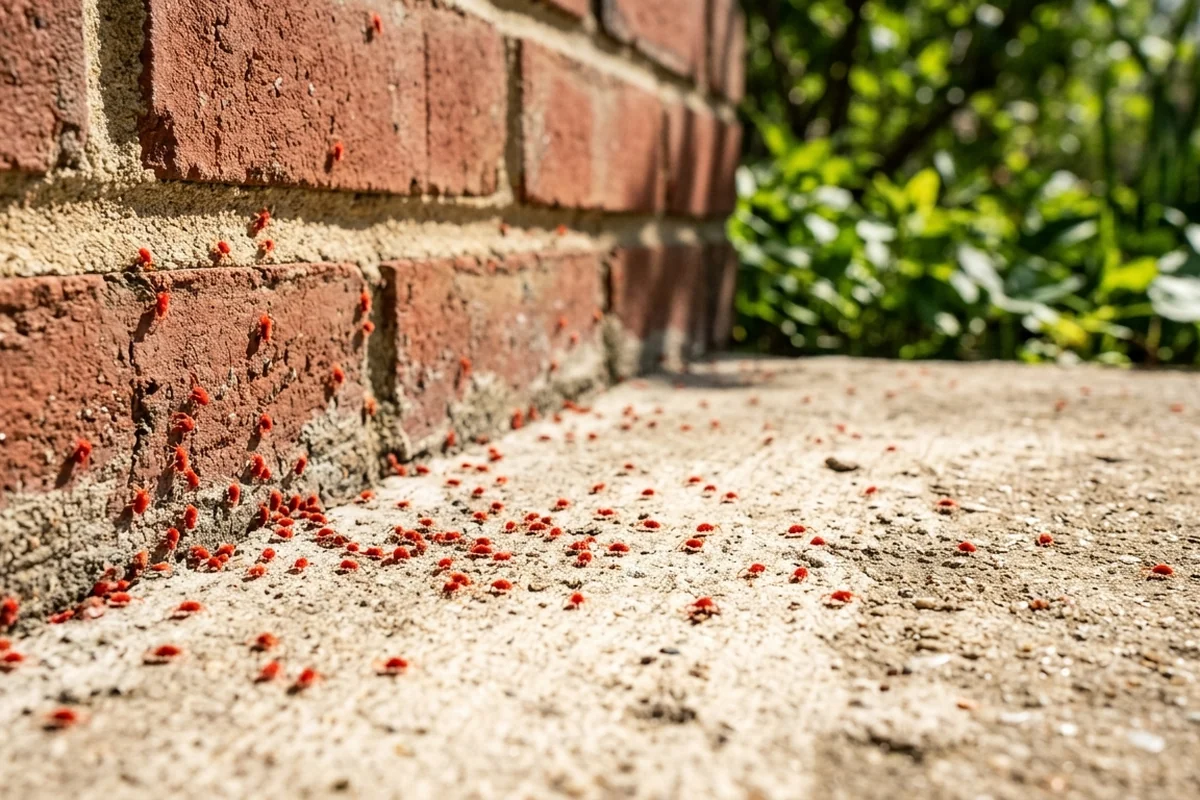

- Also called tiny red bugs, little red bugs, red mites, and brown mites.
- They feed on plants and do not bite people or pets.
- An adult is about 0.75 mm long, with front legs much longer than the rest.
- In the Dallas area they show up most as winter ends, and again in fall.
- Squashing one leaves a red stain, so vacuum them instead.





What are the tiny red bugs on my patio and windowsills?
Usually clover mites. Penn State Extension says an adult is about 0.75 mm long, reddish or greenish, with a very long first pair of legs, and that they gather on windowsills on the sunny side of a home. Oklahoma State University Extension says they have 8 legs and are relatives of ticks and spiders.
That long front pair is the giveaway. Texas A&M AgriLife’s Insects in the City blog says the front legs are nearly twice the length of the others and stick out past the head. Oklahoma State says that gives them the look of antennae. Adults run from light to dark reddish or greenish brown, and the eggs and newly hatched young are bright red, which is why a cluster on pale concrete looks like a spill of red pepper.
Clover mites live in lawns and feed on grass and other low plants. Texas A&M says they have been found on more than 200 plant species but prefer clover and grass, and are more likely on heavily fertilized lawns. Every one is female, it adds, and each can lay up to 70 eggs, so a few become thousands quickly.
Do clover mites bite?
No. Penn State Extension says clover mites do not attack people, and Ohio State University Extension says the larger red mites seen on patios and lawn furniture do not bite humans, mammals or birds. Texas A&M AgriLife Extension adds that they carry no disease and do not damage food or the house itself.
The trouble with clover mites is the number of them and the mess. Oklahoma State University Extension says they do not feed on anything in the home, but can leave a reddish orange stain if crushed on curtains, bedspreads, furniture, walls or carpet. If you are finding itchy bites after time in the yard, clover mites are not the cause, and our guide to chigger bites is the better place to start.
Are clover mites and chiggers the same thing?
No. Ohio State University Extension says the biting chiggers are typically too small to see without magnification, while the red mites on patios and lawn furniture are larger, are not chiggers, and do not bite. Clover mites also carry a tell of their own: front legs much longer than the rest, stretched out ahead of the head.
The two get mixed up because both are red mites that turn up in the same yards in Collin County. Chiggers wait in tall grass, brush and leaf litter and bite at the sock line and waistband. Clover mites sit out in the open on sunny walls, patios and window frames, and they do not bite at all. Our article on where chiggers wait in a Texas yard covers the biting kind.
Why are there clover mites in my house?
They climb up from the lawn. Penn State Extension says clover mites near a house may climb the exterior walls and get in around windows and doors, and that their eggs spend winter in cracks in concrete, under tree bark and between the walls of buildings. Mites hatching inside a wall can walk into a room instead of going outside.
That is why they show up first on the sunny side of the house, on windowsills, sliding door tracks and the walls beside them. Penn State notes that how close the lawn runs to the house, and how well fed it is, appear to govern how likely an invasion is.
The good news is that they cannot settle in. Penn State Extension says clover mites do not reproduce indoors and die within a few days from drying out.
How do you get rid of clover mites in the house?
Vacuum them, and do not wipe or squash them. Texas A&M AgriLife Extension says wiping them up leaves a smear that stains fabrics and walls, and to use a handheld vacuum and empty it straight away. Penn State Extension says spraying indoors is not needed, because the mites die inside within a few days.
Then stop more of them getting in. Check the seals around windows and the sweeps on doors on the sunny side of the house, since that is where they gather. Utah State University Extension suggests a strip of double-sided carpet tape as a barrier where they are coming in. The longer fix is outside, at the foundation, where the next section starts.
How do you get rid of clover mites outside and on the patio?
Put a bare strip between the lawn and the house. Texas A&M AgriLife Extension suggests a strip at least 3 to 5 feet wide with no grass or weeds, covered in pea gravel or mulch. It also says a high pressure spray from a hose can cut their numbers, and that mowing and weeding can make an insecticide unnecessary.

Plants in that strip matter too. Texas A&M lists geranium, chrysanthemum, zinnia, marigold, salvia, rose and petunia, and the shrubs barberry, juniper and yew, as plants clover mites find unattractive. Even a narrow band helps: Penn State says pulling the grass back 6 to 24 inches from the foundation deters them.
Where they are still gathering, Texas A&M says spot treatments of a product labeled for mites can be applied to the foundation walls, paying attention to the line where the foundation meets the soil. Use only a product whose label names mites, and follow that label.
Why are clover mites so bad this year?
The weather sets their numbers. Texas A&M AgriLife Extension says clover mites prefer about 50 to 80 degrees, so they peak in spring and fall, and go quiet once it passes about 85 degrees. A mild late winter in Collin County can bring them out early, and a generation takes only about 1 month.
Penn State adds that the eggs tend to hatch after rain. So a warm, wet stretch at the end of winter is a likely setup for a busy patio. Oklahoma, just north of us, sees them most in March and April, and sometimes in fall and early winter, according to Oklahoma State. Expect them to vanish in the summer heat and come back when the nights cool off.
Clover mites and chiggers, told apart
From Texas A&M AgriLife Extension (its clover mite post and its chigger guide), Penn State Extension and Ohio State University Extension.
| Question | Clover mite | Chigger |
|---|---|---|
| Can you see it? | Yes, about 0.75 mm, red dots that walk | The biting stage, typically not without magnification |
| Where you find it | Sunny walls, patios, windowsills | Tall grass, brush, leaf litter |
| Does it bite people? | No | Yes, the itchy welts after yard work |
| Worst season here | Late winter, spring and fall | Late spring to fall |
The chigger that bites is the one you cannot see.
What Pest Me Off does about clover mites
When you call us about tiny red bugs in a McKinney, Allen, Frisco or Plano home, we start with where you see them, how many, and whether they are inside, outside or both. A handful on the patio in March needs nothing more than the steps above. Thousands on the sunny wall and coming in at every window is a different call.
We look at where the lawn meets the foundation, the windows and doors on the sunny side, and the cracks in the slab and walkways where the eggs spend the winter. Then we explain what we found, what we recommend and why, and what you can do yourself, before any work is done. Our clover mite control page explains the service.
Tiny red bugs all over the sunny side of the house? Same-day pest control in McKinney and the surrounding cities when you call before noon.
We look at where they gather and how they get in before we recommend anything. Free inspection and estimate.
