
Voles or Moles? The Runways and Holes in a Collin County Lawn
Holes in the lawn, a soft trail through the grass and a shrub with its bark chewed off could be a vole, a mole or both. This article covers how to tell them apart by the damage, whether there are voles in Texas, whether they hurt a yard, and what works on each one.
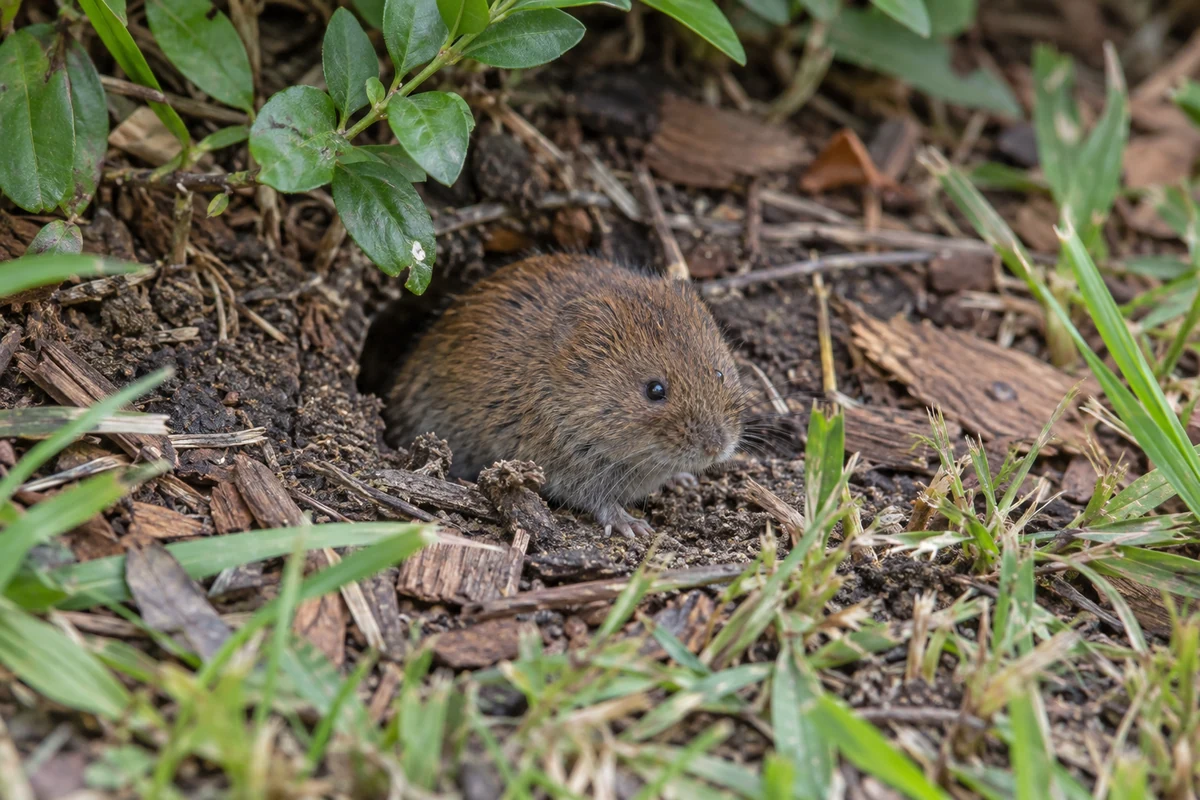

- A vole is a rodent that eats plants. A mole eats worms and soil insects.
- Volcano-shaped mounds of soil mean a mole. Voles leave open holes and no mound.
- Collin County’s vole is the woodland vole, about 5 inches long.
- The woodland vole tunnels just under the surface, much like a mole.
- No sound stake or scare device has been proven to work on either one.





How do you tell vole damage from mole damage?
Look for mounds of soil. The Internet Center for Wildlife Damage Management says moles push up volcano-shaped hills 2 to 12 inches tall and raised ridges that collapse when you step on them. Voles leave open burrow holes with no mound, and they eat plants, gnawing roots, bulbs and bark. Moles eat worms and insects.
The wildlife damage reference on mole damage adds a twist. Most of the garden damage blamed on moles is done by rodents using the mole’s tunnels to reach plants, it says, so one lawn can have both animals at once. It also says the number of mole hills does not tell you how many moles there are.
The animals look nothing alike up close. The same reference’s mole page describes a hairless, pointed snout, no outer ears and huge front feet wider than they are long. A vole is a short-tailed rodent with small eyes and ears tucked into its fur. Pocket gophers make a third kind of mound, larger, kidney-shaped and cloddy, often in a line or a cluster.
Are there voles in Texas?
Yes. Texas Tech University’s Mammals of Texas places the woodland vole in eastern and central Texas, though it says the vole is nowhere common in its Texas range. It is about 5 inches long with a tail of about an inch, and it burrows just under the ground, much the way a mole does.
That last part is what makes a Collin County lawn confusing. Texas Tech’s woodland vole account says it sometimes uses surface runways in grassy areas but would rather live in underground tunnels it digs or takes over from moles and shrews. The burrows are about 4 centimeters across, roughly an inch and a half, and seldom more than 7 to 10 centimeters deep.
The wildlife damage reference on vole damage agrees. Most voles cut surface runways 1 to 2 inches wide, but it says pine voles, another name for the woodland vole, build underground tunnels instead. So the vole in a Collin County yard can leave shallow tunnels that look like a mole’s, without the mounds.
The mole lives in this part of Texas too, though not in every yard. Texas Tech’s eastern mole account places it across the eastern two-thirds of the state, but says it keeps largely to moist, not wet, sandy soils and avoids deep, dry sands and heavy clays. Where it lives, it marks its shallow runs with a winding ridge and its deep burrows with cone-shaped mounds.
Are voles bad for your yard?
They can be. The Internet Center for Wildlife Damage Management says voles girdle young trees and ornamental plantings, usually in fall and winter, leaving uneven gnaw marks at many angles. Texas Tech says the woodland vole eats mostly roots and tubers, including bark from the roots of trees and shrubs.
The gnaw marks tell you who did it. The same reference says vole marks are about 1/8 inch wide in irregular patches, while rabbits clip branches neatly at a 45 degree angle.
Numbers matter more than any one vole. The wildlife damage reference on vole biology says voles have 1 to 5 litters a year, averaging 3 to 6 young, do not hibernate, and in booms that come every 2 to 5 years have reached 4,000 voles per acre. Each one lives on a quarter acre or less, so the voles in your lawn are living in your lawn.
They are rarely a health worry. The same reference says voles are no major hazard to public health because they seldom meet people. Our vole page in the pest library covers the health questions in full.
How do you get rid of voles in the yard?
Take away their cover first, then trap. The Internet Center for Wildlife Damage Management says to mow regularly, clear weeds and litter, cut down on spilled bird seed and pull mulch 3 feet or more back from trees. It says hardware cloth with quarter-inch mesh, buried 6 inches, keeps voles off young trees.
The wildlife damage reference on vole control says trapping can work on a small area such as a home yard, and that voles are easier to trap in fall and winter, when food is scarce. A board or shingle over the trap helps. It says no frightening device works on voles, and that poison baits are a hazard to ground-feeding birds, a risk that placing them in burrow openings or bait stations only reduces.
How do you get rid of moles?
Trapping is the most successful and practical method, according to the Internet Center for Wildlife Damage Management. It says no frightening device has been proven to work, castor oil repellents have shown only minor effect, and killing the grubs often does not help, because a lawn can be free of grubs and still have moles.
The wildlife damage reference on mole control names the vibrating, sonic, magnetic and pinwheel devices among the ones never proven. It says home remedies such as chewing gum, rose thorns, broken glass and used cat litter do not work and some are hazardous. Moles eat earthworms and ants as well as grubs, it says, so a grub treatment can even send them digging harder for food. For traps, it says to pick a straight stretch of surface tunnel with fresh activity, never a twisting ridge or a mound, and to move a trap that catches nothing in 2 or 3 days.
It also warns that moles and voles are often found in the same place and their damage gets confused, and that the methods for the two are different. Knowing which one you have comes first.
Vole, mole or armadillo, by what the lawn shows
These come from Texas Tech University, the Internet Center for Wildlife Damage Management and our own wildlife removal page.
| Animal | What you see in the lawn | What it is after |
|---|---|---|
| Woodland vole | Open holes about 1 1/2 inches across with no mound, shallow tunnels, bark gnawed in patches | Roots, bulbs, stems and bark |
| Eastern mole | Winding raised ridges that sink underfoot, volcano-shaped hills 2 to 12 inches tall | Earthworms and soil insects |
| Armadillo | Cone-shaped holes dug across the lawn and beds, at night | Grubs |
Holes with no soil piled around them point to a vole. Soil pushed up from below points to a mole. Our article on armadillos in Texas yards covers the third digger.
How to find out which one is in your lawn
- Look for mounds. Volcano-shaped hills of soil mean a mole, the wildlife damage reference says, and larger kidney-shaped mounds in a line mean a pocket gopher.
- Step on a ridge. A raised tunnel that sinks under your foot is a mole’s surface tunnel.
- Check the plants. Bark gnawed in uneven patches and roots or bulbs eaten from below point to a vole. A branch clipped clean at a 45 degree angle points to a rabbit.
- Set out an apple slice. The wildlife damage reference suggests apple slices under an overturned box with 1-inch half-moon holes cut in its edges. An eaten apple is a strong sign voles are working the spot.
- Get it confirmed. If the signs still point both ways, a free inspection tells you which animal you have before anyone sets a trap.
How Pest Me Off handles voles
Our wildlife removal service covers voles: the surface runways and shallow tunnels across the lawn, the gnawed plant stems and bark, and the golf-ball-size holes in the yard. We trap and knock the population down, then talk through the lawn and mulch conditions feeding them. The free inspection confirms it is voles and not moles or mice, and wildlife jobs are quoted per job after it, never guessed over the phone.
Most of our vole calls come from October to February, our vole library page says, when voles turn to bark. Same-day inspections are available for McKinney and the surrounding cities when you call before noon.
Runways and holes spreading across the lawn? Vole removal in Collin County.
We confirm it is voles, trap them on their runways and show you what is feeding them. Free inspection.
