
Armadillos in Texas Yards, the Holes They Dig and the Leprosy Question
Fresh holes across the lawn every morning and flower beds rooted up overnight are the usual way people in Collin County meet armadillos in Texas. This article covers whether an armadillo can give you leprosy, how dangerous they really are, what they eat and why they dig, the armadillo’s year, and how to make your yard a place it stops visiting.
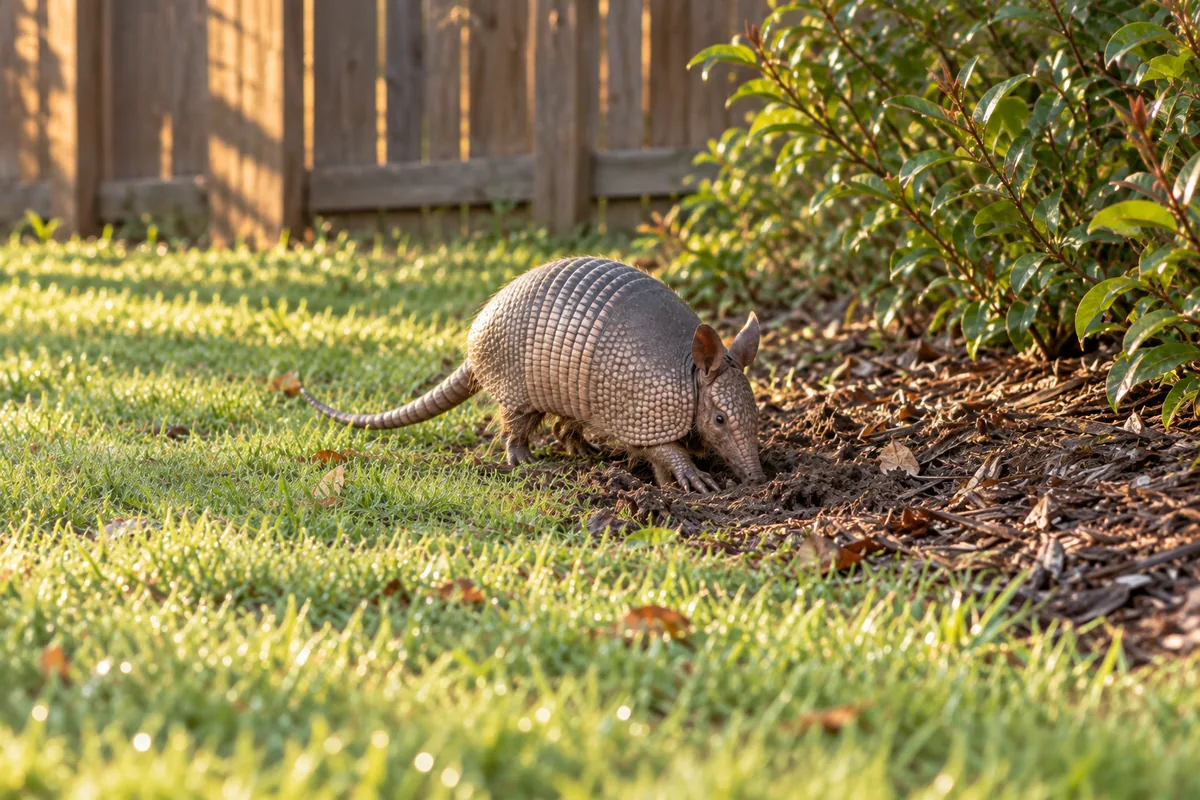

- Armadillo feeding holes run 3 to 5 inches wide and 1 to 3 inches deep.
- They dig for grubs, beetles, ants, termites and earthworms.
- They come out at night in summer and in the afternoon in winter.
- Armadillos are born as four identical young, usually in March.
- The CDC calls the leprosy risk from armadillos very low. Still, never handle one.





Do armadillos carry leprosy in Texas?
Some armadillos in Texas carry the bacteria that cause leprosy, but the risk is very low. The CDC says some armadillos in the southern United States are naturally infected and may be able to spread it, that most people who come into contact with them are unlikely to get leprosy, and that around 95% of people cannot get it.
The link is real. Texas Tech’s Mammals of Texas account of the nine-banded armadillo describes a genetic study that found the same strain of leprosy in 28 of 33 wild armadillos and in 25 of 39 patients who lived in states where armadillos are common. The researchers said contact with fresh armadillo blood or tissue raises the risk, which is the reason to never pick one up, skin one or clean one.
Leprosy, also called Hansen’s disease, can be cured when treatment is completed as prescribed. The CDC’s page on leprosy says it is treated with a combination of antibiotics, usually for 1 to 2 years, and that up to 225 people a year are diagnosed with it in the United States.
Are armadillos dangerous?
Armadillos rarely cause people harm, and the real risk comes from handling one. The Internet Center for Wildlife Damage Management advises against touching armadillos with bare hands and against contact with their blood and fluids. They have no front teeth, and no rabid armadillo appears in the latest Texas rabies report.
An armadillo’s mouth holds only peg-like cheek teeth, the wildlife damage center’s armadillo page says. The Texas Department of State Health Services rabies report for 2024 lists bats, skunks, foxes, raccoons and one coyote as the wild animals confirmed rabid that year, and it names bats, skunks, foxes, raccoons and coyotes as the high-risk rabies animals under Texas law.
Two other cautions apply. The wildlife damage center’s damage page notes armadillos can carry the parasite behind Chagas disease, though people usually get it from insect bites. And a startled armadillo can leap 3 to 4 feet straight up, the University of Florida says, so a cornered one is best left to someone trained to handle it.
The real damage is to property. The same damage page says armadillos burrow under foundations, concrete slabs, driveways and pools, and uproot flowers and other plants.
What do armadillos eat?
Armadillos eat mostly insects and other invertebrates they dig out of the soil. Texas Tech’s Mammals of Texas says 93 percent of their food by volume is animal matter, led by scarab beetles and their grubs, then termites and ants and caterpillars, with earthworms also common at times. Berries and fungi make up only 2.1 percent.
That diet is why they dig. Texas Tech’s study of over 800 stomachs found 488 different food items, with scarab beetles and their grubs at nearly 28%, termites and ants at about 14% and caterpillars at nearly 8%. Texas Parks and Wildlife says the armadillo’s habit of digging up lawns is driven by its appetite for grubs, which can also harm lawns.
Armadillos are rarely the egg thieves they are blamed for. Bird eggs turned up in only 5 of 281 stomachs in Texas Tech’s study, which it says refutes the idea that they prey on quail and turkey eggs, though Texas Parks and Wildlife notes they do occasionally eat bird eggs. A lawn full of grubs and earthworms is what keeps one coming back.
How do you get rid of armadillos in your yard?
Trapping and removal, then making the yard less inviting, is the most direct fix for armadillos in your yard. Texas A&M AgriLife’s armadillo guide says cage trapping is an effective way to capture armadillos, that no repellent is registered for them, and that clearing brush, rock piles and tall grass will sometimes discourage them.
Trapping works, but it takes patience. The Texas A&M AgriLife guide to managing armadillo damage, written by Texas Wildlife Services, says cage trapping is an effective way to capture armadillos, but that they can sometimes be difficult to catch because they are so unpredictable. The wildlife damage center’s handling page adds that relocating one usually is not practical.
Soil matters too. Texas Tech says ground that is easy to dig supports more armadillos, and that on the heavy clay soil of the prairie region that takes in Collin County, according to Texas Parks and Wildlife’s county table, they are extremely rare and stay close to streams, where the soil near the water is softer. So in Collin County, a yard that backs onto a creek is the kind of spot to watch.
The armadillo’s year in Collin County
These details come from Texas Tech’s Mammals of Texas and Texas Parks and Wildlife, which describe the armadillo across the state.
| Time of year | What the armadillo is doing |
|---|---|
| Winter | Out during the warmest part of the day, usually mid-afternoon. It does not hibernate. |
| March | Four identical young are born in a burrow, some litters as early as February or as late as May. |
| Spring | The young walk within hours and follow the mother on her feeding trips within a few weeks. |
| Summer | Out in the cool of the evening and at night. Breeding begins in July. |
| November | The embryo, paused since summer, finally implants and starts to grow. |
Night digging in summer and afternoon digging in winter are both armadillo signs. The holes are 3 to 5 inches wide either way.

To tell armadillo holes from skunk or raccoon digging, our armadillo page in the pest library compares all three side by side.
How to make your yard less inviting to armadillos
- Confirm it is an armadillo. The wildlife damage center describes holes 1 to 3 inches deep and 3 to 5 inches wide, dug for food. A round burrow 7 or 8 inches across, the size Texas A&M AgriLife gives, dug under the slab, a driveway or a pool, means one may be living on the property, not just feeding there.
- Clear the cover. Texas A&M AgriLife says removing brush, rock piles and tall grass will sometimes discourage armadillos from settling in, since they dig their burrows where there is cover.
- Go easy on water and fertilizer. The University of Florida suggests watering and fertilizing sparingly to limit the grubs and earthworms that draw armadillos, and picking up fallen fruit. If you treat the lawn for grubs, Texas A&M AgriLife warns the digging may get worse for a while before the armadillo moves on.
- Fence the beds that matter most. Texas A&M AgriLife says a fence slanted outward at a 40-degree angle, with at least 18 inches buried, usually deters them, though it is costly for a large area. The University of Florida suggests a fence at least 2 feet high and 18 inches deep around the areas you want to protect.
- Skip the repellents and keep your hands off. No repellent is registered for armadillos, Texas A&M AgriLife says, and the wildlife damage center advises against touching one with bare hands. Call a professional when fresh holes keep appearing or a burrow opens up beside the foundation.
How Pest Me Off handles armadillos
Pest Me Off’s wildlife removal deals with armadillos the same way every time: we trap and remove the armadillo, close the burrow, and talk through what is drawing it into your yard. Every job follows four steps. We inspect and identify the animal and its burrow, remove it the humane way with a live trap sized to the species, clean up and flag the damage, and seal the way in. We never use poison on wildlife.
The wildlife inspection is free, and each job is quoted after we have looked, never guessed over the phone. Same-day service when you call before noon, in McKinney and the surrounding cities. We are members of the National Wildlife Control Operators Association and certified by Get Bent Academy in advanced wildlife exclusion.
Holes in the lawn or a burrow by the slab? Wildlife removal across Collin County.
We trap and remove the armadillo, close the burrow, and talk through what is drawing it into your yard. Free wildlife inspection, with the job quoted after we look.
